
Stroke
DOCUMENT ANALYSIS — *handwriting, ink, paper; comparison methodology.* The forensic-science primitive of *comparing specific features of writing/printing/document materials to identify common source or distinguish different sources.*
Listen along — Stroke
Loading audio…
Press play to listen along. The line being read lights up as you go.
Show full transcript
Loading transcript…
Chapter 4 — Stroke and the Comparison-Magnifier
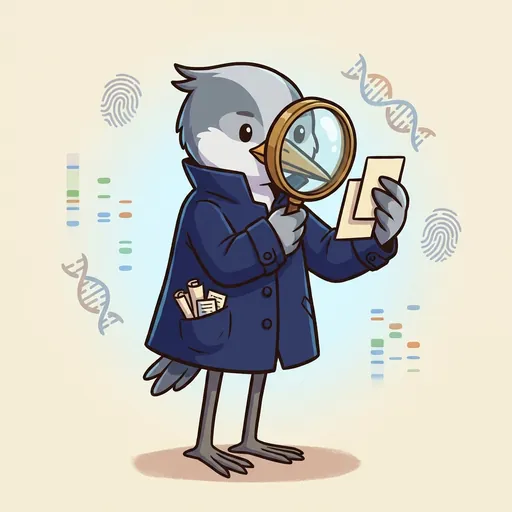
Stroke was a small heron-tween, all long legs and grey-and-white feathers. She moved with a patient, deliberate grace, her steady eyes always seeming to notice the tiny details others missed. In her wing-pocket, she carried two treasures: a small magnifying glass and a folded collection of writing samples. These weren’t just random papers. They were her tools, her way of uncovering hidden truths.
When Stroke worked, she would carefully lay two pieces of writing side by side. Her magnifying glass would hover, then descend, focusing on a single letter, a tiny curve, a faint pressure mark. “Look closely,” she’d often murmur, even when no one else was around. “Don’t just see. Compare.” This was her gift, her discipline: document analysis. It was about finding the facts hidden in the loops and lines of ink.
Sometimes, two pieces of writing might look almost identical at first glance. They might use similar words, or the overall impression might suggest the same person wrote them. But Stroke knew that impressions could lie. “Did the same person write both?” she would ask herself. To answer, she didn’t trust a feeling. She trusted facts.
She’d examine how the crossbar on a ‘t’ joined the vertical stem. Was it a crisp, clean connection, or did it float slightly above? She’d study the loops of an ‘e’ or an ‘l’ – did they close completely, or were they left open, like tiny, unfinished smiles? She looked at the slant of the letters, the pressure marks left by the pen, the spaces between words, and any characteristic flourishes, like a fancy capital ‘S’ or a looping ‘g’. Each tiny detail was a clue.
Stroke had seen many novices make the same mistake. They’d glance at two notes, declare, “Yep, same person!” and move on. “No,” Stroke would say, her voice quiet but firm. “That’s an impression. We compare specific features.” She’d tap the paper with her magnifying glass. “Not a gut-feeling. Gut-feelings are tricky.”
She always emphasized this: “How the ‘t’-crossbar joins the ‘t’-stem. How loops close, or if they don’t. The slant angle. Letter spacing. Pressure marks. These are specific features.” She’d pause, letting the words sink in. “If many specific features match, we have high confidence it’s the same writer. If few match, it’s either different writers, or the same writer under different conditions.” Her method was clear: comparison, not instinct.
Stroke knew that even the most careful comparison needed good evidence. “You can’t just have one sample,” she’d explain. “Writing changes. If you’re tired, or rushed, or using a different pen, your handwriting shifts.” She called this “collecting adequate samples.” You needed many examples from a writer to understand their typical style, their baseline.
She also insisted on “same conditions when possible.” Comparing a hurried note scribbled on a napkin with a formal letter written on fancy stationery wasn’t fair. “It’s like comparing apples and oranges,” she’d say. “Different paper, different pen, different mood. All those things add variability.” For true comparison, you needed similar paper, similar pens, similar text, if you could get them.
Sometimes, the investigation went beyond just the handwriting. “We look at the ink and paper too,” Stroke would say, holding up a small vial. “Ink composition, for example.” She’d glance at Drop, the tiny, energetic chemical analyst. “Drop can use chromatography to separate the colors in the ink. It’s a method where we see how different parts of the ink travel at different speeds on a special paper, showing us what’s inside.” This helped determine if two inks were even the same type.
Then there were the paper characteristics: the fibers, any watermarks, even the age of the paper. All these details could help narrow down possibilities. Stroke also saw a connection between her work and Loop’s teaching. “Loop talks about class features and individual features,” she’d remind her students. “My work is similar. Class features, like a particular style of cursive, narrow down the candidates. But individual features – that unique way you cross your ‘t’ – that’s what identifies the writer.”
“The hardest part,” Stroke admitted, “is resisting gut-feel.” She called it confirmation bias. “If you expect a match, you’re more likely to see a match, even if it’s not really there.” It was a human tendency, a trick of the mind. That’s why the discipline was so important: systematic, feature-by-feature comparison, ideally done “blind,” without knowing who was supposed to have written it.
At SleuthLab, their cases weren’t about high-stakes crimes. They were junior-forensics-team scale. “Who wrote the anonymous note teasing the class clown?” Stroke might ask. “Whose handwriting is on the test paper with the wrong answers?” These were the puzzles they solved, using her careful, precise method.
Stroke grew up in a small village, nestled beside a winding river. Her family had always been the village’s clerk-witnesses. For generations, they had countersigned important documents, making sure everything was official. Part of their job was recognizing the handwriting of every resident, stored carefully in dusty ledgers. It was a job that demanded immense patience and systematic comparison.
By the time Stroke was six heron-years old, she had already learned a crucial lesson. She’d seen elders make quick judgments based on a general look, only to be proven wrong. “Gut-feel is unreliable,” her grandmother had taught her, pointing to tiny differences with a steady claw. “Feature-by-feature, that’s what’s reliable.” That lesson had stayed with her, shaping her into the meticulous detective she was today.
When Stroke arrived at SleuthLab, a bit nervous but determined, Inspector Vex had greeted her. “Tell me, Stroke,” the Inspector had boomed, “what is document analysis?”
Stroke had stood tall, her small magnifying glass clutched in her wing. “It’s comparing specific features, Inspector,” she’d said clearly. “Not impressions. Letter shapes. Slant. Pressure. Spacing. Many specific matches mean high confidence. Few matches mean a different writer, or the same writer in different conditions.”
Inspector Vex had studied her for a long moment, a thoughtful glint in his eye. Then he’d smiled. “You are appointed,” he’d declared.
“I have compared many writing samples over the years,” Stroke often said, her voice calm and steady. “And I can tell you, most novice mistakes come from gut-feel matching. The discipline is feature-by-feature.” She’d hold up her magnifying glass, catching the light. “It’s not hard. It’s about specific features, systematic comparison, and honest confidence. Not gut-feel.” The magnifying glass, ever ready, seemed to gleam, waiting to catch the next tiny, telling letter.
The SleuthLab ensemble
Stroke is part of SleuthLab's distributed-narrative cast. Each character embodies a different curricular primitive; together they teach the full subject.
-

Loop
Impression evidence — fingerprints, shoeprints, toolmarks (class vs individual evidence)
-

Fiber
Trace evidence — fibers, hairs, paint, glass (Locard's exchange principle)
-

Drop
Chemical evidence — chromatography, pH, spectroscopy (test-don't-guess)
-

Witness
Biological + digital evidence — DNA + digital footprints (statistical-match, not certainty)
-

Seal
Chain of custody — bag it, label it, log every hand it passes through; a broken chain can't be trusted; otter with evidence bags + logbook
-
Sketch
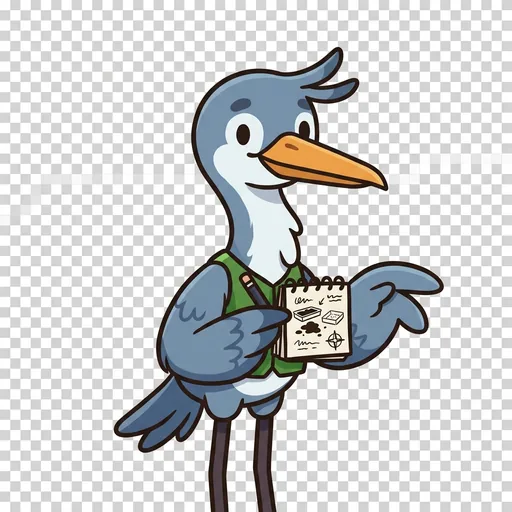
Scene documentation — record the scene before anyone touches it; the scene only tells its story once; heron with a measuring notebook
-

Tick
Timeline reconstruction — put every event in order on the clock; the sequence is where the answer hides; mouse with a paper timeline
-

Branch
Alternative explanations — ask 'what else could explain this?' and test each branch before choosing; squirrel with a whiteboard of possibilities
-

Account
Testimony reliability — ask open questions and listen; memory is fragile and a confident witness isn't always correct; rabbit with a gentle notebook