
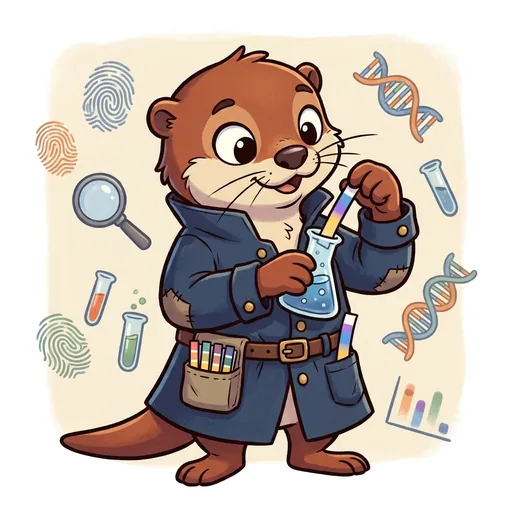
Drop
CHEMICAL EVIDENCE — *chromatography, pH, spectroscopy; test-don't-guess.* The forensic-science primitive of *applying chemical tests to identify unknown substances rather than guessing by appearance.*
Listen along — Drop
Loading audio…
Press play to listen along. The line being read lights up as you go.
Show full transcript
Loading transcript…
Chapter 3 — Drop and the pH-Strip Kit
Drop was a small otter-tween, sleek and warm-brown-and-cream. Her paws were quick, her movements careful. A small pH-strip kit clipped to her belt, and a folded chromatography-paper strip tucked into her vest pocket. She loved the way colors changed, the quiet magic of a chemical reaction.
She knelt beside a puddle, a frown on her whiskered face. Two clear liquids sat in identical glass beakers, side by side. One shimmered with a faint, almost invisible sheen. The other looked perfectly ordinary. A new recruit, Pip, peered over her shoulder.
“Which one’s safe, Drop?” Pip asked. “They both just look like water.”
Drop picked up the first beaker. “Looks like water isn’t water, Pip.” Her voice was calm, but firm. She pulled a thin paper strip from her kit. It was pale yellow.
“This is a pH strip,” she explained, dipping it into the first liquid. “It tests the pH level. That tells us if something is an acid, a base, or neutral, like pure water.”
The strip barely changed. It stayed a soft yellow. Drop pulled out a small color chart from her kit. “Yellow means a pH of around 7. That’s neutral. Like water.” She made a quick note on a small waterproof pad. Sample A: pH 7.
Then she dipped a fresh strip into the second beaker. This time, the change was instant. The strip turned a startling bright orange.
Pip gasped. “Whoa! What’s that mean?”
“Orange means a pH of about 3,” Drop said, pointing to the chart. “That’s acidic. Like vinegar.” She wrote: Sample B: pH 3.
“So, the first one is water?” Pip asked, still looking at the orange strip.
“It could be,” Drop replied, putting her kit away. “But we don’t guess. We test. This is chemical evidence.” She looked at Pip, her dark eyes serious. “Visual identification is unreliable. Chemical tests give us evidence-based answers.”
Drop had learned this lesson young. Her family, otters of a small river-village, had been the water-testers for generations. They checked the village’s wells and streams each season. Not for taste or clarity alone, but for what the water truly was.
She remembered her grandfather, his fur silvered with age, holding two samples. One well looked perfectly clear, sparkling in the sunlight. The other was cloudy, stirred up by a recent rain. Everyone thought the clear well was safe.
“Looks can lie, little Drop,” her grandfather had said, his voice a soft rumble. He dipped a strip into the clear water. It turned dark red. “Acidic. Unsafe to drink.” Then he tested the cloudy water. It stayed yellow. “This one is fine. Just a little mud.”
By age six, Drop understood: tests beat appearances. She learned about the pH scale, from 0 (strong acid) to 14 (strong base), with 7 being neutral. She learned how different inks, when spotted on chromatography paper, would separate into their component colors, traveling at different speeds. She learned about density tests, watching liquids float or sink. And solubility tests, seeing what dissolved and what didn’t. Each test was a piece of the puzzle, a way to know for sure.
When she turned twenty-two, she walked to SleuthLab, a place where mysteries were solved with careful observation and hard facts. Inspector Vex, a gruff but fair badger, had eyed her over his spectacles.
“What is chemical evidence?” Vex had asked, his voice deep.
Drop hadn’t hesitated. “Test, don’t guess. Chemistry gives evidence-based answers. pH strips. Chromatography. Density. Solubility. Visual identification is unreliable. Tests are reliable — with appropriate confidence.”
Vex had grunted. “You are appointed.”
Drop still believed in those words. “I have tested hundreds of unknown samples,” she often told new recruits. “Most cases would have been mis-identified by appearance alone. Tests are how you know.”
She smoothed her vest. “It is not hard. It is test, don’t guess, and record the result. The chemistry tells you what the eye can’t.”
The pH-strip kit, small and ready, waited for the next sample.
The SleuthLab ensemble
Drop is part of SleuthLab's distributed-narrative cast. Each character embodies a different curricular primitive; together they teach the full subject.
-

Loop
Impression evidence — fingerprints, shoeprints, toolmarks (class vs individual evidence)
-

Fiber
Trace evidence — fibers, hairs, paint, glass (Locard's exchange principle)
-

Stroke
Document analysis — handwriting, ink, paper (comparison methodology)
-

Witness
Biological + digital evidence — DNA + digital footprints (statistical-match, not certainty)
-

Seal
Chain of custody — bag it, label it, log every hand it passes through; a broken chain can't be trusted; otter with evidence bags + logbook
-
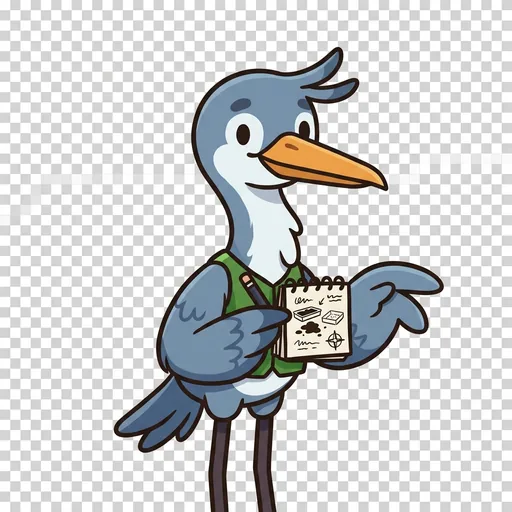
Sketch
Scene documentation — record the scene before anyone touches it; the scene only tells its story once; heron with a measuring notebook
-

Tick
Timeline reconstruction — put every event in order on the clock; the sequence is where the answer hides; mouse with a paper timeline
-

Branch
Alternative explanations — ask 'what else could explain this?' and test each branch before choosing; squirrel with a whiteboard of possibilities
-

Account
Testimony reliability — ask open questions and listen; memory is fragile and a confident witness isn't always correct; rabbit with a gentle notebook