Wellspring and Vet
PUDDLE OR SPRING — a fact is only as good as where it comes from: Wellspring traces a claim back to its original source instead of a puddle downstream, and Vet checks that source for currency, authority, and honesty before you trust it — find the spring, then test the water
A story read by Wellspring and Vet
Loading audio…
Press play to listen along. The line being read lights up as you go.
Show full transcript
Loading transcript…
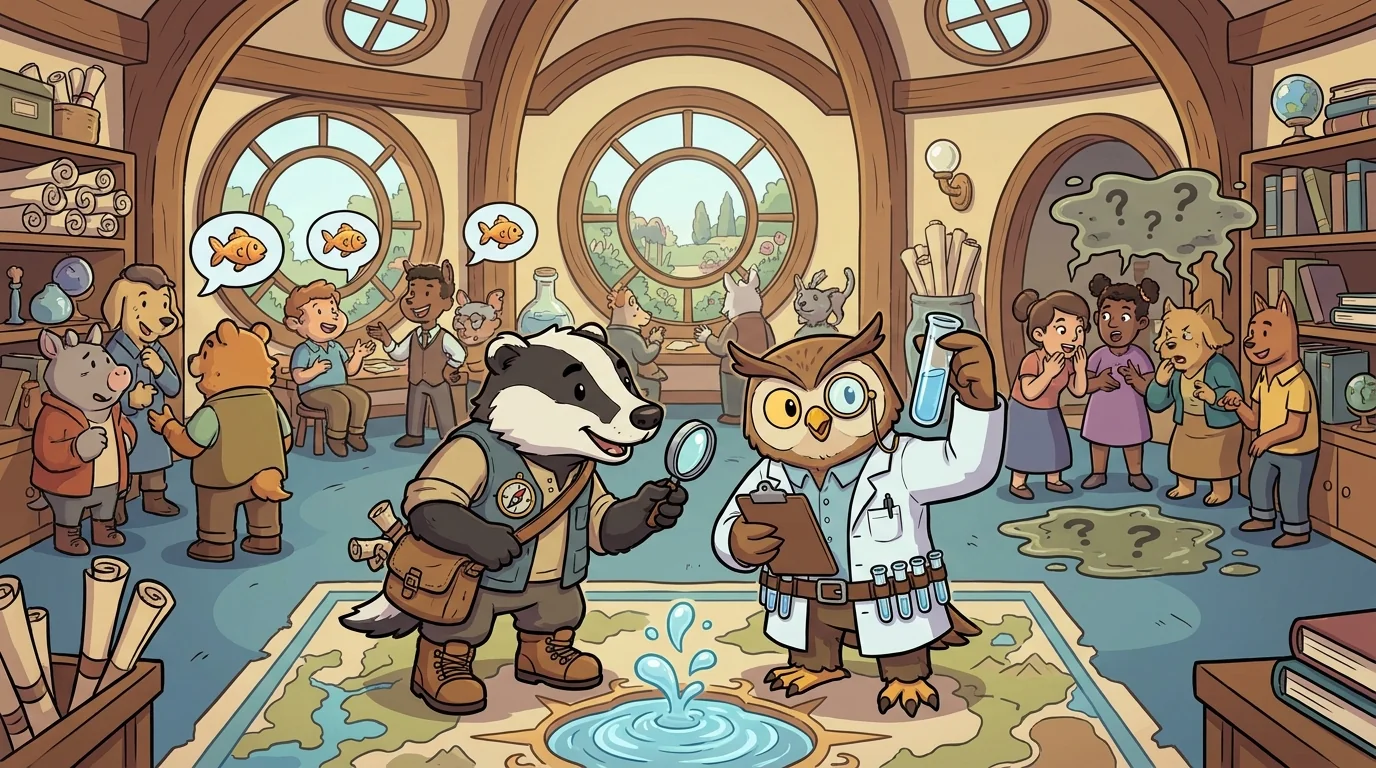
There was a claim loose in the research hall, and it was spreading fast.
"A goldfish only has a three-second memory!" someone said, and someone else repeated it, and it hopped from mouth to mouth across the hall, sounding truer each time simply because more people were saying it. And two keepers of the hall watched it spread and exchanged a look — the look they always exchanged when a fact came running through with no source in sight.
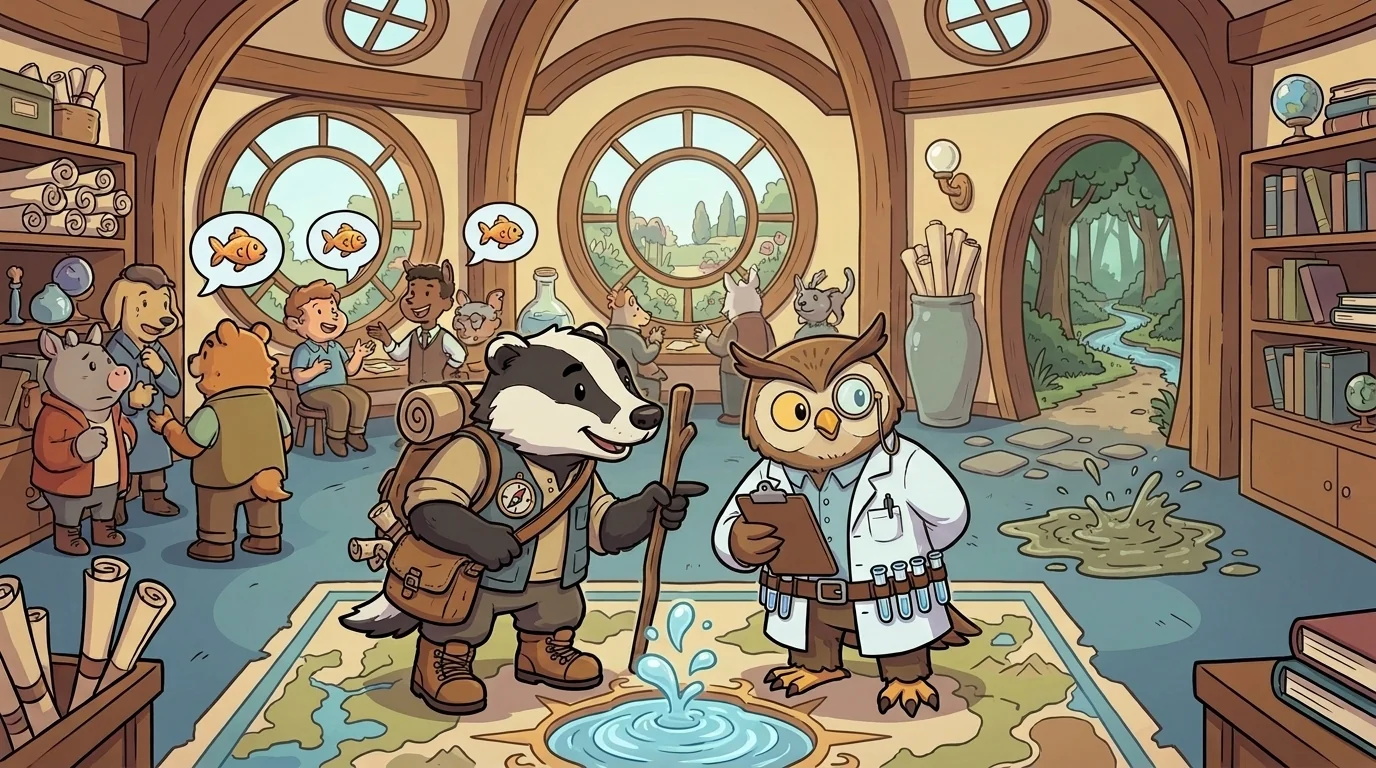
Wellspring picked up a walking stick, the kind you'd use to hike upstream.
Vet picked up a small careful checklist.
"Puddle," said Wellspring, watching the claim splash from person to person. "Definitely a puddle. Let's go find the spring."
Wellspring went first, because you cannot trust a fact until you've walked it back to where it started.
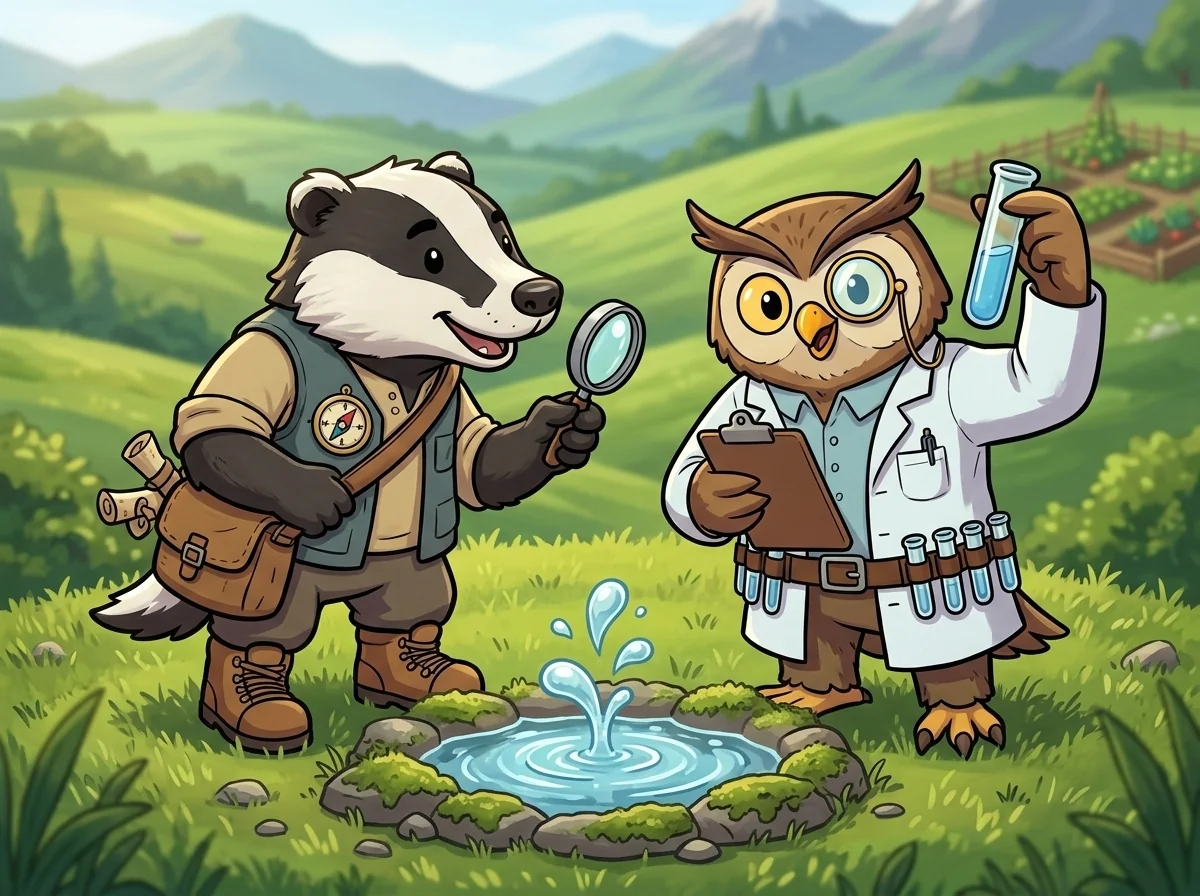
"Everyone's drinking from the same puddle," Wellspring said, "and nobody's asking where the water came from." So Wellspring started hiking upstream. "Who said the goldfish thing?" Oh, I read it on a poster. "And where did the poster get it?" From a website. "And where did the website get it?" From another website, that got it from a magazine, that got it from... a cartoon?
Up and up Wellspring climbed, past copy after copy after copy — a puddle fed by a stream fed by a trickle — always asking the same stubborn question: but where did they get it? "A copy of a copy of a copy isn't a source," Wellspring said, climbing. "It's an echo. Each time a fact gets passed along, it can get bent, or simplified, or just plain made up somewhere back up the line. I don't want the puddle everyone's splashing in. I want the spring — the first place this water actually came out of the ground. The original. The real study, the real measurement, the person who first found it out."
And when Wellspring finally reached the top — the actual scientists who actually study fish memory — the spring told a very different story than the puddle: goldfish can remember things for months.
But finding the spring wasn't the end — because not every spring is clean, and this was Vet's whole careful job.
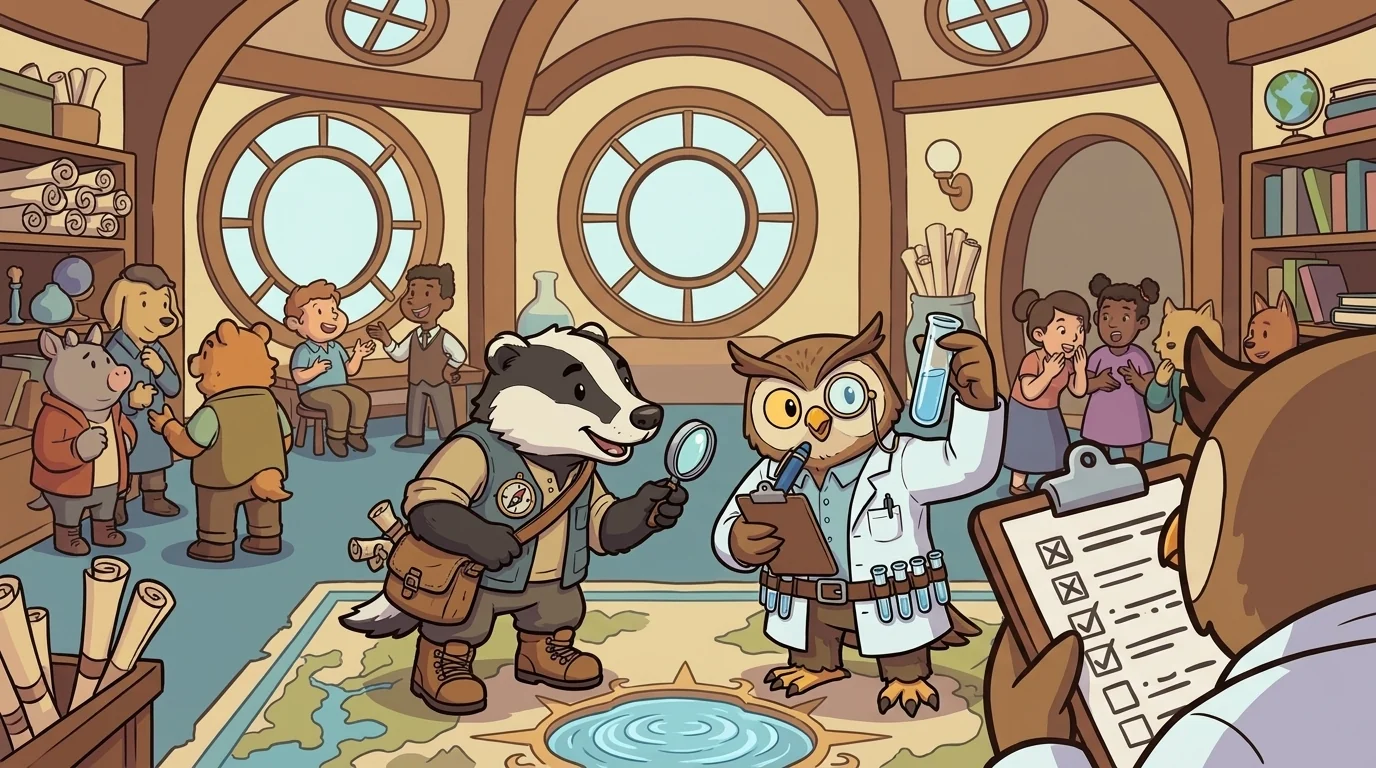
"You found the original source," said Vet, "and that's most of the battle. But 'original' doesn't automatically mean 'trustworthy.' Before we drink, I test the water." And Vet ran the checklist — the same handful of honest questions Vet ran on every source, spring or puddle.
Is it current? — Is this recent enough to still be right, or so old it's been overturned? Who's behind it? — Real fish scientists, or someone with no idea, or someone with something to sell? Is it accurate? — Does it show its evidence, or just assert? Does it agree with other good sources? And why was it made? — To inform you honestly, or to scare you, or to sell you fish food?
"This spring passes," Vet said, checking each box on the real study. "Recent. Written by actual researchers. Shows its evidence. Made to inform, not to sell. That's water we can drink." Vet capped the pen. "The checklist isn't about being suspicious of everything. It's about being fair to everything — giving each source the same honest test, so I trust things for real reasons instead of just because they sound right or came first."
So the two of them brought the tested truth back down to the hall — goldfish remember for months, and here's the trustworthy spring it comes from — and, gently, the puddle started to dry up.
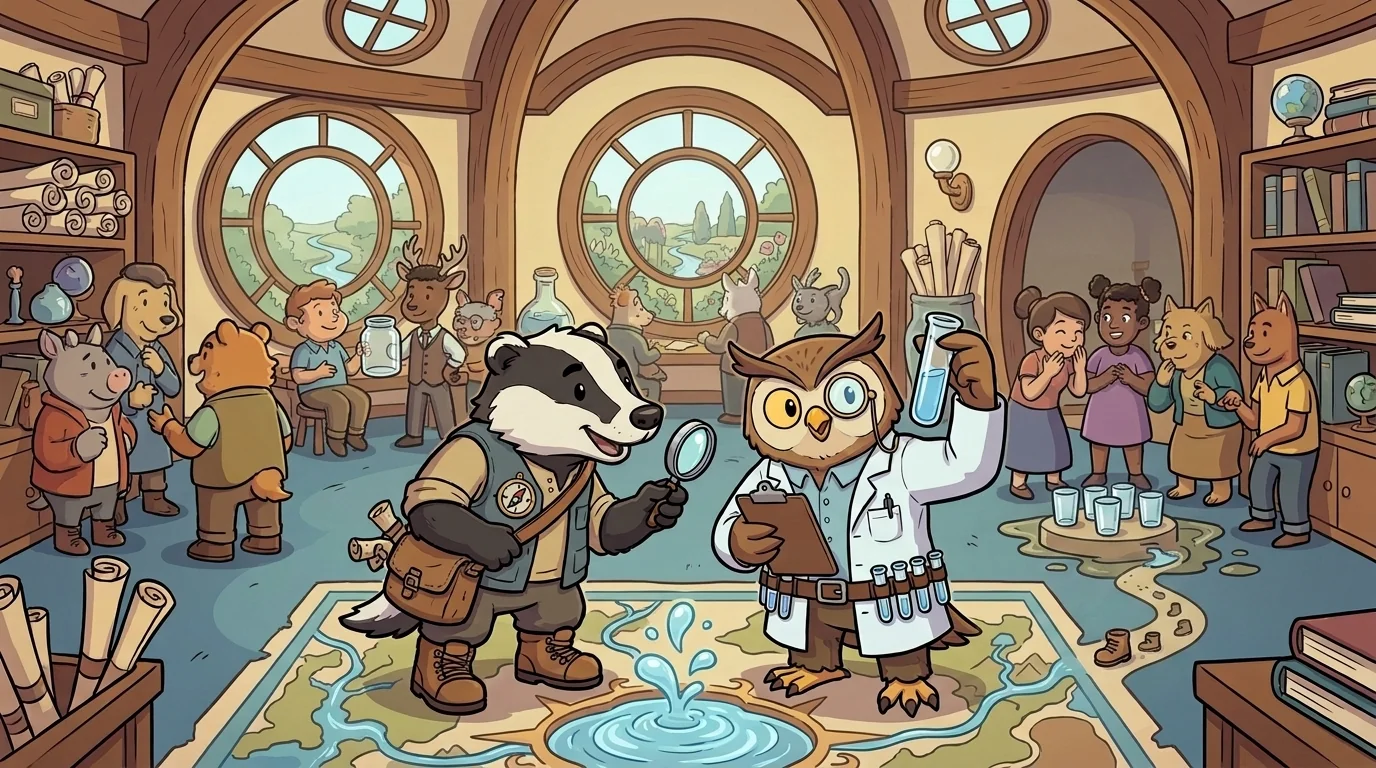
Some people were surprised. Some were a little embarrassed to have passed the wrong thing along. But nobody was shamed for it, because Wellspring and Vet knew the secret: everybody drinks from puddles sometimes. The skill isn't never being fooled. The skill is knowing how to hike upstream and test the water before you swallow — and before you hand a cup to somebody else.
"Good hiking," said Vet.
"Good testing," said Wellspring.
There is a quiet, grounded confidence that comes from knowing how to check — from refusing to trust water just because it looks clear or because everyone's already drinking it, and instead finding the spring and testing it yourself. It is slower than splashing in the puddle with everyone else. But the person who can do it carries something rare into a world absolutely full of loud, fast, confident-sounding claims: the calm ability to find out, for themselves, what's actually true.
The ResearchQuest ensemble
Wellspring and Vet is part of ResearchQuest's distributed-narrative cast. Each character embodies a different curricular primitive; together they teach the full subject.
-

Wonder
Question-formulation — narrowing vague interest into focused, answerable research questions
-

Vet
Source-evaluation — CRAAP test (Currency, Relevance, Authority, Accuracy, Purpose)
-

Quote
Note-taking — quoting + paraphrasing + summarizing; keeping voices separate
-

Synth
Synthesis — combining evidence across multiple sources; finding agreement, disagreement, gaps
-

Tether
Citation — attribution + bibliography; gratitude + map back to sources
-

Survey
Background reading — read around a topic to learn the lay of the land before narrowing (W.7)
-

Trawl
Search strategy — cast a wide net of keywords, then pull it tight; refine when it comes back wrong (W.8)
-

Crosscut
Lateral reading / corroboration — don't trust one page; cross-check a claim across independent sources
-

Verdict
Forming a thesis — gather the evidence, then take a stand; 'here's what I think, and here's why' (W.1)
-

Wellspring
Primary vs secondary sources — trace a claim upstream to its original, firsthand source