The Glass Lantern (Bella the Lanternkeeper)
The DOUBLE ATTACK — a single move that threatens two pieces at once, not via jumping (knights' fork) but via geometric position (the bishop's diagonal forking two pieces, or a queen attacking two targets along different lines)
A story read by The Glass Lantern (Bella the Lanternkeeper)
Press play to listen along. The line being read lights up as you go.
Show full transcript
Loading transcript…
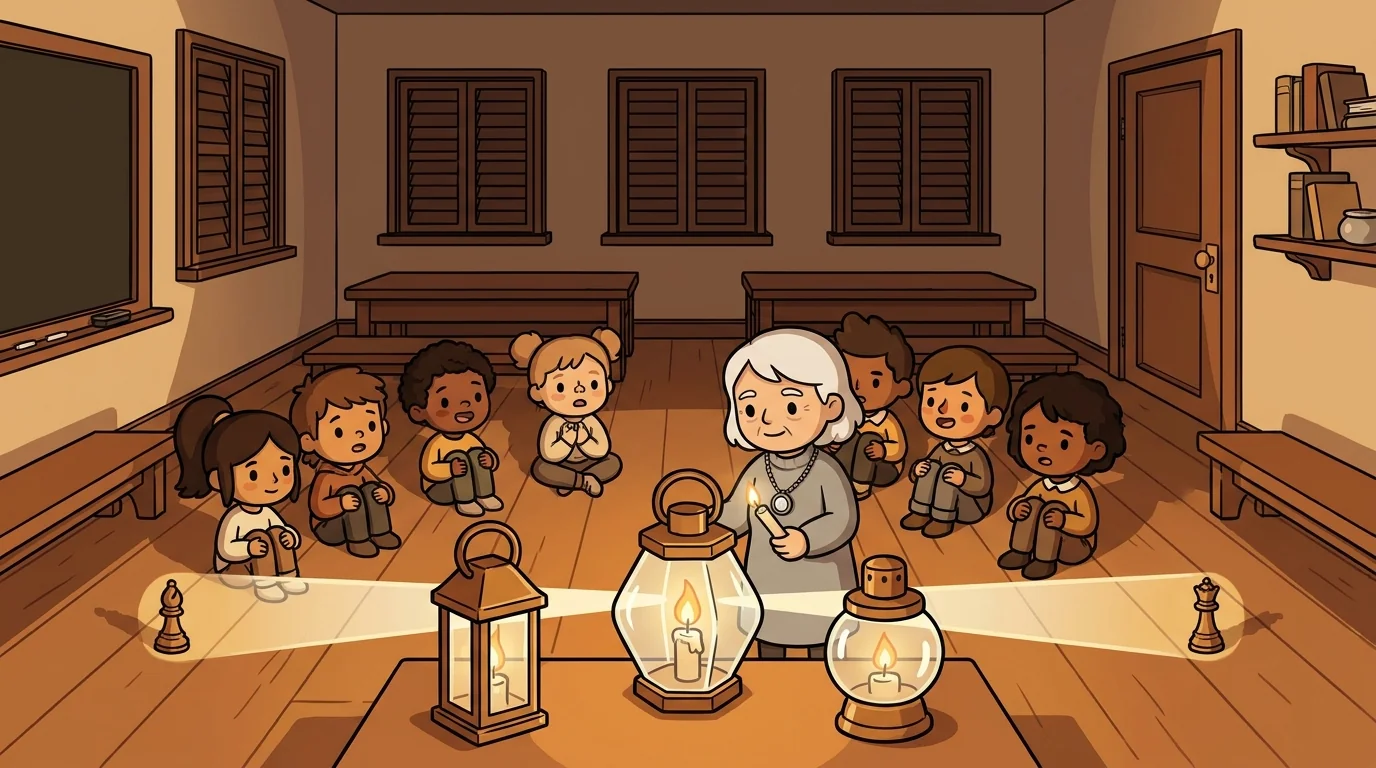
In the smaller of the academy's two classrooms, on an afternoon in early winter, there are three lanterns on the front table and no other light in the room. The windows have been shuttered. The door is closed. The children sit in a half-circle on the floor, knees drawn up, watching.
At the front of the room, the Glass Lantern stands between the lanterns. She is small — not much taller than the bigger children — and dressed entirely in soft grey wool, with a thin silver chain around her neck from which a tiny round magnifying lens hangs. Her hair is white and short and tucked behind both ears. She is, in this room, the calmest thing.
She lights the first lantern. She does not announce it. She simply touches a candle to the wick and a small steady flame catches. The lantern is a strange shape — not a square box, but a glass shell with two flat angled sides and curved sides between them. The light, when it falls from the lantern, falls in two directions at once. Two clear bright beams, one going to the left of the room and the other going to the right.
The children's eyes follow the beams. The beams land on two small wooden chess-pieces that the Lantern has placed, very deliberately, on opposite sides of the room.
The Lantern lifts her hand. She says, in a voice almost lower than the candle's hiss:
"Two pieces. One light. Both seen."
She pauses. The children wait. She has trained them, over eight years, to wait through her pauses. The pauses are part of the teaching.
"This is what we mean," she says, "when we say double attack."
She moves to the chessboard at the front of the table. The board has been set up before the children arrived. There is a white bishop on b2 and two black pieces — a rook on h8 and a knight on g7. She points at the bishop with the tip of her index finger. She does not raise her voice.
"The bishop sits," she says. "It does not move. It does not jump. It does not advance. It only sits. But it sees" — she traces the long diagonal with her finger, slowly — "the rook. And it sees" — she traces a short diagonal — "the knight. Two pieces. One light. Both seen."
The children look at the board. They see it. The room is so quiet that the candle on the table actually pops audibly, and a small child near the back jumps.
The Glass Lantern smiles, very slightly. It is the smile of a person who has been a teacher for a long time and has not stopped enjoying it.
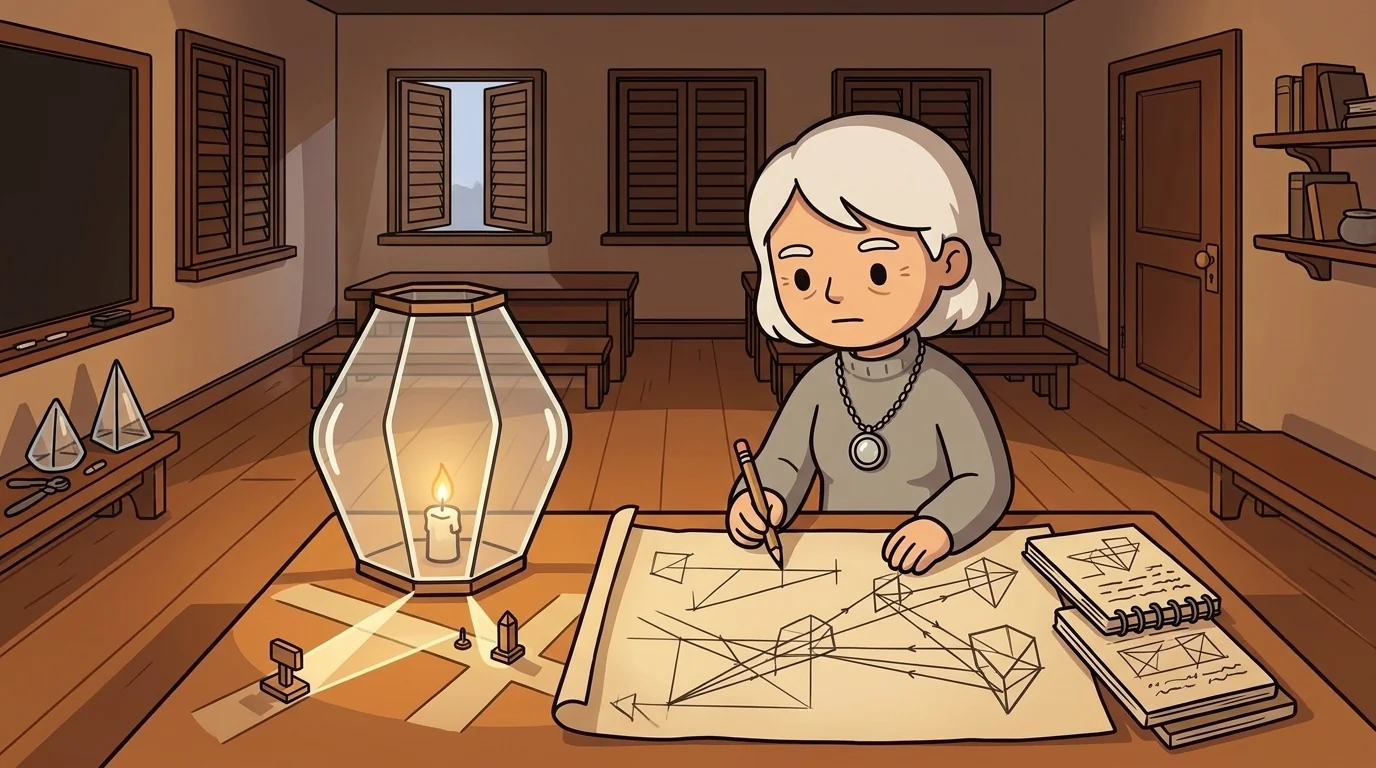
She has not always been a teacher. She was, for forty-five years, a glassmaker.
Her name is Bella. (She has stopped trying to be called Bella here at the academy. She lost that fight to the children eight years ago. She does not mind.) She was born in a small town on the western edge of the kingdom called Marrowmile, where her family had been making windows for four generations. Bella was good at windows. She was also, for reasons her family found mildly worrying, interested in light.
Not the kind of interest that ends in being a poet — she was not romantic about light. She was interested in the geometry of it. She had spent (her older sister Maren kept count for a while, then gave up) three thousand hours sketching how rays of light passed through different shapes of glass. She filled fourteen notebooks. Maren had stopped commenting on the notebooks the way older sisters eventually stop commenting on most of their younger sisters' choices.
Bella was twenty-eight years old when the Marrowmile town council came to her workshop.
The council had a problem. Just outside Marrowmile, two streets met at a sharp angle to form a crossroad. The streets were called Long Street and Short Street, which were not romantic names but were accurate ones — Long Street went east for about a mile and a half, and Short Street went south-east for about three hundred yards. Both streets were narrow. Both had high stone walls on either side. After dark, the corner where they met was the kind of corner where a cart could meet another cart head-on and neither driver would see the other until it was much too late.
There had been three accidents in the last winter. One of them had been bad.
The council, which was a sensible council, wanted a lantern at the apex of the corner. A single light, mounted high, that would illuminate both streets at the same time.
They told Bella the budget.
Bella said, "Give me three weeks."
She took the budget, walked back to her workshop, and stared at the wall for almost two days.
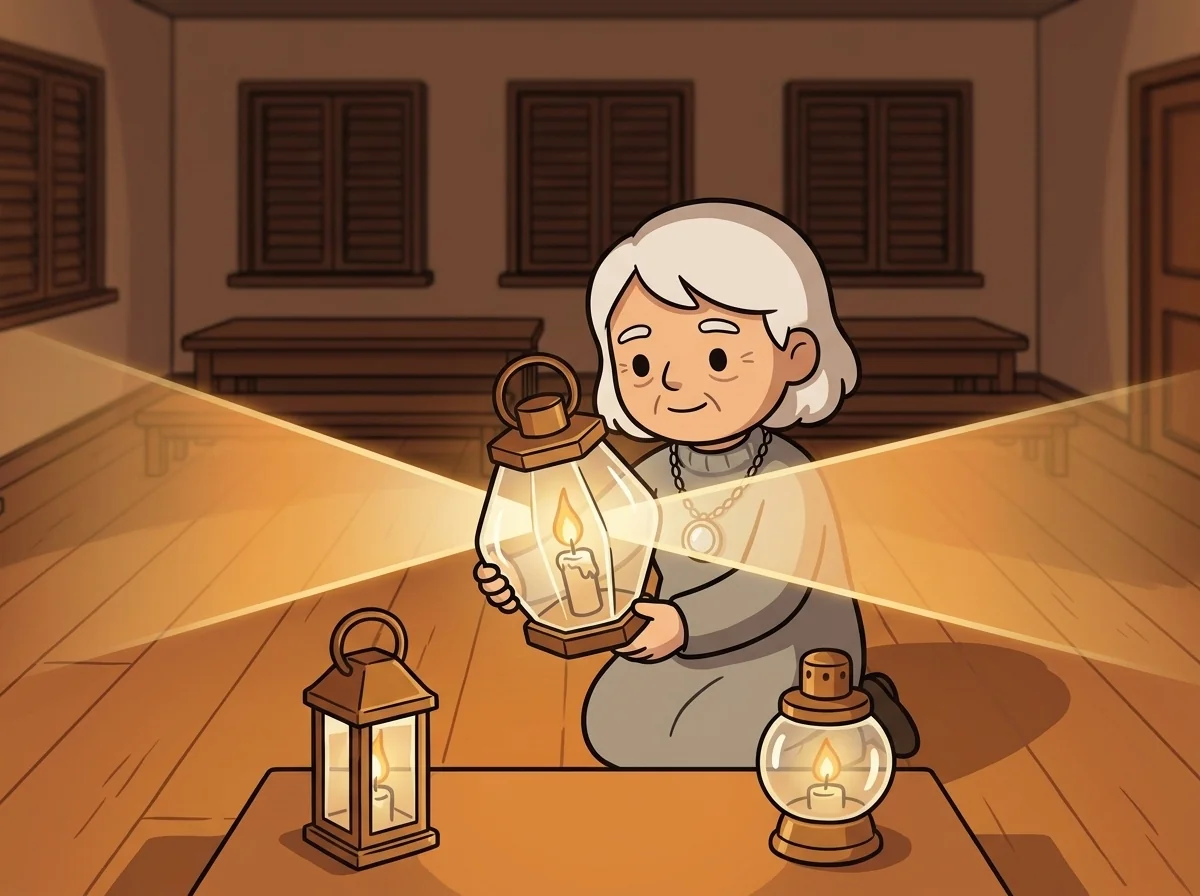
The problem was geometric. A normal lantern — a candle inside a glass box — lights everything around it equally. But the council didn't need equal light. They needed focused light, in two directions. They needed the lantern to throw light down Long Street to the east and throw light down Short Street to the south-east, while not wasting light on the high stone walls in between.
A normal lantern, mounted at the corner, would have given each street about a third of its candlepower and wasted the rest on the walls. Bella worked out, on a long sheet of paper, that this was the same as having two-thirds of a candle. She did not want to give the council two-thirds of a candle. She wanted to give them two whole candles. That was the entire job.
She designed, over those three weeks, a glass shell that no Marrowmile glassmaker had ever made before. It had two flat sides — one facing Long Street, one facing Short Street — and the flat sides were cut at very precise angles so that the candlelight inside reflected off the inside surfaces of the other walls and focused itself outward, doubled, in only those two directions.
She made the shell in her workshop. She made it twice, because the first one cracked on cooling. She mounted the second one at the corner herself, on a wooden scaffold that her sister Maren held steady from below. The council attended a small ceremony at dusk. They lit the lantern.
Long Street, half a mile to the east, lit up clearly. Short Street, three hundred yards to the south-east, lit up clearly. The walls in between stayed mostly dark, which was fine — nobody walked on the walls.
A cart driver who happened to be passing said, with feeling: "Two streets. One light."
Bella heard him say it. She wrote it down that night in her notebook. She underlined it twice. (She rarely underlined anything twice.)
The crossroad has not had a serious accident since.
Bella made nineteen more lanterns over the next ten years — for other dangerous crossroads, for harbour entries, for the front gates of public buildings that needed to throw light in unusual ways. She became, in the polite phrase of the time, the kingdom's two-direction glassmaker. Some of her lanterns are still in use. The original Marrowmile lantern is still hanging at the crossroad. (It has been re-glazed twice. Bella did the re-glazing herself.)
When the chess academy began searching for somebody to teach the double attack — the tactical pattern where one piece, by sitting in exactly the right square, threatens two enemy pieces along two different lines — the academy master remembered Bella.
He sent her a polite letter. He was sixty-three years old by then and Bella was sixty-five. He had visited Marrowmile, once, on a walking holiday twelve years before, and had spent a long evening at the crossroad watching the lantern shine in two directions at once. He had remembered the lantern. He had, over the years, occasionally remembered the lantern at unexpected moments — once, in particular, while teaching a child the bishop-fork pattern.
His letter said:
Bella — there is a tactic in chess that has no good teacher. It is when one piece looks down two different roads at the same time. We have nobody who teaches it well, because most teachers teach moves rather than positions. We need somebody who teaches positions. Who teaches light. Will you come?
Bella, by this point, had taught one apprentice glassmaker who had moved away. She had been getting bored. She had been sketching, in her notebooks, increasingly geometric drawings that her sister Maren found unsettling. She had been catching herself, in conversations, going quiet at unhelpful moments.
She wrote back: Yes.
She arrived at the academy in early autumn with three lanterns wrapped in soft cloth and a notebook in her bag. The notebook had her grandfather's name written on the inside cover. (Her grandfather had also been a glassmaker, in case you were wondering.) The academy master met her at the gates and walked with her, in companionable silence, to the smaller of the two classrooms.
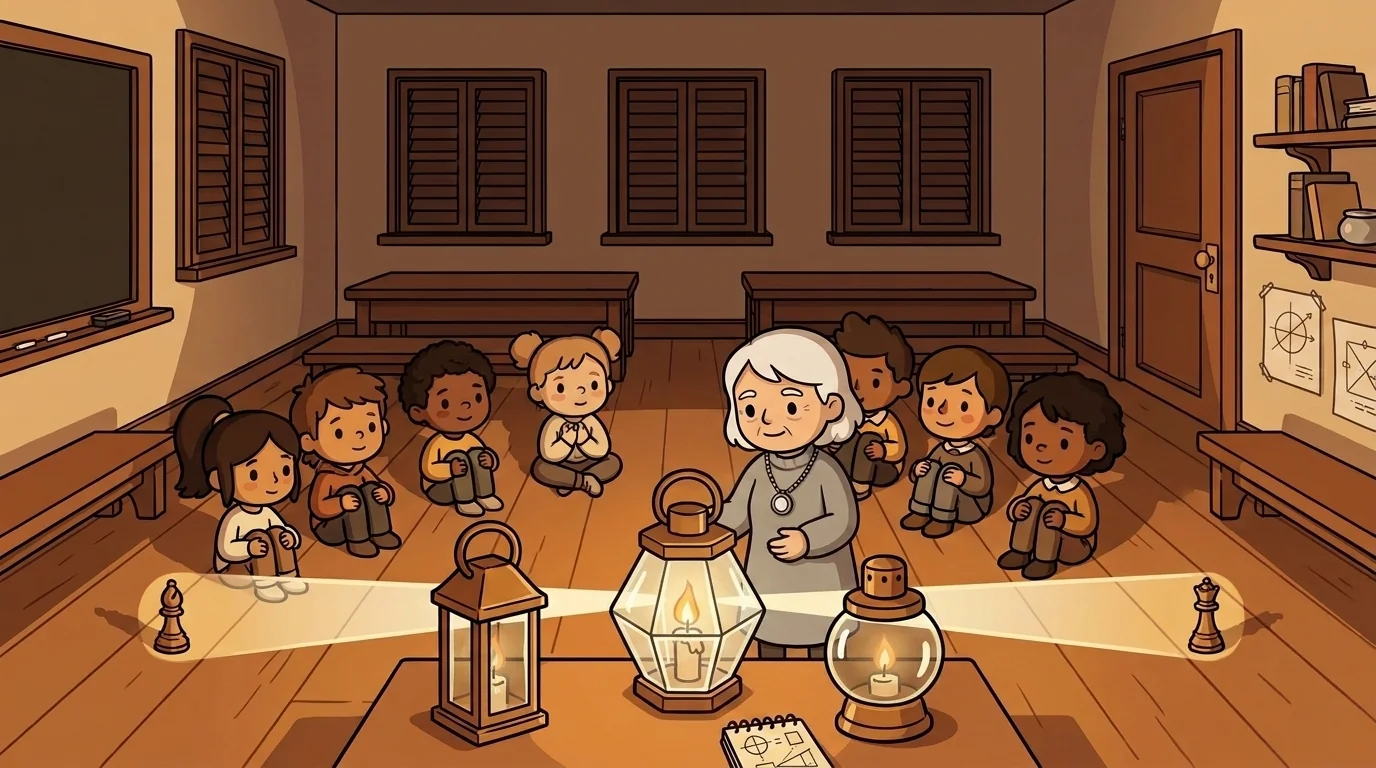
She set up the lanterns at the front. She lit them. She stood between them, in the doubled light, and waited for the children to file in.
When they had all sat down, she said — very quietly — "Two pieces. One light. Both seen."
The room went silent. The academy master, watching from the doorway, said afterward that it was the first time he had ever seen Captain Crossfire shut up voluntarily. (Captain Crossfire had insisted on attending the Lantern's first lesson. He had been hopping with anticipation. He stopped hopping the moment she lit the second lantern.)
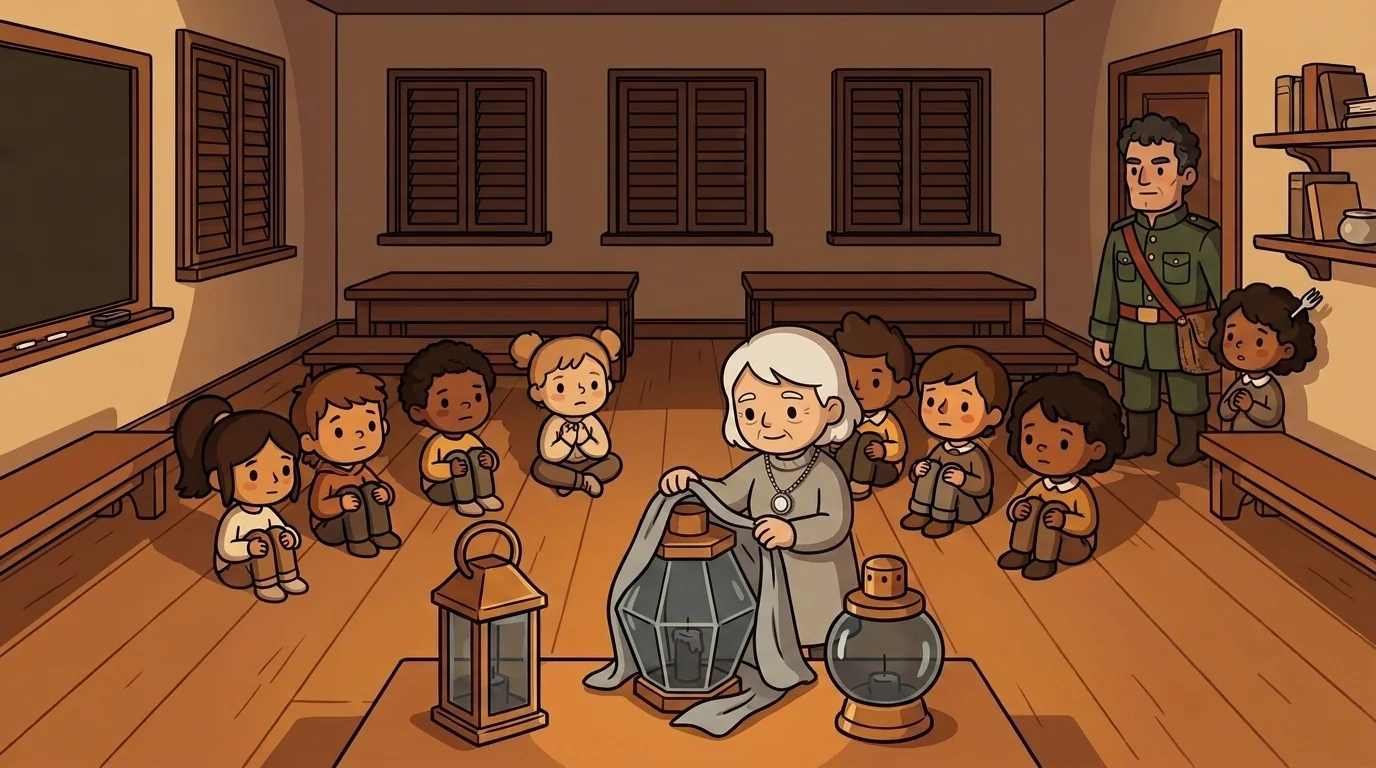
She has been teaching at the academy for eight years now. The children call her the Glass Lantern. She has stopped trying to be called Bella here. (She lost that fight to the children. She does not mind.)
This afternoon, after her lesson, she stays in the small classroom for a few minutes to put the lanterns away. The candles are blown out. The shutters are still closed. The room smells very faintly of beeswax and metal.
A small student — eight years old, with a fork-pin in her hair — has lingered at the door. She is not quite sure whether she is allowed to ask a question after the lesson. The Glass Lantern looks up. She nods, once.
The girl says, "How do you find the square?"
The Glass Lantern thinks about this. She wraps a lantern in its cloth carefully, the way other people wrap presents.
"You don't find the square," she says, finally. "The square finds you. You set up the position. The square appears."
The girl thinks about this. She says, "But what if I can't see it?"
"Then you have not set up the position yet."
The girl nods. She runs off to find her friends. The Glass Lantern watches her go.
A moment later there is a soft knock at the doorframe. Captain Crossfire is standing there, holding two cups of tea. He has, somewhere along the way, learned to knock softly when approaching the Lantern's classroom. He carries the tea carefully. He does not spill it.
"Tea?" he says, at less than half his usual volume.
"Please," says the Glass Lantern.
He sets the cups down on the front table. He sits on a low wooden bench. The Glass Lantern sits beside him. The shuttered room is dim now, with only the late sun bleeding through the cracks in the shutters. They drink their tea in silence for a long minute.
Then Crossfire says, "You did the lantern again."
"I did."
"The new ones liked it."
"They did."
He sips his tea. He says, after a moment, "The kingdom's quietest teacher."
The Glass Lantern smiles, very faintly. She lifts her cup in a small toast. He lifts his.
She is the lantern that lit two streets. She is the most precise teacher in the cast. And sitting in the dim, beeswax-scented quiet with her old friend and a warm cup in her hands, she feels — very quietly, the way she feels everything — deeply, calmly happy.
The GambitTales ensemble
The Glass Lantern (Bella the Lanternkeeper) is part of GambitTales's distributed-narrative cast. Each character embodies a different curricular primitive; together they teach the full subject.
-

Sir Pinwell
Pin pattern — freezes pieces along a line
-

Twin Knights of Fork Hill
Fork pattern — attack two targets at once
-

Lady Skewer
Skewer pattern — force a valuable piece out of the way
-

Veil & Vow
Discovered attack — step aside to reveal a hidden threat
-

Captain Crossfire
Double attack — one move threatens two targets
-

King Pumble & King Sable
Two kings — librarian and gardener; one step at a time
-

Queen Vesper
Queen — ranger-messenger; any direction, any distance
-

Captain Castle
Mentor + narrator — rook archetype; the mascot who introduces the cast + scaffolds the lesson
-

The Pawn Cohort
Ensemble piece — the four pawn-paired sets (Pawn Patrol + Sienna & Bran + Trotter & Trundle + Gable & Garrett) acting as one in the world layer