
Equi and Stretch
EQUIVALENT SCALING — Equi (different forms, same value) + Stretch (scaling fractions to a common base) — together, the rule and the application of the same idea
A story read by Equi and Stretch
Press play to listen along. The line being read lights up as you go.
Show full transcript
Loading transcript…
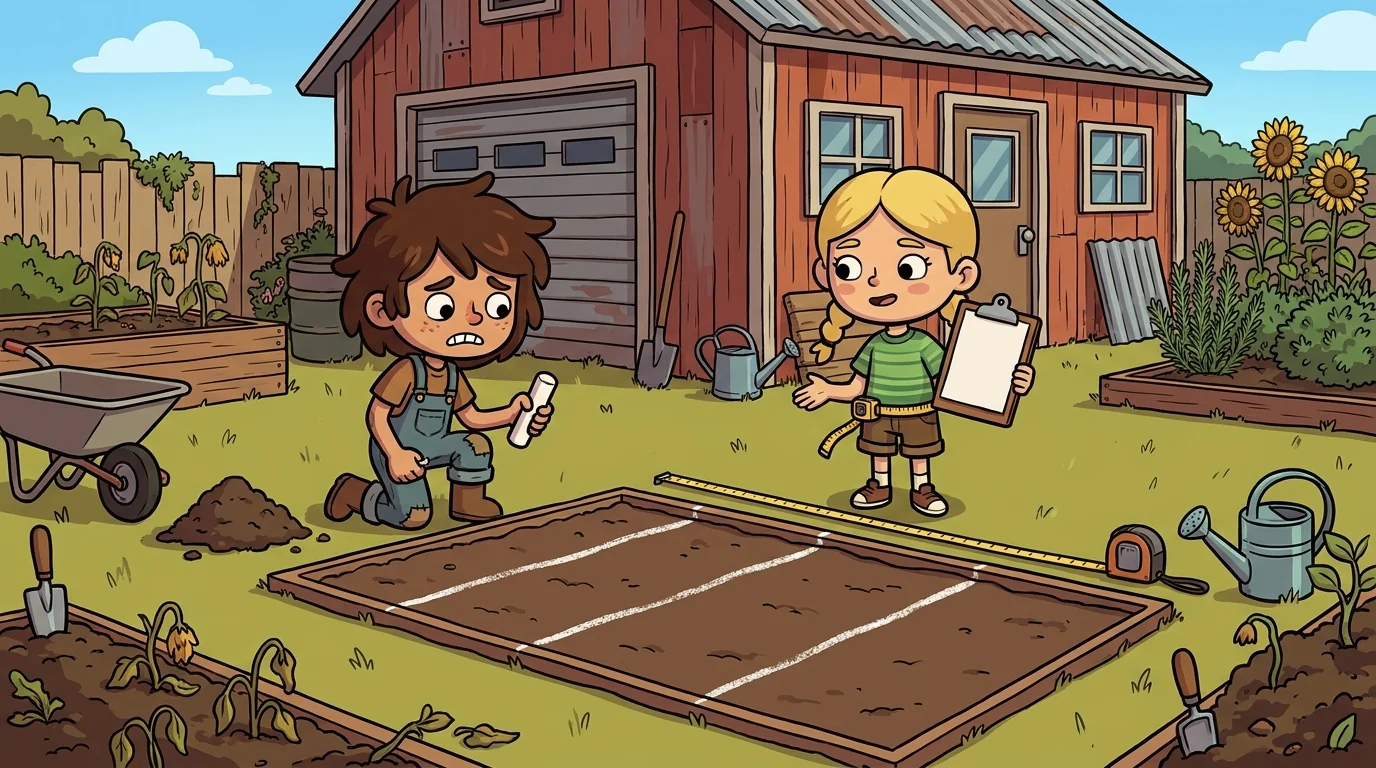
Behind the school workshop, a long rectangular patch of earth lay waiting. For generations, this garden plot had witnessed the enthusiastic, if sometimes chaotic, efforts of the gardening club. Most years, carrots mysteriously sprouted in the rosemary patch, while ambitious sunflowers cast long shadows over delicate herbs. But this year, a new order was promised. The gardening club had divided into four distinct groups, and each group insisted on its own perfectly *equal space*.
Equi clutched a stick of chalk, her brow furrowed in concentration. Beside her, Stretch unspooled a bright yellow tape measure, a thoughtful, almost serene expression on her face.
"Four groups," Equi announced, her voice firm. "One long rectangle. The solution is simple: we divide it into four equal strips." She knelt, drawing four confident chalk lines across the dry dirt. The garden plot instantly fractured into four neat, vertical sections. "Strip A for the herbs," she narrated, pointing with her chalk. "Strip B for salad greens. Strip C for root vegetables. And Strip D, of course, for the sunflowers." She stood, dusting her hands. "Done."
Stretch, however, slowly rewound her tape measure. "Almost done," she corrected, her tone gentle but firm.
Equi turned, a question etched on her face. "Did I miss something obvious?"
Stretch held up a clipboard, its pages covered in neat handwriting. "The herbs group's list," she began. "They need three separate herb plots: basil, parsley, and mint. Basil and mint, as you know, are not exactly friendly neighbors. They can't share a single strip. So, they need three distinct sub-strips within their quarter."
Equi's gaze dropped to the clipboard, her initial confidence wavering. "Oh."
"Then the salad-greens group," Stretch continued, flipping a page. "They've planned for six different kinds of lettuce. Each kind requires its own dedicated row."
"Oh," Equi repeated, a little softer this time.
"The root-vegetables group needs two sub-plots: one for carrots, the other for radishes."
"And the sunflowers?" Equi asked, almost hopefully.
"Just one sub-plot," Stretch confirmed. "Pure sunflowers."
Equi stared at the pristine chalk lines, which now seemed less like a solution and more like the beginning of a puzzle. The herbs group needed their strip divided into thirds. The salad greens group required sixths. The root vegetables group wanted halves. And the sunflowers, bless their simple hearts, just needed their entire quarter. Four distinct strips, each demanding a different internal partition. This wasn't just about drawing lines; this was going to require some serious, brain-stretching thought.
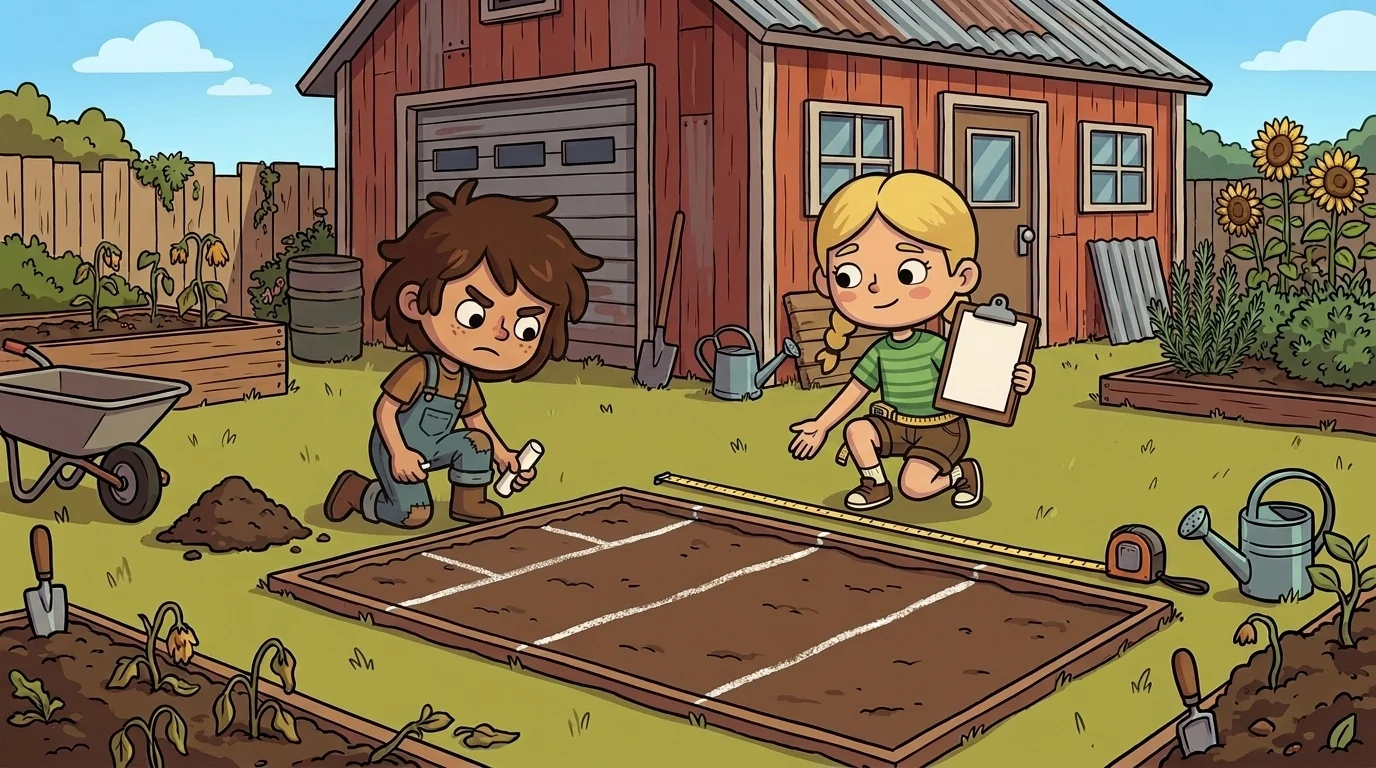
Stretch crouched beside the chalk lines, her fingers tracing the boundaries. "Here's my starting point," she explained. "Every group begins with the same outside boundary: one-quarter of the entire plot. That's their designated strip. So, when we look inside each strip, every group is essentially slicing their own quarter into smaller sub-portions."
"Right," Equi murmured, watching her.
"Take the herbs group's strip," Stretch continued, drawing a small, imaginary box in the dirt. "It's one-quarter of the whole plot. They need to slice that quarter into three equal sub-portions. Each sub-portion is therefore one-third of their quarter. Which means, if we think about the entire garden, each of those herb sub-portions is one-twelfth of the whole. Because a third of a quarter, well, that makes a twelfth."
Equi blinked, her eyes wide. "Did you just… multiply fractions?"
Stretch nodded. "Exactly. One-third times one-quarter equals one-twelfth. It's the same fundamental idea as your *equivalence* rule, just applied to a practical slicing problem."
"No," Equi countered, shaking her head slightly. "That's not multiplication in the way I teach it. That's scaling. You took the herbs group's quarter and you stretched it down, making it visible on a much finer scale. Their single quarter suddenly became three twelfths."
"Yes," Stretch agreed, a small smile playing on her lips. "That's precisely what I do. I stretch fractions to a common scale. It allows us to compare them fairly across different groups and different needs."
Equi paused, letting the idea settle. "So," she mused aloud, "if I wanted to know how much space the basil gets, compared to, say, just one single row of lettuce…"
"You stretch them both to the same scale," Stretch finished for her. "The basil occupies one-twelfth of the entire plot. One row of lettuce, however, takes one-sixth of the salad-greens strip, which translates to one-twenty-fourth of the whole garden. So, when basil and one row of lettuce are both viewed on that common scale, it's one-twelfth versus one-twenty-fourth."
"Which means," Equi concluded, a spark of understanding in her eyes, "basil gets twice as much space as one row of lettuce."
"Exactly," Stretch confirmed.
Equi remained silent for a long moment, the chalk dust on her fingers suddenly feeling significant. "I've taught kids that two-thirds equals four-sixths for years," she finally said, her voice soft with revelation. "I've always thought of it as naming the same number differently. Like a kid having a nickname, or a secret identity. But I've never considered it as stretching a fraction to a finer scale."
"Both perspectives are correct," Stretch replied, her gaze steady. "It's the same fundamental idea, just viewed from two different angles. You see the equivalence. I see the scaling. And when we put those two views together, we find the complete answer."
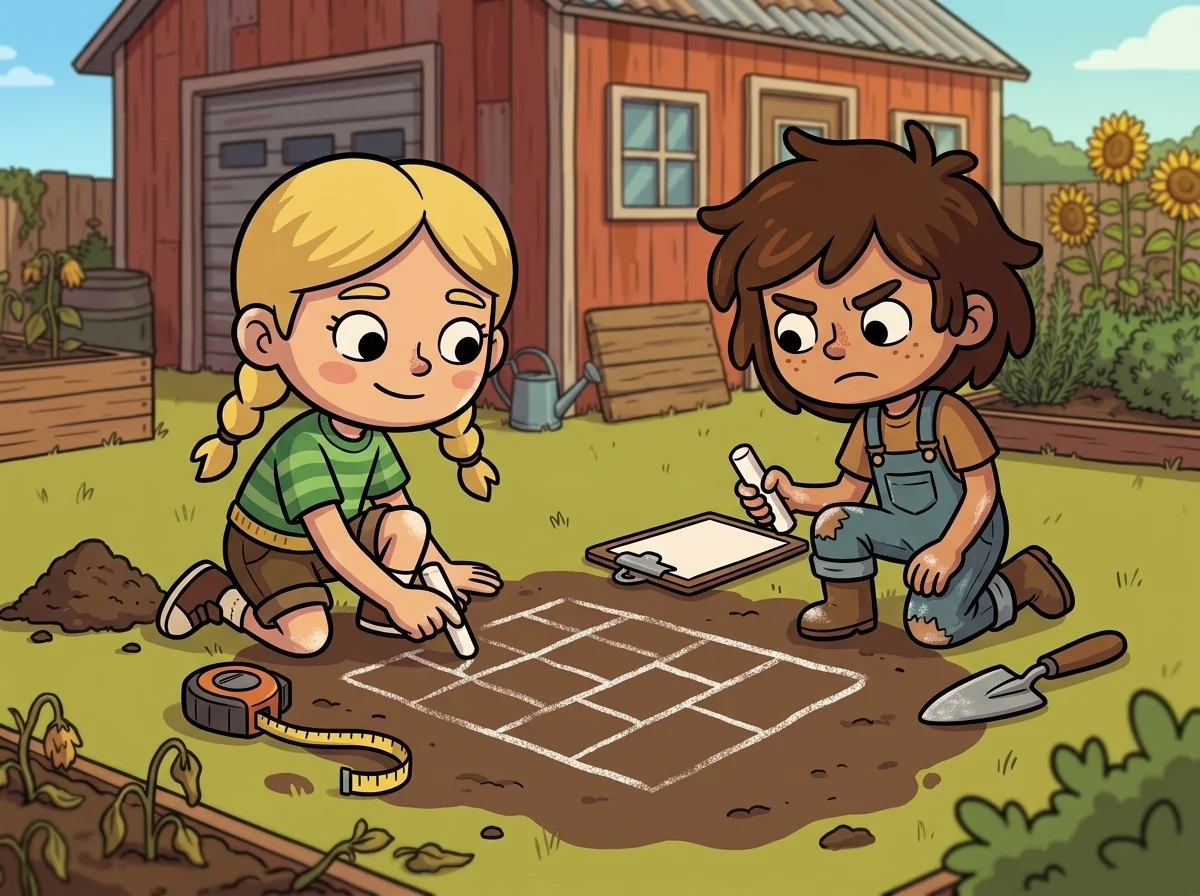
Equi picked up a fresh piece of chalk, its white tip pristine against the brown earth. "Okay," she began, her tone more confident now. "Let me try to restate this, just to make sure I've truly grasped it. What we've accomplished is this: we took four groups, each with their own unique way of slicing their space. We then scaled all those diverse sub-portions to a single, common base—sixths. This allows us to plan the entire garden using one shared, understandable scale. Each group still gets to slice their own quarter-strip however they choose. But on this diagram, everything is now expressed in sixths."
"Precisely," Stretch affirmed.
"And this common scale," Equi continued, gesturing vaguely, "is it twelfths? Or twenty-fourths?"
Stretch gently took the chalk from Equi's hand. She knelt and quickly sketched a small, neat grid into the dirt, an abstract representation of the problem. "We need a *common denominator*," she explained, her finger tracing a line. "That's a number, a scale, that all four groups' sub-portions can be expressed in. The herbs group needs thirds of their strip. Salad greens require sixths. Root vegetables need halves. And the sunflowers, well, they just need the whole strip, which we can think of as one."
Equi recited the numbers, almost to herself. "Three, six, two, one."
"Now," Stretch prompted, looking up. "What's the smallest number that all four of those values divide into evenly?"
Equi's eyes narrowed in thought. "Six," she declared.
"So, if we slice each individual strip into sixths," Stretch continued, her chalk moving across the dirt, "then it looks like this:"
She quickly drew a series of smaller lines within her grid, transforming the abstract into something concrete.
"The herbs group's three sub-portions," she narrated, "will each take up two sixths of their strip." "The salad-greens group's six sub-portions will each occupy one sixth." "The root-vegetables group's two sub-portions will each claim three sixths." "And the sunflowers group's single sub-portion will encompass six sixths, the entire strip."
"Now," Stretch concluded, sitting back on her heels, "everyone is finally on the same scale: sixths of a strip."
Equi leaned closer, studying the intricate diagram. "And this," she said slowly, tracing a line with her finger, "is what you mean by a common denominator."
"Precisely," Stretch confirmed.
"And it's also what I mean by *equivalent fractions*," Equi added, a triumphant note in her voice. "Every group's portion has simply been renamed in sixths."
"Exactly," Stretch agreed.
"They are the same idea," Equi stated, a wide smile spreading across her face.
"They are the same idea," Stretch echoed, returning the smile.
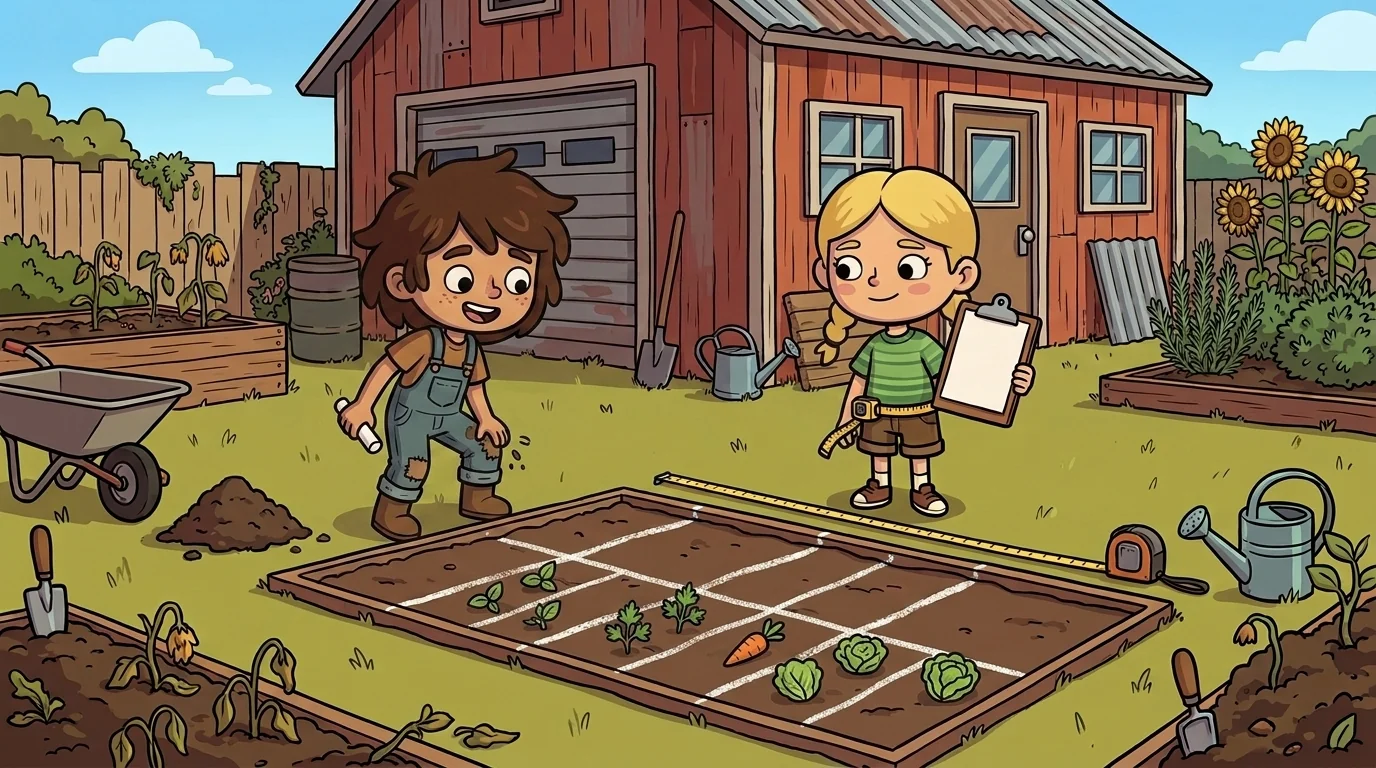
Equi stood up, brushing loose dirt from her knees, a new lightness in her movements. "All right," she said, her voice clear and confident. "Let me restate one last thing, just to solidify it. What we've accomplished is this: we took four groups, each with their own unique way of slicing their space. We then scaled all those diverse sub-portions to a single, common base—sixths. This allows us to plan the entire garden using one shared, understandable scale. Each group still gets to slice their own quarter-strip however they choose. But on this diagram, everything is now expressed in sixths."
"Exactly," Stretch confirmed, a proud look in her eyes.
"So," Equi continued, her finger hovering over the diagram, "when the herbs group says, 'Basil gets one of our three sub-portions,' we can immediately translate that. It means basil gets two sixths of the herbs strip. And when the salad-greens group says, 'Arugula gets one of our six sub-portions,' we translate that to arugula getting one sixth of the salad-greens strip. Now, both of those measures are directly comparable. This holds true even though basil and arugula reside in completely different strips."
Stretch grinned. "You just articulated the entire purpose of common denominators in a single, perfect sentence."
"I just restated the entire purpose of common denominators," Equi corrected, a playful glint in her eye. "And the only reason I could restate it so clearly is because you literally showed me what scaling looks like, right here in the dirt."
She smiled, a genuine, unburdened smile.
"My equivalence rule and your scaling rule," Equi concluded, "they're just the same trick, told in two different ways."
"And when applied to garden plots," Stretch added, "they ensure we can share space fairly, without argument."
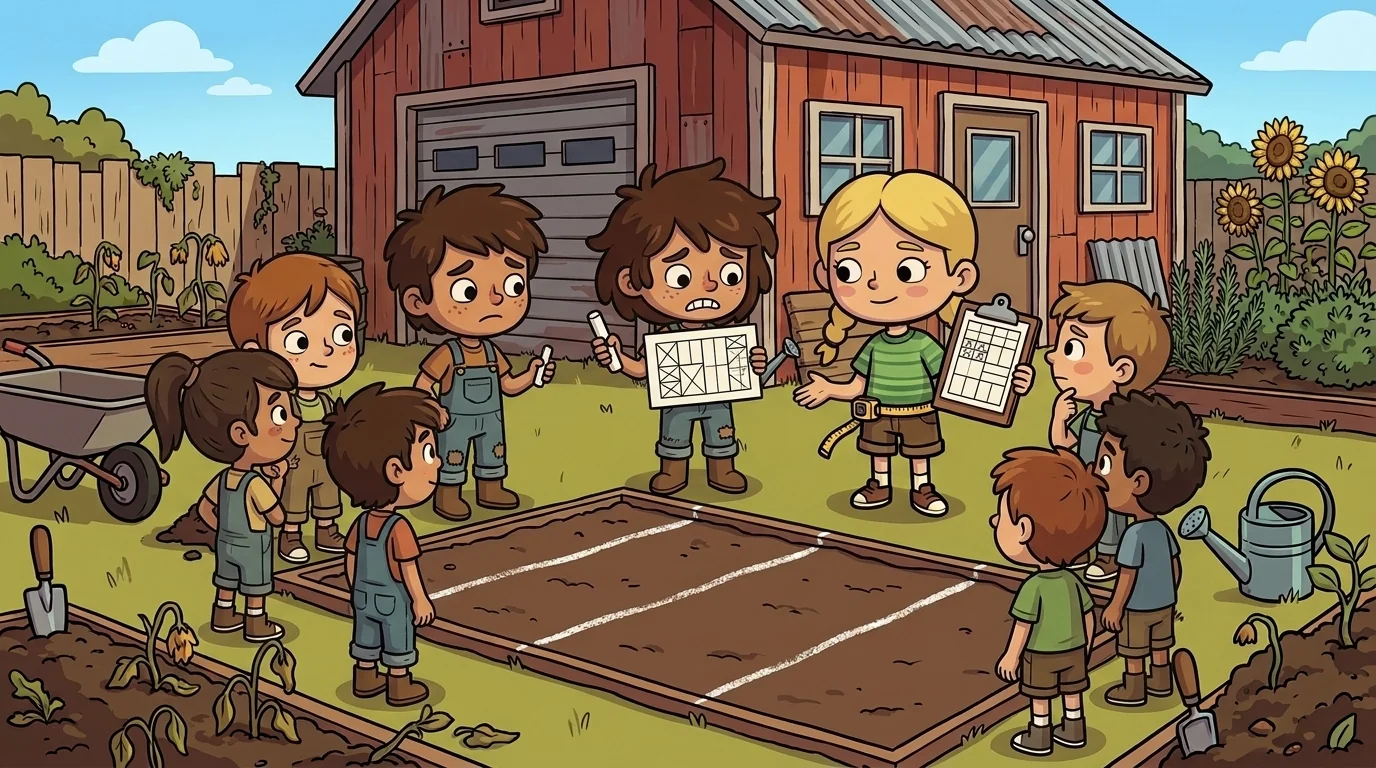
A moment later, the garden club kids emerged from the workshop, their chatter filling the air. They quickly gathered around Equi and Stretch, their eyes curious. Equi handed out copies of the newly drawn diagram, which showed the garden plot in clear detail. Each group's main strip was clearly visible. But now, inside each strip, the smaller sub-portions were precisely drawn to the common scale. The herbs group could easily identify their basil, parsley, and mint sections. The salad-greens group saw their six distinct lettuce rows. The root-vegetables group could point out their carrots and radishes. Even the sunflowers group could see their entire strip laid out, perfectly theirs.
"How do we know it's fair?" a girl named Maya asked, her brow furrowed with a familiar middle-school skepticism.
Equi pointed to the diagram, her finger moving across the lines. "Look closely," she instructed. "Each group's outside boundary is exactly one-quarter of the entire plot. That's the same for everyone. And inside their own strip, they still get to slice it however they need. The clever part is that we translated each group's unique slicing into the same scale—sixths-of-a-strip. This way, we can see everyone's space side by side, clearly."
Stretch nodded in agreement. "Which means, Maya, when you're standing in the herbs strip and you see basil get two sixths of that strip, you automatically know. Without asking anyone, you understand that two sixths of a quarter is precisely two-twenty-fourths of the whole garden. That's a real, measurable, and truly fair share."
Maya considered this, her skepticism slowly melting into understanding. "So, even if basil and arugula are planted in completely different strips, I could tell you exactly how much bigger basil's plot is than arugula's?"
"You absolutely could," Equi confirmed.
"Basil is twice as big," Maya stated, a small smile appearing.
"Precisely," Stretch replied.
Equi and Stretch exchanged a knowing smile. The four chalk lines, once a simple division, now stretched across the dirt, holding the promise of a whole garden's worth of fair, organized work.
"Equivalent forms," Equi murmured, looking at the lines.
"Common scales," Stretch replied, her gaze meeting Equi's.
"The same trick," Equi concluded.
"Told twice," Stretch finished.
The FractionForge ensemble
Equi and Stretch is part of FractionForge's distributed-narrative cast. Each character embodies a different curricular primitive; together they teach the full subject.
-

Halver
Partitioning — splitting a whole into equal parts (denominator construction)
-

Pie
Wholes and parts — mixed numbers, improper fractions, whole-as-pie anchor
-

Equi
Equivalent fractions — different forms, same value (×n/×n scaling)
-

Stretch
Common denominators — scaling to a common base for comparison + addition
-

Dot
The decimal point and fraction-decimal-percent equivalence
-

Liner
Number-line placement — every fraction has an exact spot between the whole numbers
-

Gather
Adding and subtracting fractions — you can only combine pieces that are the same size
-

Times
Multiplying fractions — a fraction OF a fraction, shown as the overlap of two strips
-

Tenth
Decimal place value — each column right of the point is ten times smaller
-
Rank
Comparing and ordering fractions using benchmarks and reasoning