Dot
DECIMAL POINT — a special-case fraction notation where the denominator is always a power of 10. 0.3 = 3/10. 0.07 = 7/100. The decimal point's position determines the denominator.
Press play to listen along. The line being read lights up as you go.
Show full transcript
Loading transcript…

Dot was, for most of her childhood, the smallest person in every room.
This is, when you are a child, a strange feeling. Adults always see you. Adults often address you as if you were younger than you are. Adults sometimes step around you because they did not notice you were there, and then they apologize, and then they ask if you are all right, and then they pat you on the head, which is not necessarily what a small person wants. The world, when you are small, is full of large things politely trying not to bump into you.
Dot — whose given name was Mila, though she has gone by Dot since her older brothers nicknamed her at age four — grew up in a household of tall, loud, fast-moving siblings. She had four older brothers. They were all, even by adult standards, large. By the time her oldest brother was seventeen and Mila was four, he could pick her up under one arm and carry her up the cottage's stairs without breaking stride. (He did this often. He thought it was funny. Mila thought it was deeply unfair and would have much preferred to walk up the stairs herself, but she did not yet have the words to object.)
Her brothers called her Dot because she was a small dot in the family painting. She did not mind the name. She liked it, actually. Dot felt accurate. She was a dot.
But — and this is the chapter's essential fact — Dot understood, very early, that her smallness did not mean she was unimportant. She understood that small things, placed correctly, could mean a great deal.

This was a thing she learned from her grandmother.
Her grandmother — Vade, who had been a calligrapher in her younger years and who still maintained the family's library of carefully-lettered books — had taught Dot to read by pointing at each letter with a fingertip. The fingertip touched the letter for a heartbeat. The fingertip moved to the next letter. Vade said, very slowly: "Each letter is small. Each letter only has meaning in its place. If you move the letter, the word changes. If you remove the letter, the word breaks. Small things matter when their place matters."
Dot understood this immediately. She had been four. She had learned to read in three months.
Over the next several years, Dot internalized the principle. Small things, placed correctly, were not unimportant. They were the placement itself. A comma in the wrong place changed a sentence. A grain of sand in a clock's gears stopped the clock. A small candle in a dark room was the light.
When Dot was nine, she encountered decimals at the village school. The schoolteacher wrote on the board:
3.14.
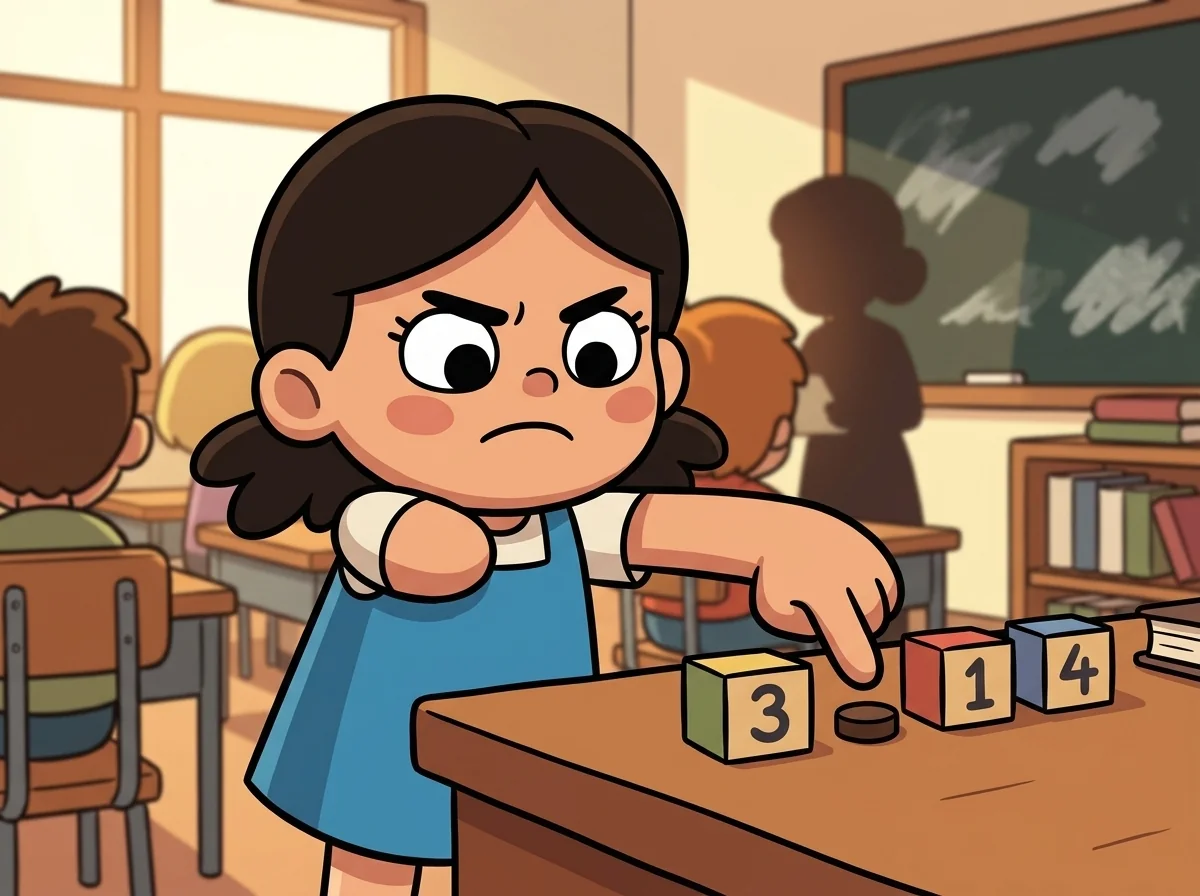
The schoolteacher said: "This is a decimal number. The dot between the 3 and the 14 is called the decimal point. It separates the whole part from the fractional part. The 3 is three whole units. The 1 is one-tenth. The 4 is four-hundredths."
Dot stared.
She said: "The dot is the most important part of the number."
The schoolteacher said: "Why?"
Dot said: "It tells you which digit means what. Without the dot, you would have the number 314, which is three hundred fourteen. With the dot, you have 3.14, which is three-and-some-fraction. The dot decides whether the 3 is three units or three hundred units. The dot is small. The dot decides everything."
The schoolteacher was, by his own later admission, struck. He had been teaching decimals for fifteen years. He had not heard anyone state the case for the decimal-point's importance quite that directly.
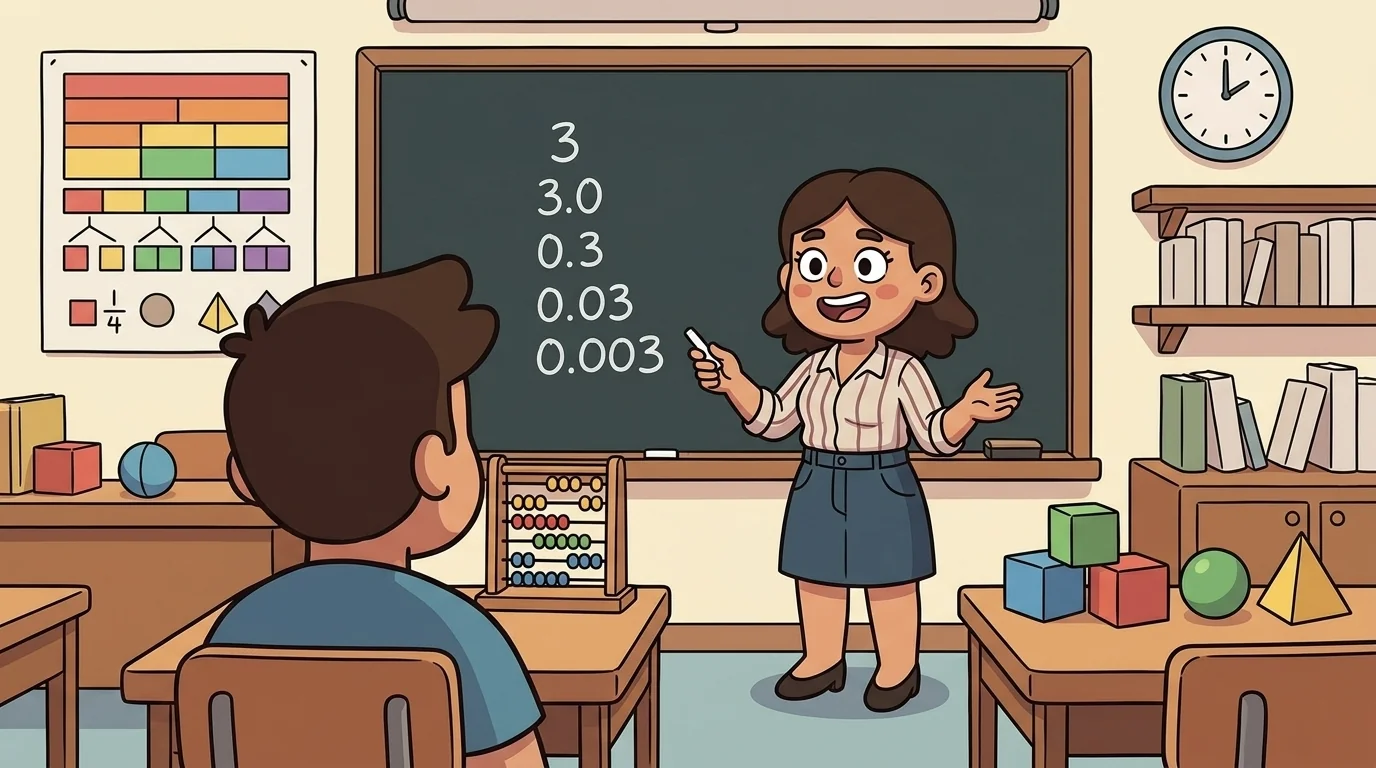
He said: "Yes. That is exactly right. The decimal point is small but it is essential. Its position determines what every digit means. Move the decimal point one place to the right, and every digit moves one place to the left in value — every digit becomes ten times bigger. Move the decimal point one place to the left, and every digit becomes ten times smaller."
Dot nodded. She thought of her grandmother. Small things, placed correctly, were the placement itself. The decimal point was such a small thing. The decimal point was the placement.
She has been teaching the decimal point ever since. She studied at the FractionForge academy from sixteen to nineteen. She joined the faculty at twenty. She is now thirty-one. She is no longer the smallest person in every room (she had a late growth spurt and is now of slightly-above-average height) but she is still called Dot and she does not mind.
In her classroom, she begins every first-day lesson the same way. She writes on the board:
3 3.0 0.3 0.03 0.003.
She turns to the class. She says: "These all contain the digit 3. They are not the same number. What makes them different?"
The children — always — say the dot. (Sometimes they say the decimal point, but most of them call it the dot.)
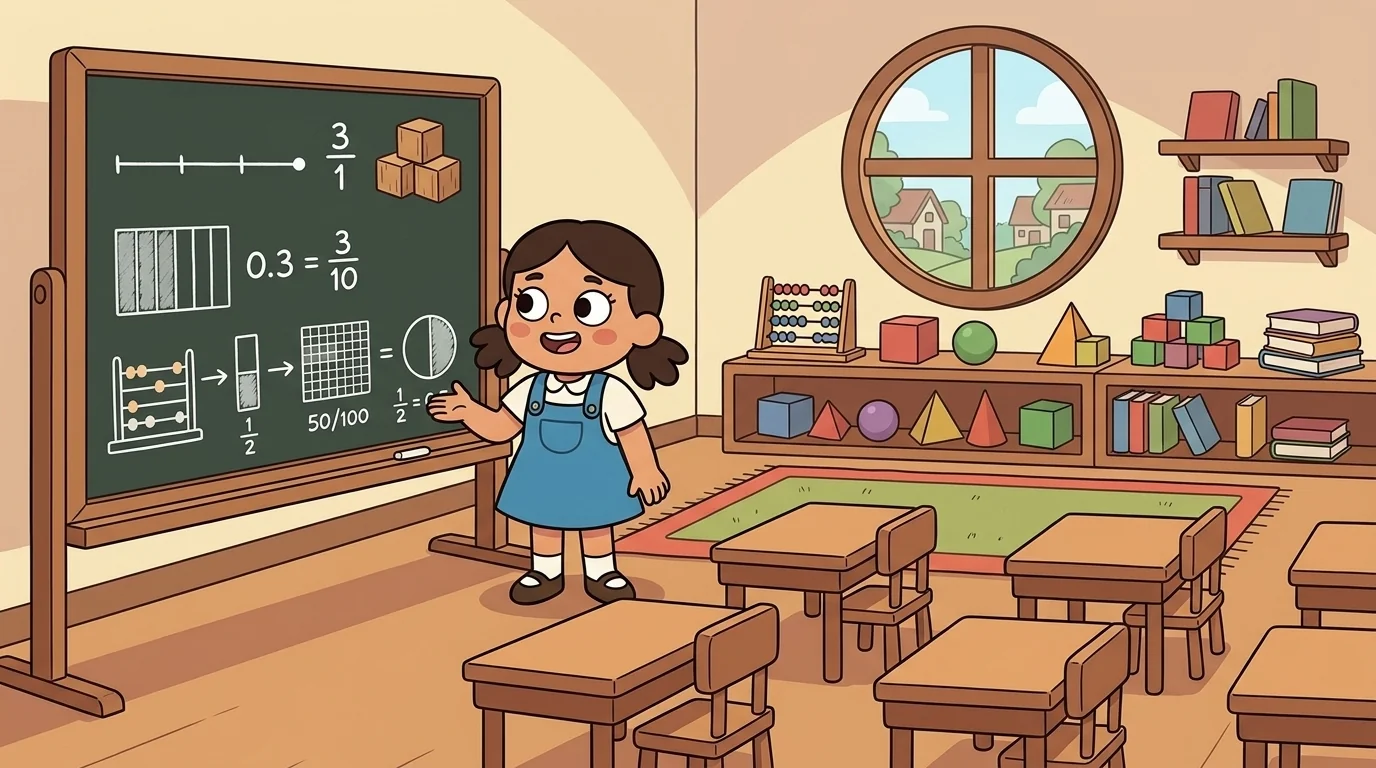
Dot smiles. She says: "The dot is small. The dot decides everything. 3 is three whole units. 3.0 is also three whole units (the zero is just confirming there is nothing in the tenths position). 0.3 is three tenths. 0.03 is three hundredths. 0.003 is three thousandths. The digit 3 is the same. The place changes. The value changes by a factor of ten with every step."
She then writes: 1/2 = 0.5 = 50%. She says: "Decimals are fractions. 0.5 means 5/10, which equals 1/2. Percentages are fractions with denominator one hundred. 50% means 50/100, which equals 1/2. These three are the same value in three different writing systems. The fraction, the decimal, the percent. All three are equivalent."
The children — always — see it. Once Dot has made the connection between fractions and decimals, the rest of the curriculum opens up.
When children ask whether decimals are hard, Dot always says the same thing:
"They are not hard. They are fractions with denominator a power of ten. The decimal point's place tells you which power of ten the denominator is. Tenths after the dot is over ten. Hundredths is over one hundred. Thousandths is over one thousand. Decimals are just a different way to write the same fractions you already know."
She still has her grandmother's calligraphy slate. She brings it to class sometimes. She points at letters. She says: "My grandmother taught me about placement before I knew there was such a thing as a decimal point. The same idea. Different letters."
And every time she holds that worn old slate, something in her goes warm and quiet. The smallest person in the room, once. Never invisible. Never unimportant. Just waiting for the moment her place would matter — and glad, deep down, that it finally did.
The FractionForge ensemble
Dot is part of FractionForge's distributed-narrative cast. Each character embodies a different curricular primitive; together they teach the full subject.
-

Halver
Partitioning — splitting a whole into equal parts (denominator construction)
-

Pie
Wholes and parts — mixed numbers, improper fractions, whole-as-pie anchor
-

Equi
Equivalent fractions — different forms, same value (×n/×n scaling)
-

Stretch
Common denominators — scaling to a common base for comparison + addition
-

Liner
Number-line placement — every fraction has an exact spot between the whole numbers
-

Gather
Adding and subtracting fractions — you can only combine pieces that are the same size
-

Times
Multiplying fractions — a fraction OF a fraction, shown as the overlap of two strips
-

Tenth
Decimal place value — each column right of the point is ten times smaller
-
Rank
Comparing and ordering fractions using benchmarks and reasoning