
Rank
COMPARING FRACTIONS — you can tell which fraction is bigger by reasoning, not only by converting. Benchmark against 1/2. Same top, smaller bottom means bigger pieces. Same bottom, bigger top means more pieces.
Press play to listen along. The line being read lights up as you go.
Show full transcript
Loading transcript…
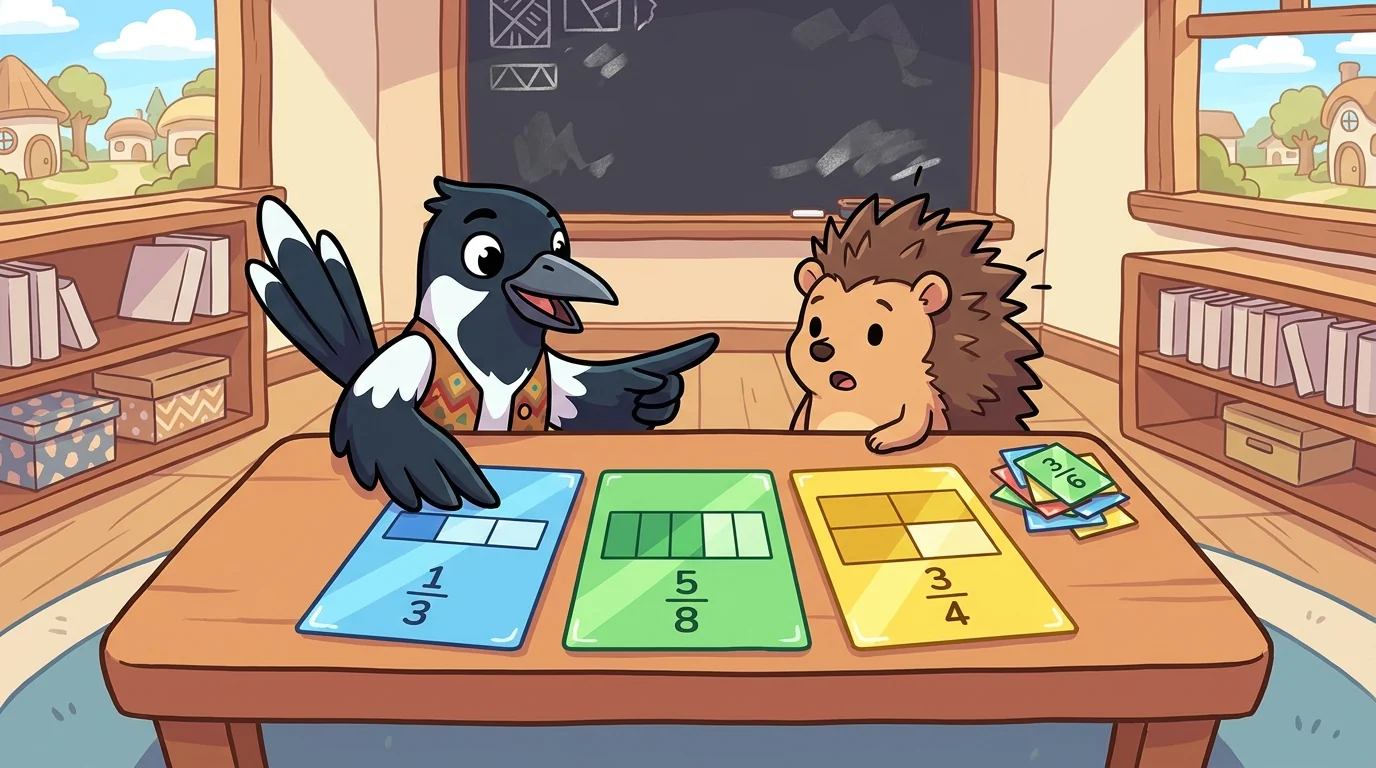
Rank loved a good line-up.
At the FairShare Village academy, whenever a pile of fraction cards got jumbled, Rank was the one who sorted them — smallest to largest, left to right, like kids lining up by height. He was a brisk, friendly magpie with a bright eye for which thing was bigger than which.
A young hedgehog named Sol dumped a handful of cards in front of him: *3/4, 1/3, 5/8*. "Put them in order," Sol said, "but I bet you have to do a ton of math first."
Rank barely glanced at them. He slid *1/3 to the left. "Smallest — that's less than half." He slid 3/4 to the right. "Biggest — that's more than half." He set 5/8* in the middle. "And this one's just a hair over half. So: a third, then five-eighths, then three-quarters."
Sol's spines stood up. "You didn't even calculate anything!"
"I compared them to half," Rank said. "Half is my middle marker. Once you know which side of half each one is on, you're most of the way there. Let me show you how I learned that."
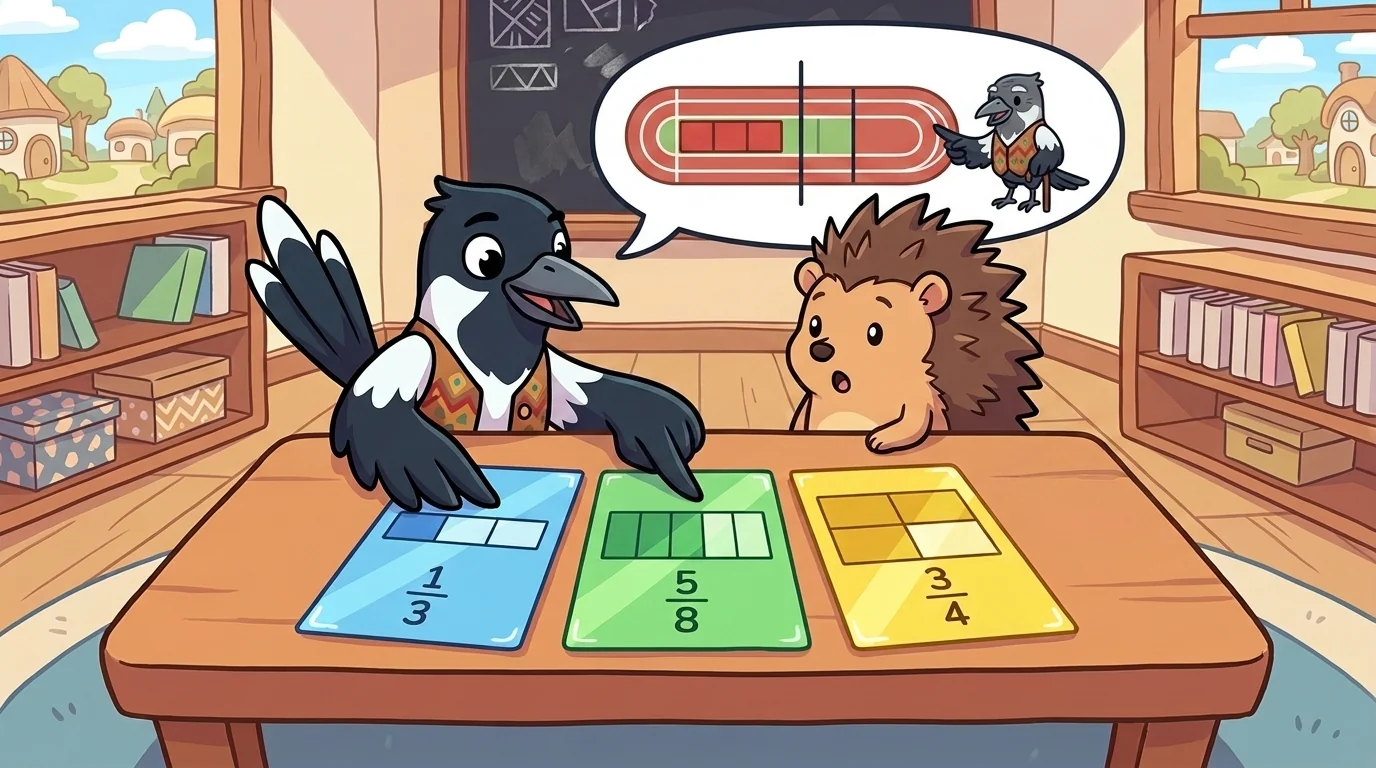
When Rank was small, comparing fractions made his head hurt.
His family ran the village relay races, and every race ended in arguments: whose runner had covered more of the track? One had run three-fifths of the way. Another had run two-thirds. The kids would shout numbers at each other and nobody could tell who'd won.
Little Rank tried to settle it by converting everything — cutting the track into tiny matching pieces, fifteenths, counting them all up. It worked, but it was slow, and by the time he finished, everyone had wandered off.
His grandfather, who judged the races, took him aside. "You don't always need the whole calculation," he said. "Look. Is three-fifths more than half the track, or less?"
Rank thought. Half of five-fifths would be two-and-a-half fifths. Three-fifths was past that. "More than half."
"And two-thirds?"
Half of three would be one-and-a-half thirds. Two-thirds was past that, too. "Also more than half." Rank frowned. "That doesn't settle it."
"No," his grandfather agreed, "but now you only have two close ones to think hard about, instead of a whole jumble. You've already thrown out the easy cases. Half did most of the work for you."
Rank stared at the track. Half. The middle marker. Suddenly comparing didn't feel like a wall of math anymore. It felt like sorting.
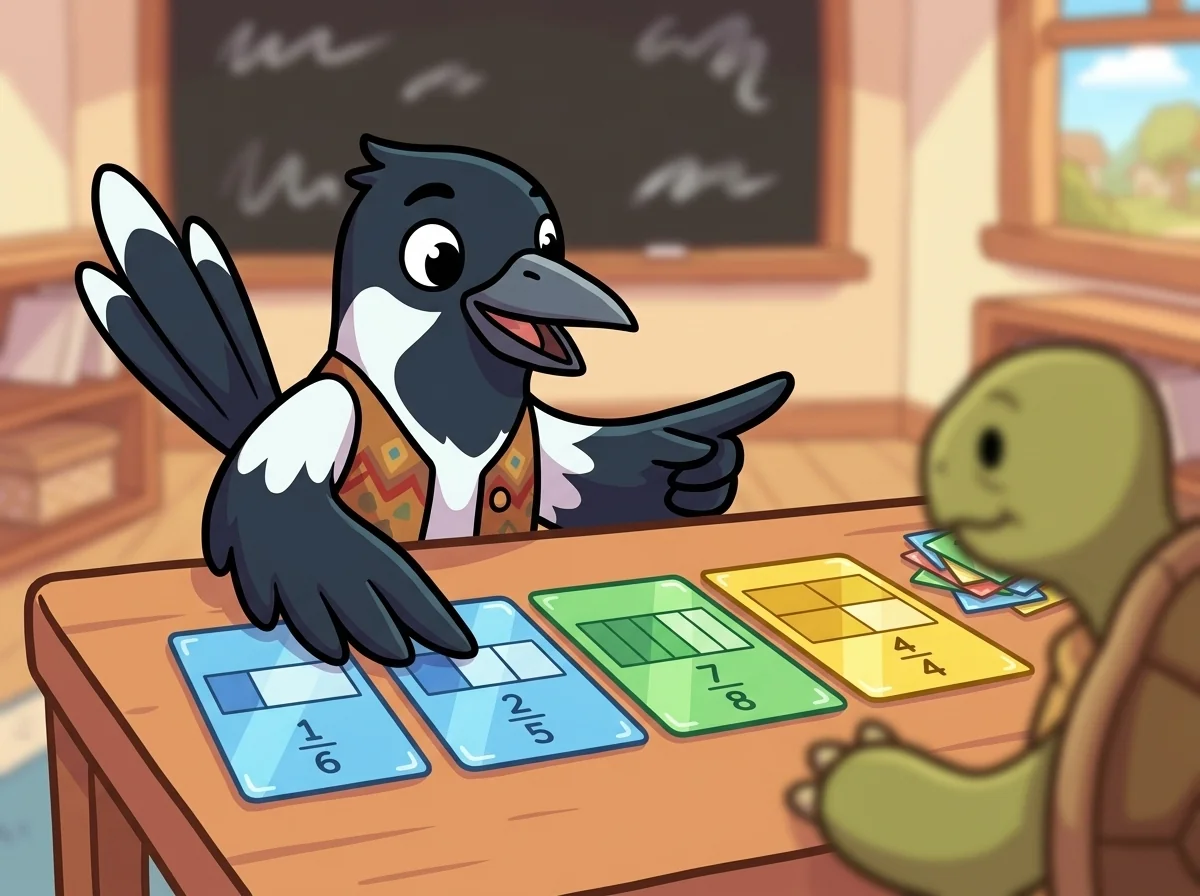
Rank came to the academy with a deck of fraction cards he could shuffle and sort faster than anyone.
Slice, the old tortoise, fanned out four cards: *2/5, 4/4, 1/6, 7/8*. "Order them," he said. "Out loud. Tell me how."
Rank didn't reach for a pencil. "Four-fourths is a whole one — that's the biggest, it's a complete thing. One-sixth is a tiny sliver, way under half — smallest. Two-fifths is under half too, but bigger than that little sliver. And seven-eighths is almost a whole, just under four-fourths." He laid them out left to right. "One-sixth, two-fifths, seven-eighths, four-fourths."
"And if two are both close to half?" Slice asked.
"Then I think harder," Rank said. "Same top number? The one with the smaller bottom is bigger — fewer, fatter pieces. Same bottom number? The one with the bigger top is bigger — more pieces. And if I'm really stuck, I'll do it Stretch's way and give them a common bottom. But most of the time, reasoning gets me there first."
Slice looked at the tidy row of cards. He had taught comparison as always convert first for sixty years. He had never watched a student sort by thinking out loud. "You may stay," he said.
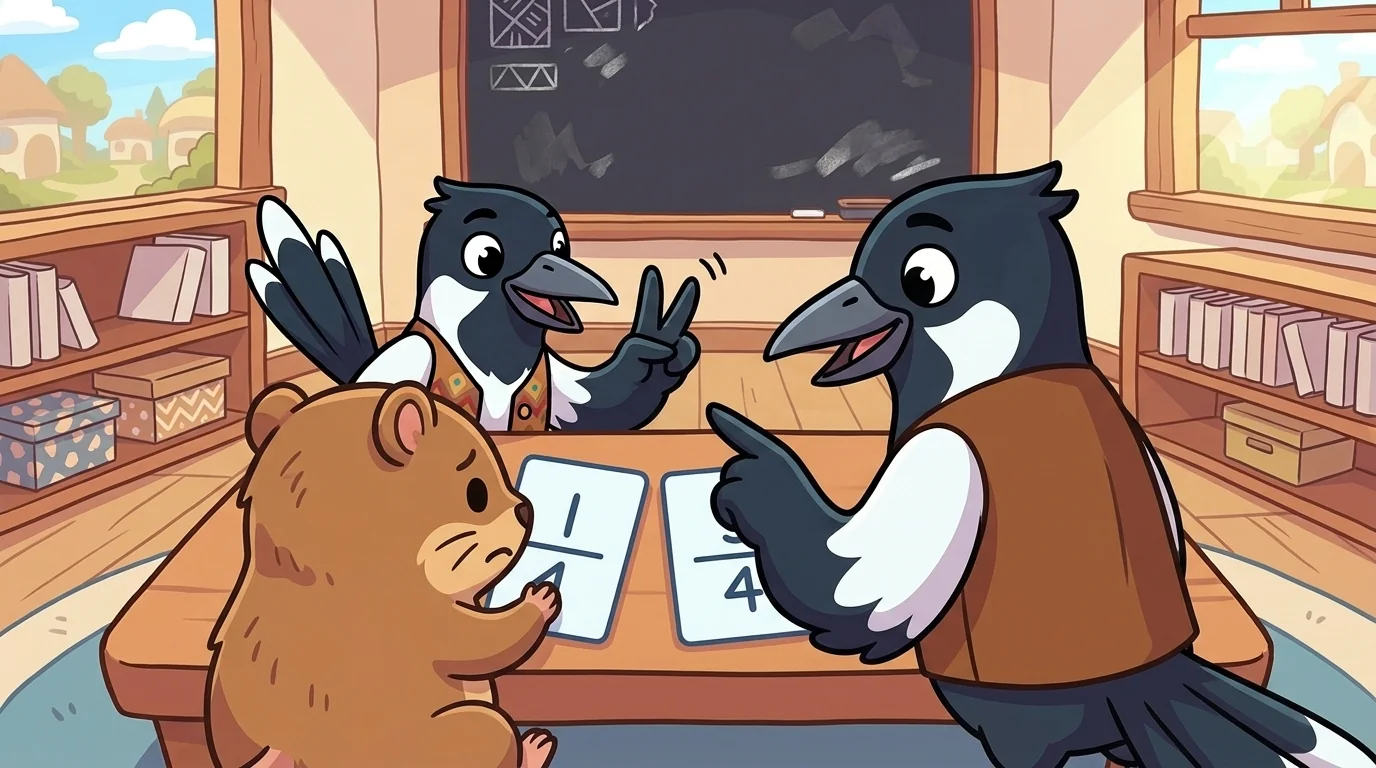
In his corner, Rank met a worried vole named Wisp clutching two cards.
"I have to figure out which is bigger," Wisp said, "three-fourths or two-thirds, and I always get them mixed up."
"Middle marker first," Rank said. "Are they over half or under half?"
Wisp thought. "Three-fourths... half of four is two, three is past two, so over half. Two-thirds... half of three is one-and-a-half, two is past that, so also over half." Wisp sagged. "They're both over half. Now I'm stuck again."
"Good — you've earned the harder look," Rank said warmly. "Now think about how far past a whole they each fall short. Three-fourths is missing just one-fourth to be a whole. Two-thirds is missing one-third to be a whole." He held up two fingers a little apart. "Which gap is bigger — a fourth or a third?"
Wisp pictured the pieces. "A third is bigger than a fourth. So two-thirds is missing a bigger chunk."
"So which one is closer to a whole?"
"Three-fourths! It's only missing a little fourth. So three-fourths is bigger!" Wisp nearly dropped the cards. "I figured it out by thinking about what was missing."
"That's the magpie's trick," Rank grinned. "Sometimes the easiest way to see which is bigger is to see which one has less missing."
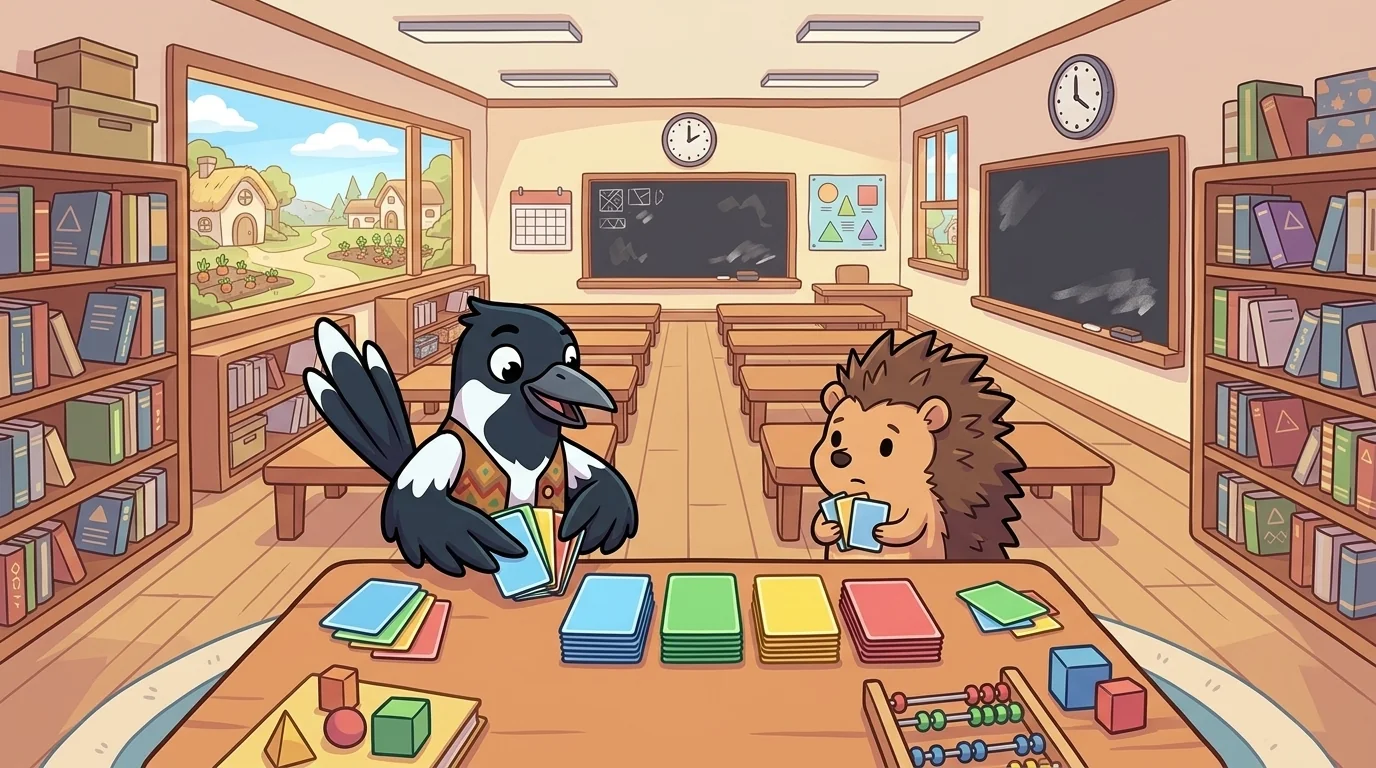
At the end of the day, when the academy emptied and the card piles were all sorted, Rank shuffled his deck one last time, just for the pleasure of putting it back in order.
He thought about the old relay races — the shouting, the arguments, his slow careful fifteenths while everyone wandered away. His grandfather's quiet question. Is it more than half, or less? That one marker had turned a wall of math into a simple line-up. He'd never been afraid of comparing since.
Sol the hedgehog, still hanging around, asked the last question. "Rank? What if I get two that are really, really close?"
"Then you slow down and do it carefully — benchmark to half, check what's missing, and if you still can't tell, give them a common bottom like Stretch does," Rank said. "But start by thinking. Most of the time, a fraction will tell you which side of half it's on, and that sorts the line-up before you've done a single sum."
Sol nodded, gathered the cards, and headed home, quietly sorting every pair of fractions he could think of — over half, under half, almost a whole — putting the whole world in order, one quick comparison at a time.
The FractionForge ensemble
Rank is part of FractionForge's distributed-narrative cast. Each character embodies a different curricular primitive; together they teach the full subject.
-

Halver
Partitioning — splitting a whole into equal parts (denominator construction)
-

Pie
Wholes and parts — mixed numbers, improper fractions, whole-as-pie anchor
-

Equi
Equivalent fractions — different forms, same value (×n/×n scaling)
-

Stretch
Common denominators — scaling to a common base for comparison + addition
-

Dot
The decimal point and fraction-decimal-percent equivalence
-
Liner
Number-line placement — every fraction has an exact spot between the whole numbers
-

Gather
Adding and subtracting fractions — you can only combine pieces that are the same size
-

Times
Multiplying fractions — a fraction OF a fraction, shown as the overlap of two strips
-
Tenth
Decimal place value — each column right of the point is ten times smaller