Pie
WHOLES AND PARTS — mixed numbers, improper fractions, the whole-as-pie anchor. 9/8 is one whole pie plus one extra slice; 1 and 1/8 is the same quantity expressed differently.
Press play to listen along. The line being read lights up as you go.
Show full transcript
Loading transcript…
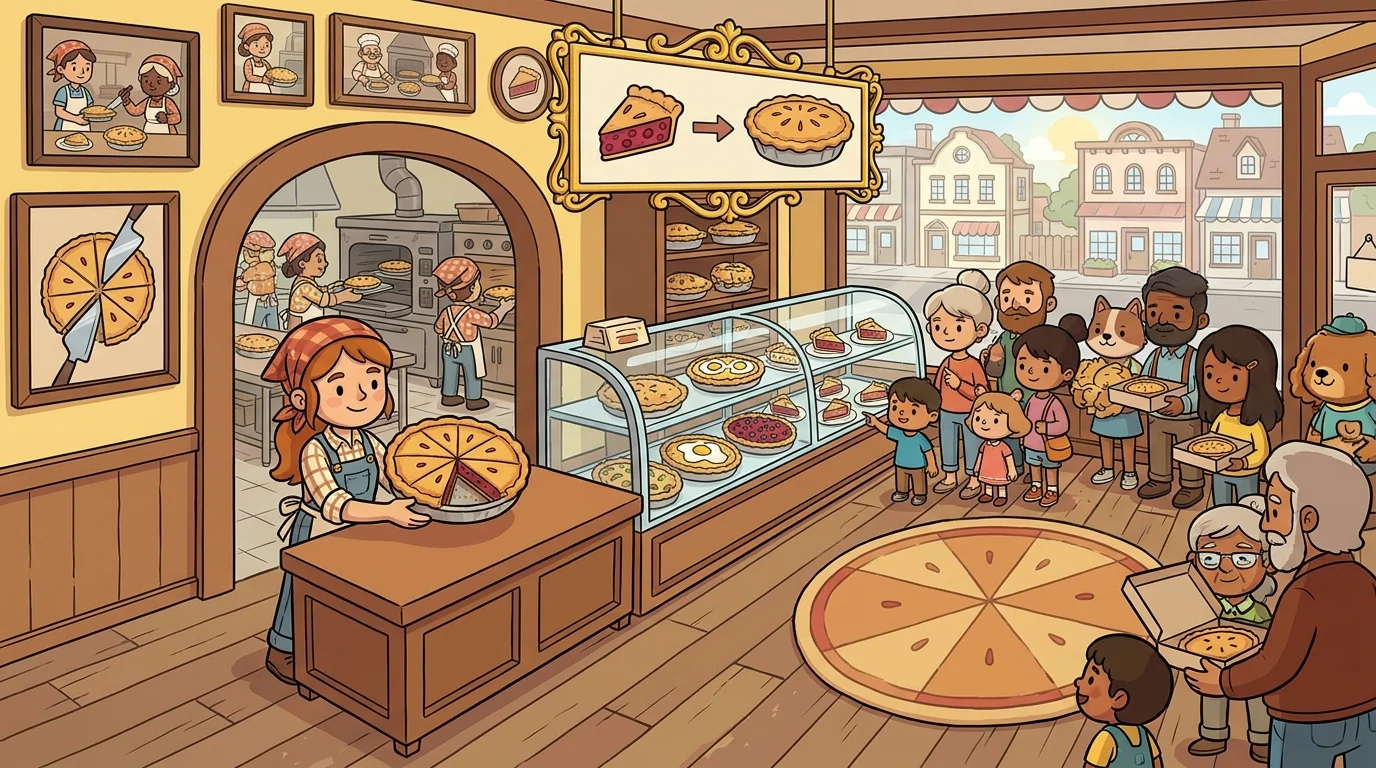
Pie grew up in a pie-shop.
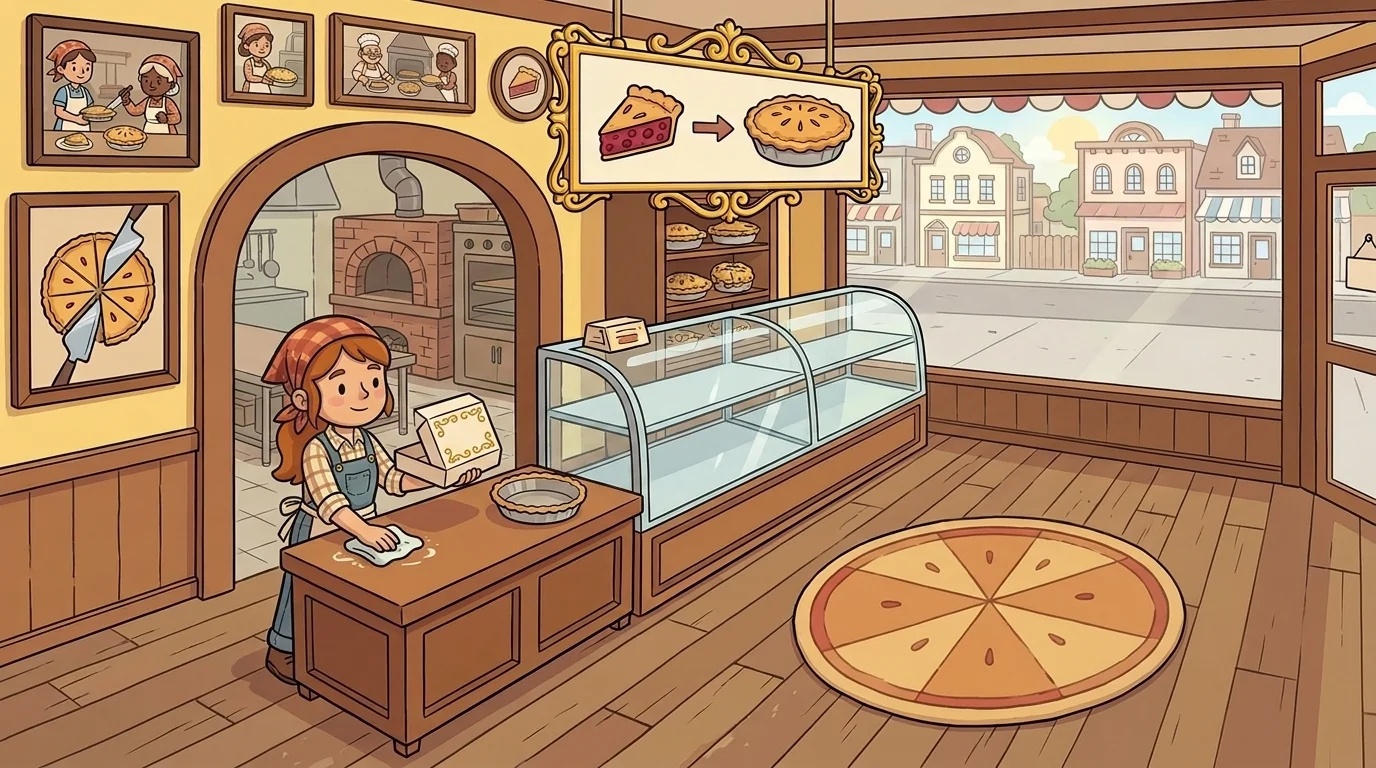
The pie-shop — Crustford and Co., on the main street of the town of Crustford — had been in her family for five generations. Her great-great-grandfather had founded it. Her great-grandfather had standardized the pie-sizes. Her grandfather had added the savory line. Her grandmother had added the breakfast pies. Her parents had added the slice-by-slice retail counter so customers could buy single slices without ordering whole pies.
The shop was, by Crustford's standards, famous. Travellers came from three towns over to buy its pies. The slogan, painted in large gold letters above the front window, was:
"THE SLICE IS THE UNIT. THE PIE IS THE WHOLE."
This slogan was, Pie eventually realized, the foundation of her future career.
Crustford pies had been standardized since her great-grandfather's day. Every Crustford pie was twelve inches across. Every Crustford pie was cut into eight slices. Every slice was exactly the same size. This had been an aggressive standardization in its time — most village pie-makers cut whatever sizes the customer wanted — but Crustford's great-grandfather had decided that consistency was good for the customer. The customer always knew what a Crustford slice was. The customer could always compare prices. The customer could always know, exactly, how much pie they had paid for.
Pie — whose given name was Tess, though everyone called her Pie from the time she was two and a half — grew up with the slice-and-pie ratio as a foundational fact of her life.
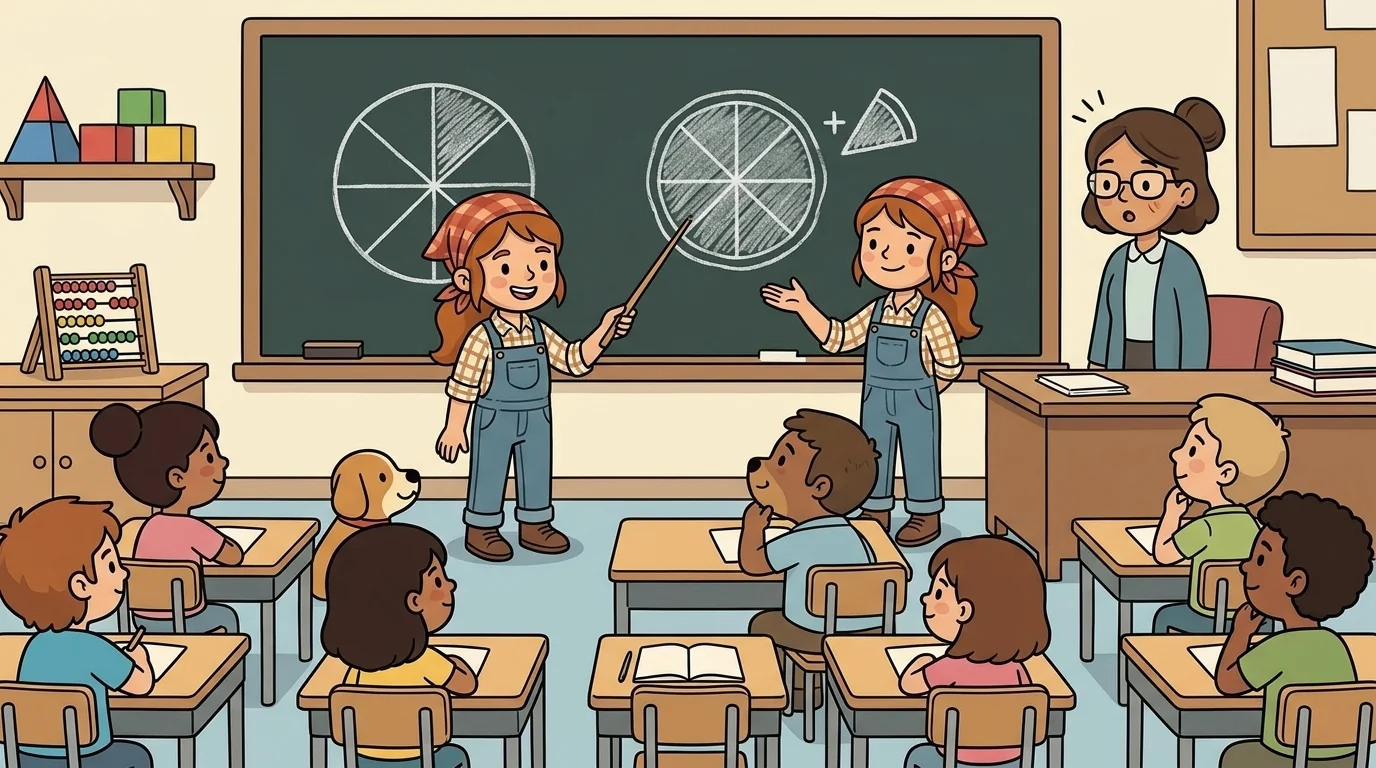
By the time she was four, she could answer questions like: "If you have three slices and your brother has four slices, how many slices total?" (Seven.) "How much of a whole pie is that?" (Seven-eighths.) "And if your sister brings two more slices to the table?" (That makes nine slices — one whole pie plus one extra slice — one and one-eighth pies.)
She did this in her head, all day, every day, throughout her childhood. It was not, to her, arithmetic. It was just how pies worked.
When she was eleven, she walked into the village school for the first time. (Her parents had homeschooled her until then; she had been working in the shop.) The schoolteacher introduced fractions to the class. She drew a pie on the board. She said: "A pie cut into eight pieces. Each piece is one-eighth. If you eat three pieces, you have eaten three-eighths."
Pie raised her hand. She said: "What if you eat nine pieces?"
The schoolteacher said: "You would have eaten more than the whole pie."
Pie said: "Yes. You would have eaten one and one-eighth pies. The first eight pieces are a whole pie. The ninth piece is one-eighth of another pie."
The schoolteacher blinked. "That is correct. We call that a mixed number."
Pie said: "You can also write it as nine-eighths. The 9 is the total slices. The 8 is the slices-per-pie. 9/8 is the same as 1 and 1/8. Same quantity. Just written differently."
The schoolteacher stared at her.
The schoolteacher said: "How do you know that?"
Pie said: "We sell pies."
The schoolteacher, after a long pause, said: "That is called an improper fraction. The numerator is larger than the denominator. It can always be converted to a mixed number. And the mixed number can always be converted back. They are equivalent."
Pie nodded. She had not known the names. She had been doing the operation, in her head, since she was four.
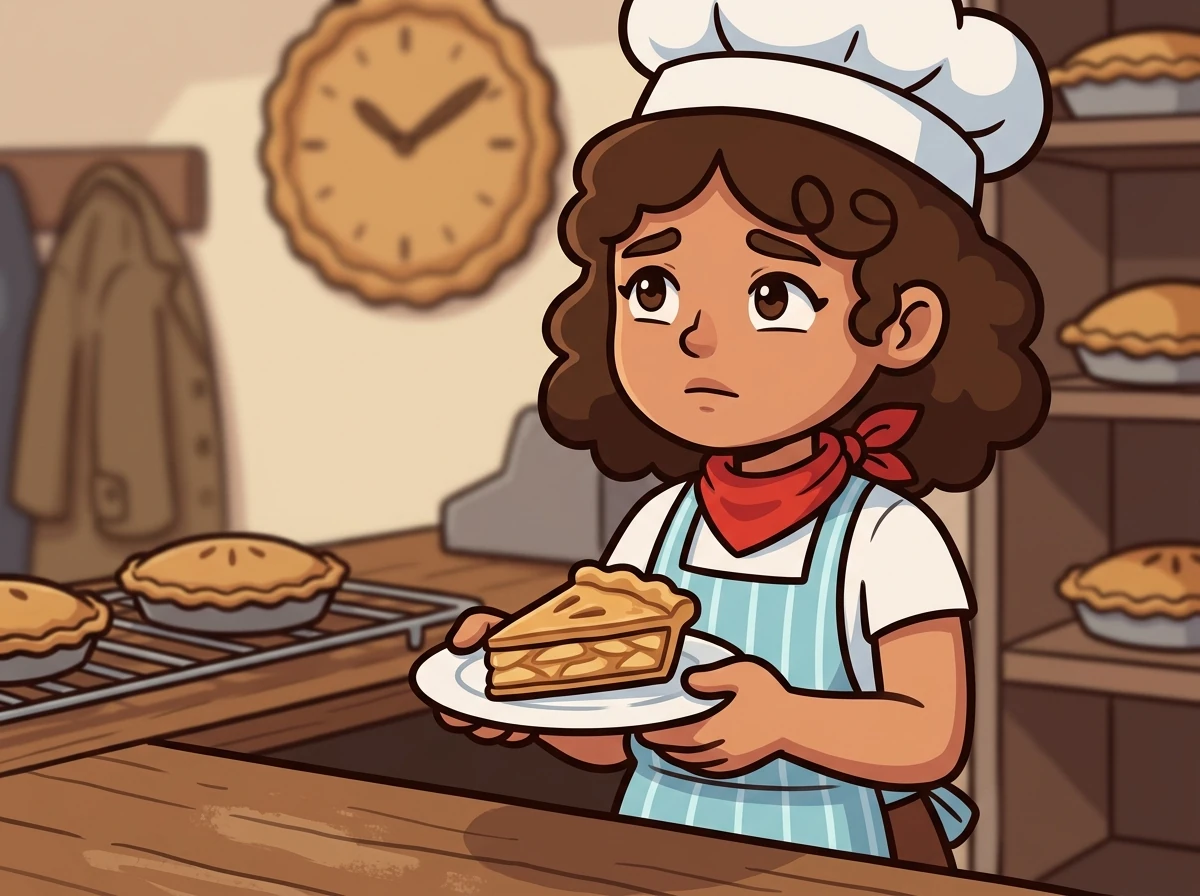
That afternoon, the schoolteacher walked to Crustford and Co. and bought a single slice. She asked Pie's mother: "Has anyone in your family ever taught fractions formally?"
Pie's mother said: "No. We just sell pies."
The schoolteacher said: "Your daughter is a natural teacher of fractions. The slice-and-pie ratio in this shop has done her education."
Pie's mother said, after thinking: "She does spend a lot of time computing slice-counts."
The schoolteacher said: "If she ever wants to teach formally, she has a place at the FractionForge academy. Tell her."
Pie's mother told her that evening. Pie thought about it for two years. She loved the pie-shop. She did not, at the time, want to leave. But by the time she was fourteen, she had begun to feel that the slice-and-pie ratio belonged to more than just the shop. It was, in a small way, a piece of mathematics that her family had been quietly preserving. It deserved a wider audience.
She joined the academy when she was fifteen. Her younger sister inherited her position behind the slice-counter. Pie studied for three years. She joined the faculty when she was eighteen. She has been teaching wholes-and-parts ever since.
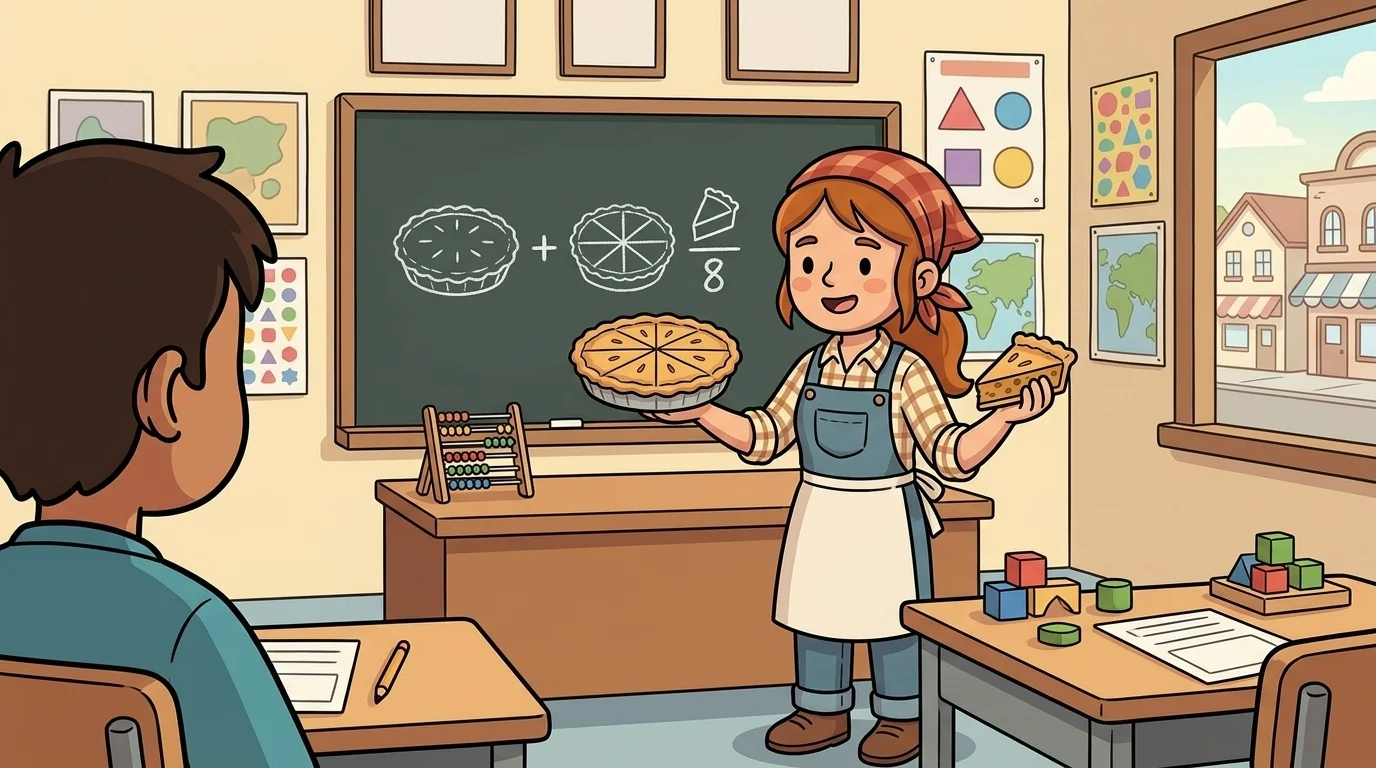
In her classroom, she begins every first-day lesson the same way. She brings, from the shop (now run by her cousin), one whole twelve-inch savory pie. (A new one every year. The cousin sends them gladly. The cousin says the academy children appreciate the slices more than the regular customers do.) She places the pie on her desk. She turns to the class. She says: "This is one pie. It has eight slices. Each slice is one-eighth of the whole pie."
The children — always — agree.
Then she says: "If I give you one slice, you have one-eighth. If I give you three slices, you have three-eighths. If I give you eight slices, you have a whole pie. If I give you nine slices, you have one whole pie plus one extra slice. That is a mixed number: 1 and 1/8. It is also an improper fraction: 9/8. Same nine slices. Different name."
She cuts the pie. The children eat the slices. The children understand mixed numbers and improper fractions before they have finished chewing.
When a child asks whether mixed numbers are hard, Pie always says the same thing:
"They are not hard. They are just more than a whole. When the numerator gets bigger than the denominator, you can count how many wholes you have plus how many extra slices. Same quantity. Different way of writing it."
She still has the slogan painted above her classroom door. "THE SLICE IS THE UNIT. THE PIE IS THE WHOLE." She points at it whenever a child looks confused.
After the last class of the day, when the slices are eaten and the children have gone home, Pie always stays behind for a few minutes. She washes the pie tin. She wipes the desk. She folds the box the cousin's pie came in.
The box has the same gold lettering as the shop window. Crustford and Co. Same slogan. Same slice ratio her great-great-grandfather decided on six generations ago. Pie looks at the empty tin and thinks, sometimes, about her four-year-old self counting slices on the shop counter while her mother served customers. That child did not know she was learning mathematics. She thought she was learning how the family did business. It turned out to be the same thing.
That is the part Pie wants her students to feel, more than anything she puts on the board. Math is not a separate thing. It is built into the way ordinary people, in ordinary towns, have always counted what they had. A pie is a whole. A slice is a part. Five generations of pie-makers can pass that down quietly, until somebody notices, and gives it a name, and writes it in books.
The naming is nice. The naming gives the kids vocabulary. But the feeling — that warm, ordinary recognition that I have always known this; I just didn't know that anyone else had a word for it — that is the lesson Pie hopes they carry. It feels, in her chest, like the moment of stepping off the boat after a long crossing and realizing the new shore is familiar. Oh, the feeling says. I have lived this. It is mine.
She turns off the lamp. She walks home. The shop, six streets away, is still open. The cousin will be there until eight. There will be one slice left, by then, set aside for Pie's dinner. There always is.
The FractionForge ensemble
Pie is part of FractionForge's distributed-narrative cast. Each character embodies a different curricular primitive; together they teach the full subject.
-

Halver
Partitioning — splitting a whole into equal parts (denominator construction)
-

Equi
Equivalent fractions — different forms, same value (×n/×n scaling)
-

Stretch
Common denominators — scaling to a common base for comparison + addition
-

Dot
The decimal point and fraction-decimal-percent equivalence
-

Liner
Number-line placement — every fraction has an exact spot between the whole numbers
-

Gather
Adding and subtracting fractions — you can only combine pieces that are the same size
-

Times
Multiplying fractions — a fraction OF a fraction, shown as the overlap of two strips
-

Tenth
Decimal place value — each column right of the point is ten times smaller
-
Rank
Comparing and ordering fractions using benchmarks and reasoning