
Gather
ADDING AND SUBTRACTING FRACTIONS — you can only add or take away pieces that are the same size. 1/5 + 2/5 = 3/5 because the pieces match. To combine fifths and quarters, you must first make the pieces the same.
Press play to listen along. The line being read lights up as you go.
Show full transcript
Loading transcript…
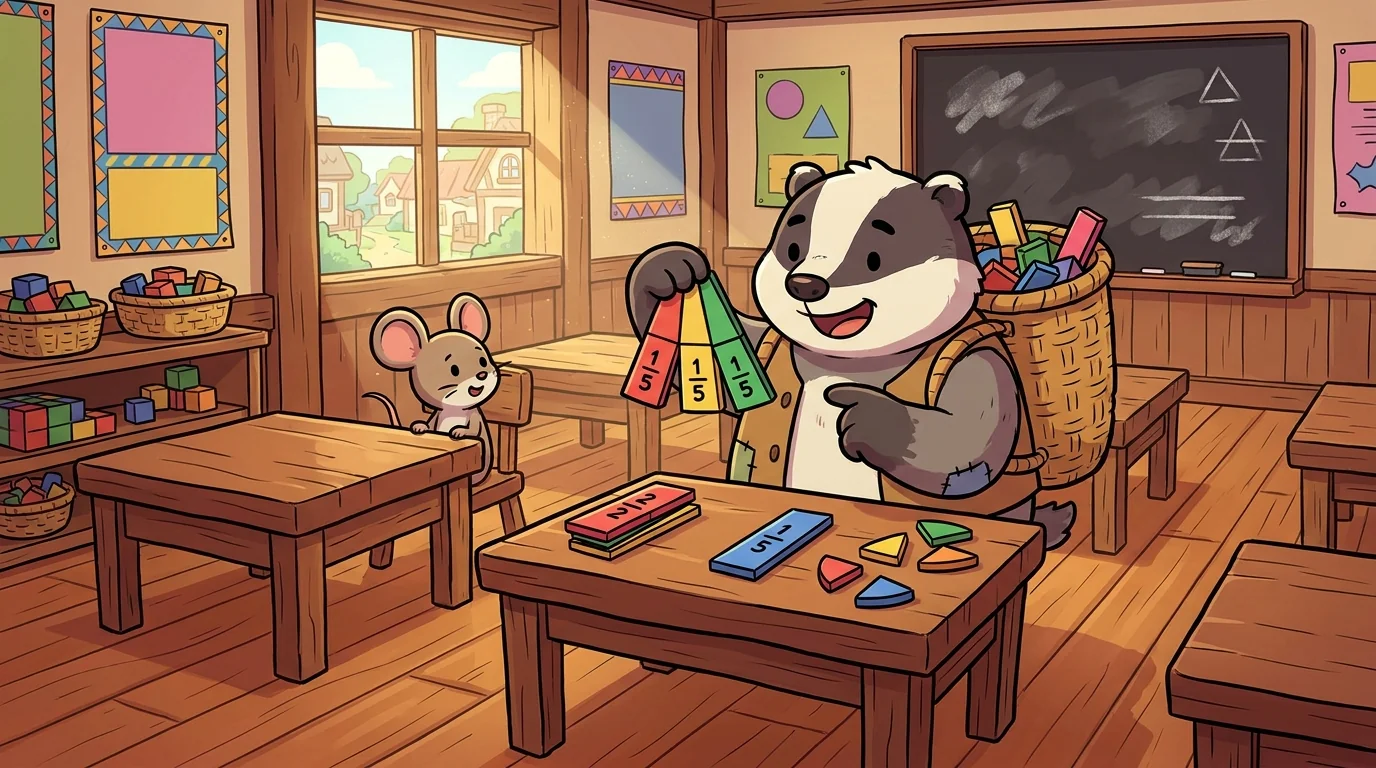
Gather collected things. It was the most natural thing in the world to him.
He was a round, busy badger with a big woven basket strapped to his back, and he spent his days at the FairShare Village academy gathering up fraction pieces and adding them together. Someone would hand him two-fifths of a ribbon and one-fifth of a ribbon, and he'd drop them in his basket, give it a little shake, and announce the total.
"Three-fifths," he'd say, holding up the combined ribbon. "Two pieces, then one more piece. All the same size. Three-fifths."
He made it look easy. Drop the pieces in, count them up, done.
A young mouse named Pip watched him work. "So adding fractions is just... counting?" she asked.
"When the pieces match," Gather said cheerfully, "it really is. The trouble only starts when they don't."
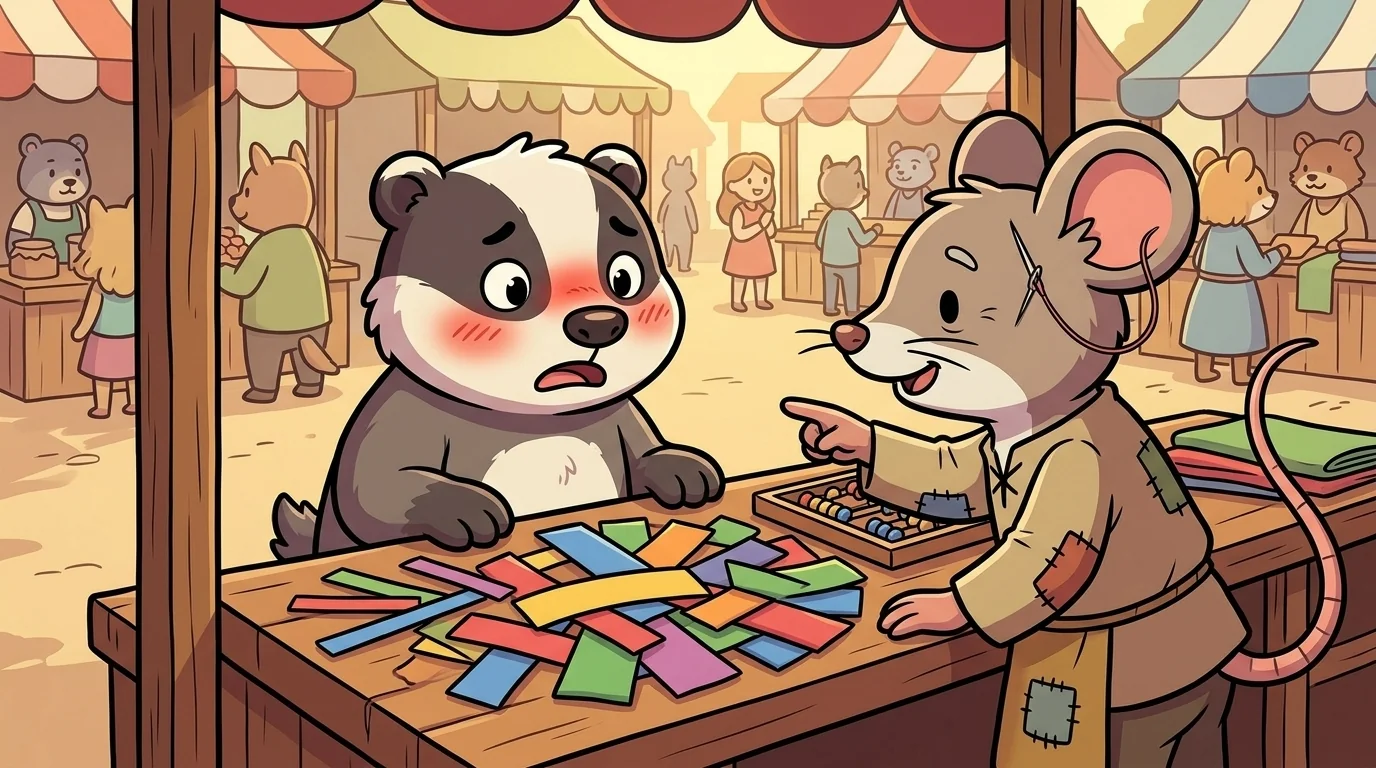
When Gather was a kid, he learned this the hard way.
He grew up helping at his family's button stall in the market. People brought scraps of cloth and his job was to add up how much they had. One afternoon a tailor dumped a pile on the counter: some pieces were cut into fifths, some into quarters, all jumbled together.
"How much cloth altogether?" the tailor asked.
Little Gather started counting pieces. One, two, three, four, five, six. "Six pieces!" he said proudly.
The tailor frowned. "Six pieces of what, though? These three are fifths. These three are quarters. They're not the same size. You can't just say six."
Gather looked at the pile. The fifths were skinny. The quarters were wider. He had counted them like they were all the same — but they weren't. Six pieces, sure. But six pieces of nothing in particular.
His ears went hot. He had been adding things up his whole life, and he'd been doing it wrong — or at least, half-right. You could count pieces. But only if the pieces were the same size.
"How do I fix it?" he asked.
The tailor smiled. "You make them match first. Then you count."
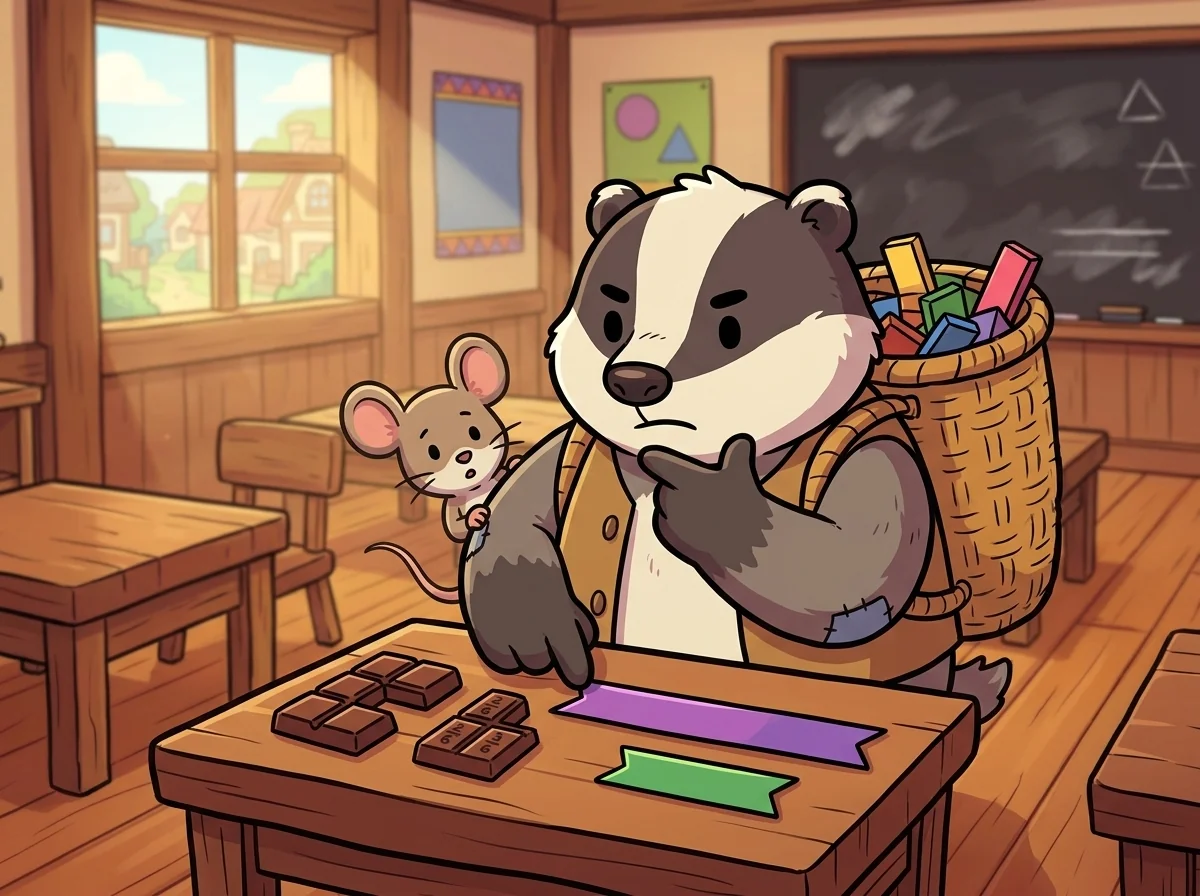
Gather came to the academy years later, basket on his back, determined to teach the one thing that had tripped him up.
Slice, the old tortoise who ran the place, set a test on the table: two-sixths of a chocolate bar and three-sixths of a chocolate bar. "Add them," he said.
Gather dropped both into his basket and gave it a shake. "Five-sixths," he said at once. "Both in sixths. Pieces match. Two plus three is five. Five-sixths."
Then Slice slid over a trickier pair: one-half of a bar, and one-third of a bar. "And these?"
Gather did not shake his basket. He stopped. He set the two pieces side by side and looked at them carefully. The half was big. The third was smaller. They didn't match.
"I can't add these yet," he said. "Not honestly. The pieces are different sizes. If I just say 'two pieces,' I'd be lying about how much there is." He looked up. "First I have to make them the same. I'd cut both into sixths. The half becomes three-sixths. The third becomes two-sixths. Now they match. Now I can gather them. Five-sixths."
Slice nodded slowly. "Most people shake the basket first and think later," he said. "You think first. You may stay."
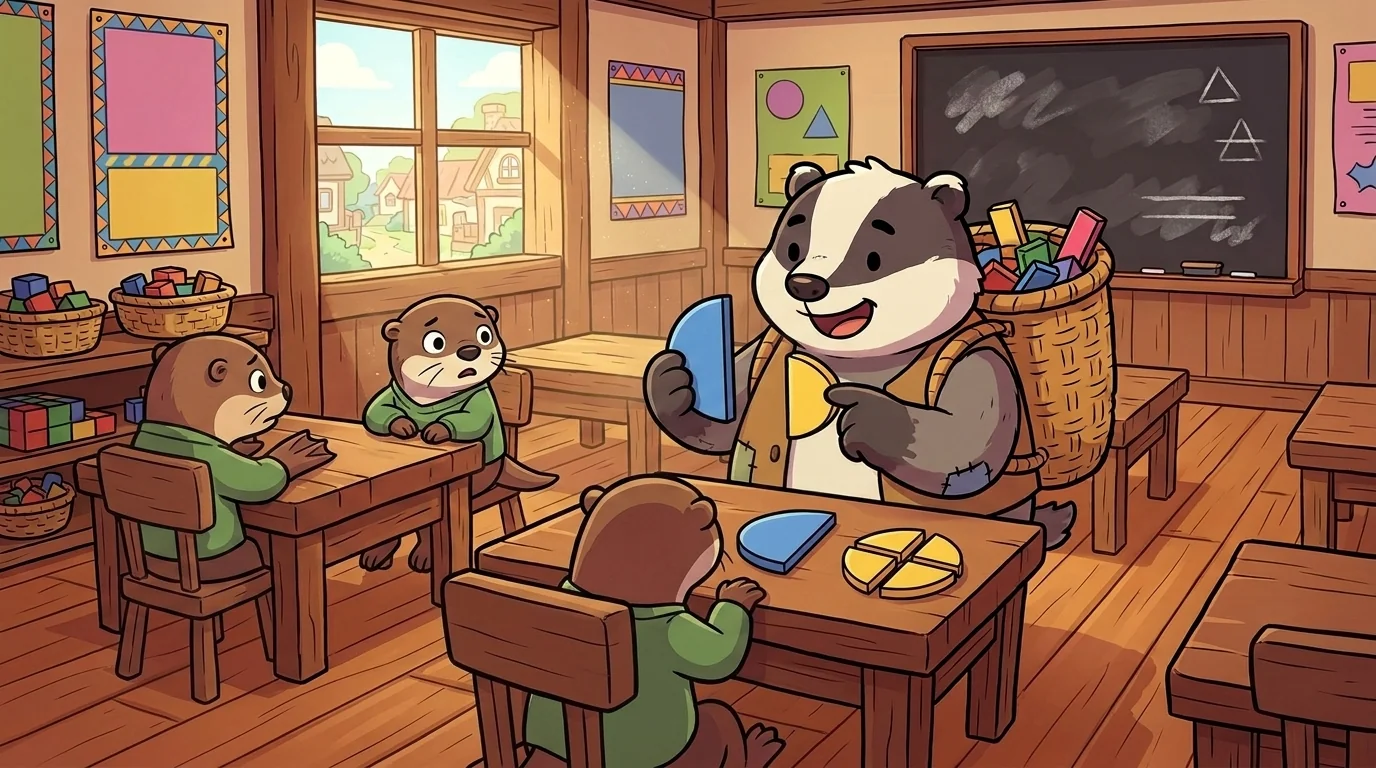
In his corner of the academy, surrounded by baskets, Gather met a frustrated otter named Wren.
"I hate adding fractions," Wren announced, dropping into a chair. "I did one-fourth plus one-half and I got two-sixths. My teacher said it's wrong. But I added the tops AND the bottoms, which is what you do with regular numbers!"
"Ah," Gather said kindly. "That's the trap. Let's gather them for real." He took out a fourth-piece and a half-piece and set them in the basket. "Look. These don't match. The half is bigger. If we just smush the numbers together, the basket doesn't know what size the pieces are."
He took the half-piece and showed Wren how it could be cut into two equal fourths. "Watch. One half is the same as two-fourths. Now both pieces are fourths. They match." He dropped them in. "One-fourth plus two-fourths. Three pieces, all fourths. Three-fourths."
Wren stared. "So the bottom number stays the same once they match?"
"The bottom number tells you the size of the pieces," Gather said. "Once the sizes match, you stop touching the bottom. You just gather the tops. Three-fourths."
Wren laughed, a little stunned. "I was adding the sizes together. That's like saying two baskets plus two baskets equals four... basket-baskets."
"Exactly," Gather grinned. "Keep the size. Gather the count."
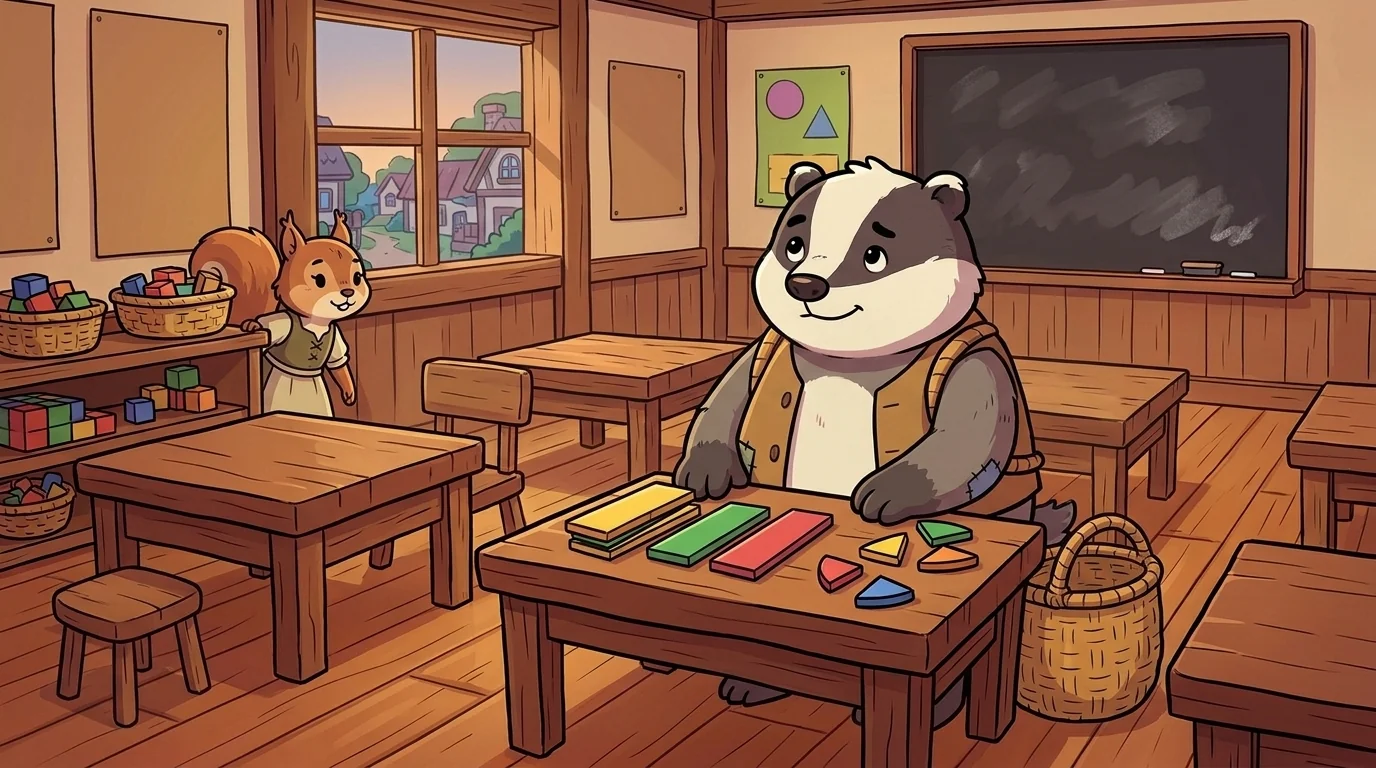
At the end of the day, when the academy emptied out, Gather sat with his basket and tidied his pieces, sorting them by size the way some people fold laundry.
He thought about that afternoon at the button stall, his ears hot, six pieces of nothing in particular sitting on the counter. He hadn't been bad at adding. He'd just been skipping the quiet first step — the step where you make sure the pieces match before you trust the total.
Wren poked her head back in on her way out. "Gather? What if I forget to check whether the pieces match?"
Gather patted his basket. "Then your basket will tell you," he said. "If the answer feels too big or too small — if a fourth plus a half somehow comes out smaller than a half — stop. Look at the pieces. They probably don't match yet. Make them match. Then gather."
Wren nodded, and headed out into the evening, already cutting halves into fourths in her head, just to feel them line up.
The FractionForge ensemble
Gather is part of FractionForge's distributed-narrative cast. Each character embodies a different curricular primitive; together they teach the full subject.
-

Halver
Partitioning — splitting a whole into equal parts (denominator construction)
-
Pie
Wholes and parts — mixed numbers, improper fractions, whole-as-pie anchor
-

Equi
Equivalent fractions — different forms, same value (×n/×n scaling)
-

Stretch
Common denominators — scaling to a common base for comparison + addition
-

Dot
The decimal point and fraction-decimal-percent equivalence
-
Liner
Number-line placement — every fraction has an exact spot between the whole numbers
-

Times
Multiplying fractions — a fraction OF a fraction, shown as the overlap of two strips
-
Tenth
Decimal place value — each column right of the point is ten times smaller
-
Rank
Comparing and ordering fractions using benchmarks and reasoning