
Equi and Stretch
EQUIVALENT SCALING — Equi (different forms, same value) + Stretch (scaling fractions to a common base) — together, the rule and the application of the same idea
A story read by Equi and Stretch
Press play to listen along. The line being read lights up as you go.
Show full transcript
Loading transcript…
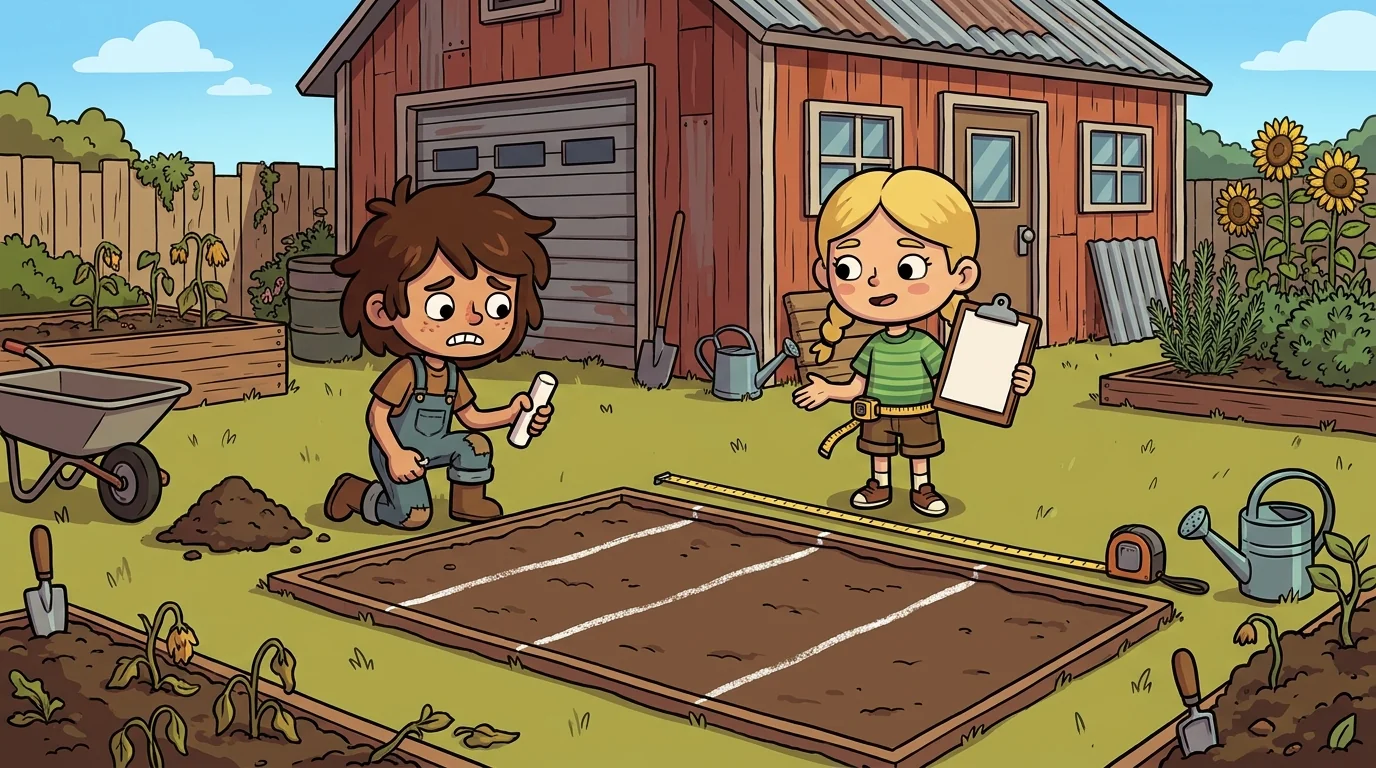
The school's garden plot was a long rectangle behind the workshop. It had been there for as long as anyone could remember. Most years, the kids just planted whatever they wanted in whatever spot, and most years, the carrots ended up in the rosemary patch and the rosemary ended up shaded out by the sunflowers. This year was different. This year, the gardening club had FOUR groups, and each group wanted EQUAL SPACE.
Equi had a stick of chalk and a worried look. Stretch had a tape measure and a calmer one.
"Four groups," Equi said. "One long rectangle. So we split it into four equal strips. Easy."
She drew four chalk lines across the dirt, dividing the plot into four equal vertical strips. Each group would get one strip. Strip A for the herbs group. Strip B for the salad-greens group. Strip C for the root-vegetables group. Strip D for the sunflowers group.
"Done," Equi said.
"Almost done," Stretch said.
Equi looked at her. "Did I miss something?"
"Look at the herbs group's list," Stretch said. She held up a clipboard. "They have THREE separate herb plots — basil, parsley, and mint. They can't share one strip; basil and mint hate each other. So they need THREE separate sub-strips inside their one strip."
Equi looked at the clipboard. "Oh."
"And the salad-greens group has SIX kinds of lettuce. Each kind needs its own row."
"Oh."
"And the root-vegetables group has TWO sub-plots — one for carrots, one for radishes."
"And the sunflowers?"
"One sub-plot. Just sunflowers."
Equi stared at the chalk lines. The herbs group needed thirds within their strip. The salad-greens group needed sixths within theirs. The root-vegetables group needed halves. The sunflowers group needed the whole strip. Four strips, four different ways of slicing. She had a feeling that this was going to require thinking.
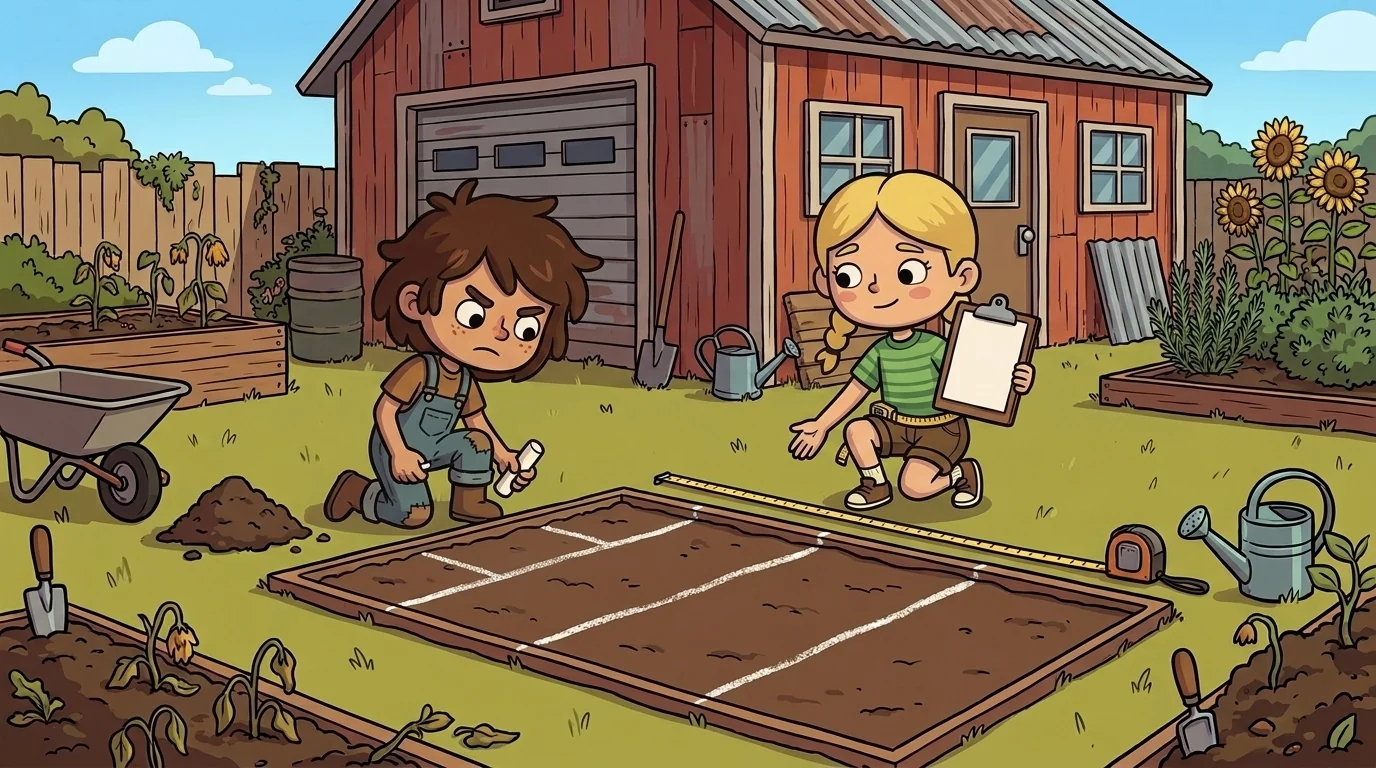
Stretch crouched down by the chalk lines. "Here's what I'd start with," she said. "Each group has the same outside boundary. One-quarter of the whole plot, right? Their strip. So when we look INSIDE each strip, every group is slicing their own quarter into sub-portions."
"Right."
"Herbs group's strip is one-quarter of the plot. They need to slice their quarter into three equal sub-portions. Each sub-portion is one-third of their quarter. Which means each sub-portion is one-twelfth of the whole plot, because thirds-of-quarters is twelfths."
Equi blinked. "Did you just multiply?"
"I just multiplied. One-third times one-quarter equals one-twelfth. Same idea as your equivalence rule, but applied to a slicing problem."
"That's not multiplication, that's scaling. You took the herbs group's quarter and you stretched it down into a finer scale. The quarter became three twelfths."
"Yes," Stretch said. "That's what I do. I stretch fractions to a common scale so we can compare them across groups."
Equi thought about this. "So if I want to know how much space basil gets relative to one whole row of lettuce..."
"You stretch them both to the same scale. The basil takes one-twelfth of the plot. One row of lettuce takes one-sixth of the salad-greens strip, which is one-twenty-fourth of the whole plot. So basil and one row of lettuce, both on the same scale: one-twelfth versus one-twenty-fourth."
"Which means basil is twice as big as one row of lettuce."
"Right."
Equi was quiet for a long second. Then she said: "I have been teaching kids that 2/3 equals 4/6 for two years and I have never thought about it as stretching before. I have always thought about it as naming the same number differently. Like a kid having a nickname."
"Both are right," Stretch said. "Same idea seen from two angles. You see the equivalence. I see the scaling. Together we get the answer."
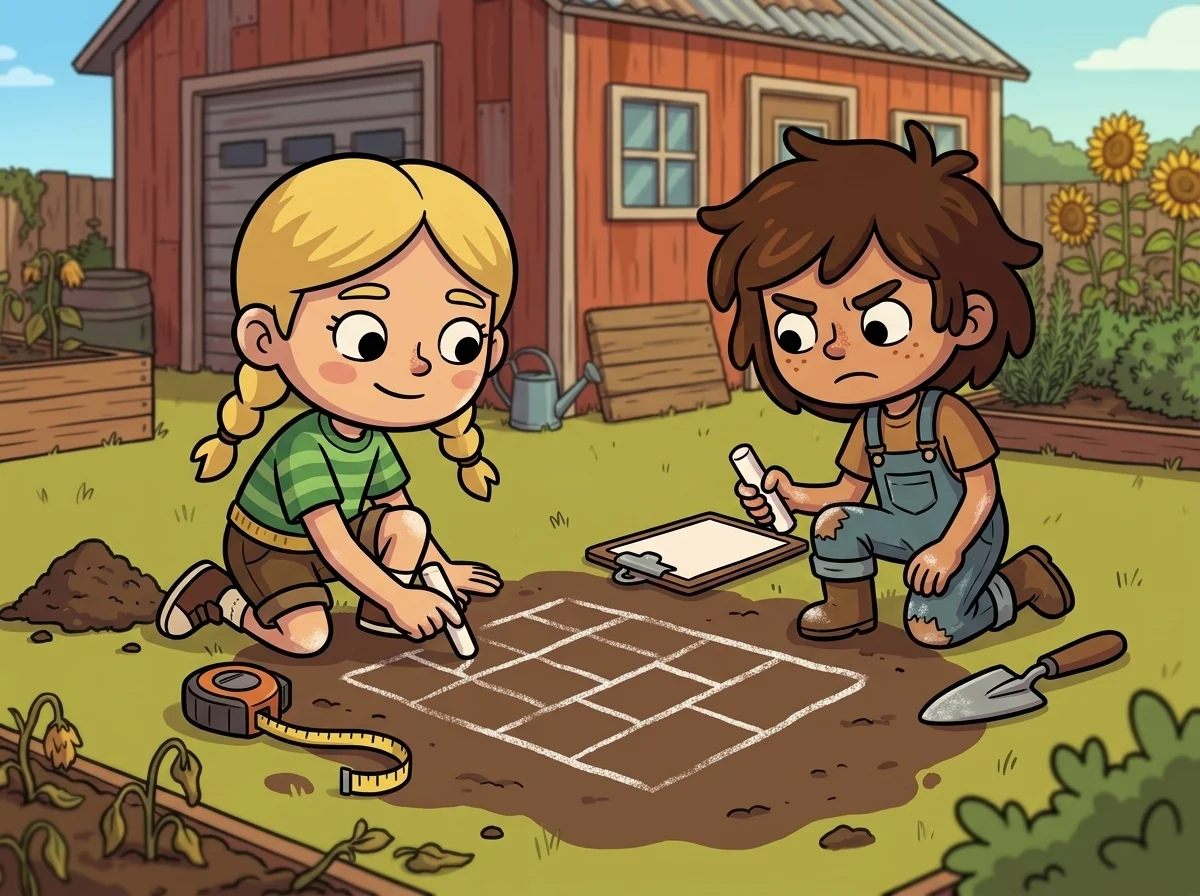
Equi picked up a fresh piece of chalk. "Okay," she said. "Let me try restating what you're saying so I'm sure I have it. We can't just give each group their strip and call it a day, because each group will slice their strip differently. So we need to scale every group's sub-portions to a COMMON scale, so we can see who has more space and who has less and whether everything still adds up."
"Right."
"And the common scale is — what? Twelfths? Twenty-fourths?"
Stretch took the chalk from Equi and drew a small grid in the dirt. "We need a common denominator. Something all four groups' sub-portions can be expressed in. Herbs needs thirds-of-the-strip. Salad-greens needs sixths-of-the-strip. Root-vegetables needs halves-of-the-strip. Sunflowers needs the whole strip — which is just one."
"Three, six, two, one," Equi said.
"What's the smallest number that all four of those divide into evenly?"
"Six."
"So if we slice each strip into sixths, then:"
She drew on the dirt:
Herbs group's three sub-portions take up TWO sixths each. Salad-greens group's six sub-portions take up ONE sixth each. Root-vegetables group's two sub-portions take up THREE sixths each. Sunflowers group's one sub-portion takes up SIX sixths (the whole strip).
"Now everyone is on the same scale," Stretch said. "Sixths-of-a-strip."
Equi looked at the diagram in the dirt. "And this is what you mean by common denominator."
"Yes."
"And this is also what I mean by equivalent fractions. Every group's portion has been renamed in sixths."
"Yes."
"They are the same idea."
"They are the same idea."
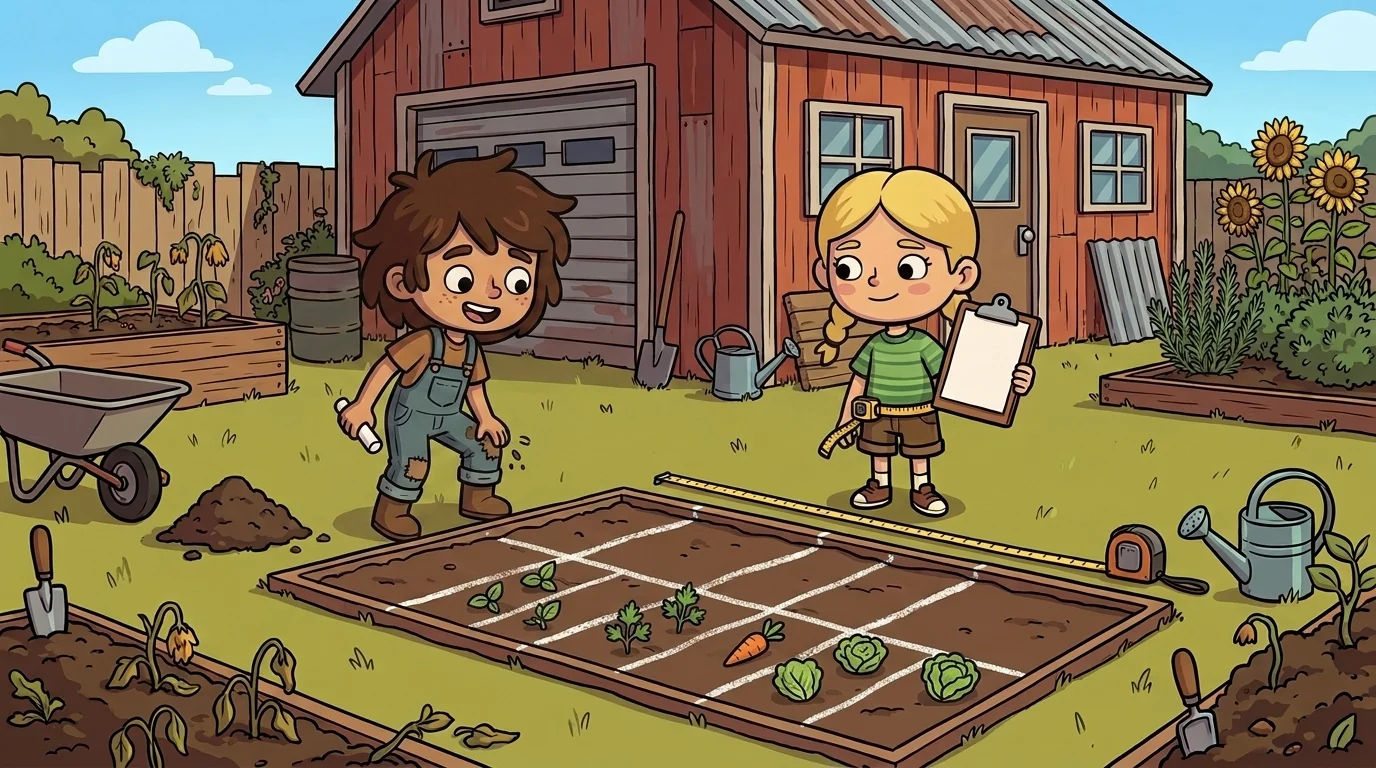
Equi stood up and brushed the dirt off her knees. "All right," she said. "Let me also restate one more thing, because I want to be sure. The thing we just did is: we took four groups with four different ways of slicing, and we scaled them ALL to a common base — sixths — so we could plan the whole garden as one shared scale. Each group still slices their own strip however they like. But on PAPER, on this diagram, everything is in sixths."
"Right."
"So when the herbs group says 'basil gets one of our three sub-portions,' we can translate that to 'basil gets TWO sixths of the herbs strip.' And when the salad-greens group says 'arugula gets one of our six sub-portions,' we translate that to 'arugula gets ONE sixth of the salad-greens strip.' And both of those measures are now comparable, even though basil and arugula are in different strips."
"You just defined the whole point of common denominators in one sentence," Stretch said.
"I just restated the whole point of common denominators," Equi said. "And the only reason I could restate it is because you showed me what scaling looks like in dirt."
She smiled.
"My equivalence rule and your scaling rule are the same trick, told two different ways."
"And applied to garden plots, they let us share space fairly."
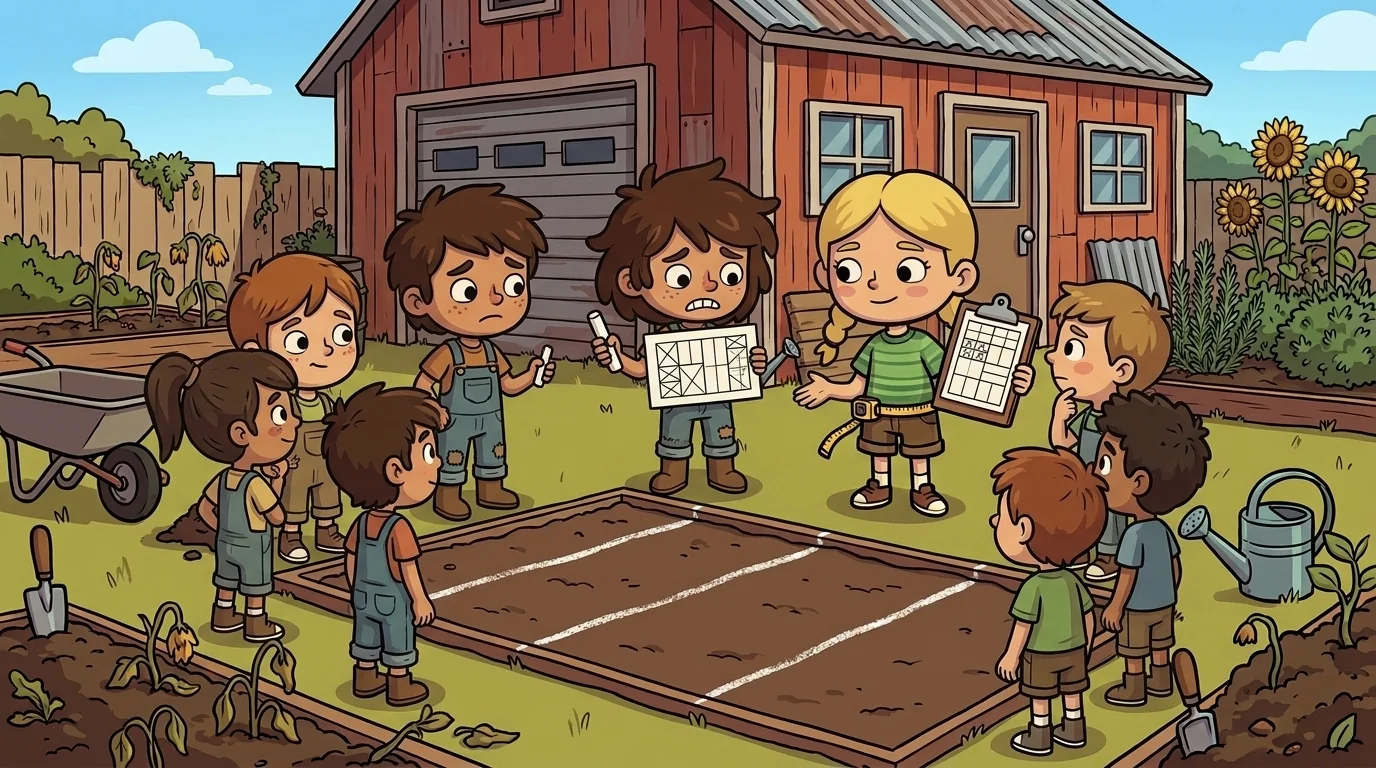
The garden club kids came out from the workshop and gathered around. Equi handed out copies of the diagram. Each group's strip was visible. Inside each strip, the sub-portions were drawn at the common scale. The herbs group could see their basil, parsley, and mint sub-portions. The salad-greens group could see their six lettuce rows. The root-vegetables group could see carrots and radishes. The sunflowers group could see the whole strip was theirs.
"How do we know it's fair?" one of the kids asked.
Equi pointed at the diagram. "Each group's outside boundary is exactly one-quarter of the plot. Same. And inside their strip, they get to slice however they need. We translated each group's slicing into the same scale — sixths-of-a-strip — so we could see them side by side."
Stretch nodded. "Which means when you're standing in the herbs strip and you see basil get two sixths of the strip, you know — without asking anyone — that two sixths of a quarter is exactly two-twenty-fourths of the whole garden. And that's a real, measurable, fair share."
The kid thought about this. "So even if basil and arugula are in different strips, I could tell you exactly how much bigger basil's plot is than arugula's plot."
"You could."
"Basil is twice as big."
"Right."
Equi smiled. Stretch smiled. The four chalk lines stretched across the dirt, holding a whole garden's worth of work.
"Equivalent forms," Equi said.
"Common scales," Stretch replied.
"The same trick."
"Told twice."
The FractionForge ensemble
Equi and Stretch is part of FractionForge's distributed-narrative cast. Each character embodies a different curricular primitive; together they teach the full subject.
-

Halver
Partitioning — splitting a whole into equal parts (denominator construction)
-

Pie
Wholes and parts — mixed numbers, improper fractions, whole-as-pie anchor
-

Equi
Equivalent fractions — different forms, same value (×n/×n scaling)
-

Stretch
Common denominators — scaling to a common base for comparison + addition
-

Dot
The decimal point and fraction-decimal-percent equivalence
-

Liner
Number-line placement — every fraction has an exact spot between the whole numbers
-

Gather
Adding and subtracting fractions — you can only combine pieces that are the same size
-

Times
Multiplying fractions — a fraction OF a fraction, shown as the overlap of two strips
-

Tenth
Decimal place value — each column right of the point is ten times smaller
-
Rank
Comparing and ordering fractions using benchmarks and reasoning