
Steady
SUSTAINED ATTENTION — keeping a gentle, steady flame on one task while shinier things flit past, especially in the dull middle after the first excitement wears off.
Press play to listen along. The line being read lights up as you go.
Show full transcript
Loading transcript…
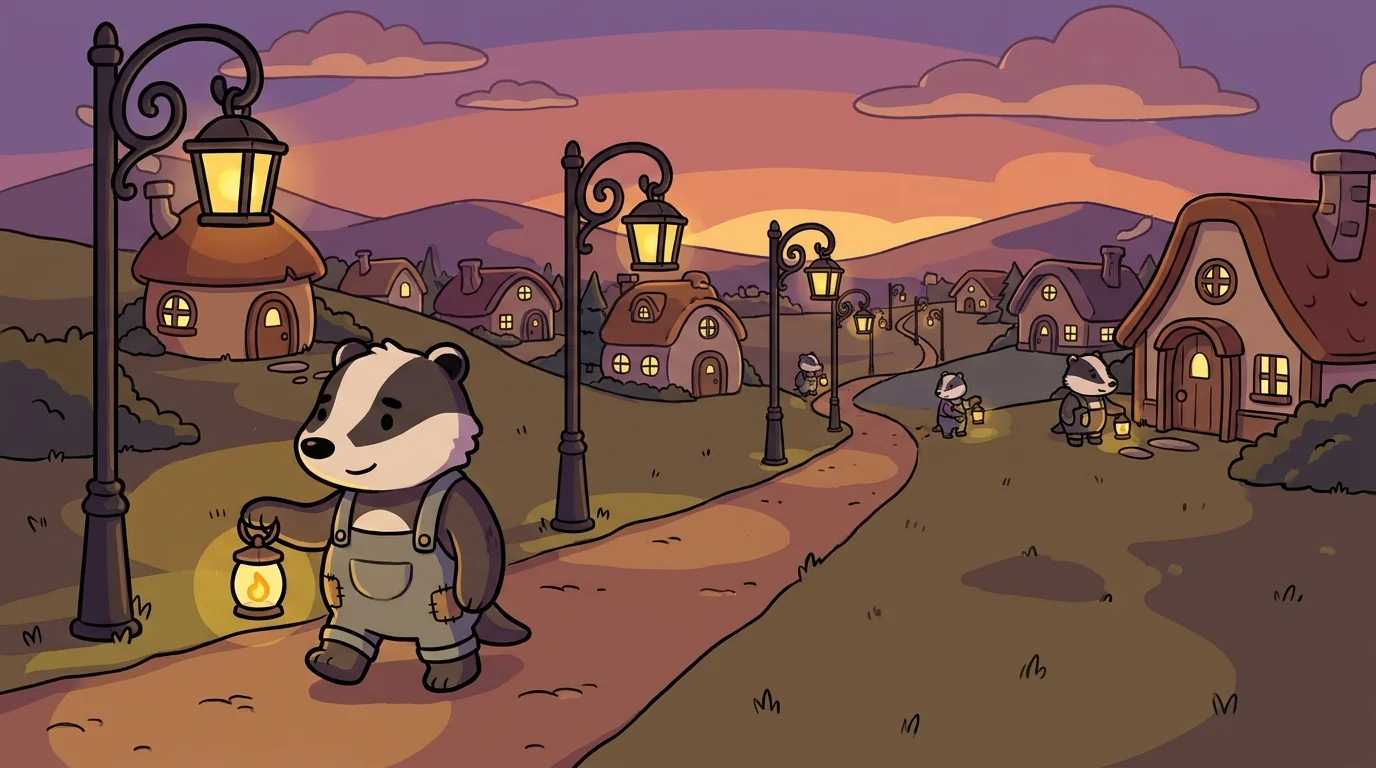
Steady was a slow-moving badger who carried a small lantern wherever he went, and his whole art was keeping its flame from going out.
Not a roaring fire. Just a small, steady flame. "A big flame is easy at the start," he'd say. "Anybody can blaze when a thing is brand-new and exciting. The skill isn't the blaze. The skill is keeping the little flame alive through the long middle — after the new wears off, when the wind of every shinier thing comes by trying to blow it out."
He'd grown up in a village of lamplighters. Their job was to walk the long road at dusk, lighting each lamp and keeping it lit through the night. The first few lamps were thrilling. But the road was long, and somewhere in the middle every young lamplighter learned the real lesson: the exciting part ends, and the work goes on anyway, and that's not a sign anything is wrong.
In the FocusForge academy, a young magpie named Pim had started a task in a blaze of excitement — and then, right in the dull middle, every shiny thing in the room had started calling. A glint here. A noise there. Pim's attention kept flitting off like a bird after sparkles.
"I keep getting pulled away," Pim fretted. "I start great and then I just — drift. Something's wrong with me."
Steady set down his lantern beside her. "Nothing's wrong with you," he said quietly. "You've just hit the long middle. Everybody's flame flickers here. Let me show you how to keep it lit."
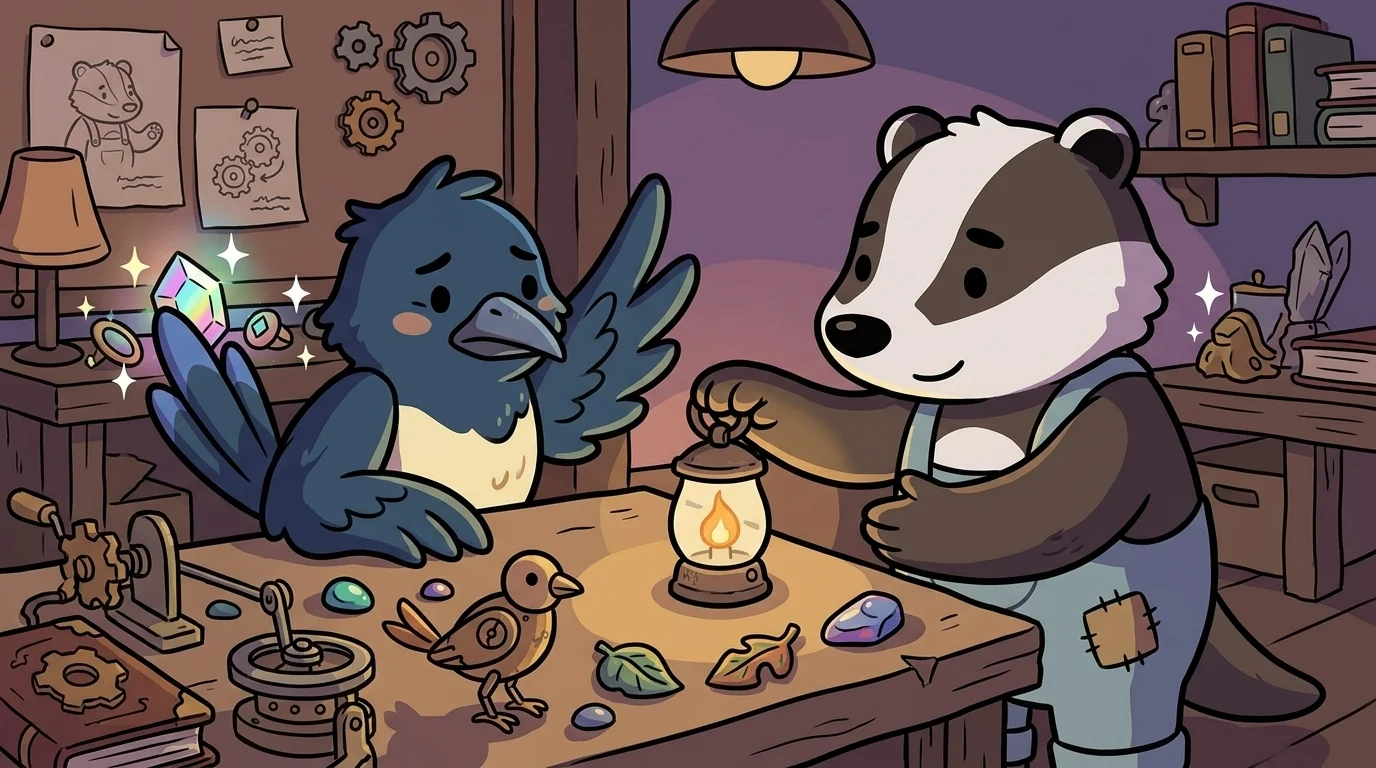
Pim shrank a little. "Other creatures don't drift like I do. They just stay. I can't."
"You'd be surprised," Steady said, with a gentle badger-shrug. "Lots of creatures drift. Some just got a little practice keeping the flame lit, so the drifting looks invisible from outside." He tended his lantern, cupping a paw against an imaginary breeze. "Here's the first thing, and it's the most important: when your attention flits off — and it will, a hundred times — that is not a failure. That's just wind. Wind happens. The skill isn't never drifting. Nobody never-drifts. The skill is coming back, gently, without yelling at yourself on the way."
Pim blinked. "I always thought drifting meant I'd already lost."
"That's the cruelest trick," Steady said. "Folks drift once, decide they've failed, get mad at themselves, and that — the getting-mad — is what actually blows the flame out. Not the drift. The shame after the drift." He nudged the lantern toward her. "If you just come back, calm, no scolding, the flame's still right there. It was never as gone as it felt."

Steady showed Pim the lamplighter's trick for the long middle. It wasn't a clamp to chain her attention down. It was softer than that.
"When you notice you've drifted," he murmured, "you just say, quiet and friendly, 'oh — there I went,' and you walk your attention back to the task. Like guiding a young bird back to a branch. Not grabbing it. Just offering the branch again." He tended the flame. "And you'll do it again a minute later. And again. That's not you failing five times. That's you succeeding five times at coming back. Each return is a rep. Each return makes the staying a little easier."
Pim tried it. Her attention flitted to a glint across the room — and instead of the old hot rush of I failed again, she said, softly, "oh, there I went," and walked it back. The flame steadied. A minute later it flitted again. Again she came back, calm. Again the flame held.
"I drifted like six times just now," Pim said, half-laughing.
"And came back six times," said Steady, beaming. "Six reps. Your flame's still lit. Look at it. That's not a creature who can't focus. That's a creature learning to keep the lantern."

They sat together through the whole long middle of the task — the dull stretch with no excitement to carry her — and Pim kept the small flame alive the lamplighter's way: drift, notice, come back, no scolding. Drift, notice, come back. The shiny things kept calling. She kept gently returning.
And slowly, something shifted. The returns got easier. The drifts got shorter. And when she finally reached the end of the task — not in a blaze, just on a small steady flame that had survived the whole long road — Pim felt something she had never once felt about her own attention before.
"I stayed," she said, almost in wonder. "Not perfectly. I drifted a million times. But I kept coming back, and I stayed, and I finished." She looked at the small warm flame in Steady's lantern. "I always thought finishing took a big roaring fire I didn't have. But it didn't. It just took a little flame I was willing to keep relighting."
"That's the whole secret of the long middle," Steady said warmly. "Not a bigger fire. A flame you're kind enough to keep coming back to."
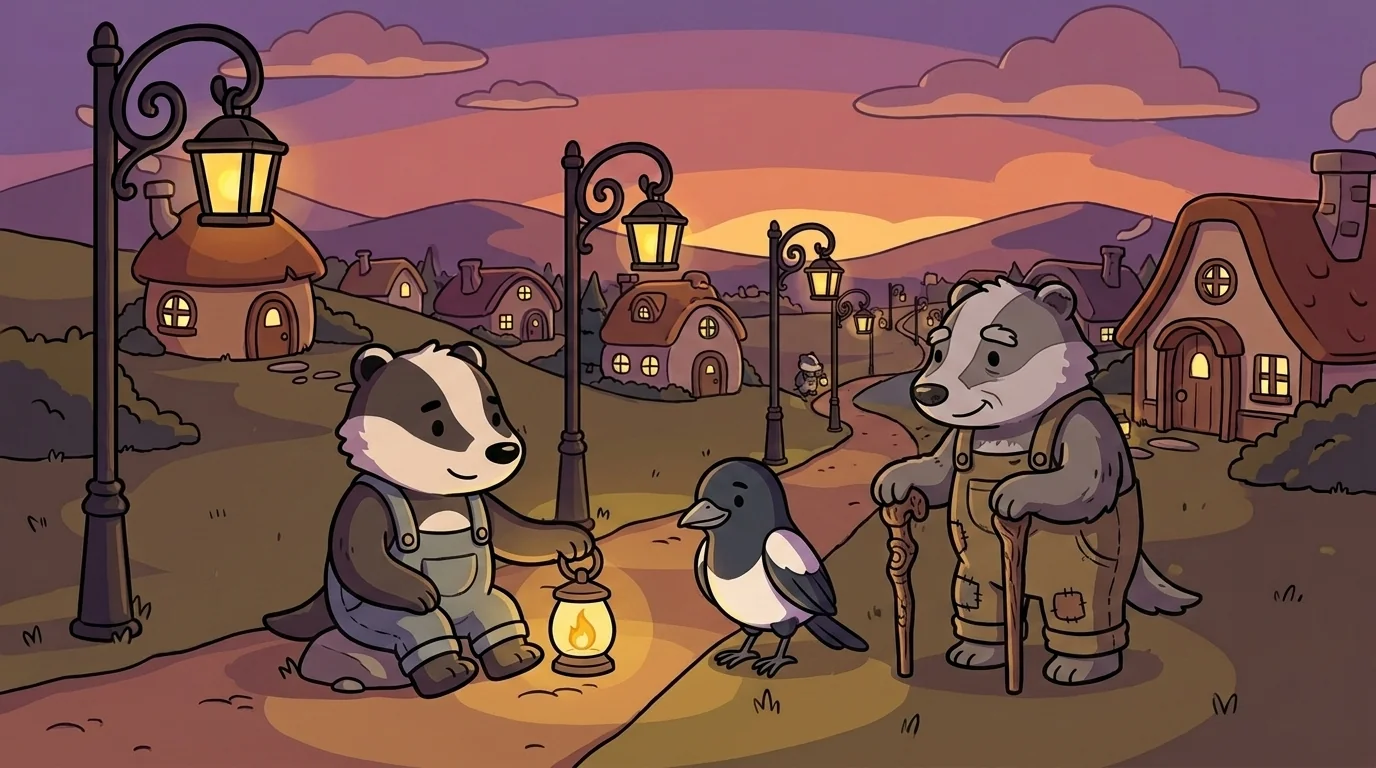
That evening Anchor found them by the finished work, the lantern still glowing.
"What is keeping the flame?" Anchor asked Steady.
Steady thought of the long dusk road and the lamps. "It's staying with a thing after the exciting part ends," he said. "Knowing your attention will drift, and coming back gently every time it does, without shame. The skill isn't never drifting. It's the coming-back."
Anchor turned to Pim. "And how does it feel," they asked, "to have stayed all the way through the long middle?"
Pim searched herself. She'd expected to feel tired, or relieved it was over. Instead she felt something steadier and warmer than that — a quiet, proud kind of glow, low in her chest, that hadn't come from finishing fast or burning bright.
"It feels like I'm not broken after all," Pim said softly. "I used to think drifting meant I'd never finish anything. Now I know I can drift a hundred times and still get there, as long as I keep coming back kindly. It feels like I found out I'm allowed to be the way I am — and still cross the finish line." She watched the small flame hold steady in the dark. "It feels like hope, honestly. Just a small, steady kind."
And Steady tended his lantern, glad in the slow, warm way he always was when a creature discovered that the long middle was survivable — not by burning brighter, but by being gentle enough to keep relighting a small, faithful flame.
The FocusForge ensemble
Steady is part of FocusForge's distributed-narrative cast. Each character embodies a different curricular primitive; together they teach the full subject.
-

Hold
Working memory — keeping a thing in mind while you use it; cast literally cups an orb that pulses gently
-

Wait
Inhibitory control — the pause between impulse and action; cast treats the pause as a skill, NEVER a moral test
-

Pivot
Cognitive flexibility — switching strategies / reframing; cast treats plan-change as INTERESTING not catastrophic
-

Map
Planning + organization — breaks ANY task into chunks; never says 'you should already know how'
-

Begin
Task initiation — the hardest part is the first second; cast is gentle never-pushy (rejected: Spark — brand collision; Lift-Off — verbosity)
-

Clock
Time awareness — time as a felt sense the learner can BUILD; never says 'you should know how long this takes'
-

Scan
Checks your own work as you go, catching a wrong turn while it is still small instead of at the very end.
-

Whittle
When everything feels urgent at once, carves the loud pile down to the one true next thing.
-

Chip
Stays with a hard task by taking one small piece at a time, instead of quitting or trying to force it all at once.