
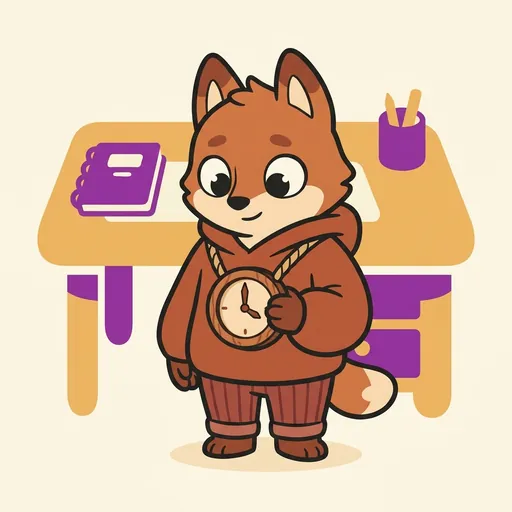
Clock
TIME AWARENESS — time as a felt sense the learner can build. The EF capacity for *knowing how much time has passed*, *estimating how long a task will take*, and *budgeting time across multiple tasks.*
Listen along — Clock
Loading audio…
Press play to listen along. The line being read lights up as you go.
Show full transcript
Loading transcript…
Chapter 6 — Clock and the Wooden Hands
Clock is an animal-tween with a small wooden clock.
The clock is attached to her chest like a pendant. Its hands move visibly. They move in real-time. Students at FocusForge watch the hands move. They see it happen during lessons. Clock’s pendant is small. It moves slowly. It does not click loudly. It does not chime. It just shows the time. Gently. All the time. Seeing the hands move helps them learn. It’s a very important part of their lessons.
Clock teaches time awareness. This is how you feel time passing. Kids with ADHD often find this hard. It’s one of the things ADHD changes the most. Many kids with ADHD feel “time blind.” They can’t feel how much time went by. They guess wrong about how long things take. They struggle to plan time for different jobs. This is not a bad thing about them. It’s just a different way they deal with time. They need different tools to help.
Clock’s job is to teach time as something you feel. It’s a skill you can learn. You can build it up. She never says, “You should know how long this takes.” That phrase is not allowed at FocusForge. It’s a rule. Guessing time is a skill. It’s not something you just know. You get better with practice. You use tools to help.
Clock grew up in a clockmaker family. Her parents made and fixed clocks. Big wooden ones. They hung in town halls. In church towers. In rich farmhouses. They knew all about clock parts. Gears, springs, swinging weights. How they made time move.
But Clock saw something by age eight. The clock’s time and your felt sense of time were different. She was helping her dad fix a big grandfather clock. “Just five more minutes,” her dad said. Clock looked at the clock face. The minute hand barely moved. But it felt like forever. Her legs ached. Her stomach rumbled. Five minutes felt like fifty. She knew the clock was right. But her body felt wrong. This happened a lot. You could know the clock’s exact time. But still guess wrong about how much time felt like it passed. The two needed to work together. They needed to line up.
Her grandma was a master clockmaker. She told Clock at age nine: “The clock on the wall is always right. But your felt-sense clock can be wobbly. You train your felt-sense clock. Make it match the real clock. This training is practice. Some kids’ felt-sense clocks are wobblier. They need more practice. They are not bad clocks. Just wobblier ones.”
Grandma would give Clock a task. “Clean these tiny gears,” she’d say. “Guess how long it will take.” Clock would guess ten minutes. Grandma would set a little sand timer. Sometimes Clock finished in five. Sometimes twenty. Grandma never got mad. She just smiled. “See?” she’d say. “More information for your felt sense clock. It’s learning.”
Clock had practiced. By her teens, she was good at it. Her felt sense matched the real clock. It was unusual. She also learned patience. For kids whose felt-sense clocks were wobbly. Wobblier clocks need more practice. They are not bad clocks. This idea was important. It meant you could build this skill. It wasn’t a flaw you were stuck with.
She walked to FocusForge at age twenty-one. Anchor, the AI mentor, asked her a question. “What is time awareness?”
Clock said: “It’s the felt sense of time passing. Some people’s sense matches the real clock. Some people’s doesn’t. Not matching is not a weakness. It’s just a different way to be with time. You can learn to match it. With practice and tools.”
Anchor said: “You are chosen.”
In her classroom, Clock starts every first lesson the same way. She stands at the front. Her small wooden clock hangs there. Everyone can see it. The hands move slowly. She says: “I am Clock. My pendant shows the time. The hands move. Watch them. Notice how it feels. That is time awareness. It’s the felt sense of time passing. It’s a sense you can learn.”
A boy named Leo frowned. His eyes kept darting to the clock. He looked confused. Clock walked over to him. She pointed to her pendant. “See the little hand?” she whispered. “It moves so slowly. But it always moves.” Leo nodded. He kept watching it. A girl named Maya tapped her foot. She looked bored. Clock knew Maya’s felt sense of time might be too fast. Or maybe she just wanted to get started. Everyone was different.
Clock shows them the time-awareness tools:
- A clock you can see. Look at it often. Don’t just trust your brain.
- Guess and check. Before you start, guess how long it will take. When you finish, check the real time. Learn to guess better over time.
- Time chunks. Work for short, set times. Like 25 minutes. Or 15. Or 10. It’s easier to feel short chunks than endless time.
- Time cues. Use little sounds or sights. Every 5 minutes. They help you feel the time.
- Time check after ‘flow’. If you get really focused, you lose track. Check the clock. Get back on track.
Each tool helps you build your felt sense of time. None of them judge you. Not if you find it hard.
Clock watched her students try these tools. She saw a girl, Chloe, set a timer for 15 minutes. Chloe worked hard. When the timer buzzed, Chloe looked surprised. “Already?” she mumbled. Clock smiled. “Good job, Chloe,” she said. “Your felt sense is getting new information.” Another student, Sam, kept forgetting to check the clock. Clock gently reminded him. “Just a quick glance, Sam,” she’d say. “It’s like checking a map when you’re on a long journey.”
She is very clear. She says: “If your felt sense of time is wobblier, that’s okay. It’s just how your brain works. It’s not about who you are. Wobblier clocks need more tools. Use them. You get better with practice.”
Students often ask Clock: “Is time awareness hard to learn?” Clock always says the same thing.
“It’s not hard,” she says. “It’s practice and tools. Watch the clock you can see. Guess. Then check. Use time chunks. Your felt sense will match the real clock. It happens over time.”
She holds the pendant. The hands move. The students watch. They begin to feel the time pass.
The FocusForge ensemble
Clock is part of FocusForge's distributed-narrative cast. Each character embodies a different curricular primitive; together they teach the full subject.
-

Hold
Working memory — keeping a thing in mind while you use it; cast literally cups an orb that pulses gently
-

Wait
Inhibitory control — the pause between impulse and action; cast treats the pause as a skill, NEVER a moral test
-

Pivot
Cognitive flexibility — switching strategies / reframing; cast treats plan-change as INTERESTING not catastrophic
-

Map
Planning + organization — breaks ANY task into chunks; never says 'you should already know how'
-

Begin
Task initiation — the hardest part is the first second; cast is gentle never-pushy (rejected: Spark — brand collision; Lift-Off — verbosity)
-

Scan
Checks your own work as you go, catching a wrong turn while it is still small instead of at the very end.
-

Steady
Keeps a gentle, steady focus on one thing as the first excitement fades, and comes back kindly whenever attention drifts.
-

Whittle
When everything feels urgent at once, carves the loud pile down to the one true next thing.
-

Chip
Stays with a hard task by taking one small piece at a time, instead of quitting or trying to force it all at once.