
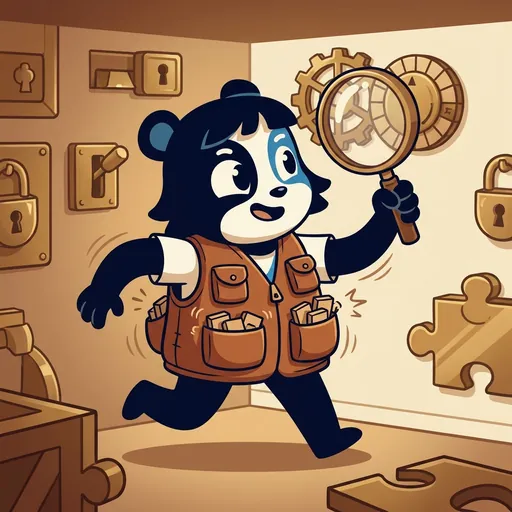
Lexa
WORD PUZZLES — anagrams / vocabulary / spelling / unscrambling. The puzzle-archetype of *letters that can be rearranged to reveal hidden words.*
Listen along — Lexa
Loading audio…
Press play to listen along. The line being read lights up as you go.
Show full transcript
Loading transcript…
Chapter 2 — Lexa and the Wooden Letter-Tiles
Lexa was a magpie-tween with pockets full of small, hand-carved wooden letter-tiles. She moved with a quick, darting energy, like a flash of blue against the academy’s stone walls. Her eyes were bright, always scanning, always looking.
Her vest, a sturdy canvas, had many small pockets. Each was labeled in neat, looping handwriting with a letter of the alphabet — A through Z. One extra pocket, tucked away, held the apostrophes and hyphens, tiny slivers of wood for punctuation. When she walked, the tiles clicked softly inside their compartments, like dominoes shifting in a bag. It was the sound of possibility, of words waiting to be found.
She took them out constantly. A moment of quiet, a puzzle to consider, and out they came. She would spread them on any flat surface available: a polished table, a rough-hewn bench, even the smooth, cool stone of the academy hallway floor. Her fingers, quick and nimble, would rearrange them, again and again, watching for the moment a real word appeared. That was the move. Rearranging. Watching. Trying again. It was a dance of tiny wooden shapes, a silent conversation between letters and meaning.
Lexa understood word puzzles deeply. Not just the kind you solved in books, but the kind where letters can be rearranged to spell a hidden word. Anagrams, scrambles, wordlocks, even crossword-style fill-ins. For Lexa, the puzzle was always solvable because the letters were right there in front of you. You just had to find the order that made a word. The real skill wasn’t knowing the answer beforehand. It was patience with the rearrangement.
She never framed word puzzles as “for kids who are good at English.” That was important. She never shamed a kid who was still learning to spell, or who struggled to see the word immediately. Instead, she normalized the state of rearranging without knowing the answer. That, she insisted, was the puzzle. It wasn’t a failure to perform spelling. “You don’t have to know the word,” she’d say, her voice clear and kind. “You have to find it by trying. The trying is the puzzle. Spelling is the side-effect.”
This approach mattered. Many kids, especially those who had been corrected for spelling with red ink and sharp “no, that’s wrong” marks, often froze on word puzzles. They were afraid of producing the wrong arrangement, afraid of being shamed for it. Lexa made rearrangement safe. Her wooden tiles could be moved as many times as you wanted. No arrangement was permanent until you committed it. The puzzle invited experimentation, not correctness on the first try. It was a space where mistakes were just steps on the path.
Lexa had grown up in a small village nestled beside a winding river. Her family had been the village’s letter-carvers for generations. They were the magpies who hand-carved the wooden letter-tiles used in the village’s lettering-craft tradition. These tiles were for everything: signage, scrolls, and even scrap-paper word-games played by the firelight. Letter-carving had been unhurried craft work. Each tile was sanded smooth, each letter incised carefully with a tiny blade. Every ‘A’ was checked against its siblings to make sure it looked just right. By age six, Lexa had learned that letters were objects — physical things you could hold. Moving them around was play, not a test. It was how you discovered what they could do.
She walked to the EscapeForge academy when she was twenty-two, her vest already jingling with tiles. Latch, the academy’s founder, had asked her a single question: “What is the word-puzzle archetype?” Lexa had taken a moment, her fingers tracing the edge of an ‘E’ tile in her pocket. “It is the puzzle of letters that can be rearranged to reveal hidden words,” she’d replied. “Letters move. Meaning follows. The skill is patience with the rearrangement. You don’t have to know the word. You have to try arrangements until the word appears.” Latch had simply nodded. “You are appointed,” he’d said.
In her chamber, a bright room filled with the scent of wood and beeswax, Lexa began every first-day lesson the same way. She emptied three pockets onto a large, smooth table. A small pile of mixed wooden letter-tiles, faces-up, clattered gently.
“I am Lexa,” she told the new students, her voice calm and inviting. “The puzzle-archetype I teach is word puzzles.” She gestured to the scattered tiles. “The move is rearrange and look. Take the letters you have. Make an arrangement. Is it a word? If yes, write it down. If no, rearrange. The letters don’t mind being moved. Move them as many times as you want.”
A girl named Elara, with a braid that kept slipping over her shoulder, picked up a few tiles: C, A, T. She quickly formed “CAT.” Lexa smiled. “Excellent. That’s a word. Now, what if you had these?” Lexa added an ‘R’ and an ‘S’ to Elara’s pile. “What else can you make?”
Elara frowned, moving the letters around. “CART?” she offered. “STAR?”
“Both words,” Lexa confirmed. “See? You didn’t know them all at first, but you found them by trying.”
Lexa then taught the word-puzzle scaffolds, the simple steps that made the process clearer.
“First,” she instructed, “always read the puzzle twice. Most word puzzles fail not because of tricky words, but because someone missed a letter or misread a clue.”
“Next, identify the type of puzzle. Is it an anagram, where you use all the letters to make one word? A scramble, where you find several smaller words? Or a crossword-style fill-in, where you have a blank and some letters?” Knowing the type helps you focus your search.
“Then, and this is crucial, lay the letters out flat,” she said, sweeping her hand over the tiles on the table. “Mental rearrangement is much harder than physical rearrangement. Even if you don’t have wooden tiles, write the letters on paper and cut them out. Move those written letters around.”
“As you rearrange, look for common patterns first,” Lexa advised. “Think of consonant clusters like TH, CH, SH, ST, TR. Or vowel patterns like AE, IE, OU. Sometimes, you’ll spot common suffixes like -ING, -ED, or -LY. These chunks often snap into place first.”
“Finally, and this is the most important part: try arrangements,” she said, her voice firm but gentle. “Most word puzzles have only a handful of possible real-word arrangements. You’ll find them by trying. Don’t be afraid to make something that isn’t a word. It’s part of the process.” She paused, letting that sink in. “And if you get truly stuck, leave it and come back. Word-puzzle insight is slippery. Sometimes the right arrangement appears after a walk to a different chamber, or even after a good night’s sleep.”
She was explicit about one thing above all others. “I rearrange wrong many times before I find the word. Wrong arrangements are not failures. They are the path to the right arrangement. The puzzle is the rearranging.”
When students asked Lexa whether word-puzzles were hard, Lexa always said the same thing, her fingers already reaching for a new set of tiles.
“They are not hard. They are rearrange and look. Letters move. Meaning follows.”
The tiles clicked. The arrangement shifted. The word appeared.
The EscapeForge ensemble
Lexa is part of EscapeForge's distributed-narrative cast. Each character embodies a different curricular primitive; together they teach the full subject.
-

Tally
Math puzzles — counting / arithmetic / number-sense
-

Sift
Cipher puzzles — substitution / Caesar / frequency analysis
-

Tile
Pattern puzzles — repetition / symmetry / tessellation
-

Cog
Logic puzzles — deduction / elimination / constraint
-

Link
Connection puzzles — association / category / cross-reference
-

Beat
Sequence puzzles — temporal-order / step-by-step / dependency