
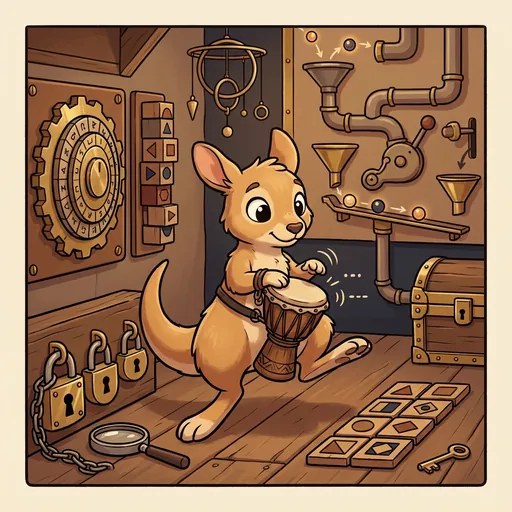
Beat
SEQUENCE PUZZLES — temporal-order / step-by-step / dependency / "what-comes-next." The puzzle-archetype of sequences that have a rhythm or rule, which the kid finds by listening for the heartbeat.
Listen along — Beat
Loading audio…
Press play to listen along. The line being read lights up as you go.
Show full transcript
Loading transcript…
Chapter 7 — Beat and the Small Handheld Drum
The door in front of Beat had nine glowing buttons and no instructions.
She was a kangaroo-rat-tween, small, sand-colored, quick on her feet, with a palm-sized wooden drum strapped to her wrist. The buttons had blinked at her twice already — a fast little run of lights, left to right, with a hitch in the middle — and then gone dark, waiting.
Most kids would have started jabbing buttons. Beat didn’t. She lifted two fingers to the taut hide of her drum and, so softly you could barely hear it, tapped along with what she remembered. Tap-tap-tap. Pause. Tap-tap-tap. Her ears twitched. There it was — the little gap, always in the same place.
“Three, then a rest, then three,” she murmured, and pressed the buttons in that order. The door sighed open. Beat grinned and blew across the top of her drum like it was a cup of something warm.
She hadn’t been born knowing this. She’d learned it at harvest, standing barefoot in the threshing yard when she was six.
Her family were the village pulse-keepers. It wasn’t glamorous work — nobody carved songs about the folks who kept time — but on threshing day, forty people swung their flails together, and if the beat wavered, someone caught a flail with their shin. So her grandmother stood on the low wall and tapped a drum. Thump-swish. Thump-swish. Steady as a sleeping chest.
“Put your hand here,” her grandmother had said, pressing tiny Beat’s palm flat against the drum-skin. Beat felt each thump travel up her arm and settle behind her ribs. She started tapping her own foot without deciding to. And she understood, in the way a small kid understands a big thing all at once: everything else in the whole loud yard was built on top of this one quiet, repeating thing. Find the repeat, and you could stand in the middle of any chaos and know exactly what came next.
She practiced on everything after that. The drip of the rain gutter. The click of her cousin’s knitting. She couldn’t stop.
She was twenty-two when she walked up the long road to the EscapeForge academy, drum still on her wrist.
Latch, who ran the place, met her at a table covered in little tin bells arranged in a crooked row. He didn’t ask her to explain herself. He just tipped one bell, then another, then two more, in a pattern — ding, ding-ding, ding, ding-ding — and looked at her.
Beat’s fingers were already moving on her drum before she’d thought about it. She listened to her own tapping, closed her eyes, and reached out and rang the next two bells: ding, ding-ding. Exactly on time.
Latch’s ears went up. “You didn’t count them out loud.”
“I did,” Beat said. “Just quietly. My hands count better than my mouth.” She patted the drum. “This holds the rhythm so my brain can hear it. Then the next bell’s just — there. Waiting.”
Latch was quiet a moment. Then he pushed the row of bells toward her and said, “The sequence room is yours.”
Her room glowed with slow-moving patterns of light. On her first day teaching, she never opened with a speech. She tapped — one-two-three, one-two-three — until the students’ heads bobbed a little, and only then put a screen up on the wall. On it: square, circle, square, circle, square, and a blinking question mark.
“Don’t guess yet,” she said. “Tap it out with me. Tap your leg if you don’t have a drum.” She touched the drum for each shape. Tap — square. Tap — circle. Tap — square. Around the room, kids patted their knees.
“Now — what stays the same, and what changes?”
A student named Pip’s hand shot up. “It’s changing! Square, circle, square, circle.”
“So the change is the rule,” Beat said, delighted. “The shapes take turns. Once you know the rule, the next one isn’t a mystery — it’s just next. So?”
“Circle!” Pip shouted.
The question mark bloomed into a circle. Pip made a small, surprised noise, like the answer had been hiding right behind the door the whole time.
Then Beat tapped out a trickier one — three fast, then a rest, then three fast — and let a girl in the back try a rule that turned out wrong. The girl’s shoulders dropped. Beat crossed the room and crouched beside her. “That’s not a miss,” she said gently. “That’s information. You just found one rule it isn’t. Fewer left to check now. Tap it again — where’s the rest?” The girl tapped, found the gap she’d skipped, and pressed the right button. The screen chimed. Her shoulders came back up.
Long after the students had gone, Pip lingered by the door.
“Beat? What if a sequence is too fast to feel?”
Beat sat down on the floor beside her and tapped, very slowly, one-two-three. “Then you slow it down until you can. You don’t have to be quick. You have to be patient enough to hear the same thing come around again.” She tipped her head. “Sequences have a heartbeat. If you can’t hear it yet, get quieter, not faster.”
Pip nodded slowly and tapped along, one-two-three, until she was smiling without knowing why.
When Pip finally scampered off, Beat stayed on the cool floor a moment longer, drum resting against her chest, feeling the small tap travel inward — that warm, settled glow of a rhythm you’d almost lost, found again and steady.
The EscapeForge ensemble
Beat is part of EscapeForge's distributed-narrative cast. Each character embodies a different curricular primitive; together they teach the full subject.
-

Tally
Math puzzles — counting / arithmetic / number-sense
-

Lexa
Word puzzles — anagrams / vocabulary / spelling
-

Sift
Cipher puzzles — substitution / Caesar / frequency analysis
-

Tile
Pattern puzzles — repetition / symmetry / tessellation
-

Cog
Logic puzzles — deduction / elimination / constraint
-

Link
Connection puzzles — association / category / cross-reference