
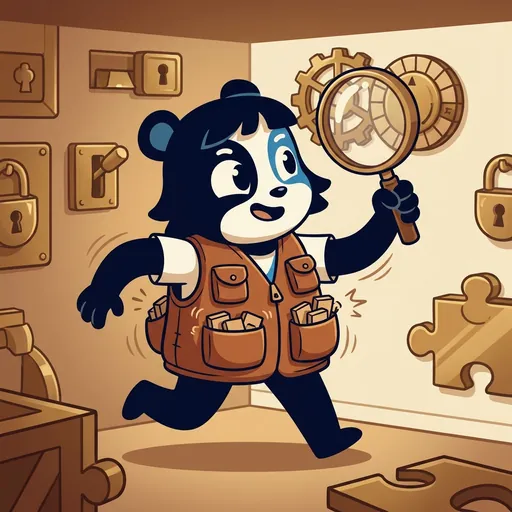
Lexa
WORD PUZZLES — anagrams / vocabulary / spelling / unscrambling. The puzzle-archetype of letters that can be rearranged to reveal hidden words.
Listen along — Lexa
Loading audio…
Press play to listen along. The line being read lights up as you go.
Show full transcript
Loading transcript…
Chapter 2 — Lexa and the Wooden Letter-Tiles
Lexa dumped a fistful of wooden tiles onto the stone floor and started shoving them around with one finger.
She was a magpie-tween — black and white with a flash of blue at the wing — quick-moving and bright-eyed, wearing a vest with a row of tidy little pockets, each one lettered A through Z in careful handwriting. The tiles clicked when she walked, soft as dominoes shifting in a bag. Right now she had seven of them face-up on the floor: G, R, D, N, E, A, and one more she’d almost lost under a bench.
The locked chest in front of her had a word-slot on its lid and no clue at all except these seven letters. Lexa didn’t sit and think. She reached down and slid the tiles: E-N-R-A-G-D-N. Not a word. She nudged them again. D-A-N-G-E-R. She tilted her head. Then she moved one tile, and the whole thing turned into GARDEN. She said “there you are” to the tiles, fitted them into the slot, and the chest popped open with a little wooden thunk.
She’d learned to trust her hands like that back home, where her family carved the letters other people took for granted.
They were the village letter-carvers — the magpies who cut the wooden tiles used for signs, scrolls, and the scrap-paper word games kids played by lamplight. Little Lexa had spent whole afternoons at her mother’s workbench, watching a blank block become an R, sanding the edges smooth, then checking it against the other Rs to make sure they matched.
“They’re not test answers,” her mother told her once, when Lexa was six and worried she’d carved a lopsided S. “They’re just things. Pick them up. Move them around.” And that was the thing that stuck: letters were objects, like beads or buttons. You could hold them. You could try them one way, decide you didn’t like it, and try them another. Nobody got upset at a tile for being in the wrong spot. You just moved it.
That mattered more than Lexa knew yet. Plenty of kids had been scolded over spelling — red ink, that awful no, wrong — until they froze the second letters showed up, terrified of arranging them wrong. Lexa had never once been afraid of a letter.
She was twenty-two when she walked up to the EscapeForge academy, pockets clicking.
Latch met her with a scramble already laid out on his table: a jumble of tiles that spelled nothing. He didn’t quiz her. He just gestured at them.
Lexa crouched, spread the tiles flat with both hands so she could see them all at once, and began sliding. She tried a cluster — S-T-R — kept it, tried the vowels after it, discarded one arrangement, tried another. Latch watched her mutter “nope” three times without the slightest worry in her voice. On the fourth try the tiles read STREAM. She looked up.
“You didn’t do it in your head,” Latch said.
“Nobody can, really,” Lexa said. “Not for long. The tiles hold the letters so I don’t have to. My head just has to notice when a word shows up.” She swept them back into a pile. “The wrong tries aren’t mistakes. They’re the road to the right one.”
Latch pushed the whole jumbled pile toward her. “The word room is yours.”
On her first day teaching, she started every lesson the same way: she emptied three pockets onto the table in front of the class — a small heap of mixed tiles, faces up — and let them clatter.
“Take the letters you’ve got,” she said. “Make any arrangement. Then ask one question: is it a word? If yes, write it down. If no —” she nudged two tiles apart — “you move them. As many times as you want. They don’t mind.”
She put a scramble on the board: A-C-E-P. A boy named Tomas frowned hard, staring, not touching anything.
“You’re doing it in your head,” Lexa said kindly. “Don’t. Write them on your paper and slide them with your pencil. Try the C-and-E together — lots of words hide a CE or an AC.” Tomas wrote them out, shuffled, and got PACE, then his eyes widened and he flipped it to CAPE. “Two words!” he said.
“See? The letters didn’t change. You just found the orders they were already hiding.” She grinned. “Read the puzzle twice, though — word puzzles trip you up more from a letter you skipped than from bad guessing.”
A girl in front had unscrambled nothing yet and looked ready to give up. Lexa knelt by her desk. “How many tries have you done?”
“Like six wrong ones,” the girl whispered.
“Perfect,” Lexa said. “Six down. Word scrambles only have a handful of real answers in them. You’re closer, not further.” She tapped the girl’s paper. “Try a suffix — stick I-N-G on the end and see what’s left.” The girl did, found a stem, and suddenly had FIRING. She laughed out loud, surprised at herself.
After class, Tomas hung back, turning a single tile over and over.
“Lexa? What if I move them forever and no word ever comes?”
Lexa sat on the edge of the table. “Then you leave it, go get a drink of water, and come back. Sometimes the word won’t show up while you’re staring at it — but it’s waiting there the whole time. The letters are all right in front of you. That means the answer is too. You just haven’t landed on the order yet.”
Tomas set the tile down. “So it’s not about knowing the word.”
“It’s about trying arrangements until the word finds you,” she said. “Knowing how to spell it is just what’s left over afterward.”
He nodded and scampered off. Lexa scooped the tiles back into her pockets one by one, and felt that light, glad little lift she always got — the feeling of trying, and trying again, quietly turning into finding.
The EscapeForge ensemble
Lexa is part of EscapeForge's distributed-narrative cast. Each character embodies a different curricular primitive; together they teach the full subject.
-

Tally
Math puzzles — counting / arithmetic / number-sense
-

Sift
Cipher puzzles — substitution / Caesar / frequency analysis
-

Tile
Pattern puzzles — repetition / symmetry / tessellation
-

Cog
Logic puzzles — deduction / elimination / constraint
-

Link
Connection puzzles — association / category / cross-reference
-

Beat
Sequence puzzles — temporal-order / step-by-step / dependency