
Link
CONNECTION PUZZLES — association / category / cross-reference / "which-things-go-together." The puzzle-archetype of two things that look unrelated until you find the thread that links them.
Listen along — Link
Loading audio…
Press play to listen along. The line being read lights up as you go.
Show full transcript
Loading transcript…
Chapter 6 — Link and the Long Thread of Beads
The puzzle table held three objects and one instruction: which two belong together?
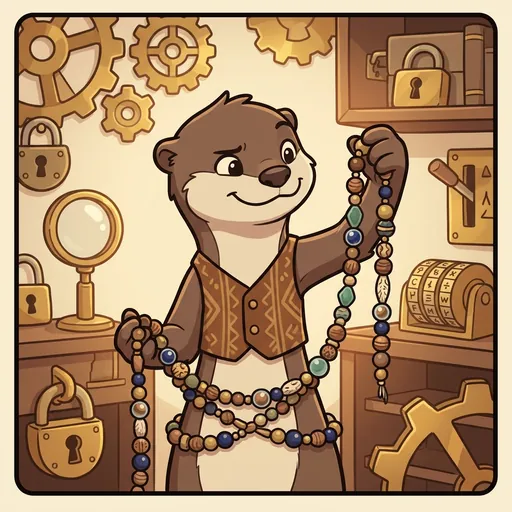
Link leaned over them — an otter-tween, sleek and brown-and-cream, with a long thread of beads looped twice around her waist and strung across her vest. On the table sat a chip of sea-glass, a curl of pale driftwood, and a small blue clay fish. She tapped the sea-glass thoughtfully with one claw.
She didn’t blurt an answer. Instead she started listing, half under her breath, the way she always did. “Sea-glass: blue-green, hard, cold, comes from the shore. Driftwood: pale, light, floats, comes from the shore.” She paused. “Both from the shore.” Then she checked the fish: blue, made of clay, made by hands at the market. “Blue… the fish is blue, the sea-glass is blue-green.” She weighed the two matches, picked the more specific one, and slid the sea-glass and driftwood together. The lock clicked. Link’s whiskers lifted in a small pleased smile.
She’d learned to look like that at her family’s bead bench, when she was six and impatient.
Her family were the village bead-makers — otters who drilled and painted and polished the beads for necklaces, festival garlands, and trading pouches. Little Link had wanted to string beads fast, grabbing whatever was nearest. Her father had stopped her hand. “Hold two,” he said, dropping a wooden bead and a stone bead into her palm. “Tell me everything about each one.”
So she had: color, shape, size, what it was made of, how heavy it felt, where it came from. And somewhere in that long boring list she noticed the two beads were exactly the same shade of brown. “They match!” she said, surprised. Her father nodded. “Any two beads share something, if you’re patient enough to find it. The trick isn’t seeing it in a flash. The trick is listing until the match shows up.” Link never forgot that the flash of oh! came at the end of the list, not the start.
She grew up believing the finding was slow, careful work — never a special talent some kids had and others didn’t.
She was twenty-two when she walked up to the EscapeForge academy, beads clicking softly at her waist.
Latch set three things in front of her: a copper coin, a dry autumn leaf, a wooden spoon. “Which two?” he asked.
Link crouched and started listing out loud without being asked. Coin — round, metal, cold, made in the mint. Leaf — thin, brown, from a tree, fell in autumn. Spoon — wooden, from a tree, made by a carver. She checked them against each other, one property at a time. “The leaf and the spoon,” she said. “Both from a tree.” Then, honest: “The coin and the leaf are both brown, so that almost fooled me — but ‘from a tree’ is a stronger, tighter link.”
Latch’s ears twitched with interest. “You said the wrong-looking one out loud.”
“Because it’s part of the work,” Link said. “I try connections that turn out wrong. That’s not a waste — it’s how I know the right one is right.” She stood. “It’s just careful comparing. Anyone can list.”
Latch pushed the three objects toward her. “The connection room is yours.”
On her first teaching day, she unspooled a short piece of thread, laid three beads on the table — a wooden one, a sea-glass one, a little carved fish — and let the class settle.
“These three share something,” she said. “Don’t guess. List. Everybody call out one thing about the wooden bead.”
“Round!” “Brown!” “Hard!” “From a tree!”
“Good. Now the sea-glass. Now the fish.” She wrote the properties in three columns on the board. Then she ran her claw across the rows. “Look for a word that shows up in all three columns.”
A quiet kid named Wren squinted. “They’re all… small enough to hold?”
“They are,” Link said, “but is that the smallest, tightest thing they share, or just a big loose one? Lots of stuff is small.” Wren looked again. “They’re all — made by hand? At the market?” Link’s whole face brightened. “That’s the one. The smallest category that fits all three. Not ‘things.’ Not ‘small things.’ The specific thread.”
Then she turned to an odd-one-out puzzle — four items, three that fit a category and one that didn’t. A boy blurted a guess and got it wrong. His shoulders sank. Link crouched by him. “Don’t hunt for the odd one first,” she said gently. “Find the group of three that go together. Whatever’s left over is your answer — you barely have to think about it.” He tried it her way, found the trio, and the leftover just fell out. He blinked, surprised it had been that calm.
After class, Wren stayed, turning a bead over.
“Link? What if I list forever and nothing matches?”
Link sat down beside her and laid two very different beads on the table. “Then list more properties. Not just color and shape — smell, weight, sound, how many syllables the name has, what season it makes you think of. The match is in there. Somebody built this puzzle on purpose, and they put a thread through it. It always exists.” She smiled. “You don’t have to be clever and quick. You have to be patient and thorough. Those feel different, but they get you to the same door.”
Wren nodded slowly, laid the two beads side by side, and started listing.
When Wren had gone, Link stayed at the table, running the thread of beads through her fingers — each one connected to the one before and the one after — feeling that quiet, certain calm she loved best: not the jolt of a lucky guess, but the settled warmth of having looked carefully and known.
The EscapeForge ensemble
Link is part of EscapeForge's distributed-narrative cast. Each character embodies a different curricular primitive; together they teach the full subject.
-

Tally
Math puzzles — counting / arithmetic / number-sense
-
Lexa
Word puzzles — anagrams / vocabulary / spelling
-

Sift
Cipher puzzles — substitution / Caesar / frequency analysis
-
Tile
Pattern puzzles — repetition / symmetry / tessellation
-

Cog
Logic puzzles — deduction / elimination / constraint
-

Beat
Sequence puzzles — temporal-order / step-by-step / dependency