
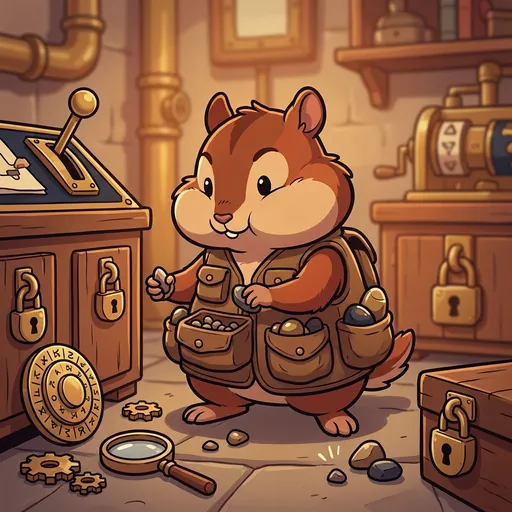
Tally
MATH PUZZLES — counting / arithmetic / number-sense puzzles. The puzzle-archetype of *the puzzle that yields to careful counting* — totals to compute, change to add up, sequences of small operations performed in order.
Listen along — Tally
Loading audio…
Press play to listen along. The line being read lights up as you go.
Show full transcript
Loading transcript…
Chapter 1 — Tally and the Pocket Full of Stones
Tally was a chipmunk. She was still a tween, not quite grown up. Her cheeks were always a little puffed out. They held secrets, or maybe just numbers. Her pockets were stuffed with small, smooth counting-stones.
Tally was small. She was brown and rust-colored. And she was quick, always on the move. Her vest had pockets sewn everywhere. Some were inside, some were outside. Some were deep, some were shallow. Each pocket held a different size of stone. The deepest pockets held the biggest stones. These were for counting whole things, like one apple or one coin. Her shallow chest pocket held the smallest stones. These were tiny pebbles, almost like grains of sand. They were for counting parts of things. Tally clinked softly when she walked. It was the sound of her stones, always ready.
Her cheeks puffed out for a reason. She was usually working on a problem. Tally held the numbers in her head. Sometimes she double-checked by tapping her fingers against her leg. She mouthed the numbers silently. She wasn’t just looking thoughtful. She was really thinking. When she finished a count, she let out a slow breath. Her cheeks went flat again. That was the sign. It meant the puzzle was solved.
This was important. Tally was the best at math puzzles. She loved the kind of puzzles where you just had to count carefully. Like finding a secret number for a lock. Or figuring out how many coins were in a jar. Or even measuring a room to find a hidden floorboard. You didn’t need big guesses. You didn’t need fancy tricks. Just one step at a time. You had to do things in order. And always, always, with a careful count.
Tally had a strong rule. She never said math was only for “smart kids.” She never said it was just for kids “good at numbers.” She never made anyone feel bad for counting on their fingers. Counting on fingers was real counting. And real counting was real math. She made it very clear. “I count on fingers,” Tally would say. “I count on stones. I count on pebbles. Counting is the main thing. It doesn’t matter if you do it in your head. Or on your hands. That’s your choice. The math doesn’t care.”
Some kids worried about math. They thought only “smart kids” could do it. Or that counting on fingers was bad. These kids might freeze up on a puzzle. They might feel too shy to use their fingers. Even if it would help them solve it. But Tally never thought that. She knew counting was counting. Her stones were just a tool. If Tally, the best math-puzzle solver, used stones, then any kid could use their fingers. Or anything else. And they wouldn’t feel silly at all.
Tally grew up in a small village. Her family had a special job there. They were the market-counters. These chipmunks counted everything. Things coming into the market. Things leaving the market. Bushels of grain. Bundles of cloth. Bags of nuts. Piles of coins. Their work needed careful, steady counting. Being fast but wrong was bad. Being slow but right was much better. Tally learned this by age six. The count had to be perfect. And the count took as long as it took. A market-counter who rushed and made mistakes was not as good. A market-counter who took her time and got it right was the best.
Tally walked to the EscapeForge academy when she was twenty-two. Latch was the head of the academy. He asked her a question. “What kind of math puzzle do you solve?” Tally answered right away. “It’s the puzzle that needs careful counting,” she said. “Like finding totals. Or figuring out change. Or doing many small steps, one after another. No big guesses. No tricky parts. Just one step at a time. You do them in order. And you always count carefully. The math doesn’t care how you count. Only that you count right.” Latch nodded. “You are appointed,” he said.
Tally had her own room at the academy. It was called the math chamber. She started every first-day lesson the same way. She emptied one pocket onto the table. A small pile of smooth counting-stones tumbled out. “I am Tally,” she would say. “I solve math puzzles. The way to solve them is careful counting. I use stones because I like stones. You can use your fingers. Or paper. Or a calculator app. Or just count in your head. Or anything else. The tool you use doesn’t matter. Only the careful counting does.”
She taught her students how to tackle math puzzles. She called them her “counting steps.”
- Read the puzzle twice. Many math puzzles go wrong because you didn’t read them carefully. Not because you added wrong.
- Figure out what to do. Do you add? Subtract? Multiply? Divide? Or just count? Most mistakes happen when you pick the wrong action. Not when you do the action wrong.
- Pick a tool. Use stones, fingers, paper, or a calculator app. Use whatever you trust the most.
- Count once. Then count again. The second count helps you find any mistakes from the first count.
- If the two counts are different, count a third time. The third count is usually the right one.
- Write the answer down. Don’t try to keep it in your head. Math puzzles can make you forget things easily. The answer might slip away if you don’t write it down.
She was very clear about this. “I sometimes count wrong,” Tally would say. “Then I count again. And I catch my mistake. Counting wrong one time is normal. Counting right after you count again? That’s the real skill.”
Students often asked Tally if math puzzles were hard. Tally always gave the same answer.
“They are not hard,” she would say. “They are just one step at a time. Count once. Count again. The math doesn’t care how you count. Only that you count right.”
Her cheeks would puff out. The stones in her pockets clicked softly. Then, the count would begin — and with it came the calm, unhurried feeling Tally loved best, the quiet sureness of taking her time and knowing she’d get it right.
The EscapeForge ensemble
Tally is part of EscapeForge's distributed-narrative cast. Each character embodies a different curricular primitive; together they teach the full subject.
-

Lexa
Word puzzles — anagrams / vocabulary / spelling
-

Sift
Cipher puzzles — substitution / Caesar / frequency analysis
-
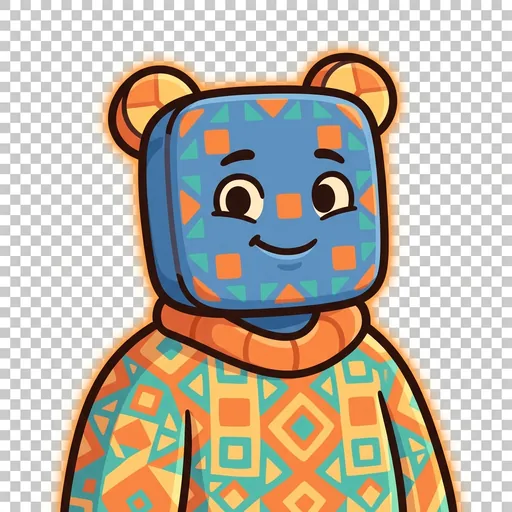
Tile
Pattern puzzles — repetition / symmetry / tessellation
-

Cog
Logic puzzles — deduction / elimination / constraint
-

Link
Connection puzzles — association / category / cross-reference
-

Beat
Sequence puzzles — temporal-order / step-by-step / dependency