
Lever and Solo
BALANCE-AND-ISOLATE — solving any equation requires (a) keeping both sides balanced as you transform it AND (b) moving every other term away from the variable until the variable stands alone. Two operations. One single, shared idea.
Press play to listen along. The line being read lights up as you go.
Show full transcript
Loading transcript…
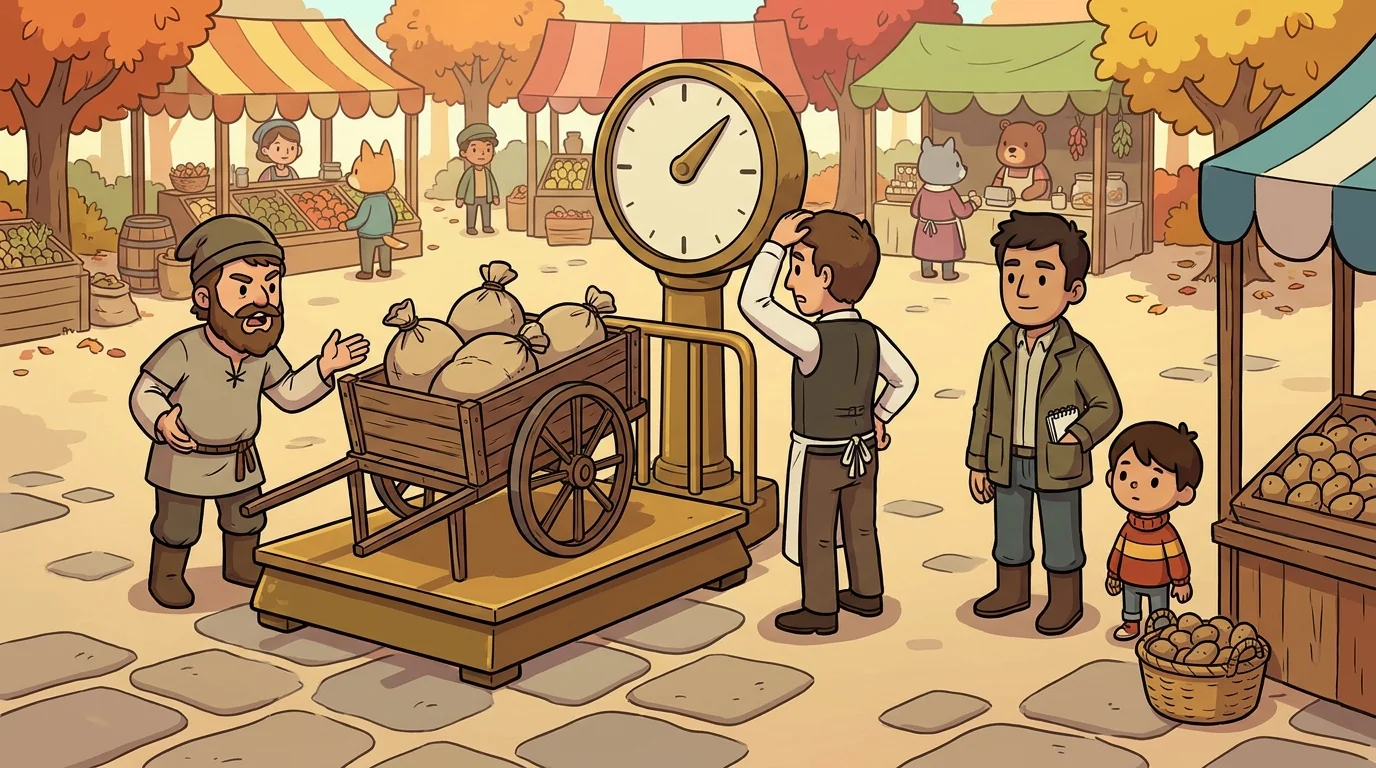
An unusual incident unfolded at the Pivot market one crisp autumn morning.
A traveling miller, a man whose face Lever recognized from countless past seasons, arrived at the front gate. He pushed his familiar, well-worn cart, laden with sacks of freshly milled flour. With a polite nod to the clerk, he maneuvered it onto the market's enormous brass scales, waiting patiently for the official reading.
The clerk, a young woman with sharp eyes, leaned in close. She squinted at the indicator, then jotted a number into her ledger. A moment later, she looked again, her brow furrowed, and shook her head slowly.
"My friend," she announced to the miller, her voice carrying across the quiet morning air, "your cart weighs five hundred and twenty pounds."
The miller’s jaw dropped slightly. "That simply cannot be correct," he countered, his voice rising in disbelief. "My cart, when empty, weighs forty pounds. I loaded precisely twelve sacks, each weighing fifty pounds. That totals six hundred and forty pounds. The scale should read six hundred and forty."
"It reads five hundred and twenty," the clerk stated, unwavering.
"Then your scales are broken!" the miller insisted, his patience wearing thin.
"My scales," the clerk replied, a hint of steel in her voice, "are never broken."
This was the precise moment Lever stepped away from the potato stall, where he had been quietly selecting his week's supply. He carefully set down his woven basket. Approaching the scale, he spoke with the particular calm he reserved for these exact kinds of disputes. "May I take a look?" he asked.
The clerk, who knew Lever well from many previous market days, offered a grateful, "Please."
Lever pulled a small, leather-bound notebook from his pocket and, with a practiced hand, wrote three concise lines:
Cart empty: 40. Twelve sacks at 50 each: 600. Expected total: 640.
Below these, he added another line: Actual reading: 520.
He then drew a firm line beneath the two totals, calculating the difference. 120 pounds missing.
His gaze swept from the miller to the cart, then to the massive brass scales.
"Solo," he said quietly, his voice barely a murmur, "I think this one is definitely one of yours."
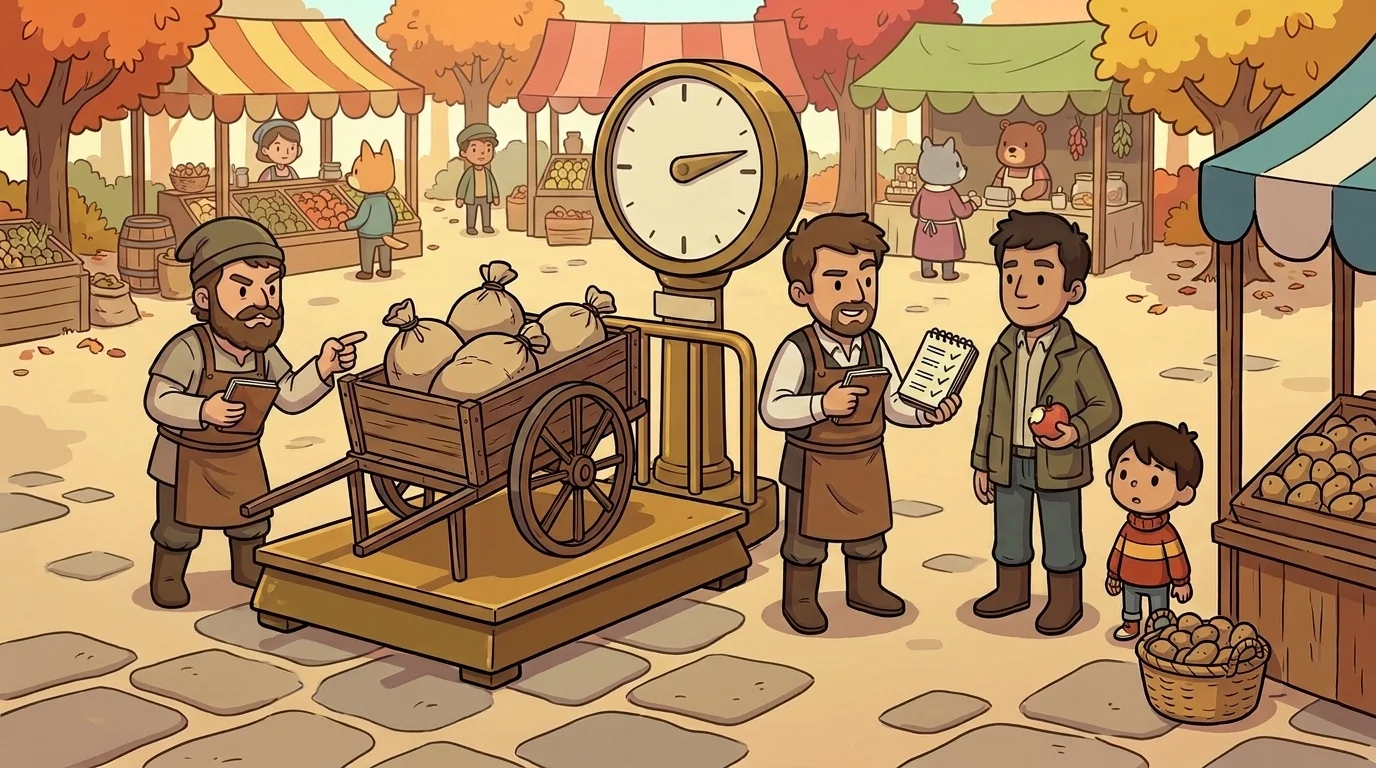
Solo had been idly browsing the apple-stall across the way, already halfway through a crisp red apple. He heard his name and casually sauntered over, taking another bite as he approached.
"What's the trouble?" Solo asked, his voice bright with curiosity.
Lever presented him with the open notebook. Expected 640. Actual 520. Missing 120.
Solo studied the page, chewing thoughtfully. He swallowed, then took another bite of the apple.
"So, somewhere in this situation," Solo observed, "the equation doesn't quite balance. The miller’s calculation says six hundred and forty pounds. The scale, however, insists on five hundred and twenty. Those two numbers are not equal. Something has to account for that difference."
"That 'something' is a variable," Lever explained, his gaze fixed on the cart. "We don't yet know its specific name. We don't know its exact size. We only know its effect. For now, let's call it x."
Solo nodded, a familiar spark in his eyes. He always liked it when Lever designated an unknown as x. It meant they were about to embark on some serious, satisfying work.
Lever flipped to a fresh page in his notebook and wrote the full equation:
Empty cart (40) + sacks (12 × 50) − x = scale reading (520).
He read it aloud, his voice steady. "Forty plus six hundred minus x equals five hundred and twenty. Our task now is to solve for x."
The miller, who had been listening intently, raised both eyebrows in surprise. He certainly had not anticipated an algebra lesson being performed on his cart at nine in the morning. He had simply expected to be paid for his flour.
"Just watch this," Solo said to the miller, a reassuring, not unkind, smile touching his lips. "It will take less than fifteen seconds. Lever has already set up the balance. Now, I will isolate the x."
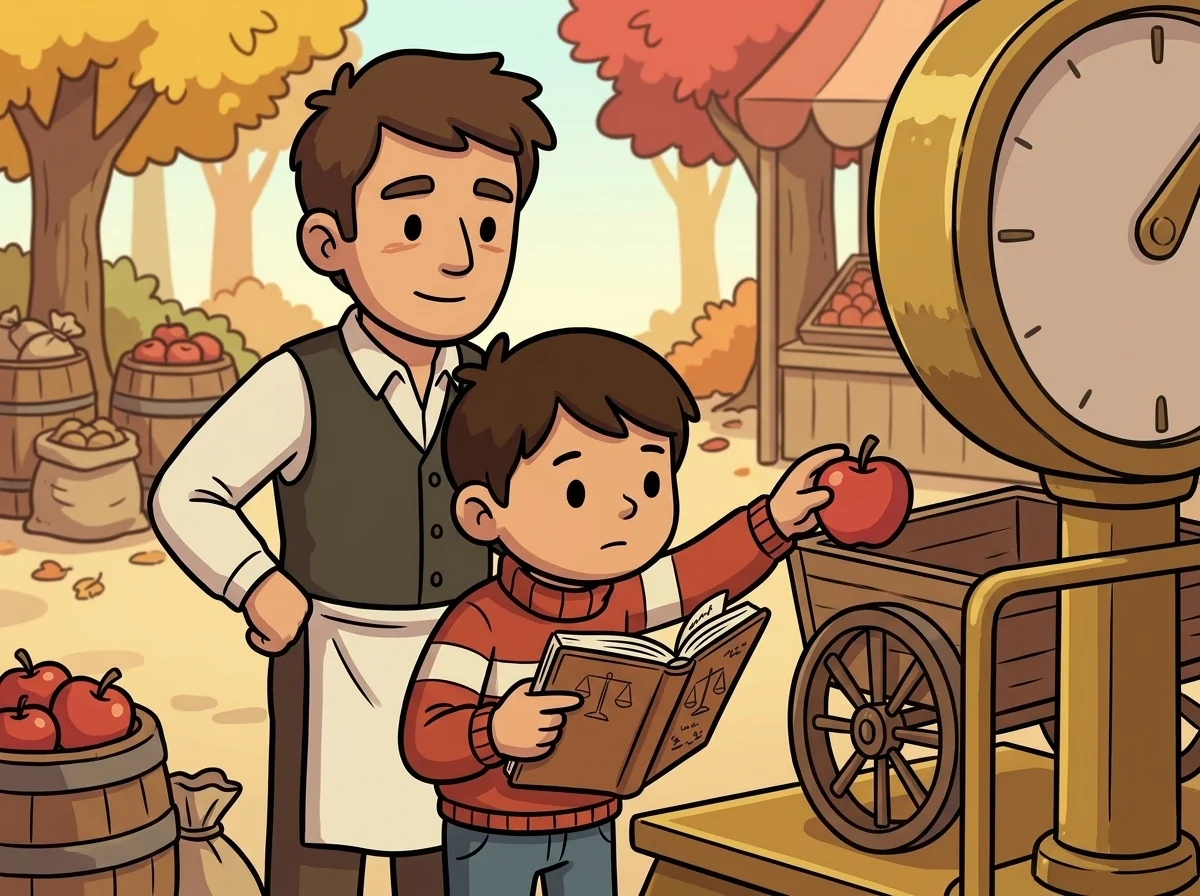
Solo carefully placed his half-eaten apple on the edge of the scale. He took the notebook from Lever and began to work through the problem out loud, just as he always did in class.
"We start with the whole equation," he explained, gesturing at the page. "Forty plus six hundred, minus x, equals five hundred and twenty. The first step is to combine the friendlier numbers on the left side. Forty plus six hundred gives us six hundred and forty. So now we have: six hundred and forty minus x equals five hundred and twenty."
He swiftly wrote the simplified equation on the page:
640 − x = 520.
"Now," Solo continued, his voice clear and confident, "I want x all by itself on one side of the equation. That means I need to move the six hundred and forty away from x. Since the six hundred and forty is being added on the left side, to move it, I have to subtract six hundred and forty. But — and this is the part Lever cares about most — I have to do the exact same thing to the other side. Whatever operation I perform on the left, I must also perform on the right. If I don't, the equation stops being a true balance. And an equation stopping being a balance is, quite frankly, Lever's worst nightmare."
The miller, despite his earlier frustration, couldn't help but crack a small smile.
Lever didn't smile, but a noticeable warmth softened his eyes.
Solo wrote the next step:
640 − x − 640 = 520 − 640.
He then simplified the expression:
−x = −120.
"Finally," Solo announced, "I have negative x on the left side. I want positive x. So, I can either multiply both sides by negative one, or, which is essentially the same thing, I can just flip every single sign. Lever permits either method."
He wrote the final answer:
x = 120.
Solo held up the notebook, a triumphant grin on his face. "There. The missing weight is one hundred and twenty pounds. The equation now balances perfectly. The miller's calculation and the scale's reading now agree, provided we can identify a hundred-twenty-pound something that we haven't yet accounted for."
The miller, still slightly bewildered, asked, "What could possibly weigh a hundred and twenty pounds and be missing from my cart?"
Lever and Solo simultaneously looked at the cart.
Then, almost in perfect unison, their eyes landed on the back wheel.
The back wheel was conspicuously new. The miller had replaced the old one just three days prior. The wheel itself wasn't the problem.
However, the old wheel — the one he had removed — had been a remarkably heavy, solid-oak wheel. The kind of wheel that weighed approximately one hundred and twenty pounds.
"You used to have a wheel that weighed a hundred and twenty pounds more than the one you have now," Lever explained, connecting the dots. "Your home scales were calibrated with that old, heavier wheel still on the cart. You weighed your twelve fifty-pound sacks against the six-hundred-forty figure you've relied on for a decade. You naturally expected the same six hundred and forty here. But the new wheel is significantly lighter. Your 'cart-empty' figure is now forty pounds, not a hundred and sixty. The math, as Solo has shown, works out perfectly."
The miller stared at his cart, then at Lever, then at the notebook, and finally, at his own calloused fingers.
"Oh," he said, a slow understanding dawning. "Oh."
He let out a slightly embarrassed laugh, shaking his head.
"I owe you fifteen pounds," he admitted. "I've been undercharging for flour for three days. The cart was lighter, but the flour was the same. My customers have been getting more flour per coin than they should have."
"Don't undo it now," Lever advised, a dry smile playing on his lips. "Customers always remember a baker who gives them a little extra. Just recalibrate your scales tomorrow."

That evening, Lever and Solo walked back together along the winding road from the market, heading toward the academy. The air was cool and crisp, carrying the scent of woodsmoke.
"That was a particularly fun one," Solo remarked, kicking a loose stone down the path.
"It was," Lever agreed, a quiet satisfaction in his voice. "Two core principles. One cart."
"The miller didn't even realize he was solving an equation," Solo mused. "He just thought he was weighing flour."
"All trade is equation-solving," Lever stated, his gaze fixed on the horizon. "Every cart that rolls onto a scale presents a balance problem. Every transaction holds an unknown until someone identifies it. Once you can name that unknown — once you can call it x — you can systematically move every other term out of the way and find its value."
"Balance," Solo summarized.
"And isolate," Lever added.
"That's it," Solo said, a sense of completion in his tone. "That's the whole job."
"Indeed," Lever confirmed. "That's the whole job."
They walked on in comfortable silence for a while, the setting sun casting long shadows behind them.
"Lever," Solo said, after a moment of quiet reflection. "Do you ever think we should put this on a poster for the classroom? Balance both sides. Isolate the variable. Something for the kids to stare at when they're stuck."
"I have tried," Lever admitted, a hint of weariness in his voice. "Three times, in fact. Every time I write it on a poster, the poster looks… flat. The principle feels alive when you're actively doing it. But on a poster, it just looks like a rigid rule. And kids, as we both know, don't truly trust rules. They trust stories."
"Then we keep doing stories," Solo concluded, a thoughtful expression on his face.
"Yes," Lever agreed, his eyes twinkling. "We keep doing stories."
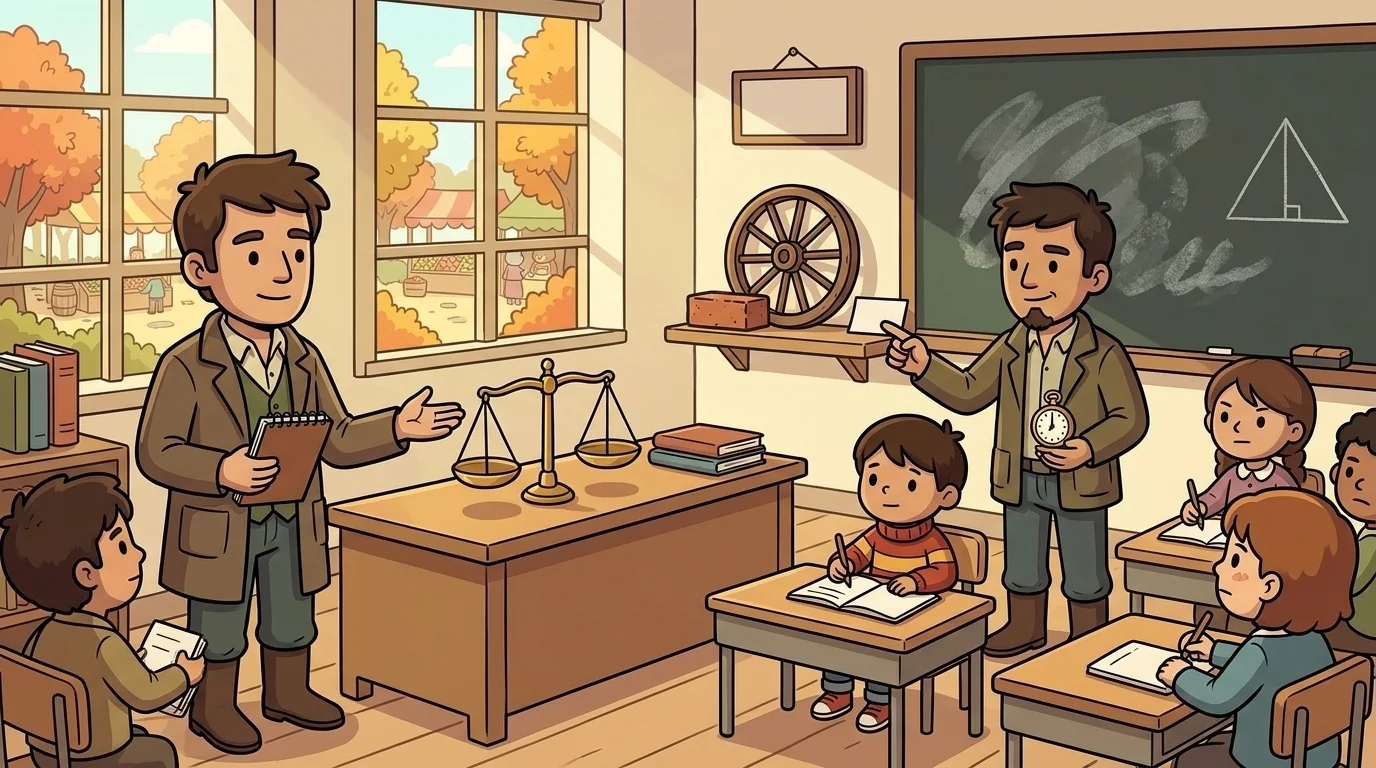
The next morning, in Lever's sunlit classroom, the familiar brick that had initiated his own teaching journey sat, as always, on its designated shelf. The equation is a balance.
Lever had placed something new beside it.
A small, weathered wooden wheel-spoke. He had picked it up from the miller's discarded old wheel, carried it home carefully in his pocket, and now set it precisely on the shelf next to the brick. Beneath it, a small handwritten label read:
A hundred and twenty pounds. Once you can name what is missing, you can find it.
The children would undoubtedly inquire about it that afternoon. He would tell them the cart story. He would recount Solo's arrival, half an apple in hand. He would explain how the miller had walked away laughing, because the scale had indeed told the truth, and Solo had expertly isolated x, revealing that the truth was, in fact, a wheel.
He would, at the very end of his narrative, set a small pair of gleaming brass balance-pans on his desk.
He would then say: "Balance both sides. Isolate the variable. That is the whole job."
The children would dutifully copy it into their notebooks. Some of them would grasp the concept instantly. Others would not quite believe it yet. But by the end of the year, he knew, every single one of them would.
The EquationQuest ensemble
Lever and Solo is part of EquationQuest's distributed-narrative cast. Each character embodies a different curricular primitive; together they teach the full subject.
-

Lever
Maintaining balance — do the same thing to both sides
-

Solo
Isolating the variable — moving everything else away from x
-

Undo
Inverse operations — addition ↔ subtraction, multiplication ↔ division
-

Spread
Distribution — multiplying across parentheses
-

Flipper
The sign-flip in inequalities when multiplying/dividing by a negative