
Lever and Solo
BALANCE-AND-ISOLATE — solving any equation requires (a) keeping both sides balanced as you transform it AND (b) moving every other term away from the variable until the variable stands alone. Two operations. One single, shared idea.
Press play to listen along. The line being read lights up as you go.
Show full transcript
Loading transcript…
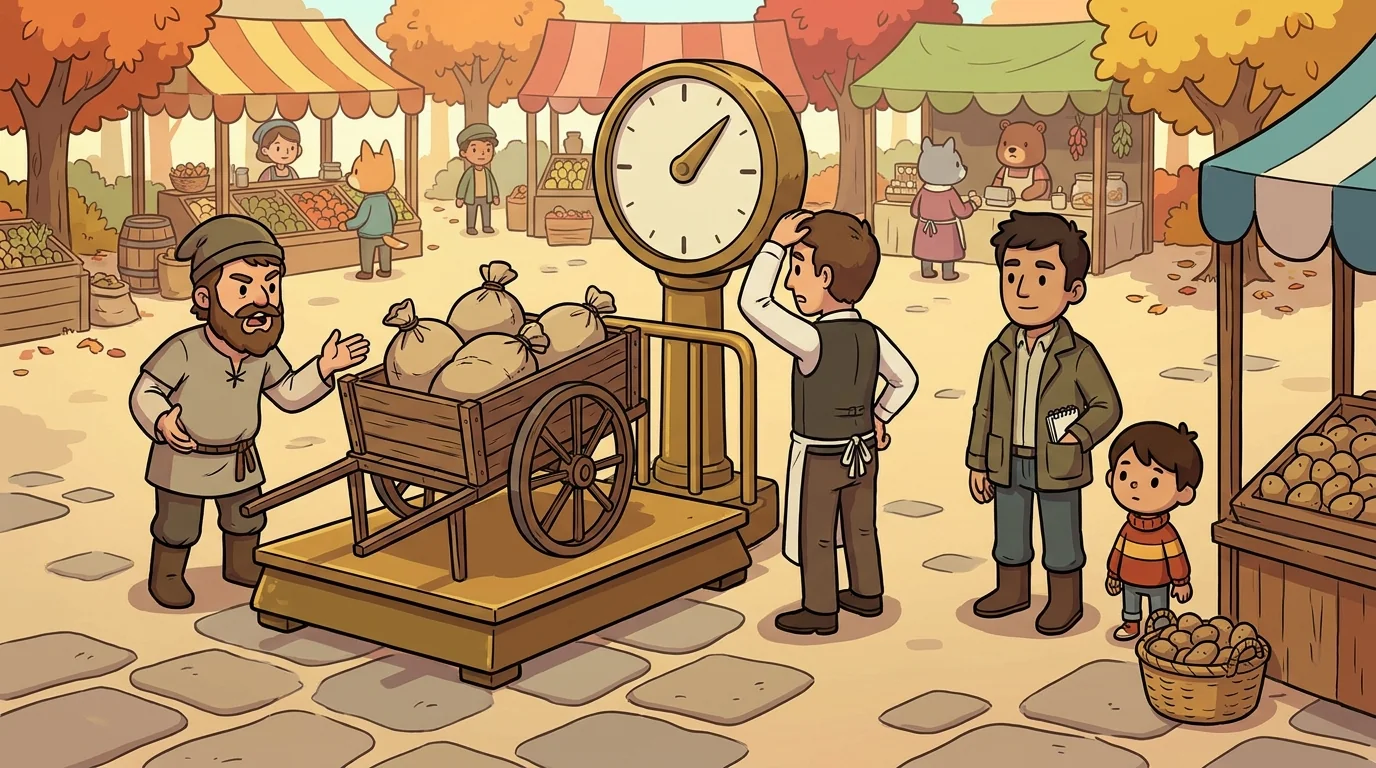
A peculiar thing happened at the Pivot market one autumn morning.
A traveling miller arrived at the front gate with his cart. The cart was old — Lever had seen this cart before, perhaps thirty times over the years — and was loaded with sacks of milled flour. The miller wheeled it onto the market's enormous brass scales and waited politely while the clerk took the reading.
The clerk leaned in. He squinted. He wrote a number in his ledger. He looked again. He shook his head.
He said to the miller: "My friend, your cart weighs five hundred and twenty pounds."
The miller said: "That cannot be correct. My cart is forty pounds empty. I loaded twelve sacks of fifty pounds each. That is six hundred and forty pounds total. The cart should read six hundred and forty."
The clerk said: "It reads five hundred and twenty."
The miller said: "Then your scales are broken."
The clerk said: "My scales are never broken."
This was the moment Lever stepped over from the booth where he had been quietly buying potatoes. He set down his basket. He said, with the particular calm he reserved for scale disputes: "May I look?"
The clerk, who knew Lever, said: "Please."
Lever opened a small leather notebook and wrote three lines:
Cart empty: 40. Twelve sacks at 50 each: 600. Expected total: 640.
He then wrote: Actual reading: 520.
He underlined the difference. 120 pounds missing.
He looked at the miller. He looked at the cart. He looked at the scales.
"Solo," he said quietly, "I think this is one of yours."
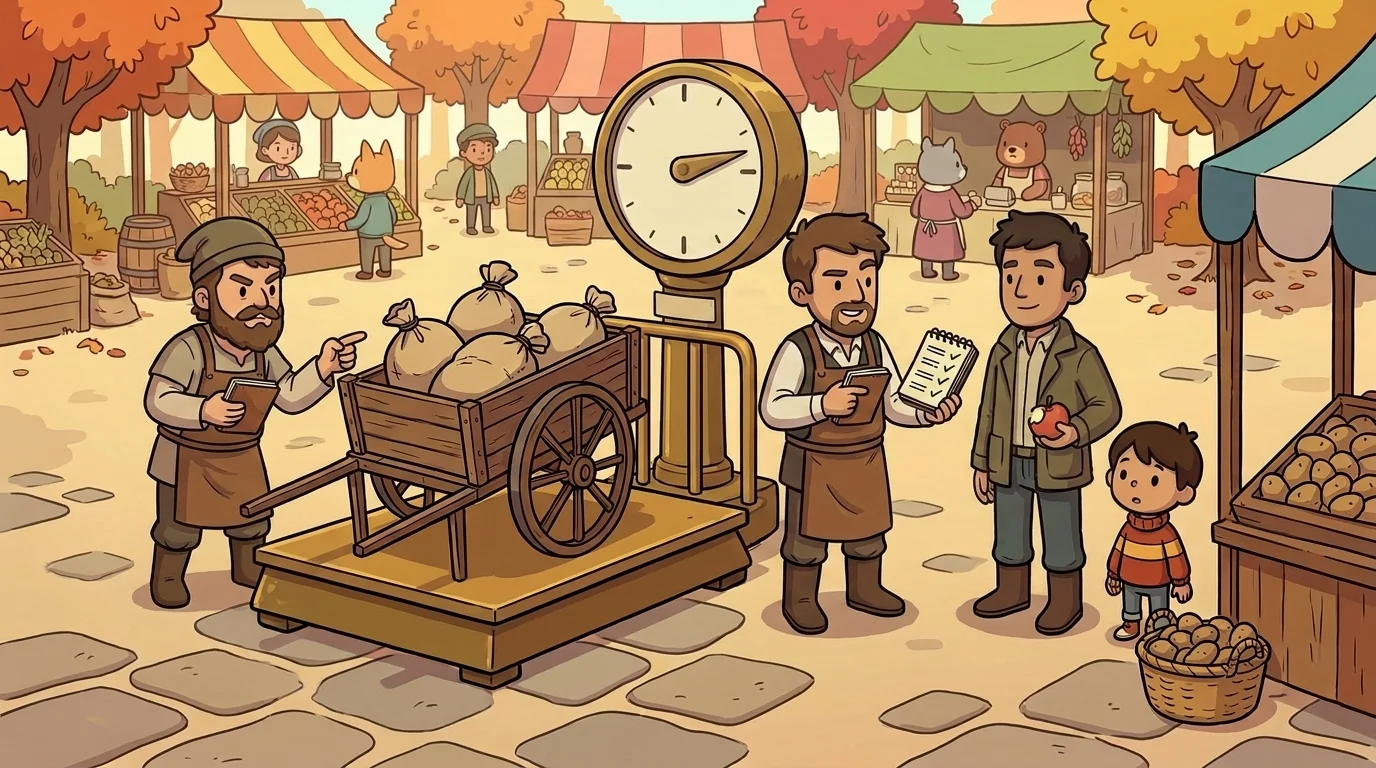
Solo had been browsing the apple-stall across the way. He heard his name and came over. He had a half-eaten apple in one hand.
"What's the problem?" Solo asked.
Lever showed him the notebook. Expected 640. Actual 520. Missing 120.
Solo studied the page. He took another bite of the apple.
"So somewhere," Solo said, "the equation does not balance. The miller's side says six-hundred-and-forty. The scale's side says five-hundred-and-twenty. Those are not equal. Something has to account for the difference."
"That something is a variable," Lever said. "We do not yet know its name. We do not yet know its size. We only know its effect. Let us call it x."
Solo nodded. He liked it when Lever called things x. It meant they were about to do real work.
Lever wrote on a fresh page in the notebook:
Empty cart (40) + sacks (12 × 50) − x = scale reading (520).
He read it aloud. "Forty plus six hundred minus x equals five hundred and twenty. Solve for x."
The miller, who had been listening, raised both eyebrows. He had not expected algebra to be performed on his cart at nine in the morning. He had expected to be paid for flour.
"Watch this," Solo said to the miller, not unkindly. "It will take fifteen seconds. Lever has done the balancing. I will isolate the x."
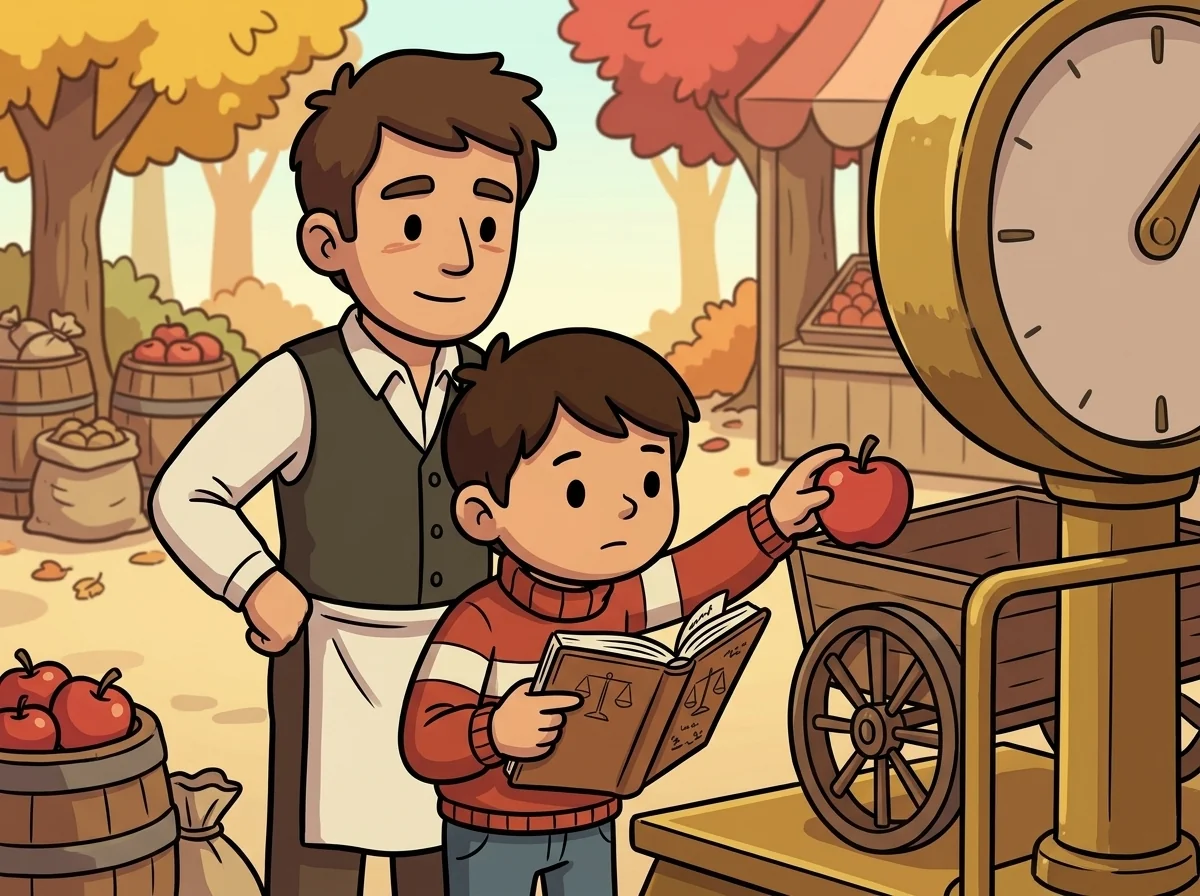
Solo set down the apple on the edge of the scale. He took the notebook from Lever. He worked through it out loud, the way he always did in class.
"Start with the whole equation," he said. "Forty plus six hundred, minus x, equals five hundred and twenty. First step: combine the friendlier numbers on the left side. Forty plus six hundred is six hundred and forty. So now we have: six hundred and forty minus x equals five hundred and twenty."
He wrote the new equation on the page.
640 − x = 520.
"Now," Solo said. "I want x by itself on one side. So I have to move the six-hundred-and-forty away from x. The six-hundred-and-forty is being added on the left. To move it away, I subtract six-hundred-and-forty. But — and this is the part Lever cares about — I have to do the same thing to the other side. Whatever I do to the left, I must do to the right. Otherwise the equation stops being a balance. And the equation stopping being a balance is Lever's worst nightmare."
The miller, despite himself, smiled.
Lever did not smile. But his eyes warmed.
Solo wrote:
640 − x − 640 = 520 − 640.
He simplified.
−x = −120.
"Now," Solo said, "I have negative-x on the left. I want positive x. So I multiply both sides by negative one. Or — equivalently — I flip every sign. Lever will allow either."
He wrote:
x = 120.
He held up the notebook. "There. The missing weight is one-hundred-and-twenty pounds. The equation balances. The miller's side and the scale's side now agree, provided we can account for a hundred-twenty-pound something that we have not yet found."
The miller said: "What could weigh a hundred-twenty pounds and be missing from my cart?"
Lever and Solo looked at the cart.
Then, almost together, they looked at the back wheel.
The back wheel was a brand-new wheel. The miller had replaced the old wheel three days ago. The wheel itself was not the problem.
But the old wheel — the one he had taken off — had been a heavy solid-oak wheel. The kind of wheel that weighed about a hundred-twenty pounds.
"You used to have a wheel that weighed a hundred-twenty pounds more than the one you have now," Lever said. "Your home scales were calibrated with that old wheel on the cart. You weighed twelve fifty-pound sacks against the six-hundred-forty figure you've used for a decade. You expected the same six-hundred-forty here. But the new wheel is lighter. The cart-empty figure is now forty pounds, not a hundred-and-sixty. The math works out."
The miller stared at the cart. Then at Lever. Then at the notebook. Then at his own fingers.
"Oh," he said. "Oh."
He laughed. It was a slightly embarrassed laugh.
"I owe you fifteen pounds," he said. "I have been undercharging for flour for three days. The cart was lighter. The flour was the same. The customers got more flour per coin than they should have."
"Don't undo it," Lever said. "Customers always remember a baker who gives them a little extra. Recalibrate tomorrow."

That evening, Lever and Solo walked back together along the road from the market toward the academy.
"That was a fun one," Solo said.
"It was," Lever agreed. "Two principles. One cart."
"The miller didn't even know he was solving an equation," Solo said. "He just thought he was weighing flour."
"All trade is equation-solving," Lever said. "Every cart that comes onto the scale is a balance problem. Every transaction has an unknown until someone names it. Once you can name the unknown — once you can call it x — you can move every other term out of the way and find it."
"Balance," Solo said.
"And isolate," Lever said.
"That's it," Solo said. "That's the whole job."
"That's the whole job," Lever agreed.
They walked on for a while.
"Lever," Solo said, after a moment. "Do you ever think we should put this on a poster for the classroom? Balance both sides. Isolate the variable. Something the kids can stare at while they're stuck."
"I have tried," Lever said. "Three times. Every time I write it on a poster, the poster looks flat. The principle is alive when you do it. On a poster it looks like a rule. And kids don't trust rules. They trust stories."
"Then we keep doing stories," Solo said.
"Yes," Lever said. "We keep doing stories."
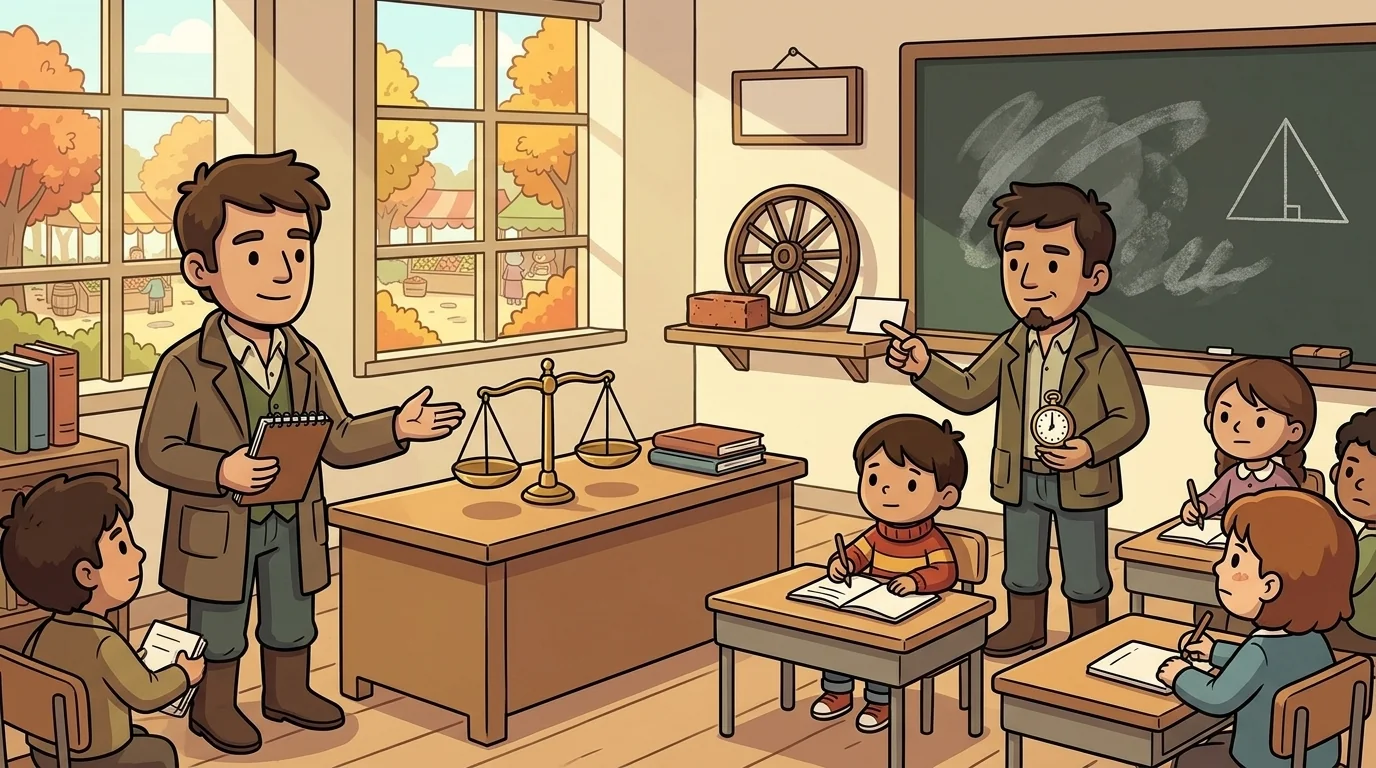
The next morning, in Lever's classroom, the brick that had started his teaching career sat as always on its shelf. The equation is a balance.
Lever had added something new beside it.
A small wooden wheel-spoke. Picked up from the miller's discarded old wheel, carried home in his pocket, set carefully on the shelf next to the brick. A small handwritten label underneath:
A hundred and twenty pounds. Once you can name what is missing, you can find it.
The kids would ask about it that afternoon. He would tell them the cart story. He would tell them about Solo arriving with half an apple. He would tell them that the miller had walked away laughing because the scale had told the truth, and Solo had isolated x, and the truth turned out to be a wheel.
He would, at the end of the story, set a small pair of brass balance-pans on his desk.
He would say: "Balance both sides. Isolate the variable. That is the whole job."
The kids would copy it into their notebooks. Some of them would believe it. Some of them would not believe it yet. By the end of the year, all of them would.
The EquationQuest ensemble
Lever and Solo is part of EquationQuest's distributed-narrative cast. Each character embodies a different curricular primitive; together they teach the full subject.
-

Lever
Maintaining balance — do the same thing to both sides
-

Solo
Isolating the variable — moving everything else away from x
-

Undo
Inverse operations — addition ↔ subtraction, multiplication ↔ division
-

Spread
Distribution — multiplying across parentheses
-

Flipper
The sign-flip in inequalities when multiplying/dividing by a negative