Spread
DISTRIBUTIVE PROPERTY — multiplication distributes over addition: a(b+c) = ab + ac. The expanding principle.
Press play to listen along. The line being read lights up as you go.
Show full transcript
Loading transcript…
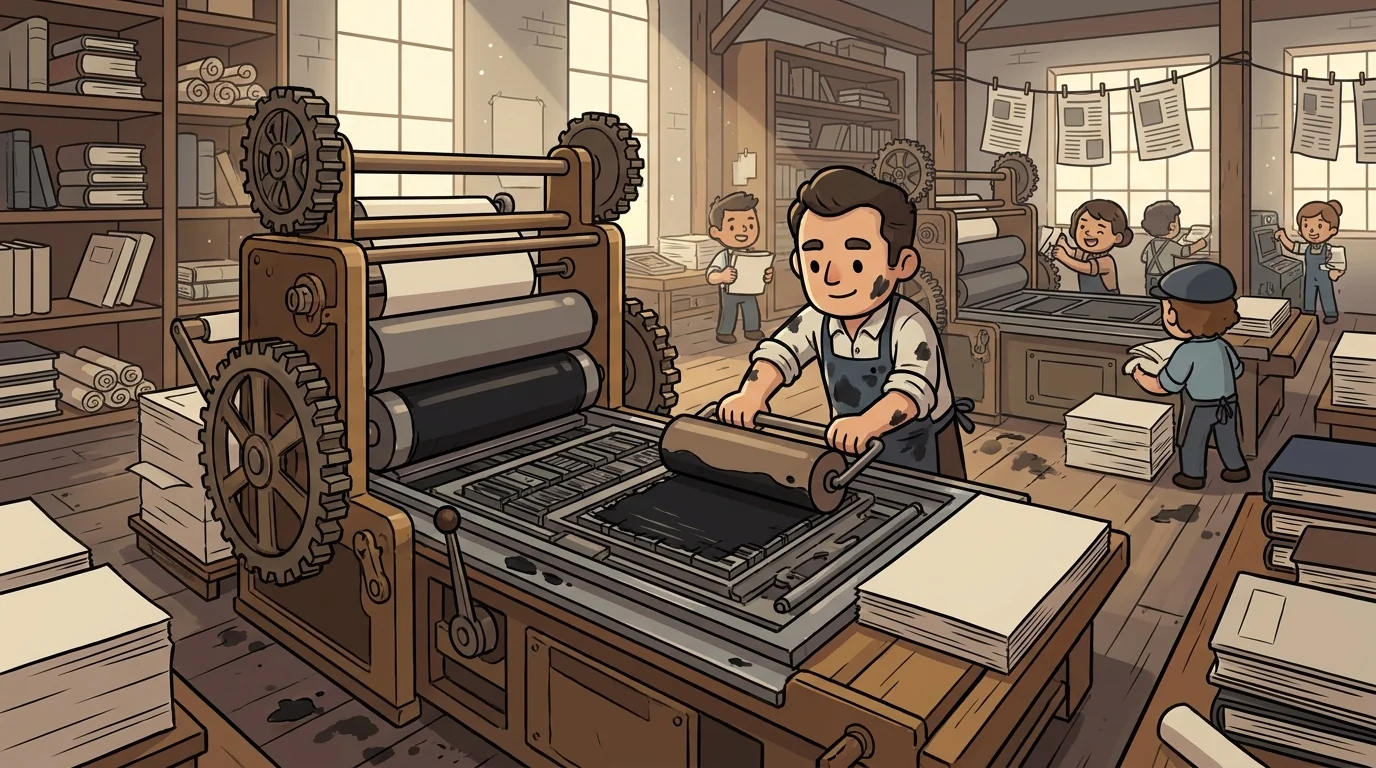
Spread worked, for fifteen years, at the central printing press of the capital city. The printing press was — and still is — the largest in the kingdom. It printed books, broadsheets, school texts, and the occasional poster announcing royal proclamations. It was a busy place. It smelled, faintly, of ink and damp paper and warm metal.
Spread's job was inking the type.
This was a specific job. The printing press worked by setting metal letters into a frame — typesetting — and then pressing inked paper down onto the frame. For the letters to print clearly, every letter had to receive the same amount of ink. Too little ink and the letter came out faint. Too much ink and the letter smudged.
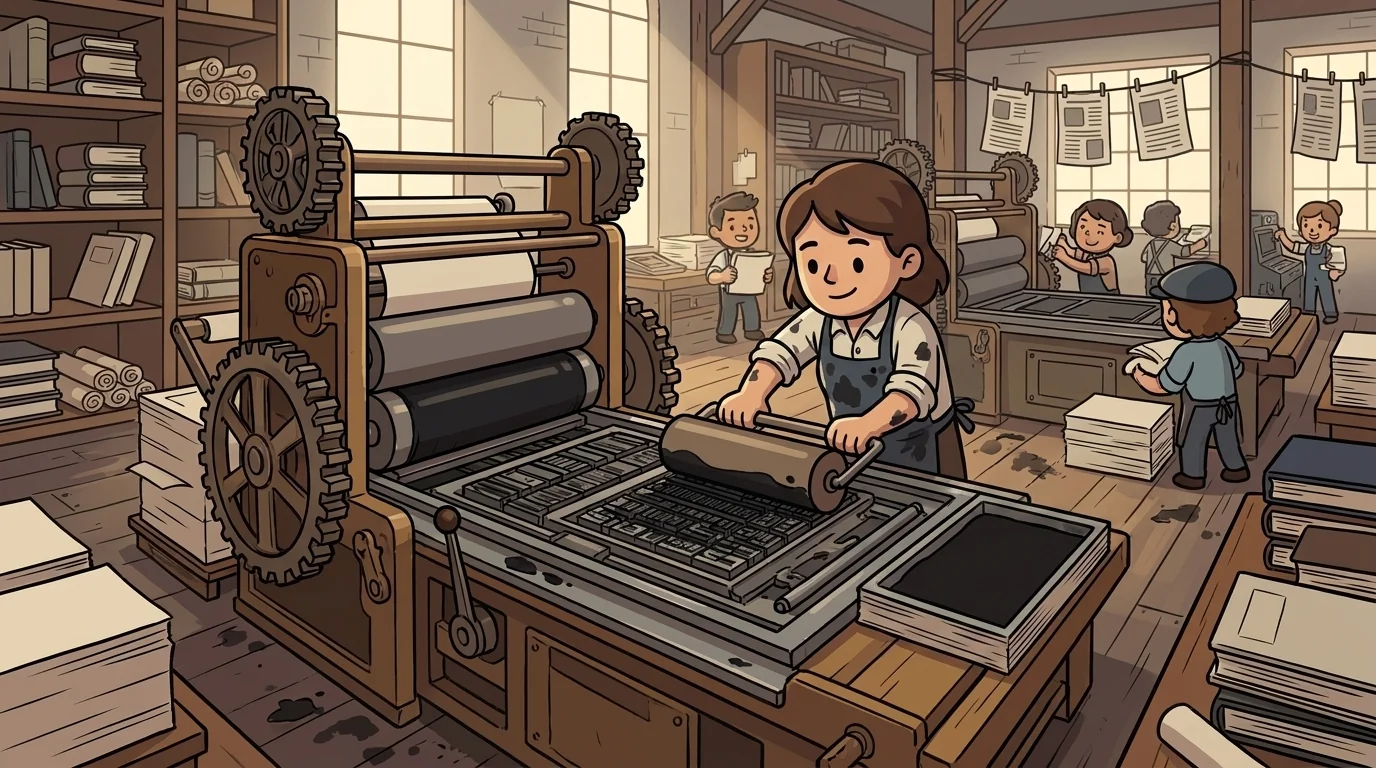
To ink the type, Spread used a roller. It was a large roller, about the size of a forearm, made of a particular kind of soft rubber that held ink well. She would roll it across a pad of ink to load it, and then roll it across the typeset frame — once, twice, sometimes three times — until every letter in the frame had received its share.
This was the magical part, to Spread: one roll of the roller distributed ink to every letter at once.
Whether the frame held four letters or four hundred, the roller did the same thing. It rolled across. It deposited a thin even layer of ink. Every letter got its fair amount. The roller did not have to think about which letter was which. The roller did not have to aim. The roller just rolled, and the ink spread across all of them.
Spread thought about this for fifteen years.
What she eventually realised — and she realised it in a particular evening in winter, when she was thirty-three, sitting at her workbench drinking tea after the day's print run — was that the rolling-the-ink operation was deeply parallel. The roller did the same thing to every letter simultaneously, with no extra effort for additional letters. If she rolled across a single letter, she used a small amount of ink. If she rolled across a hundred letters, she used a larger amount of ink — but she did the same single motion. The ink was distributed uniformly across whatever was in front of the roller.

This was, although Spread did not yet know it had a name, the distributive property.
In algebra: when you multiply a quantity by a sum — say, 3 × (5 + 7) — you can distribute the 3 across the 5 and the 7. You get 3×5 + 3×7. The multiplication "rolls across" each term. The result is the same whether you compute 3 × 12 = 36, or 15 + 21 = 36. The distributive property says these two are equal.
When Spread realised the connection between her roller and algebra, she set down her teacup. She sat for several minutes. Then she stood up, walked to her workbench, and wrote a small note to herself:
"The roller does what the parenthesis does. Multiplication rolls across each term inside."
She kept the note. She still has it. It is taped to the inside of her classroom door.

A year later, when the EquationQuest academy was looking for someone to teach the distributive property to children, a printer who knew her by reputation mentioned her name. The academy master wrote her a letter. Spread, who was thirty-four and ready for a slight change of pace, accepted.
She arrived at the academy with her old roller (her colleagues at the press had given it to her as a leaving gift). She still uses it in class. She rolls it across a sheet of paper with five large letters written on it. She watches the children watch the ink land. She says: "The roller rolled once. Every letter got ink. That is multiplication distributing across addition."
Children find this unusually clear, which is exactly the effect Spread intended. Children draw little rollers in their notebooks.
Spread's hands are still slightly inky, fourteen years after she left the press. The ink, her colleagues used to joke, takes about a generation to fully come out. Spread does not mind. She likes the small grey stains. They remind her, every time she looks at her hands, of the principle she teaches.
She still visits the press once a month. She has tea with the new chief inker, who was apprenticed under her. The new chief inker is also patient. The new chief inker is also slightly inky.
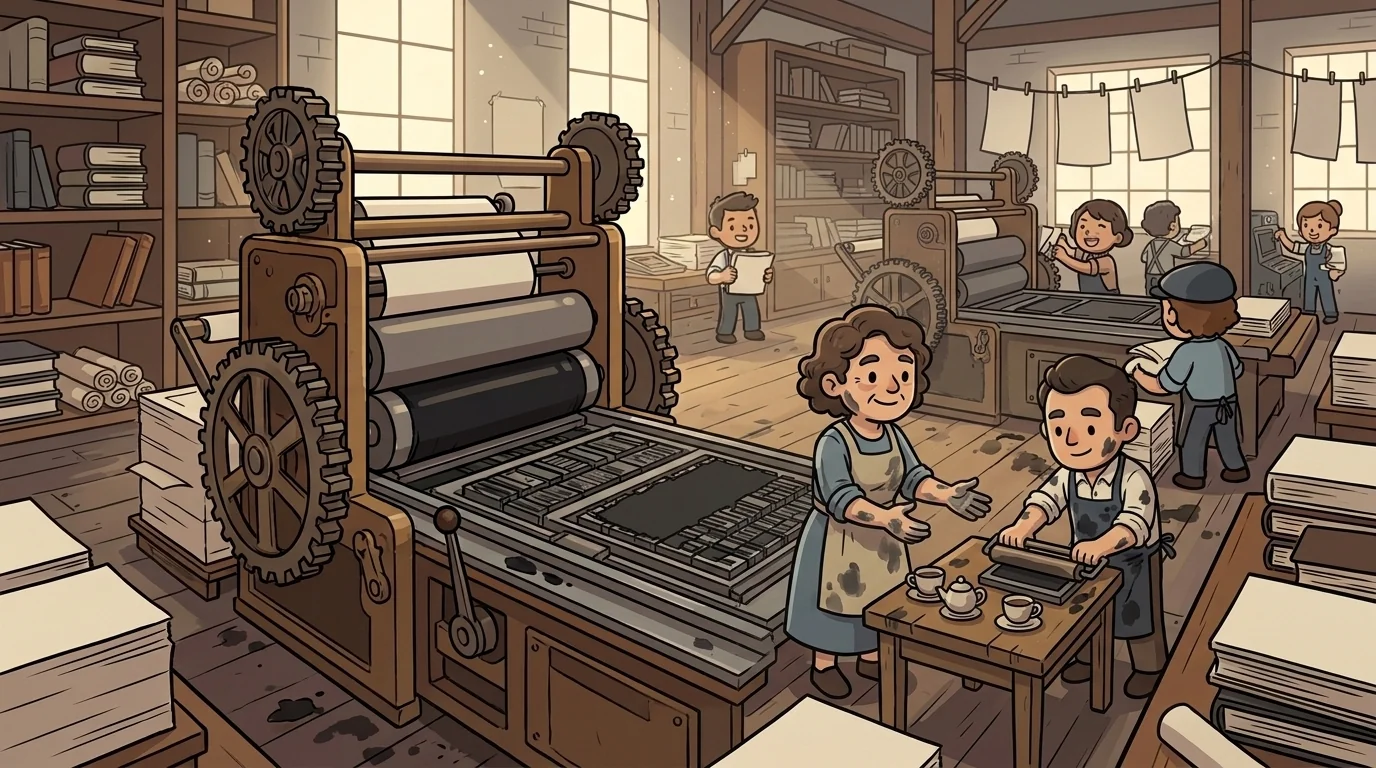
When children come to Spread's class for the first time and ask, nervously, whether the distributive property is hard, Spread always says the same thing:
"It isn't hard. It's just the roller. You multiply across each term inside the parentheses. The roller does the same thing to every letter, all at once."
She holds up her hands. They are slightly grey.
She adds: "It also helps if you don't mind a little ink."
And the children always laugh — but the ones who look closest see that she says it warmly, almost fondly, the way you'd talk about an old friend. The grey stains do not embarrass her. They make her feel steady, and glad, and quietly at home. That, more than the roller, is what she hopes they carry out the door: that the work you love can mark you, and that the mark can feel good.
The EquationQuest ensemble
Spread is part of EquationQuest's distributed-narrative cast. Each character embodies a different curricular primitive; together they teach the full subject.