Lever
BALANCING — the foundational principle that an equation is a balance, and whatever you do to one side you must do to the other.
Press play to listen along. The line being read lights up as you go.
Show full transcript
Loading transcript…
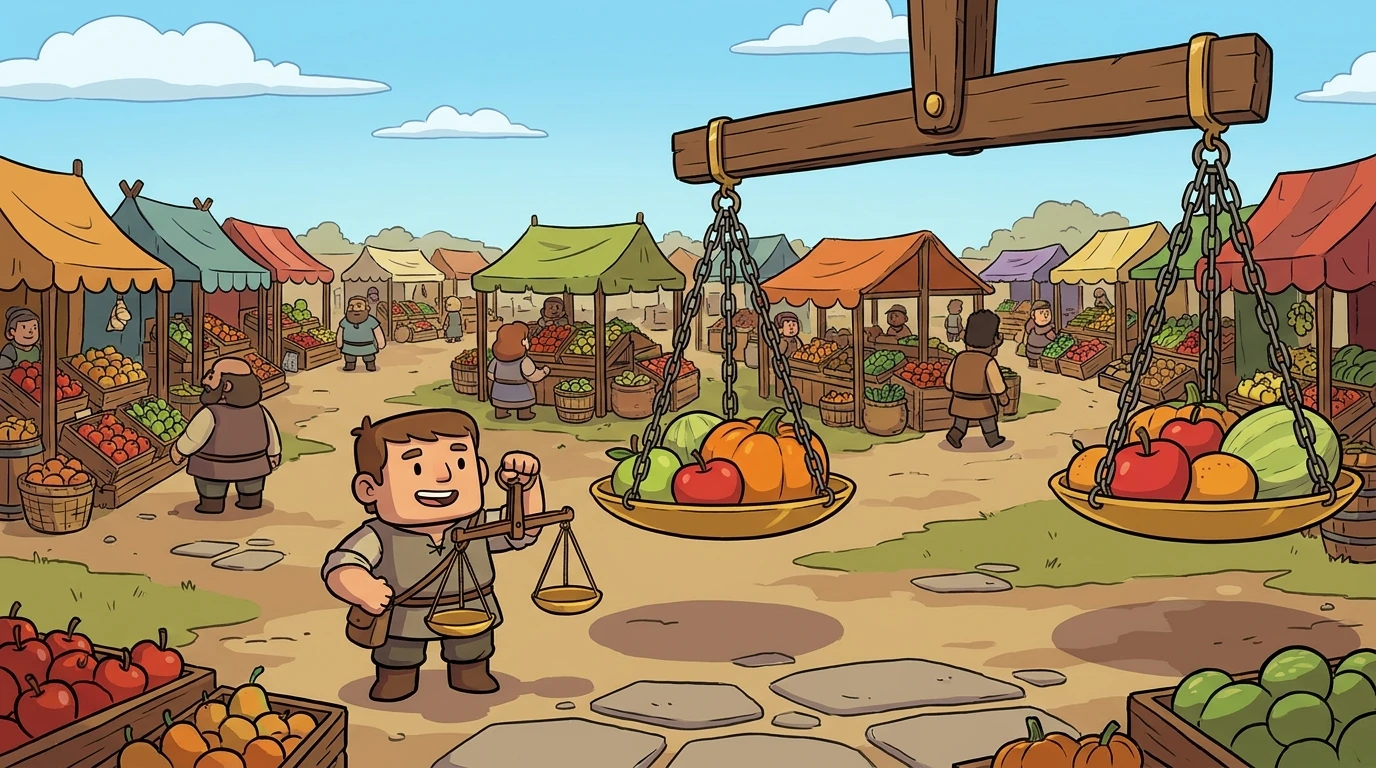
Lever is a small, square, sturdy character who carries a balance scale with him almost everywhere he goes. The balance scale is, by his own admission, not strictly necessary — he could explain everything he teaches without it — but he likes carrying it. He says it reminds him why he started.
Lever grew up in a town called Pivot, on the kingdom's central plain. (Pivot is, as the name suggests, named for a kind of mechanical joint. The townspeople have, over generations, mostly stopped finding this funny.) His family did not run a mill, or a forge, or a farm. His family ran a fruit-and-vegetable market, the largest in the central plain, with twenty-three stalls and one very large set of weighing scales at the entrance.
The scales were enormous. They had two flat brass pans, each about the size of a large dinner plate, hanging from a wooden beam that pivoted on a brass pin. The beam was four feet long. The pans were the heaviest things in the market. The whole assembly weighed about as much as a small pony.
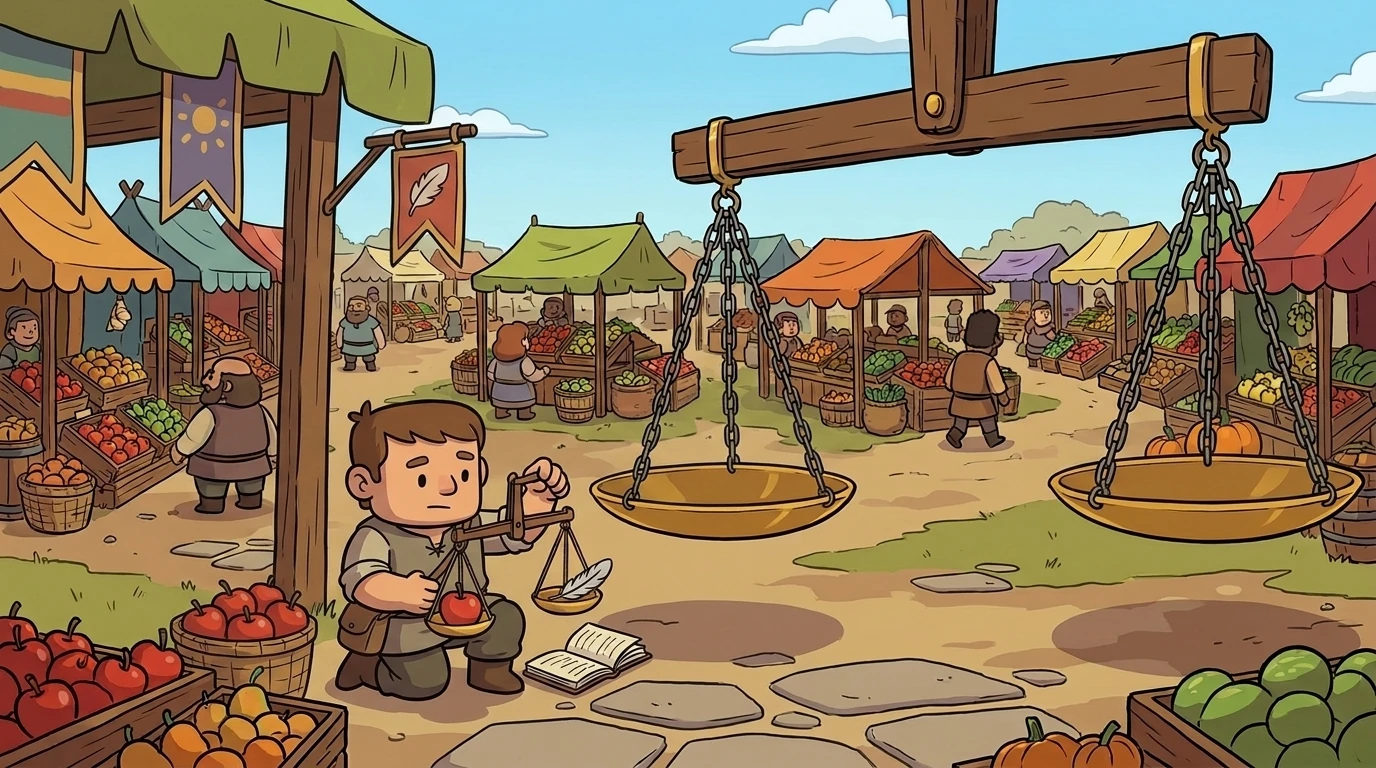
Lever grew up watching customers weigh fruit on those scales.
He spent, by his own count, approximately ten thousand hours watching people put apples on one pan and brass weights on the other. He watched until he was eleven years old, by which time he had noticed something his family had stopped noticing.
What Lever had noticed was this: the scales were honest. You could not cheat them. You could not, by tilting your head or by hoping very hard, make them say something untrue. If you put two pounds of apples on one pan, you needed two pounds of brass weights on the other pan to balance them. Exactly two pounds. Not one and a half. Not three. The scales did not negotiate.
This was, to Lever, the most interesting thing in the world.
He was, at eleven, given his own small set of scales by his grandmother. They were a beautiful set — wooden, palm-sized, with little tin pans. Lever weighed everything in his house. He weighed his shoes. He weighed his lunch. He weighed his cat (who did not enjoy this). He weighed feathers, and stones, and coins, and once, memorably, his sister's hair-ribbon. He kept a small notebook full of weighings. He thought of himself as a honest-numbers detective.
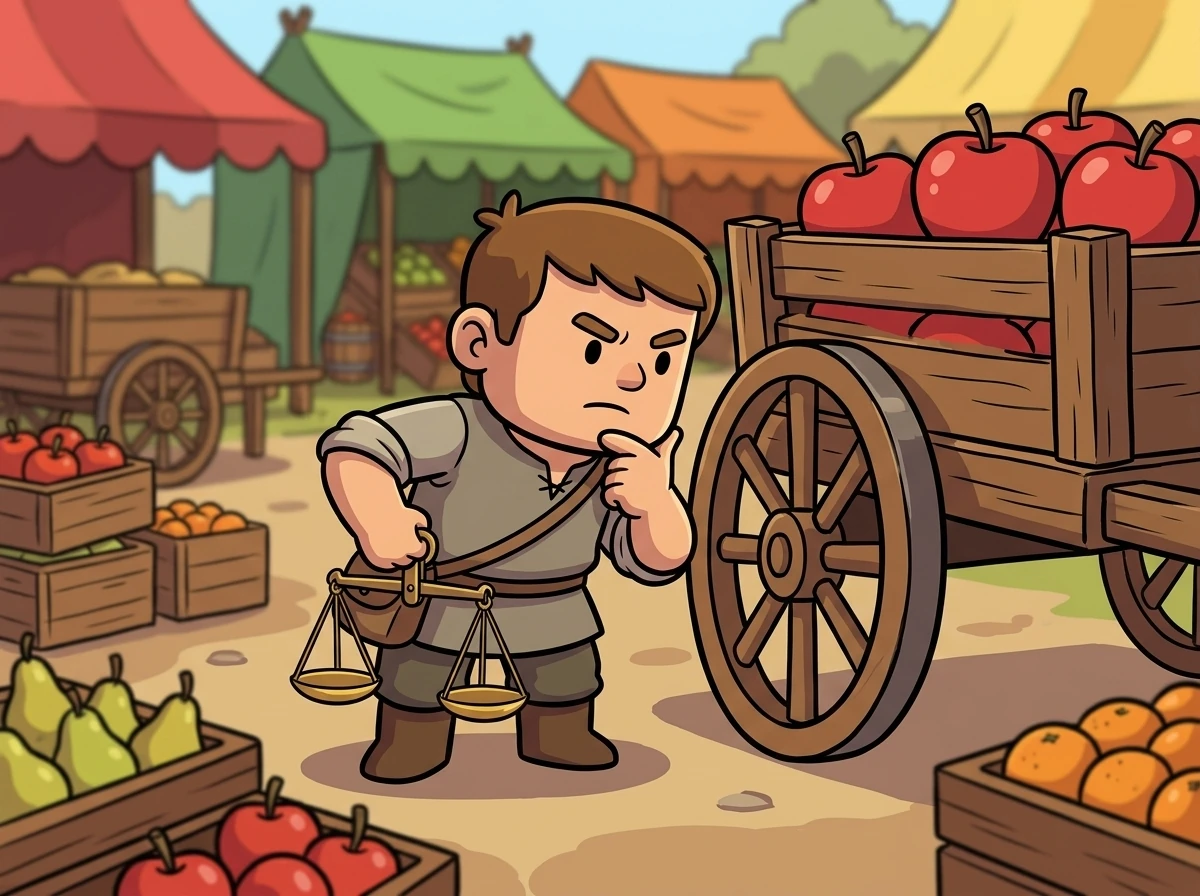
One spring afternoon, when Lever was twelve, an event occurred at the market that he has never forgotten.
A customer arrived at the front gate with a cart full of apples. The cart had been weighed at his orchard before he left. The cart weighed, according to his own scales, two hundred and forty pounds.
He arrived at the market scales. The scales said two hundred and fifty pounds.
The customer was annoyed. The market clerk was confused. The customer said he had been cheated somehow. The clerk said the market scales were honest. Lever, who was watching from a stall, did not say anything. He had been thinking.
After about a minute, he walked over to the customer's cart. He looked at it. He walked around it. He looked underneath it.
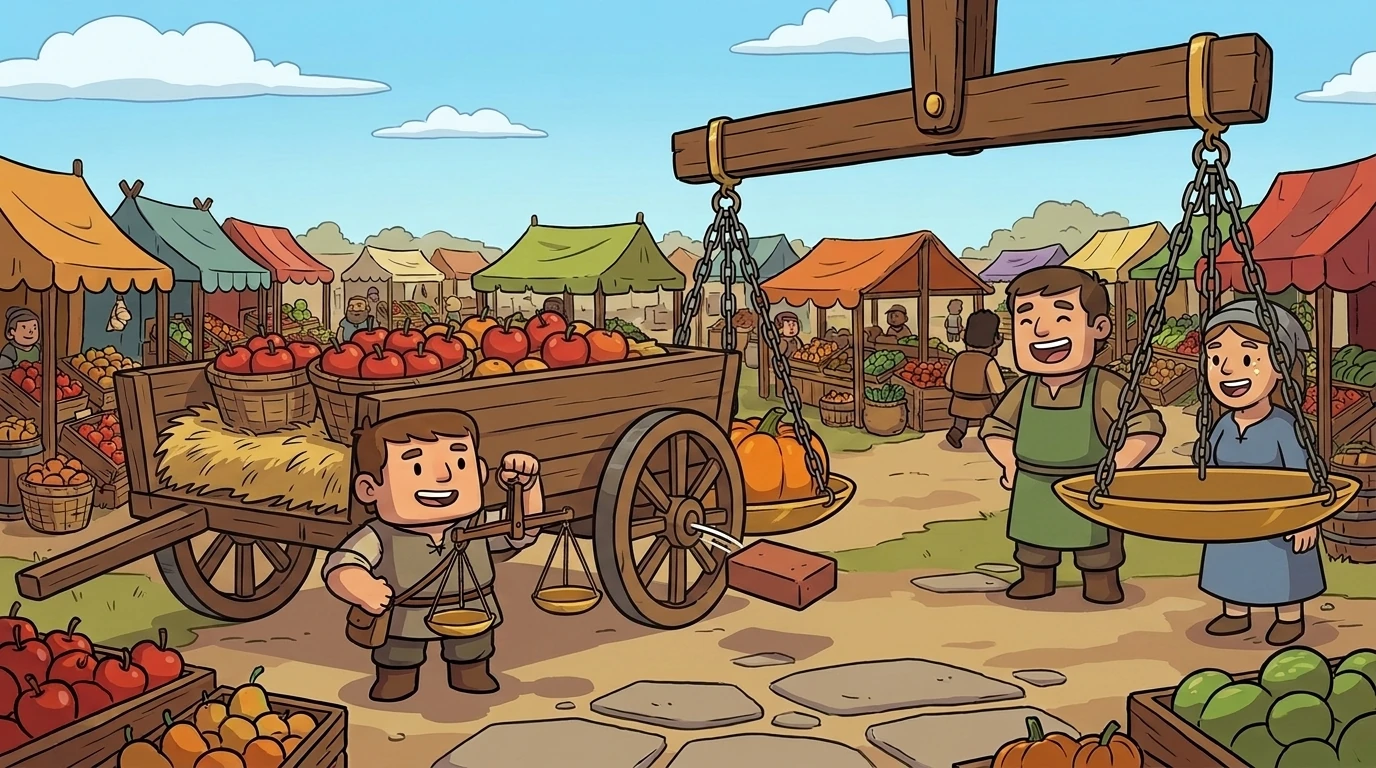
There was a brick under the cart.
Somebody — probably a child, somewhere on the road from the orchard — had wedged a brick into the underside of the cart, between two of the wooden slats, as a joke. The brick weighed ten pounds. The cart weighed two hundred and forty pounds. The brick weighed ten pounds. The total weighed two hundred and fifty pounds.
The customer's scales were right. The market's scales were right. The brick was the difference.
Lever pulled the brick out. He showed it to the clerk. The clerk laughed. The customer laughed. Both sides paid for the apples — by weight — minus the ten pounds of brick. Everybody went home happy. The brick was placed on the gatepost where it could be seen by future cart-drivers, as a kind of friendly warning.
This was the day Lever understood what would later become his job.
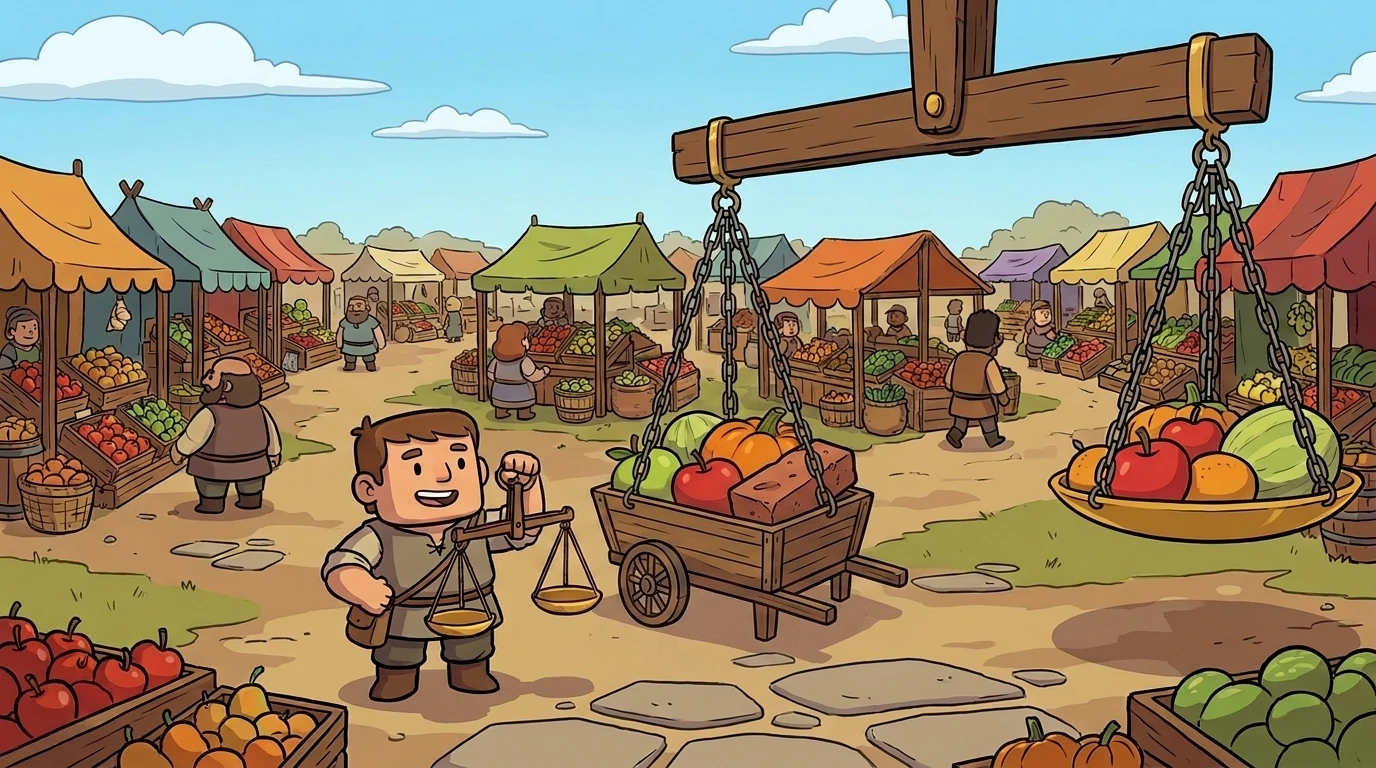
The day's lesson was: the scale told the truth. The scale could not have known the brick was there. But because the scale did not negotiate, the brick had to be accounted for. You could not just decide the cart weighed less. If you wanted the apples-only weight, you had to remove the brick. From both sides of the problem. From the cart. From the count.
This is, in algebraic terms, isolating a variable by doing the same thing to both sides.
When the EquationQuest academy invited Lever to come teach the balancing principle to children, Lever brought the small wooden scales his grandmother had given him. He still uses them in class. He still uses the brick story. The brick itself — the actual brick, from the gatepost — is now on a shelf in his classroom, with a small label that says "the equation is a balance."
He is, as you can probably tell, a patient teacher.
He still goes home to Pivot once a year to help with the harvest weighings. He still does not negotiate.
The EquationQuest ensemble
Lever is part of EquationQuest's distributed-narrative cast. Each character embodies a different curricular primitive; together they teach the full subject.