Pose, Storey and Trail
WHERE THE BODY IS — dance happens in space three ways at once: Pose is feeling the shape your body makes (proprioception), Storey is the level you move at — low, middle, or high — and Trail is the pathway you carve across the floor; together they place you, fully, in the space
A story read by Pose, Storey and Trail
Loading audio…
Press play to listen along. The line being read lights up as you go.
Show full transcript
Loading transcript…
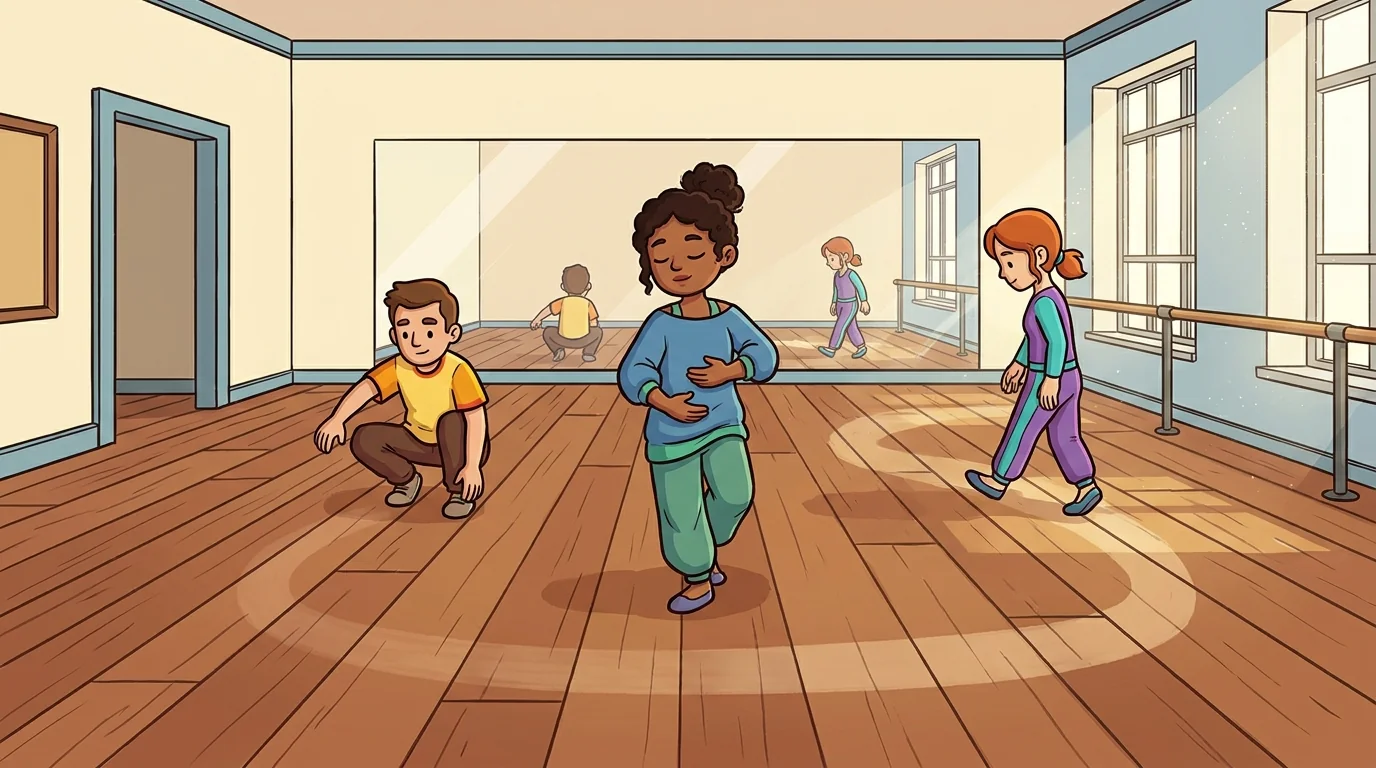
Three dancers stood in an empty studio with a wide wooden floor, and they were about to teach a nervous newcomer the thing that every dancer has to learn first — not a step, not a routine, but how to actually be in the space you're moving through.
Pose stood with eyes closed, feeling the exact shape of her own body from the inside.
Storey moved slowly up and down — sinking low, rising high — exploring the vertical.
And Trail walked a curving path across the floor, watching the invisible line her feet drew.
"You keep checking the mirror," Pose said kindly to the newcomer. "But dancing isn't about watching yourself. It's about feeling where your body is. Let me show you the first sense — the one you didn't know you had."
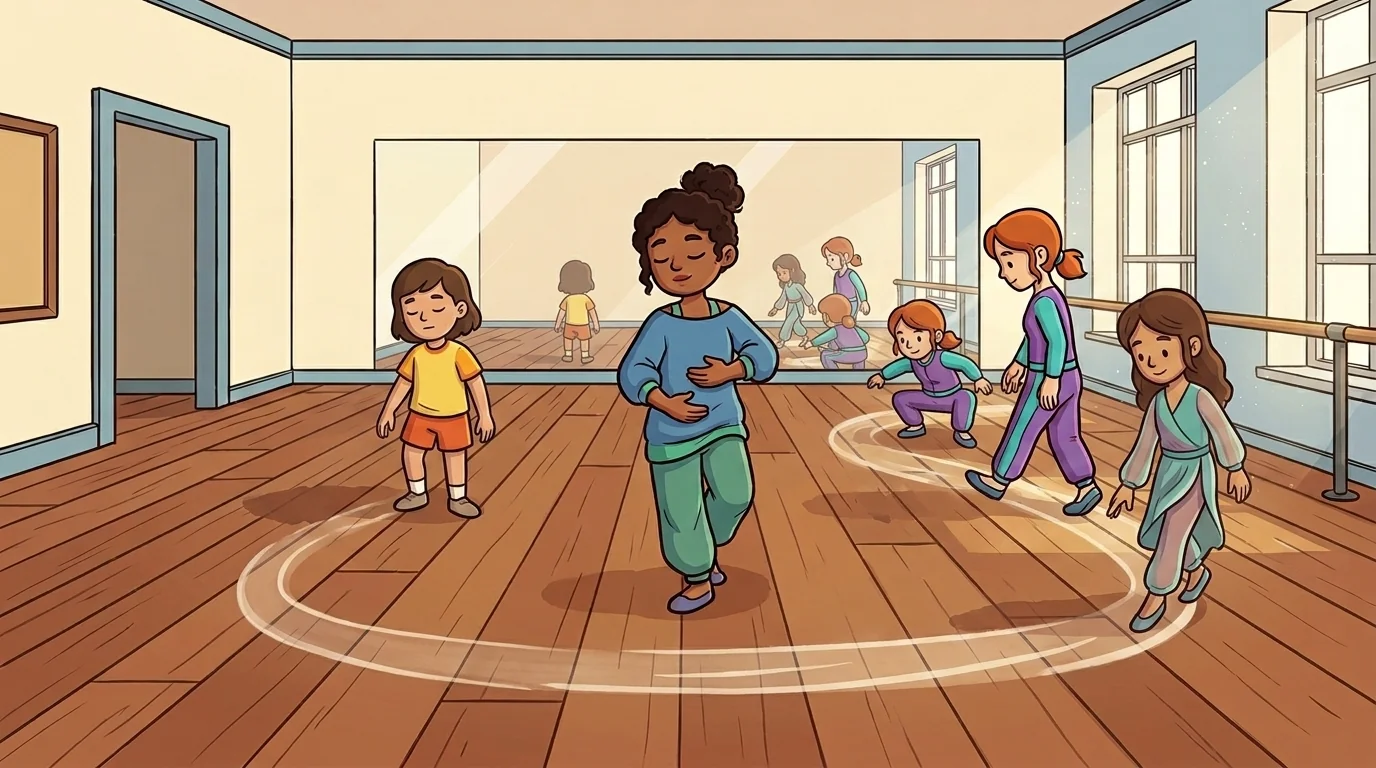
Pose went first, eyes still closed — because before you move well anywhere, you have to feel the shape you're in.
"Close your eyes," said Pose. "Now — without looking — can you feel where your arms are? How your spine is curved? Whether your weight is forward or back?" The newcomer tried, and found — to her surprise — that she could. "That's proprioception," said Pose. "Your body's sense of itself. It's the very first sense a dancer wakes up, because it's how you know the shape you're making without running to a mirror every second." Pose flowed slowly from one shape to another, eyes closed the whole time, feeling each one land. "A shape you can feel from the inside is a shape you actually own. When you only know your body by watching it, you're always a beat behind, always checking. But when you can feel it — really feel where every part of you is in space — the shape becomes yours, and you can trust it, and move from it. Start here. Learn to listen to your own shape."
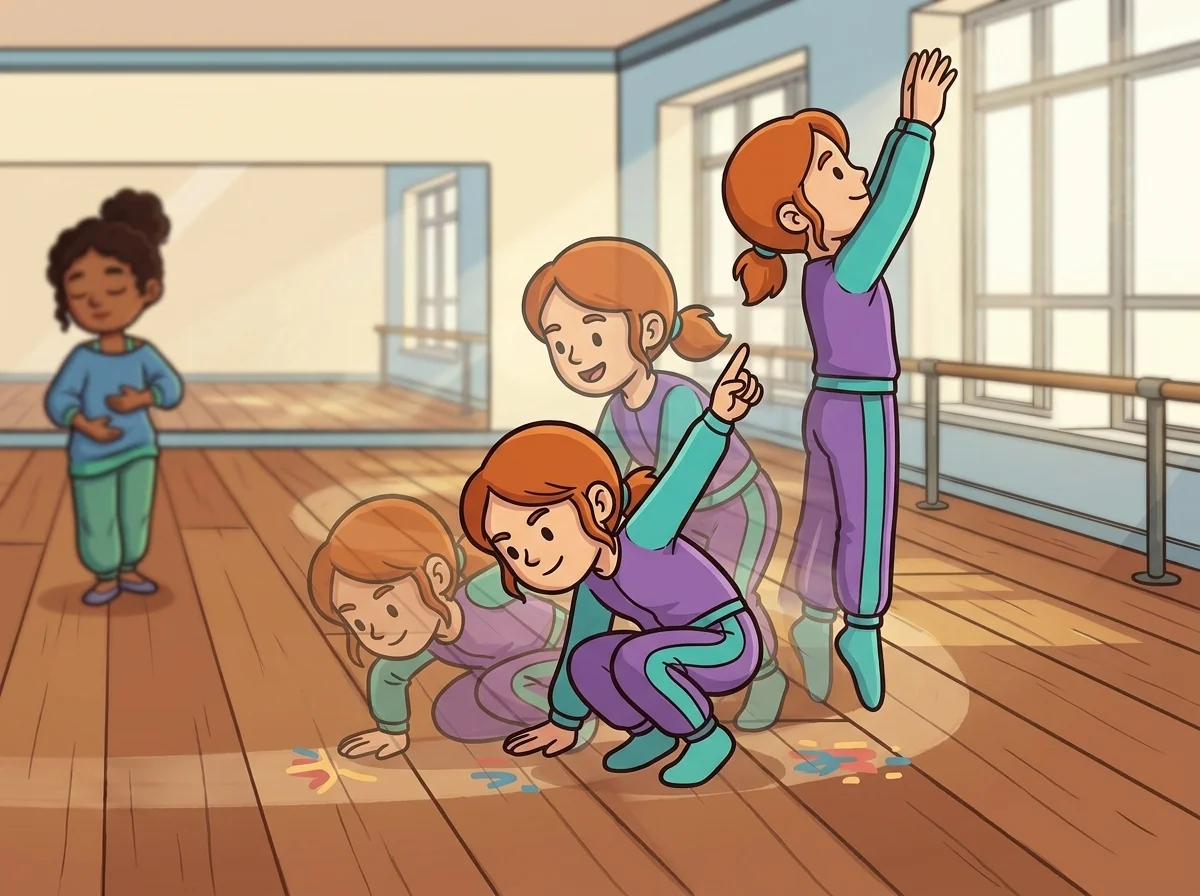
Then Storey rose and sank, exploring the up-and-down — because most beginners dance in a thin flat slice, and forget the whole vertical world.
"Watch where the newcomer dances," said Storey. "All at one height — standing, always standing, like there's a low ceiling and a high floor pressing them into one thin layer." Storey demonstrated the opposite: sinking all the way down to the floor, curling low; rising to the middle; stretching all the way up onto the toes, reaching high. "But the space isn't a thin slice — it's tall. There's a whole floor to sink into, a whole height to reach for, and every level in between." Storey moved through low, middle, high. "Level is one of the biggest, easiest ways to make movement interesting — the same gesture done low on the floor, then again up high, feels like two completely different things. A dancer who only ever moves at standing-height is using one shelf of a tall, tall cupboard. Use all of it — get low, get high, travel between. The vertical is yours too."
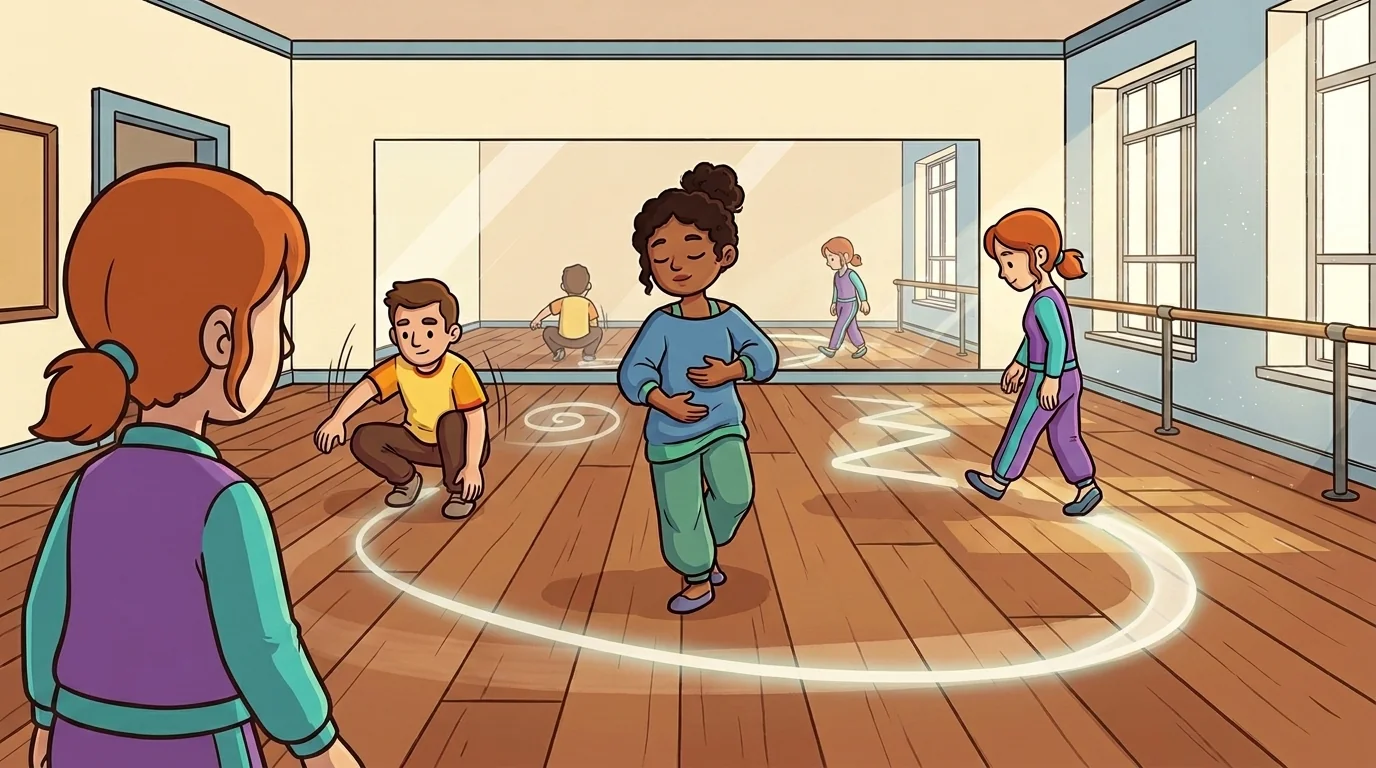
And then Trail walked a slow curving path across the wide floor, because a dancer doesn't just move their body — they draw, with their feet, across the space.
"Here's the one nobody notices," said Trail, "until you point at the floor. Every time you move across the space, your feet leave an invisible line — a pathway. Straight, curved, spiraling, zigzag." Trail walked a graceful arc, then a sharp angular path, then a spiral. "That's the trail. The shape you draw by traveling. And it matters more than you'd think — a dancer crossing the floor in a dead-straight line feels completely different from one carving a wide curve or spiraling into the center." Trail let the invisible line hang in the air behind. "Choreographers think about this constantly: where the dancers go, the patterns their paths make across the stage, the shapes the whole group draws by moving. You're not just a body making shapes in place. You're a pen, and the floor is your paper, and every path you travel is a line you're drawing. Move like you know you're drawing, and the whole floor becomes part of your dance."
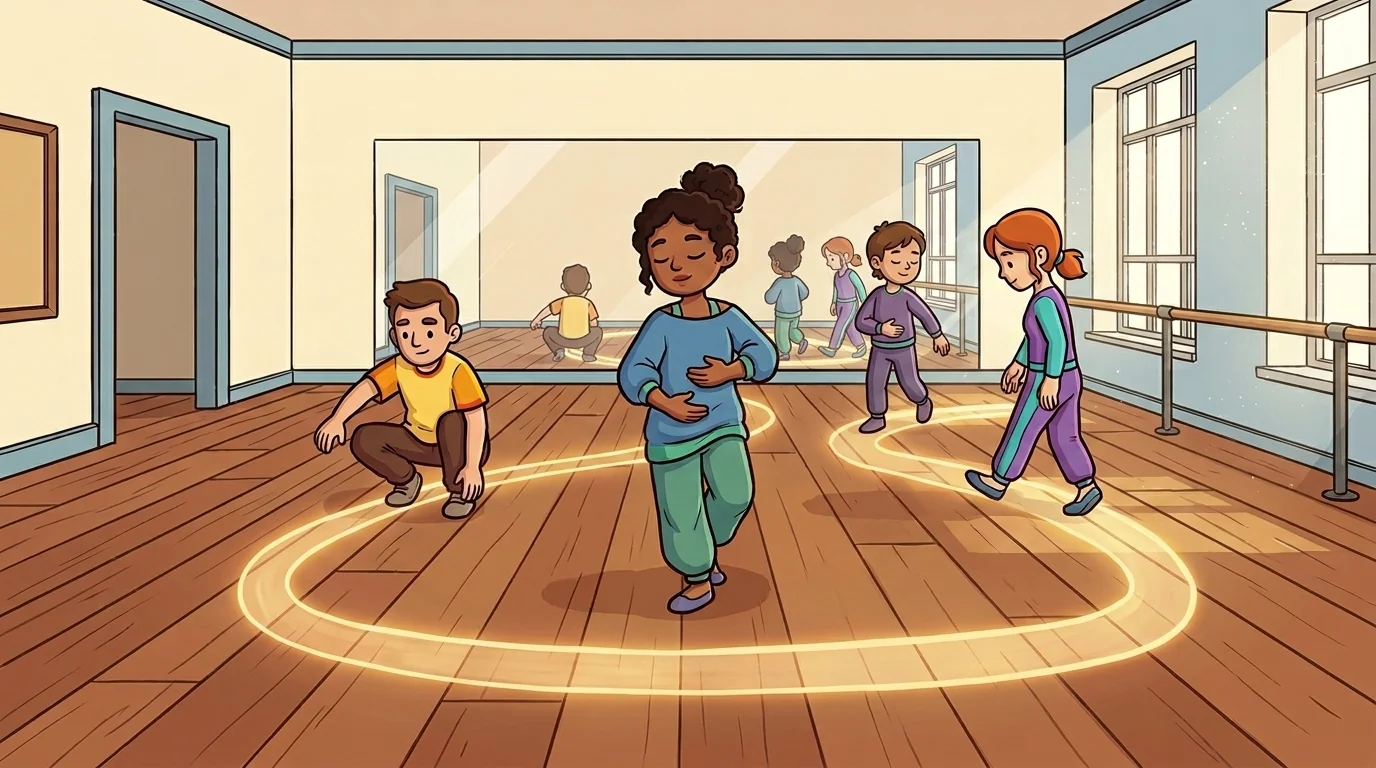
The newcomer tried all three at once — feeling her own shape, playing with high and low, curving her path across the floor — and something shifted. She stopped watching the mirror. She stopped performing. She was just... there, moving, fully inside the space and her own body at once.
"Good shape," said Storey.
"Good level," said Trail.
"Good pathway," said Pose.
There is a quiet, grounding joy in feeling truly at home in your own moving body — present in it, not anxiously watching it from outside, but simply being there, feeling your shape, playing with height, drawing your path across the floor. It's a feeling that has nothing to do with being the best dancer in the room and everything to do with being fully in your body instead of stuck in your head about it. And once you find it — that settled, present, at-home-in-your-own-motion feeling — dancing stops being something you perform for the mirror, and becomes something you simply, gladly, do.
The DanceQuest ensemble
Pose, Storey and Trail is part of DanceQuest's distributed-narrative cast. Each character embodies a different curricular primitive; together they teach the full subject.
-

Pose
Body-awareness + position — listening to your own shape
-

Trail
Space + pathways — the floor-pattern shapes you draw moving through space
-

Phrase
Time + tempo — how movement is organized in musical counts
-

Lift
Energy + effort + dynamics — quality of movement, not aesthetic judgment
-

Glide
Locomotion — the craft of going from here to there with whole attention
-

Flock
Formation — how a group of dancers arranges itself in space (lines, circles, clusters, wedges) and how that shape flows and changes; the group as one moving picture
-

Storey
Level — dancing in the vertical space: low on the floor, mid at standing, high in reaches and jumps; every height belongs to dance, no height better than another
-

Beckon
Call-and-response — one dancer or group makes a movement and another answers it; a movement conversation built on truly listening before you reply
-

Canon
Unison and canon — unison is everyone moving together as one; canon is the same move staggered one after another, rolling across the group like a wave
-

Bide
Stillness and the hold — the held, alive, motionless moment inside a dance; negative space made of time; a strong chosen pause, not tiredness or absence
-
The Company
The whole group dancing as one — how formation, level, call-and-response, unison and canon, and stillness weave together so a group of dancers moves as a single living thing