Ring
RESONANCE — *every object has a frequency it wants to vibrate at. push at that frequency, and small pushes become big motion.*
Listen along — Ring
Loading audio…
Press play to listen along. The line being read lights up as you go.
Show full transcript
Loading transcript…
Chapter 3 — Ring and the Frequency That Each Thing Wants
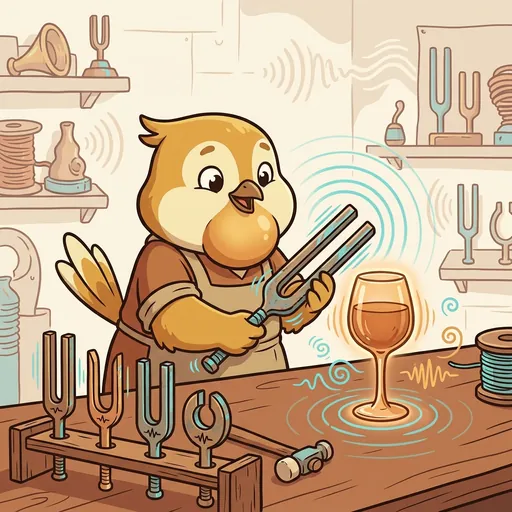
Ring hummed a quiet, resonant note deep in her throat, a sound like a tiny, perfectly tuned bell. Her throat, a bit chunky and warm-gold-and-cream, vibrated gently with the sound. Around her workbench, a small forest of tuning forks stood at attention. Each one was labeled with a number, its natural frequency written in neat, careful script. Ring, a bellbird-tween with an endless curiosity, loved finding the specific hum inside anything she could touch.
She picked up a fork marked “440 Hz.” It felt cool and smooth in her small hands. With a practiced tap against a soft block of wood, the fork sprang to life, singing a clear, steady A note. She held it close to a delicate wine glass, its rim thin and elegant. For a moment, nothing happened. Then, a faint, almost imperceptible shimmer began on the glass. A tiny, high-pitched ring, quiet at first, joined the tuning fork’s song. It grew, a ghost note echoing the fork, even though Ring hadn’t touched the glass itself.
“See that?” Ring whispered, her voice a soft chirp. “The glass is singing along. It found its partner.”
She moved the vibrating fork away from the first glass and held it near a second one. This one was thicker, its shape slightly different. The fork still hummed its 440 Hz tune. But the second glass stayed silent, stubbornly refusing to join the chorus. Not a single shimmer, not a whisper of a note.
“Same fork,” Ring said, tapping it again to refresh the sound. “Different glasses. The matched one rings. The unmatched one doesn’t.” She paused, letting the silence of the second glass speak volumes. “That’s the whole concept. That’s resonance.”
Ring believed that every object had a secret song, a natural frequency it wanted to vibrate at. It was like the pitch of her own voice, or the specific note a guitar string makes when plucked. If you pushed an object at that exact frequency, with the right rhythm, something amazing happened. Small pushes could build into something big.
“Think about pushing a swing,” she explained, gesturing with her hands. “If you push it at just the right moment, when it’s at the top of its arc, it goes a little higher each time. Push, push, push, and soon it’s soaring. That’s the right rhythm.” She paused, then added, “But if you push at the wrong time, when it’s coming back toward you, the swing just slows down. It doesn’t grow. The energy gets wasted.”
Her family had known this secret for generations. They were bell-tuners in the village bell towers, long before WaveForge existed. They were the bellbirds who knew how to make each massive bell ring its true note. They understood that choosing the right mallet, one that matched the bell’s own natural frequency, was everything. “Wrong mallet, wrong sound,” her grandmother used to say. “Right mallet, true ring.” Ring had carried that lesson forward. Every object, she knew, wanted to be rung at its own frequency.
When she first arrived at WaveForge at thirteen, Sonic, the mentor, had asked her a simple question. “What is resonance?” Ring hadn’t hesitated. “Every object has a frequency it wants to vibrate at,” she’d answered. “Push at that frequency, and small pushes become big motion. Like swings. Like wine glasses. Like radios. Right rhythm, right buildup. Wrong rhythm, no buildup.” Sonic had simply nodded. “You are appointed,” he’d said.
Now, in her workshop, Ring picked up a different tuning fork, this one labeled “523 Hz.” She tapped it, and a higher, brighter note filled the air. She held it near the first wine glass, the one that had sung with the 440 Hz fork. Nothing. The glass remained stubbornly silent.
“See?” she said, looking at the quiet glass. “It’s precise. You have to get the frequency exactly right. The system does the work for you then.”
Ring knew that many people thought of resonance as a scary, dramatic thing. They remembered YouTube videos of opera singers shattering wine glasses, or stories about the Tacoma Narrows bridge collapsing in a storm. But Ring always gently corrected them.
“Those are extreme cases,” she’d say. “Most resonance is small. It’s your voice sounding louder in the shower. It’s how a radio picks out one station from all the signals in the air. Or how a guitar string vibrates when another string is plucked nearby.”
She picked up a small, wooden model of a bridge, carefully crafted. “The Tacoma Narrows bridge,” she explained, running a finger along its miniature span. “Lots of people say it collapsed because of resonance with the wind. But it was actually something more complicated, called aerodynamic flutter. Resonance played a part, sure, but it wasn’t the whole story. Engineers and physicists are always careful to point that out.”
Ring believed that understanding resonance wasn’t about fear. It was about noticing the hidden rhythms of the world. It was about learning to listen for the secret song inside everything, and then, if you wanted to, finding the right rhythm to make it sing.
The WaveForge ensemble
Ring is part of WaveForge's distributed-narrative cast. Each character embodies a different curricular primitive; together they teach the full subject.