Ring
RESONANCE — *every object has a frequency it wants to vibrate at. push at that frequency, and small pushes become big motion.*
Listen along — Ring
Loading audio…
Press play to listen along. The line being read lights up as you go.
Show full transcript
Loading transcript…
Chapter 3 — Ring and the Frequency That Each Thing Wants
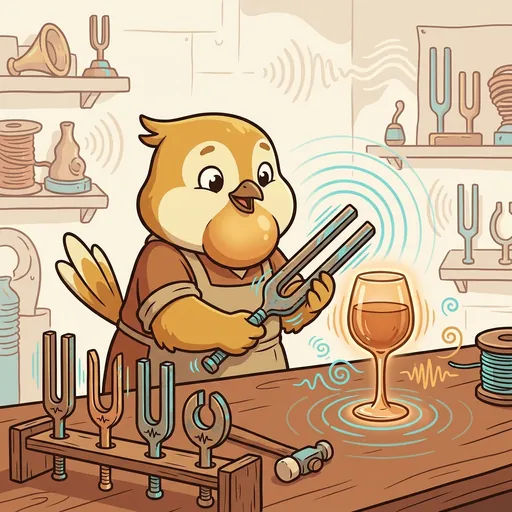
In her workshop at WaveForge, a small gold-and-cream bellbird-tween named Ring held a tuning fork close to a wine glass and did the tiniest thing.
She tapped the fork once. It hummed a clear, steady note. Then she just held it there, near the rim of the glass, not touching. For a moment nothing happened. Then — softly, all on its own — the wine glass began to sing. The same note, rising out of nothing, like the glass had woken up and decided to join in.
A cluster of students leaned in, wide-eyed.
“I didn’t touch it,” Ring said, grinning. “The fork’s note matched the note the glass already wanted to make. So the glass picked it up and started ringing along. Watch this.”
She stopped the fork, then held it near a taller, thinner glass. Tapped it again. This time — nothing. The tall glass stayed silent, still, uninterested.
“Same fork,” Ring said. “Different glass. This one wants a higher note than the fork is offering, so it just ignores it.” She tipped her head. “Every single thing — every glass, every string, every swing, every bridge, your own voice in the shower — has one note it secretly loves best. Find that note, hum it back, and the thing wakes up and rings with you. Miss it, and you can hum all day and it won’t budge.”
She set the fork down gently, as if it were a small living thing.
“That’s the whole secret,” she said. “It isn’t loud, and it isn’t scary. It’s a match.”
Ring learned about matching long before she had words for it.
She grew up in the bell-tower village, where her whole family were bell-tuners — the bellbirds who knew how to ring each great tower bell at its truest note. When Ring was small, she’d been given her very first bell and a whole rack of mallets, and told to make it sing.
She whacked it as hard as she could. It made an ugly, flat clunk. She tried a heavier mallet. Worse. She tried hitting it faster, harder, angrier — and by the end of the afternoon her wings ached and the bell sat there sounding like a dropped pot. She slumped against the tower wall, close to tears. I did everything I could think of, she thought, and it still won’t sing. Maybe I’m just no good at this.
Her grandfather climbed up beside her — an old bellbird with a soft, unhurried voice. He didn’t tell her to try harder. He picked up a small, light mallet she’d ignored, the one she’d been sure was too gentle to matter.
“You’ve been fighting it,” he said. “Listen.” He tapped the bell — barely, softly — with that little mallet. The bell opened up into a warm, ringing tone that filled the whole tower and hung in the air for a long time.
Ring stared. “But you barely touched it.”
“The bell only ever wanted one note,” he said. “My job isn’t to force a note into it. My job is to find the note it already has and give it the smallest right push.” He smiled. “Wrong mallet, wrong sound. Right mallet, true ring.”
Ring never forgot the feeling of that moment — the relief of it, the way the struggle just dissolved. It wasn’t about being stronger. It was about listening first.
She walked to WaveForge at thirteen, because a place that studied waves ought to understand the note that each thing secretly wants.
Sonic, the mentor who ran the workshops, met her at the gate. He didn’t ask her to prove she was clever. He asked one question. “What is resonance?”
Ring didn’t reach for a big word. She looked around, spotted a rope swing hanging from a beam, and gave it one gentle push. She waited. Just as it swung back to her, she pushed again — same small push, right on the beat. The swing went higher. She did it again, and again, always at that one exact moment, and soon the swing was arcing halfway to the ceiling on pushes no bigger than the first.
“Little pushes,” she said. “But only if I give them at the moment the swing’s already asking for one. Match its rhythm, and small becomes big.” She caught the swing and stilled it. “That’s resonance.”
Sonic watched the swing settle. “You belong here,” he said.
One afternoon a girl came into the workshop, frustrated and flat.
“I’ve been trying to get my recorder to make this one high note for a week,” she said. “I blow harder, I blow softer, nothing works. I think I’m just bad at it.”
Ring knew that slump. She’d felt it at the bottom of a bell tower once.
“Come here,” she said. She lined up three empty bottles, each filled to a different level. “Blow across the first one.”
The girl did. A low, hooting note came out.
“Now this one.” A middle note. “Now this.” A high, bright note.
“Same breath,” Ring said. “Three notes. The air inside each bottle only wants to shake one way, and that’s the note you get. You’re not making the note — you’re finding the one that’s already waiting in there.” She slid the tall bottle over. “Your recorder’s the same. Somewhere there’s exactly the right speed of air for that high note. Not harder. Not softer. Matched.”
The girl frowned, thought, then blew — slower, steadier, aiming instead of forcing. The clear high note leapt out, bright and easy.
Her whole face changed. “It just came,” she said. “I wasn’t even trying that hard.”
“That’s how you know you found it,” Ring said softly. “When the thing does most of the work for you. That’s not luck and it’s not muscle. That’s the match.” She smiled. “It’s the same trick everywhere — a swing, a bell, a radio finding one station out of the whole crackling sky, a glass singing next to a fork. Nothing wants to be forced. Everything wants to be met.”
Later, when the workshop had emptied, the girl came back with a quieter question.
“When it clicks like that,” she said, “and it stops feeling hard… why does it feel so good?”
Ring thought about the tower, and the little mallet, and the bell that finally sang.
“Because for a second you stop pushing against something,” she said, “and start moving with it. You spend so long feeling like you have to be stronger, or better, or you’ll never get it. And then you find the right rhythm, and all that fighting just… lets go.” She looked toward the row of bottles, still faintly humming in the quiet. “The struggle doesn’t vanish because you got tougher. It vanishes because you finally listened to what the thing was asking for all along.”
The girl nodded slowly, and Ring watched the tightness ease out of her shoulders — the same soft, spreading relief she’d felt herself, years ago, at the bottom of a tower, when a bell she’d been fighting all day finally opened up and sang.
The WaveForge ensemble
Ring is part of WaveForge's distributed-narrative cast. Each character embodies a different curricular primitive; together they teach the full subject.