Pulse
WAVE BASICS — every wave has three numbers: how fast, how big, how long.
Listen along — Pulse
Loading audio…
Press play to listen along. The line being read lights up as you go.
Show full transcript
Loading transcript…
Chapter 1 — Pulse and the Three Numbers
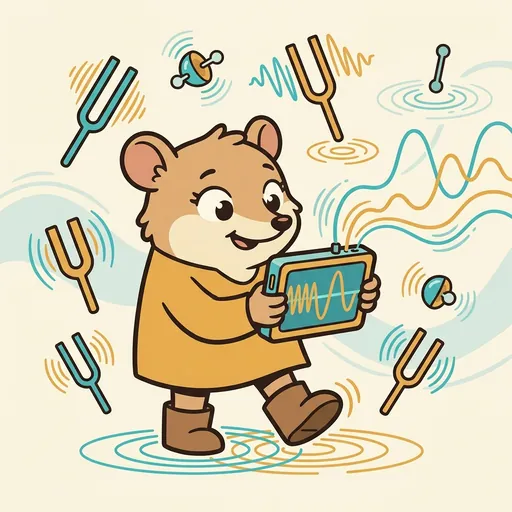
In the middle of the noisy WaveForge market, a shrew-tween named Pulse held up a small handheld screen and pointed it at a boy who was shouting for someone to buy his apples.
Her foot was tapping. It was always tapping.
“Shout again,” she said. “Louder.”
The boy shouted louder. On Pulse’s little screen, a green line jumped — it climbed into a tall, spiky wave that stretched almost to the top edge. “Taller,” she murmured, delighted. “Now whistle.”
He whistled, confused. The line changed completely: the tall spikes shrank, and the wave started repeating fast, fast, fast, packing wiggle after wiggle into the same slice of screen.
“See that?” She turned the screen so he could look. “Your shout and your whistle are both just air, wobbling. But they’re different wobbles. The shout was big — that’s why the line got tall. The whistle was fast — that’s why the wiggles crowded together.” She tapped the screen with one claw. “This little card catches sound and draws it. Your voice is a wave, and now you can see it.”
The boy stared at the green line still trembling from his whistle. “It’s a picture of my voice?”
“It’s a picture of every voice. Every wave, really.” Pulse’s foot kept its steady beat against the cobblestones. “Sound. A plucked string. Ripples on a pond. They all wobble, and they all leave a shape on this screen. And once you can see the shape, you stop being afraid of it.” She grinned. “Sing me something. Let’s watch it.”
Pulse had grown up in a small clinic where her family listened to heartbeats.
They were healers, her grandmother and her aunts, and they didn’t have fancy machines — just curved ear-trumpets they pressed to a patient’s chest. As a very small shrew, Pulse used to sit in the corner and watch her grandmother listen, eyes closed, foot tapping softly along.
“How do you hear anything in there?” Pulse had asked once. “It just sounds like thumping to me.”
Her grandmother had opened her eyes and smiled. “Because you’re only hearing noise. I’m listening for three things.” She’d held up three wrinkled fingers. “How fast it beats. How strong each beat is. And whether it keeps a steady pattern, or stumbles.” She lowered her hand. “A frightened heart runs fast and thin. A resting heart is slow and full. A sick heart loses its pattern. The heart can’t lie, little one — it tells the whole story in those three things, if you know to count them.”
Pulse remembered the exact moment it clicked — sitting in that quiet corner, foot tapping, suddenly understanding that the messy thumping wasn’t messy at all. It was organized. It had a fast, a big, and a long, hidden inside it, waiting for someone patient enough to count.
She never forgot the feeling. Not the words — the feeling. The world stopped being a blur of noise and became something she could measure.
She walked to WaveForge when she was twelve, because a place that studied waves ought to understand the kind she’d grown up counting.
Sonic, the mentor who ran the workshops, met her at the gate. He didn’t ask her to prove she was clever. He asked one thing. “What is a wave?”
Pulse didn’t answer right away. She pulled out her oscilloscope-card, held it up between them, and tapped the cobblestone twice with her foot — tap, tap. The screen drew two neat bumps.
“A wave is a wobble that travels,” she said. “Sound is air wobbling. Light is a wobble too, moving through space. My whole life, I’ve been watching one kind — heartbeats.” She tapped faster, and the bumps crowded together on the screen. “But they all work the same. Every single one has three numbers. How fast it repeats. How big it is. How long each piece stretches out.” She looked up at him. “Count those three, and you know the wave.”
Sonic looked at the little green line still bouncing on her card. “You are appointed,” he said.
Pulse’s workshop was the loudest room in WaveForge, and she liked it that way.
A girl came in one afternoon, arms crossed, scowling. “My teacher keeps saying ‘frequency’ and ‘amplitude’ and ‘wavelength,’” she said. “It sounds like a spell. I don’t get any of it and I feel stupid.”
Pulse knew that scowl. It was the scowl of someone hearing only noise.
“Come here. Whistle at this.” The girl whistled. The screen filled with tight, fast wiggles. “Those wiggles, packed close — that’s high frequency. It just means repeats fast. That’s a high note.” She held up one claw. “That’s number one. How fast.”
The girl uncrossed her arms a little.
“Now yell.” The girl yelled. The wiggles stayed the same speed — but the whole line shot up tall. “Same note. But look how tall it got. That’s amplitude. It just means how big. Louder sound, taller wave.” Two claws now. “Number two.”
“That’s… it? That’s amplitude? Just how loud?”
“Just how loud. Now hum me something really low.” The girl hummed. The wiggles stretched out long and lazy across the screen. “See how far apart the bumps are? That’s wavelength — how long each piece is. Low sounds stretch out. High sounds bunch up.” Three claws. “Number three. That’s the whole thing.”
The girl stared at the screen, then at her own throat, then back. “Those aren’t spells,” she said slowly. “They’re just… measurements. Like inches. Like seconds.”
“Exactly like inches and seconds,” Pulse said. “Fast, big, long. Count all three, and there’s no wave in the world you can’t read.”
Later, when the workshop had emptied out, the girl came back for one more question. She was quieter now.
“When I couldn’t see it,” she said, “the words felt huge. Like I’d never be smart enough. And now they feel small.” She frowned, trying to find it. “Why did it feel so different?”
Pulse thought about the corner of the clinic. About the messy thumping that turned out to be counting. About her foot, tapping, tapping, all those years.
“Because a word you can’t see feels like a locked door,” she said. “But a wave isn’t hiding anything from you. It’s the most honest thing there is. It shows you its three numbers whether you’re clever or not — you just have to slow down and look.” She set the card on the bench between them, its green line resting flat and calm. “That heavy, dumb, locked-out feeling you walked in with? That was never you being slow. That was just a wave you hadn’t watched yet.”
The girl nodded, and Pulse saw the scowl slide off her, the way a taut line goes soft when the yelling stops.
She didn’t say the rest out loud, but she felt it settle in her chest, warm and sure — the same steady, unafraid feeling she’d carried out of that clinic corner years ago, foot tapping, the whole loud world suddenly hers to count.
The WaveForge ensemble
Pulse is part of WaveForge's distributed-narrative cast. Each character embodies a different curricular primitive; together they teach the full subject.