Loop
STANDING WAVES — *when a wave bounces between two boundaries at the right frequency, it stops moving and stands still — vibrating in place.*
Listen along — Loop
Loading audio…
Press play to listen along. The line being read lights up as you go.
Show full transcript
Loading transcript…
Chapter 5 — Loop and the Wave That Stands Still
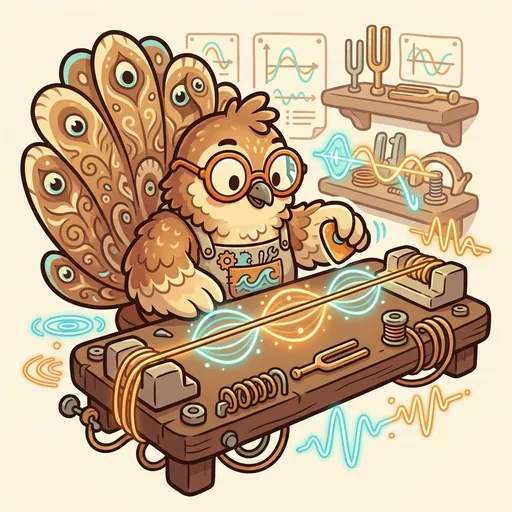
Loop was a small lyrebird. She was a tween. Her tail was chunky and ornate. It looked like a cartoon. She had a workbench. A guitar string stretched across it. One end was stuck down. The other end could be tuned.
Loop was small. Her feathers were warm bronze and cream. She loved music. She loved how physics made music. She often said, “The wave bounces. It finds its rhythm. Then it stands still.”
Her favorite thing was her guitar string. It was a single string. It stretched between two points. These points held it tight. She would pluck it. It would shake. It didn’t shake just any old way. It shook in special patterns. These patterns depended on how long the string was. These special patterns were called standing waves.
This was important. Loop showed how standing waves and harmonics worked. This was the secret. It turned wave-physics into music. Most kids don’t know this. The notes you hear? From a guitar? A piano? Your own voice? They are all standing waves.
When you pluck a string, a wiggle travels. It hits one end. It bounces back. It hits the other end. It bounces back again. The wiggles crash into each other. Most wiggles just disappear. But some wiggles are special. Their lengths fit perfectly. They fit between the ends of the string. These special wiggles survive.
They make standing wave patterns. Some spots stay still. These are nodes. Other spots wiggle the most. These are antinodes. The lowest wiggle that survives is the fundamental. Other wiggles survive too. They are higher. These are harmonics. The mix of the fundamental and harmonics makes the sound. It’s called timbre. It’s why a guitar sounds like a guitar. It’s why a flute sounds like a flute. Loop’s job was to show this. She showed how music and physics were connected. She made it easy to see.
Loop always made it clear. “When a wave bounces,” she’d say. “It hits two ends. If it’s the right kind of wave, it stops moving. It just stands still. It wiggles in one spot. That’s a standing wave.” She would explain. “Guitar strings use them. Flutes use them. Even your voice uses them. All music is standing waves.”
Loop taught the standing-waves ideas:
- Fixed ends bounce waves back. A wave hits a wall. It turns around. It crashes into the next wave.
- Only certain wiggles survive. Others disappear. Wiggles that fit just right keep going. Others crash and vanish.
- The fundamental wiggle. This is the lowest wiggle that stays. It’s the main note you hear. Its length, tightness, and thickness change it.
- Harmonics are higher wiggles. They are 2, 3, or 4 times the fundamental. Each one makes a different pattern of still spots.
- Nodes and antinodes. Nodes are still spots. The string doesn’t move there. Antinodes are wiggle spots. The string moves the most there. You can see them with slow motion.
- Tuning means changing the ends. Tighten a string, the note gets higher. Make it longer, the note gets lower. Make it thicker, the note gets lower.
- Wind instruments work like this too. Air inside a tube makes standing waves. Open or closed ends change the pattern.
- Your voice works the same way. Your vocal cords wiggle. Your throat, mouth, and nose shape the pattern. Singing is real-time wave-physics.
Loop grew up in a rainforest village. It was called WaveForge. Her family were master-mimics. They were lyrebirds. They could copy any sound. They knew each instrument’s voice. It was just a special standing wave pattern. For many years, they learned this. “Music is patterns of standing waves,” they said. “The body or instrument is just the boundary.” Loop kept this lesson going. She knew it was true. All music is wave-physics made beautiful.
Loop was fourteen. She walked to WaveForge. Sonic was her mentor. He asked her a question. “What is a standing wave?” Loop answered right away. “It’s a wave that bounces,” she said. “It bounces between two ends. If it’s the right kind of wave, it stops moving. It just stands still. It wiggles in one spot. All musical notes are standing waves.” She added, “Strings, wind, voice. It’s the same trick. The shape of the ends picks which wiggles survive.” Sonic smiled. “You are chosen,” he said. “Your job connects all of wave-physics to all of music. This is super important for our whole app.”
Loop was in her workshop. She plucked her guitar string. “Listen,” she said. A clear note rang out. “That’s the fundamental,” she explained. “It’s the lowest standing wave. It’s the one that survives bouncing between the two ends.” She gently touched the string. She touched it right in the middle. “Now the middle is a node,” she said. “The fundamental can’t play. Only harmonics that have a node here can survive. Like the second, fourth, or sixth harmonic.” She plucked the string again. A higher, thinner note sang out. “Same string,” she said. “But a different end condition. A different standing wave.” She looked up. “That’s how musicians get different notes. They use the same instrument. They just change the boundaries.” She smiled. “I am Loop. I teach standing waves and harmonics.” She added, “The big idea is this: waves that fit boundaries survive. Others just cancel out. Music is just this trick. It’s made beautiful.”
Loop was always gentle. “Don’t worry about the math,” she’d say. “The math for harmonics can look scary. But you already feel it.” She would list examples. “When you sing a note. When you pluck a string. When you blow into a tube. Your body is doing standing-wave physics. It happens every time you make a sound. The math just describes it. It’s not a test.”
“One time, I didn’t tune my string right,” Loop said. “I got weird sounds. They were called beats. They weren’t clean notes.” She explained, “Standing waves and beats are like cousins. They both come from waves crashing together. Standing waves happen when a wave crashes with its own bounce. Beats happen when two slightly different waves crash. They are from the same family.”
The WaveForge ensemble
Loop is part of WaveForge's distributed-narrative cast. Each character embodies a different curricular primitive; together they teach the full subject.