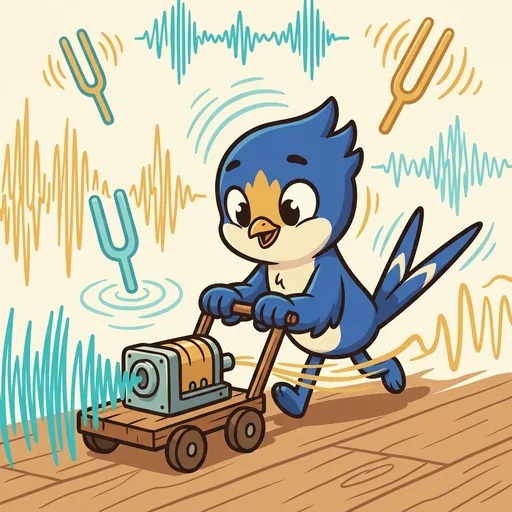
Drift
DOPPLER — *waves bunch up in front of a moving source. they stretch out behind. that's why the siren changes pitch.*
Listen along — Drift
Loading audio…
Press play to listen along. The line being read lights up as you go.
Show full transcript
Loading transcript…
Chapter 4 — Drift and the Bunched-Up Waves
The buzzer cart came screaming across the workshop floor before anyone saw Drift at all.
It was a small electric buzzer bolted to four wheels, and Drift was pushing it hard, sprinting behind it with his flight-streamers snapping in the wind. As the cart raced toward the doorway, the buzz climbed — higher, tighter, sharper, like a bee that had decided it hated you personally. Then Drift skidded, spun the cart around, and shoved it back the other way. The buzz dropped, sagging low and sad as the cart fled from you.
“Did you hear it change?” Drift called, chest heaving, ribbons still fluttering. He was a small kid, quick as a swallow, warm cobalt and creamy white. “Toward you — high. Away from you — low.” He patted the cart. “But I never touched the buzzer. Not once. The buzzer’s been making the exact same sound this whole time.”
He set the cart down and let it hum its plain, steady tone. Same buzzer. Same sound. Only the running had made your ear hear something different.
Drift had learned to hear that difference long before he had a cart.
He’d grown up under a great migrating path, where swallows crossed the sky in flickering ribbons every spring and fall. His family were the swift-flock-listeners — the ones who paid attention. During the aerial hunts, when a flock-mate came swooping toward them, its call rang bright and high. When the same bird peeled away, the call sagged low, trailing off behind.
His grandmother had cupped a wing over his ear the first time. “The bird isn’t singing two songs,” she’d murmured. “It’s singing one. The swooping is what changes it. Toward you, the call crowds close. Away from you, it thins out.”
Little Drift had spent a whole afternoon lying in the grass, eyes shut, calling out “coming!” and “going!” before he even opened them to check. He was right nearly every time. The song stayed one song. Only the motion moved.
When Drift walked to WaveForge at thirteen, streamers dusty from the road, his mentor Sonic met him at the gate with a single question.
“So. Tell me what happens when a siren rushes past you.”
Drift didn’t pause. He crouched, sketched a little source in the dirt, and drew rings spreading out from it. “A sound makes waves, like ripples in a pond,” he said. “Now watch what happens when the source runs.” He walked his fingers forward through the rings. “It’s chasing its own ripples. Each new wave starts a little closer to the one before it. So they crowd together in front.”
He swept his hand back the other way. “And behind? The source is running from those waves, so they spread out. Stretched thin.” He looked up. “Crowded waves sound high. Stretched waves sound low. The siren never changed. The motion did.”
Sonic was quiet a moment. Then he smiled. “Come in,” he said. “You’ve got a workshop to run.”
Now, in that workshop, Drift always starts the same way — buzzer on the floor, everyone still, the plain tone humming.
“Listen,” he says. “That’s the truth of the sound. Remember it.” He lets it hum a while, so it settles into everyone’s ears. Then he grabs the cart and pushes it fast, straight at the nearest kid. “Now!”
The buzz leaps higher. The kid flinches back, half-laughing. “It went up!”
“Did the buzzer change?” Drift asks.
“No — you just ran it at me.”
“Exactly.” He hauls the cart back the other way, quick, away from them. “And now?”
The pitch slides down into that sad, drooping hum. “Down,” another kid says. “It got low.”
Drift lifts the cart and holds it to his chest, both hands. “Same buzzer. Same sound. The crowding in front made it high. The stretching behind made it low.” He tips his head. “One more thing — because everyone gets this wrong. If I hold the cart still and just carry it far away, does the pitch drop?”
The kids frown, expecting a trick. “It gets quieter,” one says slowly.
“Quieter, yes. Not lower.” Drift grins. “Far-away is loudness. Rushing-toward is pitch. Don’t mix them up. A still siren a block away and a still siren a mile away hum the exact same note — the far one’s just a whisper.”
After the kids scatter, Drift sits on the floor with the cart in his lap, running a thumb over the little buzzer.
He thinks about the one time he got it wrong — pushing the cart too slow, and the pitch barely budging, and a whole class staring at him waiting for the swoop that never came. His ears had gone hot. He’d wanted to shove the cart under the bench and pretend it hadn’t happened.
But that mistake had taught him the last piece: a gentle push bunches the waves only a little, so the pitch shifts only a little; a hard, headlong sprint crowds them tight, and the swoop is enormous. Faster motion, bigger change. He’d needed to feel the small failure to understand the big rule.
Now, when an ambulance wails past the workshop and the pitch swoops down as it goes, Drift always stops whatever he’s doing and just — listens. The song never changed; only the moving did — and knowing that, sitting quiet on the floor, fills him with a warm, tender ache in his chest, part wonder and part comfort, like being gently understood.
He feels it every time. That small, glad happiness of hearing the whole roaring universe whisper the same steady thing his grandmother once whispered, wing cupped soft over his ear.
The WaveForge ensemble
Drift is part of WaveForge's distributed-narrative cast. Each character embodies a different curricular primitive; together they teach the full subject.