Loop
STANDING WAVES — *when a wave bounces between two boundaries at the right frequency, it stops moving and stands still — vibrating in place.*
Listen along — Loop
Loading audio…
Press play to listen along. The line being read lights up as you go.
Show full transcript
Loading transcript…
Chapter 5 — Loop and the Wave That Stands Still
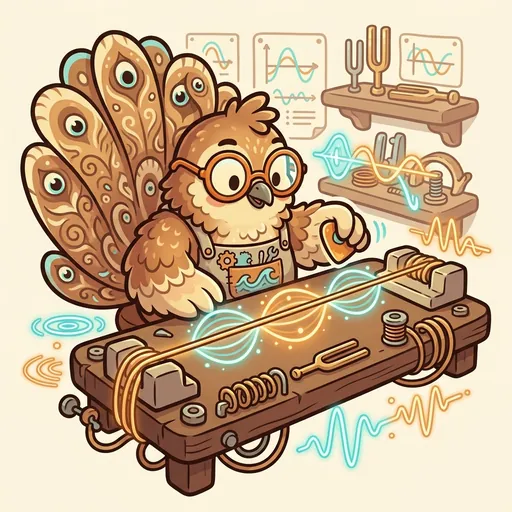
Loop was a blur of warm bronze and cream, a lyrebird-tween with a tail like a chunky, ornate fan. She hummed a low, resonant note, her head tilted, listening to the subtle vibrations of the air. Her small workbench, tucked away in a quiet corner of WaveForge, held a single guitar string. It stretched taut between two anchor points, one fixed, the other tunable with a tiny, gleaming peg. This simple setup was her world.
Loop loved to say, “The wave bounces, finds its rhythm, and stands still.” She believed this was the secret heart of all music. She was deeply curious about how physics turned into sound, how invisible forces shaped the songs we hear. Her signature demonstration always started with that single string.
She reached out, her small fingers hovering over the string. Then, with a quick, precise pluck, she sent a ripple along its length. The string blurred, vibrating so fast it seemed to disappear. A clear, ringing note filled the air.
“See it?” Loop asked, her voice soft but bright. “The disturbance travels, right? It hits the ends, those fixed points, and bounces back.” She gestured to the anchor points. “Like a ball hitting a wall.”
The wave, she explained, didn’t just bounce once. It bounced back and forth, interfering with itself. Most of the time, these returning waves would crash into each other, canceling out the sound. But certain frequencies, she showed, were different. Their wavelengths fit perfectly between the boundaries. These special waves reinforced each other, creating a stable pattern. They formed what she called standing waves.
“Most people don’t realize,” Loop continued, “that the notes you hear from a guitar, a piano, or even your own voice, are all standing waves.” She watched the string, now vibrating steadily. “The wave stops moving forward. It just stands there, vibrating in place. That’s a standing wave.”
She pointed to the string. “See how it blurs widest in the middle? That’s an antinode, where the string moves the most.” Her finger then traced the points where the string met the anchors. “And here, at the ends, it barely moves at all. Those are nodes, the still points.”
The lowest frequency that could form a standing wave on that string, the one she’d just plucked, was the fundamental. “It’s the main note you hear,” she clarified. “The musical note.” But the string could also vibrate in other ways, at higher frequencies that were multiples of the fundamental. These were the harmonics. Each harmonic created a different pattern of nodes and antinodes, adding layers to the sound.
“The mix of fundamental and harmonics,” Loop explained, “that’s the timbre. It’s what makes a guitar sound like a guitar and a flute sound like a flute. It’s the voice of the instrument.” Loop’s whole purpose was to make this connection, this “music-from-physics,” visible and understandable.
She grew up in the rainforest village, a place called WaveForge. Her family had been master-mimics for generations, lyrebirds who could imitate any sound. They learned early that each instrument’s voice, every bird call, every rustle of leaves, was just a particular pattern of standing waves. Over many generations, they understood that “music is patterns of standing waves; the body or the instrument is just the boundary.” Loop carried that lesson forward, convinced that all music was wave-physics made beautiful.
She remembered the day she walked to WaveForge at fourteen. Sonic, her mentor, had asked her a single question.
“What is a standing wave?” Sonic had asked, his voice deep and calm.
Loop hadn’t hesitated. “It’s a wave that bounces between two boundaries at the right frequency. It stops moving, standing still while vibrating in place. All musical notes are standing waves. String, wind, voice—it’s the same trick. The shape of the boundary picks which frequencies survive.”
Sonic had smiled. “You are appointed, Loop. And your appointment connects all of wave-physics to all of music. That’s essential for the whole app’s reason-for-being.”
Back in her workshop, Loop plucked her guitar string again. “Listen.” A clear, bright note rang out. “That’s the fundamental. The lowest standing wave that survives, bouncing between the two ends.”
Then, with a feather-light touch, she placed her finger exactly in the middle of the string. The note instantly changed. It became higher, thinner, almost ethereal. “Now the middle is a node,” she explained. “My finger stops it from moving there. The fundamental is suppressed. Only harmonics that naturally have a node in the middle can survive now. The second harmonic, the fourth, the sixth.”
She plucked again. The higher, thinner note sang out. “Same string,” she said, her eyes shining. “Different boundary condition. My finger created a new node. Different standing wave. That’s how musicians get different notes from the same instrument. By changing boundaries.”
“I am Loop,” she announced, as if to an invisible audience. “The primitive I teach is standing waves and harmonics. The move is: waves that fit boundaries survive; others cancel. Music is just this trick, made beautiful.”
She often spoke gently to newcomers. “Don’t be intimidated by the math of harmonics. You already feel it. Singing a note. Plucking a string. Blowing through a tube. Your body is doing standing-wave physics every time you make a sound. The math is just the description.”
She once told a story about a mistake. “I missed tuning the string once,” she recalled, a faint frown creasing her brow. “Instead of clean notes, I got these weird wobbles, like two sounds fighting each other. Those were beats.” She paused, reflecting. “Standing waves and beats are cousins. Both come from wave interference. Standing waves are interference with reflection, when a wave meets itself. Beats are interference between two slightly different frequencies. Same family, just a different kind of meeting.”
The WaveForge ensemble
Loop is part of WaveForge's distributed-narrative cast. Each character embodies a different curricular primitive; together they teach the full subject.