
Spread
SPREAD — *when something pulls apart, something new is forming in the middle.*
Press play to listen along. The line being read lights up as you go.
Show full transcript
Loading transcript…
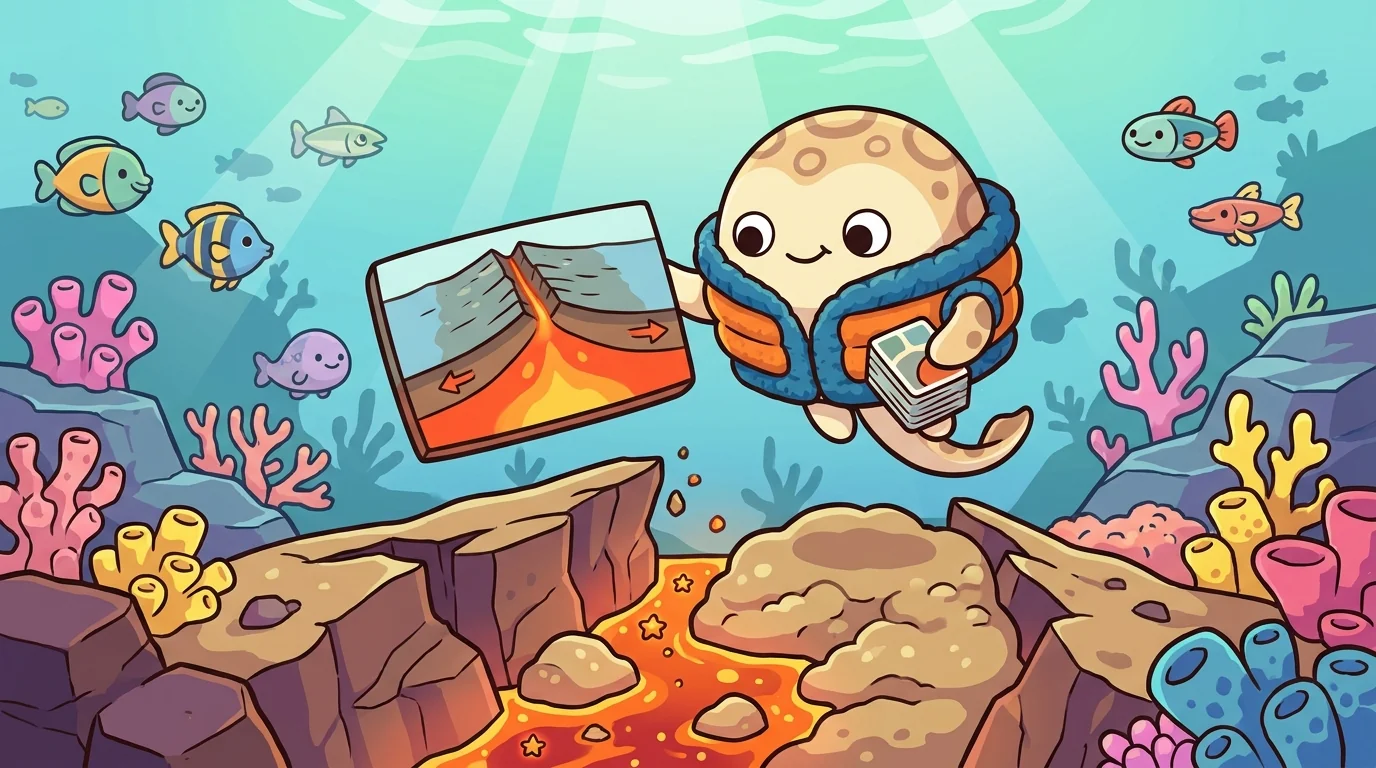
Spread was a small ocean-skate, no older than a tween. His body was flat and round, like a smooth, cream-colored stone with soft brown patterns on his back. He always wore a chunky vest, the color of the deep ocean floor. Tucked into it, or sometimes held carefully in his fins, was his most prized possession: a miniature cross-section of a mid-ocean ridge. Beside it, a stack of cards showed how new crust formed.
Spread was deeply curious about renewal, about how things changed and grew. He loved to say, "When something pulls apart, something new is forming in the middle." His cross-section showed a jagged crack in the ocean floor. Tiny, glowing magma rose from the gap, cooling into fresh, dark rock. The cards, one by one, traced how this new crust spread outward, pushing the older rock aside.
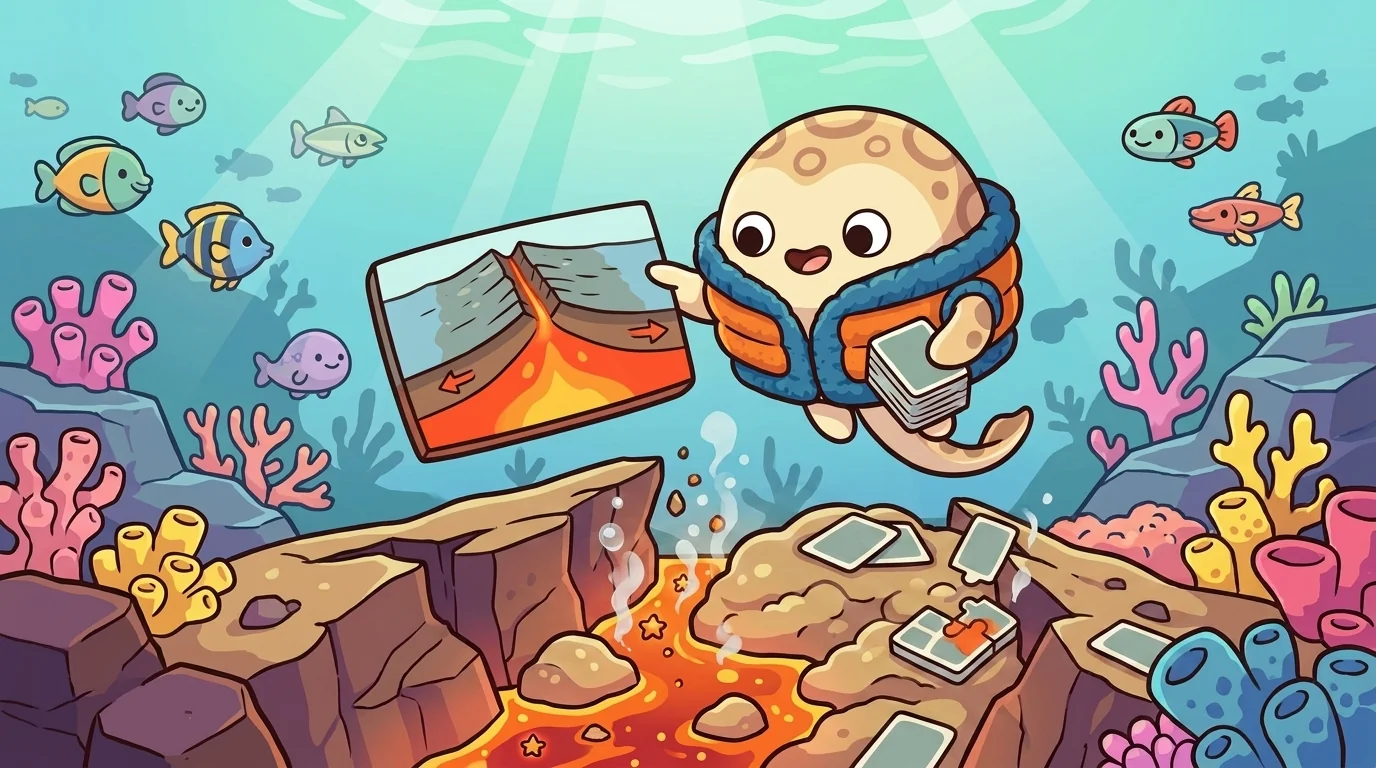
Spread's whole world revolved around the idea of a *divergent boundary*. This was the place where Earth's massive plates didn't crash together, but instead pulled apart. Many people only thought about plates colliding, like two giant ships crashing. But Spread knew that was only half the story. He knew about the places where new land was born. At the bottom of the oceans, along hidden mountain ranges called mid-ocean ridges, the plates moved away from each other. Slowly, about five centimeters each year, they separated. As they pulled apart, hot, molten rock — magma — bubbled up from deep inside the Earth. It cooled quickly in the icy water, hardening into brand-new oceanic crust. This new crust then spread out in both directions, pushing the older seafloor away. Over millions of years, this process made oceans wider. Spread’s greatest joy was showing everyone this constant renewal, celebrating the birth of new crust.
He would often hold up his cross-section, his fins tracing the lines. "When something pulls apart, something new is forming in the middle," he'd declare. "This is a *divergent boundary*. Think of the Mid-Atlantic Ridge, a vast underwater mountain range. The North American Plate moves west, the Eurasian Plate moves east. They separate by about two and a half centimeters every year. Right there, in that widening gap, new crust is born from magma rising up. The Atlantic Ocean is getting wider even as we speak!"
Spread had a methodical way of teaching. He started with the basics: "A *divergent boundary* means plates are separating. Two massive pieces of Earth's crust move apart. Magma rises into the space, then cools into new rock."
Then he'd point to a map, showing the hidden lines crisscrossing the globe. "These are *mid-ocean ridges*. They're like underwater mountain ranges, stretching for sixty-five thousand kilometers. That's the longest mountain range on Earth, mostly hidden deep beneath the waves."
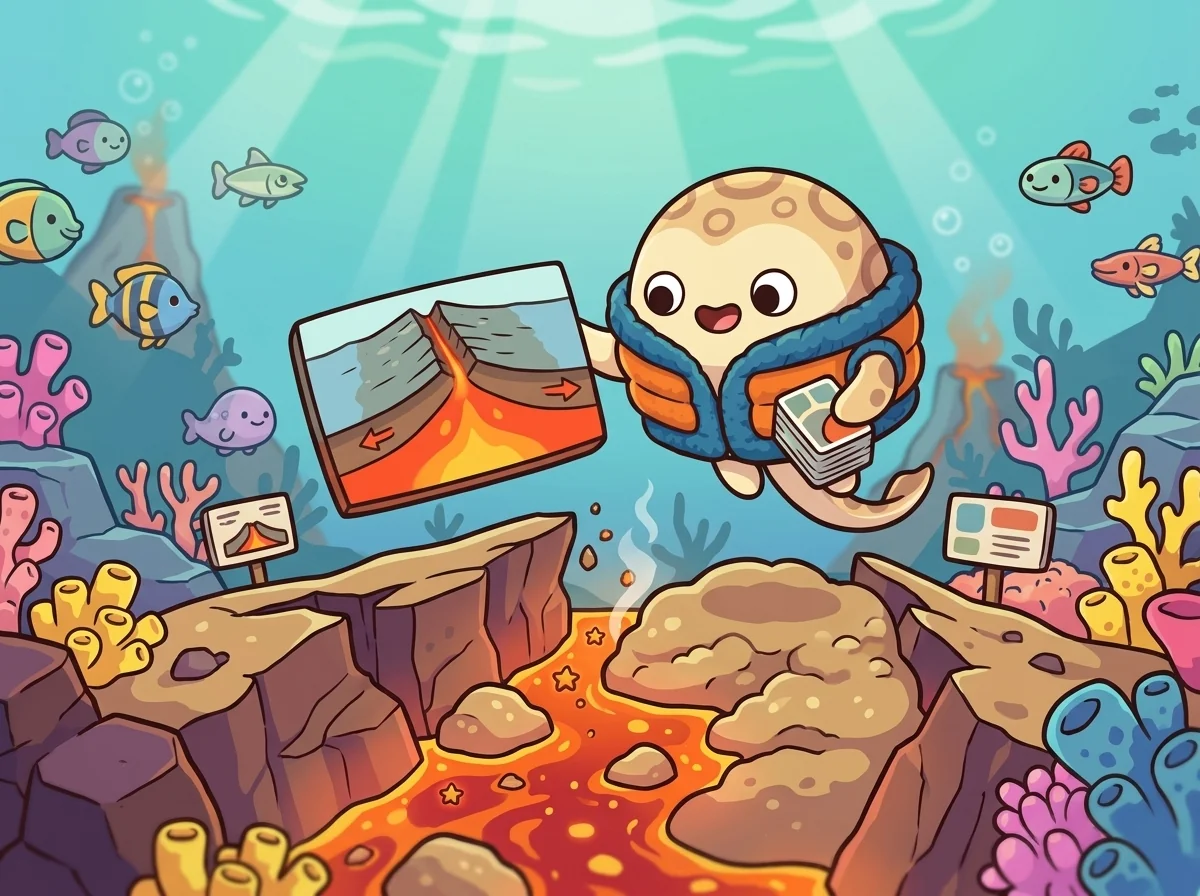
Next, he'd shuffle his cards, showing how the new crust at the ridge pushed older crust outward. "This is *sea-floor spreading*," he'd explain. "And guess what? The Earth's magnetic field has flipped many times. Each time it flips, the new crust records it like stripes. These magnetic stripes are proof that the seafloor is spreading!"
He'd show pictures of cracks appearing on land. "Divergence can happen on continents too. We call these *continental rifts*. Look at the East African Rift Valley. Africa is slowly, slowly being pulled apart there. In millions of years, a whole new ocean might form."
Finally, he'd describe the strange, smoky towers that grew at the ridges. "Where new magma meets the cold ocean water, *hydrothermal vents form. These vents pour out hot, mineral-rich water. Amazing creatures live there, not needing sunlight at all. They get their energy from chemicals, a process called chemosynthesis. If you've ever explored DepthQuest Smoke*, you've seen these places."
Spread always brought it back to his core message. "Don't think of this as destruction," he'd insist. "Think of it as renewal. New crust is always forming. It's creation, not destruction."
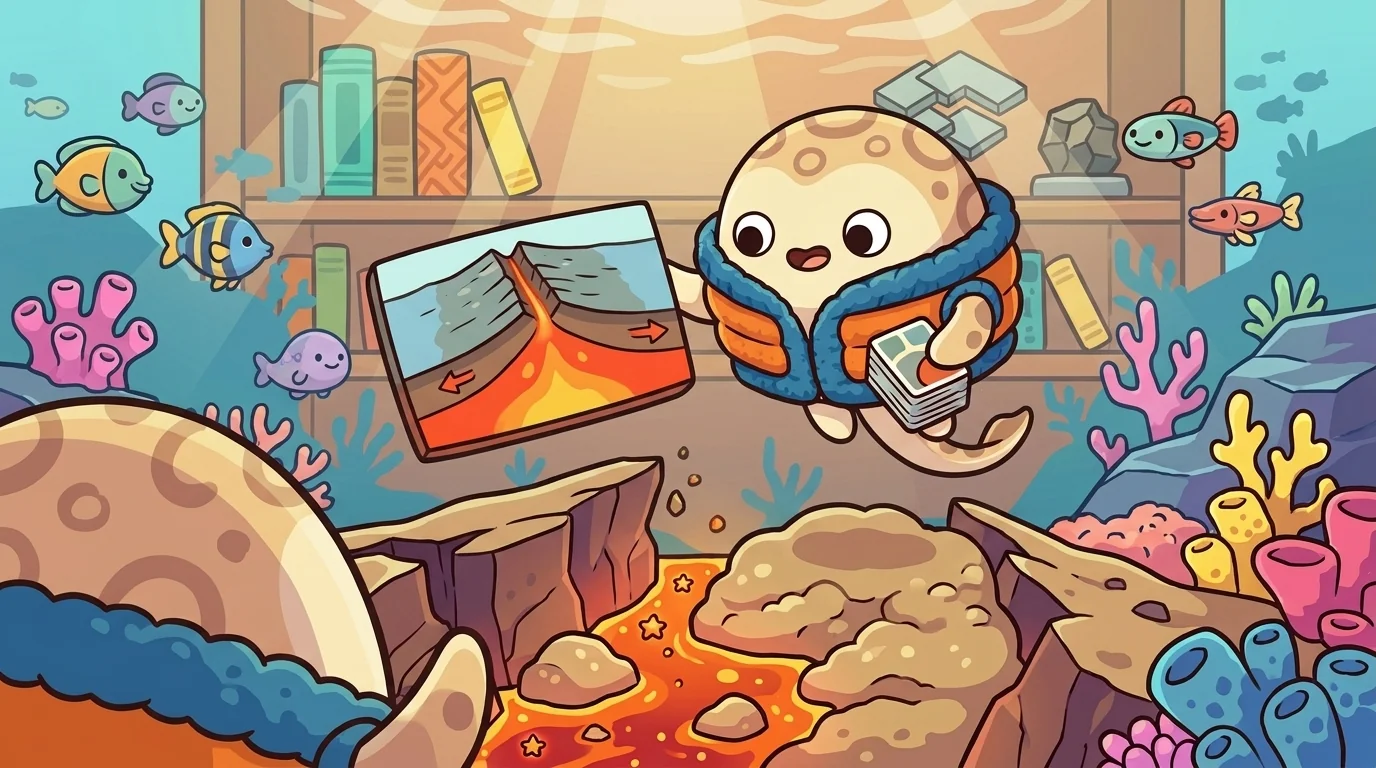
Spread had grown up on a coast carved by an ancient rift, a place where the land had once begun to tear apart. His family were known as floor-watchers in their village. For generations, these ocean-skates, with their flat bodies close to the ground, had observed the seafloor. They taught that the floor was always moving, always growing, always renewing itself. "The new crust forms where the old splits," they'd say. Spread had learned this lesson deeply, carrying it forward in his own heart.
When he was twelve, he traveled to TectonicForge, the great center of Earth-knowledge. Geo, the wise mentor, looked at him with ancient eyes. "What is a *divergent boundary*?" Geo asked.
Spread didn't hesitate. "When something pulls apart, something new is forming in the middle. New crust at mid-ocean ridges, continental rifts on land. Renewal."
Geo nodded slowly. "You are appointed," he said.
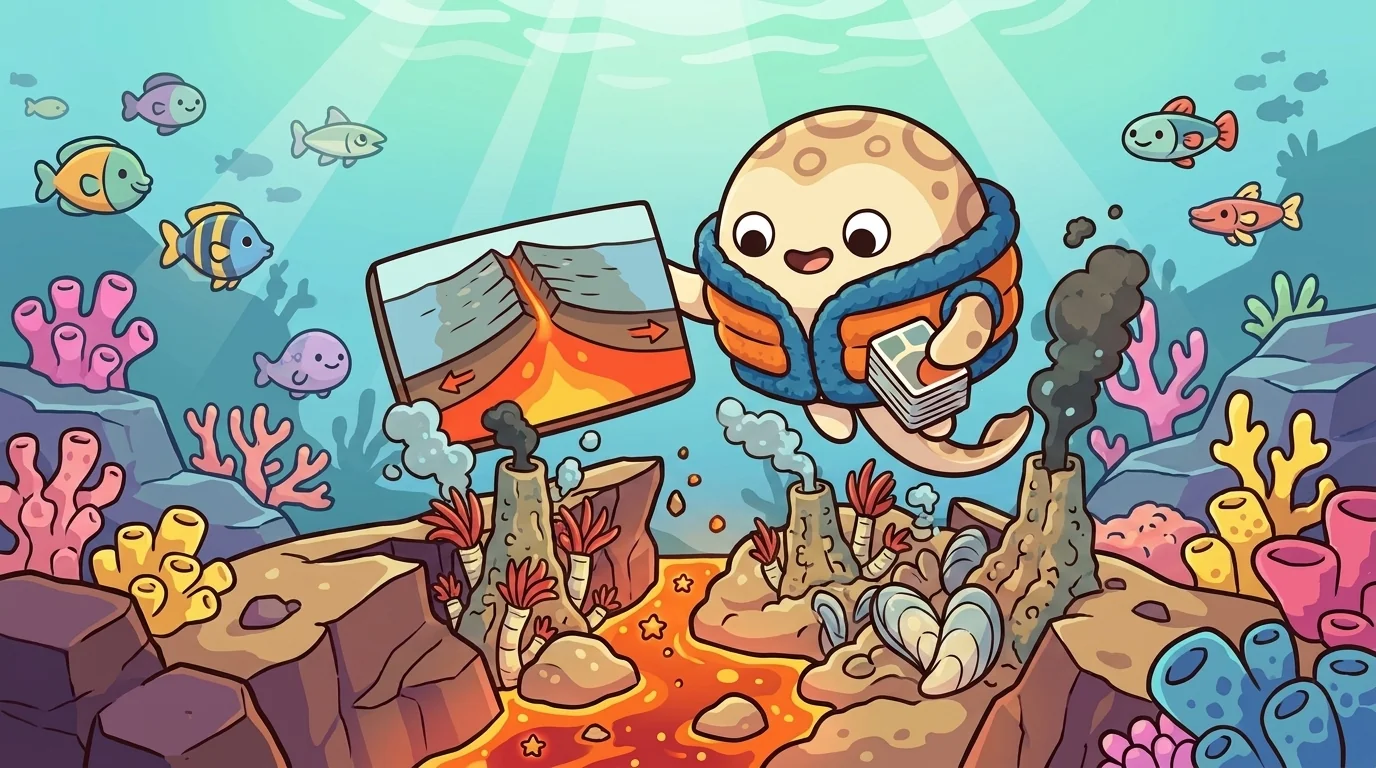
In his workshop, Spread would carefully set up his mid-ocean-ridge cross-section. "Watch," he'd say, his voice soft but firm. He'd slide the two halves of the model apart. A thin line of glowing red light, representing magma, would rise from the crack. "This is the Mid-Atlantic Ridge," he'd explain. "The North American Plate pulls west, the Eurasian Plate pulls east, about two and a half centimeters every year. That magma cools into new basalt rock. The Atlantic Ocean is getting wider, right now."
Then he'd switch to a different model, showing a landmass cracking. "Here's the East African Rift. This is *continental divergence*. Africa is slowly being pulled apart. Imagine, millions of years from now, a whole new ocean might fill that space."
He'd finish by pointing to tiny, smoking chimneys on his ridge model. "At these ridges, where new magma meets cold water, *hydrothermal vents form. Whole ecosystems thrive around them, using chemosynthesis instead of sunlight. Like the ones you see in DepthQuest Smoke." He'd pause, looking at his models. "Renewal supports life. I am Spread. The idea I teach is divergent boundary*. It's all about renewal, new crust, and the growth of oceans."
His voice would soften then. "Don't only learn about plates colliding," he'd advise. "Plates also separate. Renewal is half the Earth's story. New crust is always being born somewhere." He'd often end his lessons with his favorite phrase, a quiet reminder: "When something pulls apart, something new is forming in the middle. Renewal."
The TectonicForge ensemble
Spread is part of TectonicForge's distributed-narrative cast. Each character embodies a different curricular primitive; together they teach the full subject.
-

Sink
Convergent/subduction boundary — the heavier plate finds its way down; it takes a long time; that's okay
-
Slide
Transform boundary + stored energy — two plates sliding past; they catch, they hold, then they let go
-

Vent
Volcanism + magma chemistry — eruptions tell us what was happening below
-
Tremor
Seismology + earthquake preparedness — earthquakes are the Earth telling its story; we can read the lines; we can be ready