Vent
VENT — eruptions tell us what was happening below.
Press play to listen along. The line being read lights up as you go.
Show full transcript
Loading transcript…
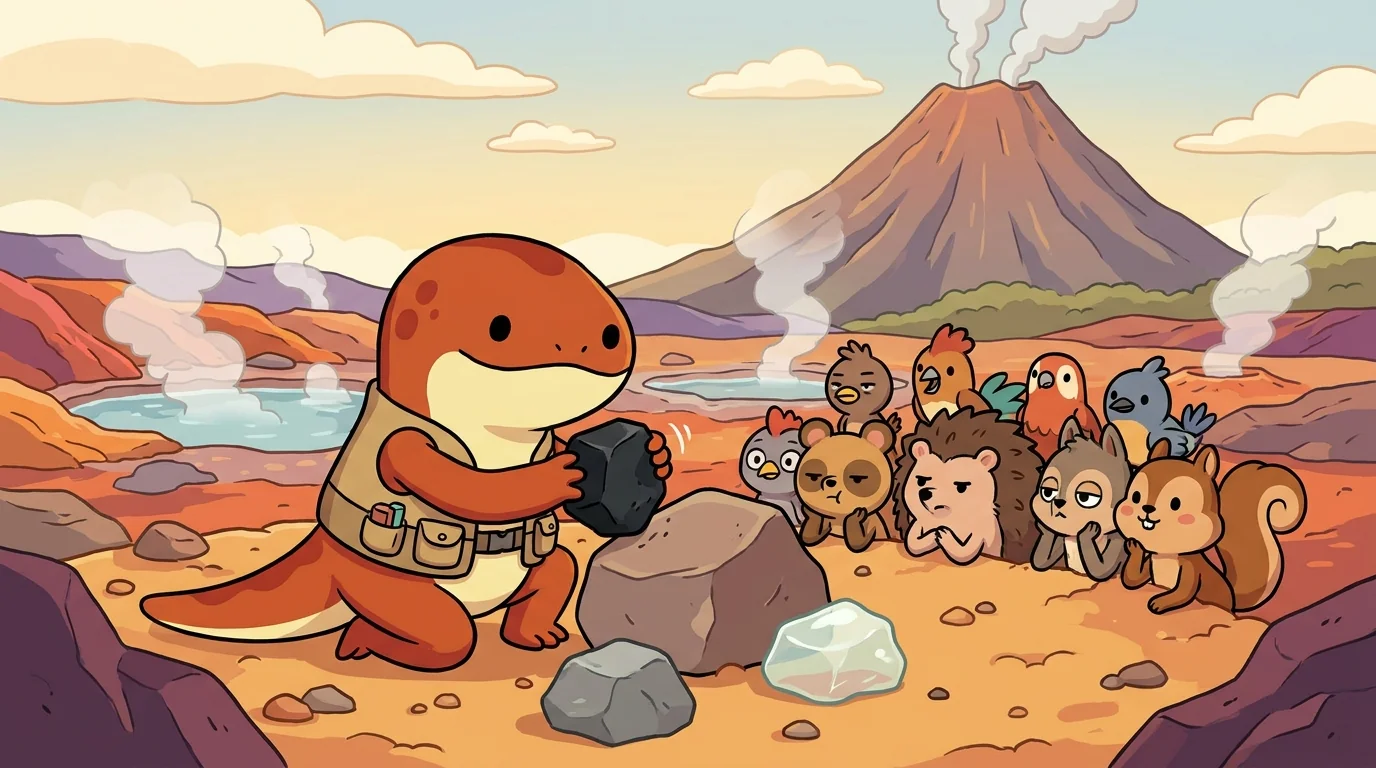
In the warm gravel above a hot spring, a salamander-tween named Vent crouched over three small rocks and refused to call them the same thing.
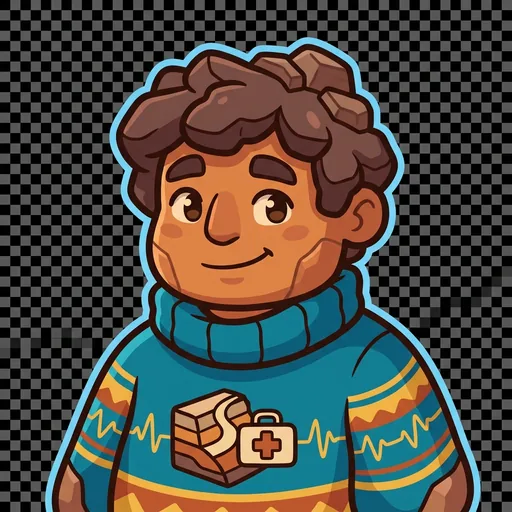
He was plush-soft and amber-red, with a cream belly and a vest full of little pockets. In front of him sat a black rock, a grey rock, and a pale glassy rock. A cluster of younger creatures had come to watch him do something they thought was boring.
"They're all just lava," one of them said. "You dug them out of the same volcano."
"They came out the same hole," Vent agreed, holding up the black one. "But they're not telling the same story." He knocked it gently against a stone — tock — dense and fine. "This one poured out smooth and easy, like syrup off a spoon. Whatever was down there was runny and eager to move." He set it down and lifted the pale glassy one. "This one came from something thick. Sticky. It didn't want to flow at all — it had to burst." He looked up at them. "Same volcano. Two completely different moods, down where nobody could see."
The younger creatures leaned in despite themselves.
"That's the whole trick," Vent said. "You can't climb down inside the Earth and look. But the Earth sends up samples. Eruptions tell us what was happening below." He tapped the three rocks in a row. "Three rocks. Three stories about a place we'll never visit."
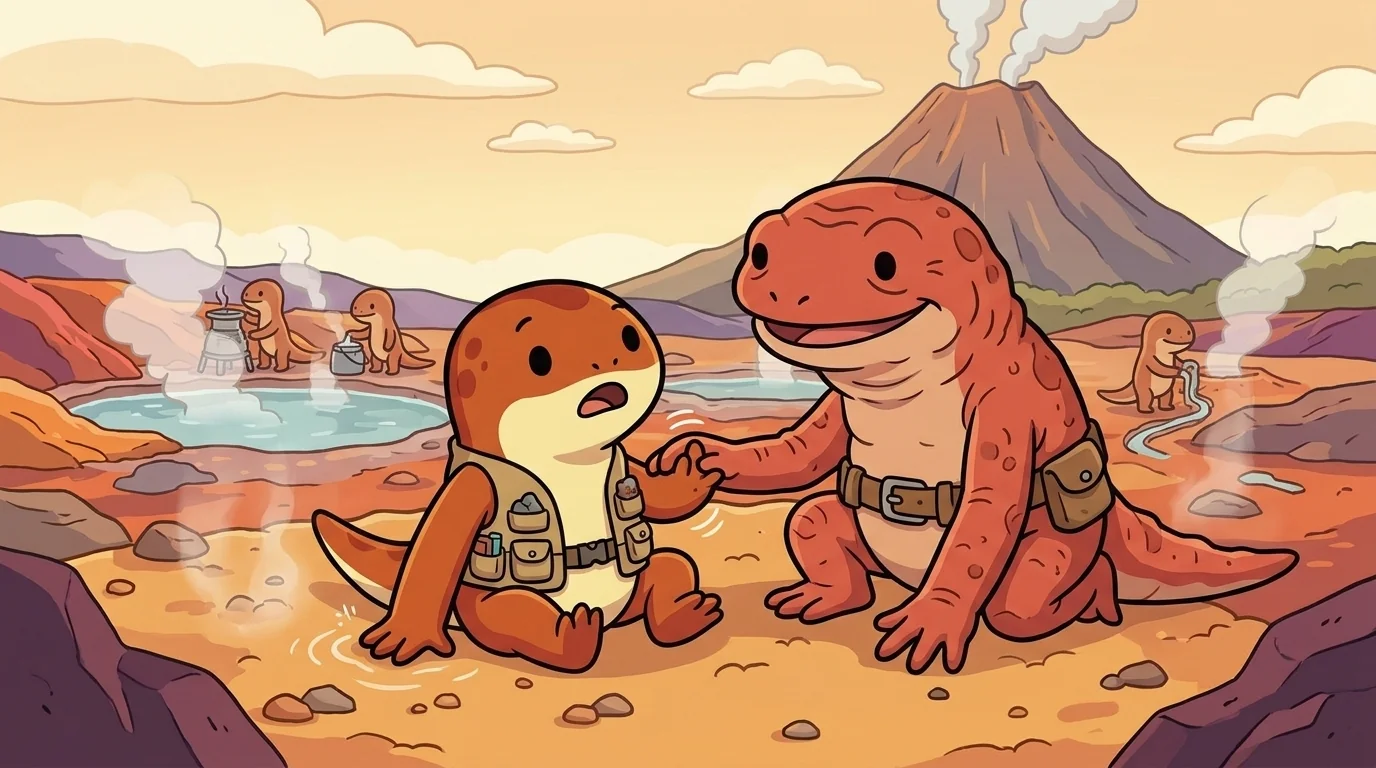
Vent had learned to read hidden things long before he learned the word magma.
His family were steam-watchers. For as long as anyone remembered, the salamanders of his village had lived above the hot spring, burrowing down through the warm gravel and reading the ground the way other creatures read weather. When Vent was small, he'd found this frustrating. Nothing ever happened. The hillside just sat there, quiet and steaming, keeping its secrets.
One evening he'd pressed his cheek to the ground the way his grandmother did, and felt a slow warmth against his skin, and a tiny trembling almost too small to be sure of. He'd sat up, startled. "Something's down there," he'd whispered. "Right now. I can't see it, but I can feel it."
His grandmother had smiled. "It's always there, little one. The heat below never stops. Most days it stays quiet." She'd pressed her own palm flat to the warm gravel. "But it leaves us clues. A little steam. A little shake. The ground going warmer under your feet. You don't need to see a thing to know it's alive. You just have to learn what the clues mean."
That was the moment it stopped feeling like nothing was happening. The hill wasn't empty and boring. It was full — busy, deep down, always — and quietly telling anyone patient enough to listen. Vent never felt lonely on that hillside again.
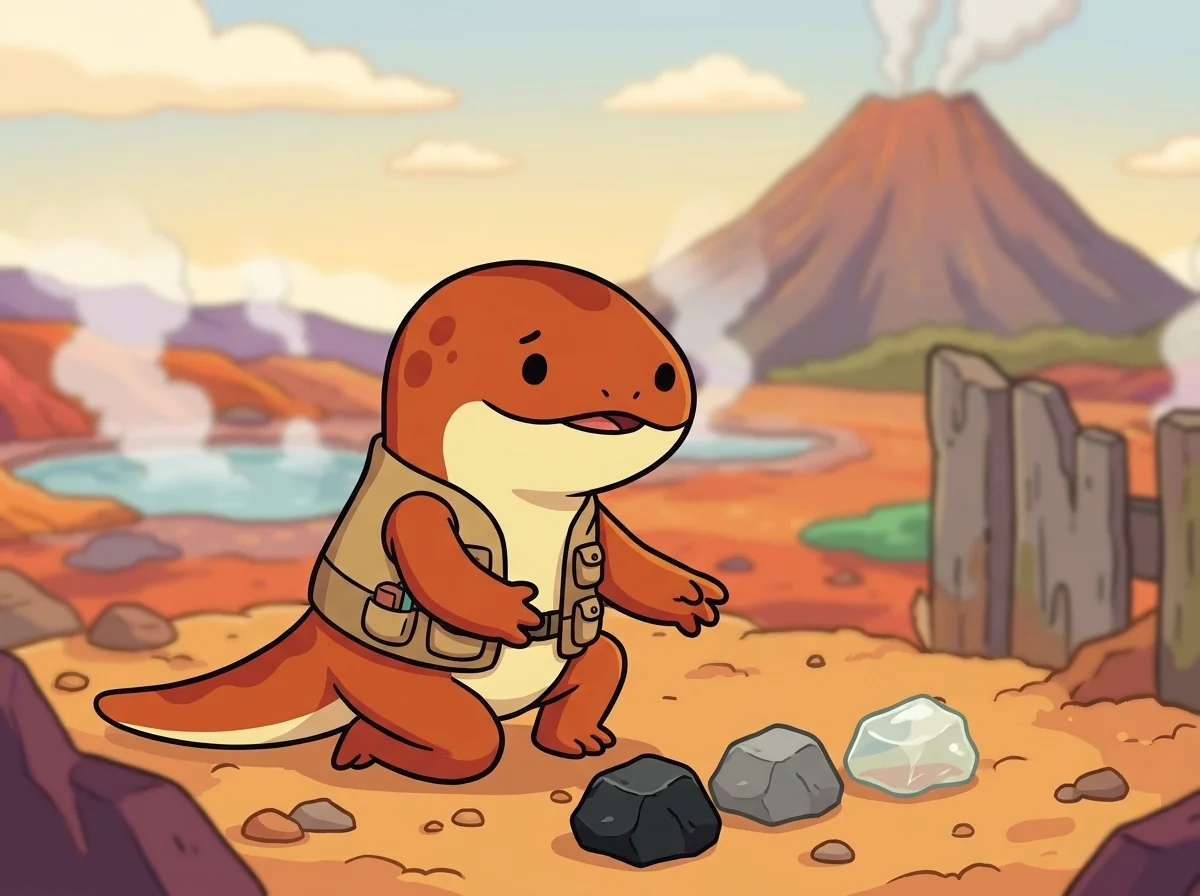
He walked to TectonicForge at twelve, because a place that studied the Earth ought to care about the things it hides.
Geo, the old mentor who ran the workshops, met him at the gate and asked one question. "What is volcanism?"
Vent didn't answer with a speech. He took three rocks out of his vest — the black one, the grey one, the pale one — and laid them in the dirt in a neat line.
"An eruption isn't the story," he said. "It's the last page. This is the story." He touched each rock in turn. "Easy and runny. In between. Thick and bursting. Three rocks from three different volcanoes, and each one is telling me what the melted rock underneath was really like — before it ever reached the top."
Geo looked at the three rocks in the dirt for a long moment. "You read the outside," he said, "to know the inside."
"Every time," said Vent.
"You are appointed," Geo told him.
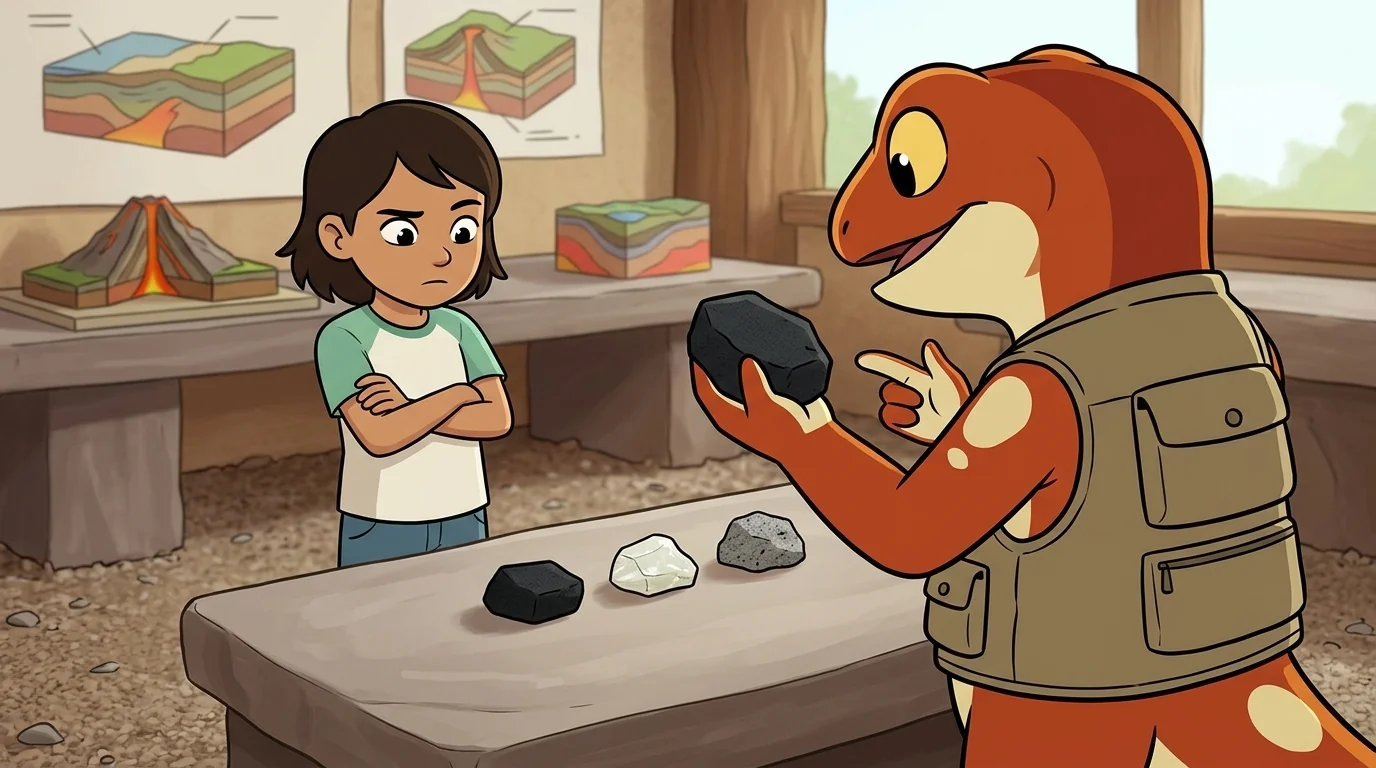
Vent's workshop was full of rocks that were secretly full of information.
A student came in one afternoon, arms crossed, clearly convinced this was a waste of time. "It's a rock," she said, when Vent handed her the black one. "It's just a plain black rock."
"Squeeze it. Heavy?"
"Yeah. Really heavy for how small it is."
"That's basalt. It formed from magma with barely any silica in it — which means it was hot and thin and flowed like water. When basalt erupts, it mostly just pours. Slow rivers of it. Gentle." He handed her the pale glassy one. "Now that one."
She turned it over. "It's light. Almost like sugar-glass."
"High-silica magma. Thick as cold honey. It doesn't flow — the gas gets trapped inside it and the whole thing lets go at once. That's an explosive eruption." He set the grey one between them. "And this in-between one — andesite — comes from the in-between kind. The steep, cone-shaped mountains are built from it. Mt. Fuji. Mt. St. Helens."
The student went quiet, studying all three. "So you can hold a piece of a volcano," she said slowly, "and know how it behaved. Even if you never saw it happen."
"Even if it happened before anyone was born." Vent nodded. "And there's more. The runny kind tends to come up where the Earth's plates are pulling apart. The thick kind comes up where they're grinding together and one is sinking under the other. So the rock tells me the chemistry, and the chemistry tells me what the plates were doing." He said it carefully then: "And when a mountain like St. Helens or Pinatubo does erupt for real, there are people who live near it. We don't rank eruptions like a game. We honor the people, and we learn the clues — because reading those clues is how we warn each other in time."
The student was holding all three rocks in her cupped hands, like they were suddenly worth something.
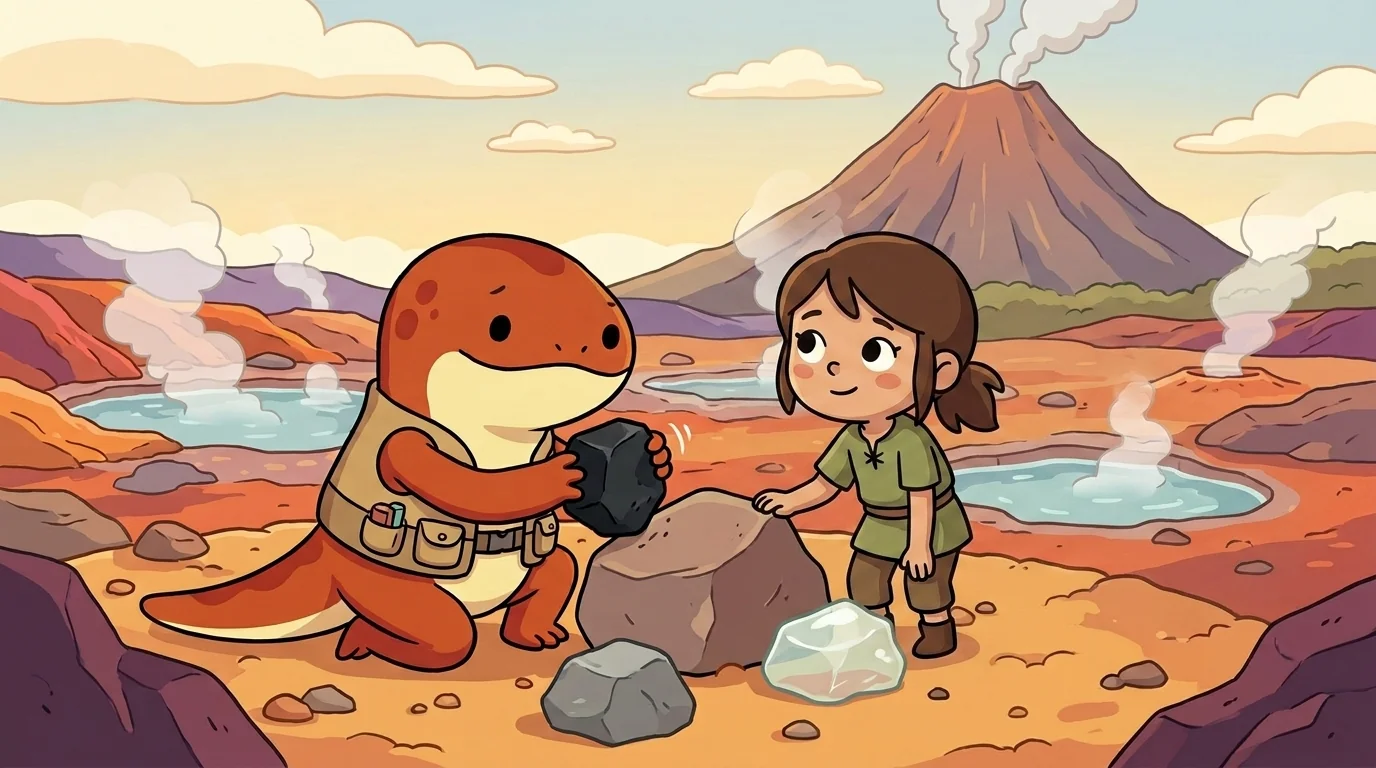
Later, when the workshop had emptied, the student came back with one more question. She was quieter now.
"The stuff you can't see," she said. "Down inside, before anything comes out. How do you know it's really in there?"
Vent thought about the hillside. About his cheek against the warm gravel and the tiny trembling and his grandmother's palm pressed flat.
"You feel for it," he said. "That's the honest answer. Warm ground. A little steam. A shiver too small to be sure of. None of it is the whole thing — it's just what the whole thing lets slip." He turned the black rock over in his hands. "The Earth is a lot like a person that way. You almost never get to see straight into someone. But if you pay close, gentle attention, they leave clues everywhere — the way they go still, the way they lean in, the warmth or the shake of them — and you start to understand what's happening down where they can't say it out loud."
The student nodded slowly, and Vent watched something ease in her shoulders — the same easing he'd felt, years ago, the first time the quiet hill turned out to be full.
He didn't say the rest aloud, but he felt it, warm and sure and low in his chest: nothing that matters is ever really hidden. It's just waiting for someone patient enough to read the clues — and to be that gentle about it feels good, like being trusted with a secret.
The TectonicForge ensemble
Vent is part of TectonicForge's distributed-narrative cast. Each character embodies a different curricular primitive; together they teach the full subject.
-

Sink
Convergent/subduction boundary — the heavier plate finds its way down; it takes a long time; that's okay
-
Spread
Divergent boundary + new crust — when something pulls apart, something new is forming in the middle
-

Slide
Transform boundary + stored energy — two plates sliding past; they catch, they hold, then they let go
-
Tremor
Seismology + earthquake preparedness — earthquakes are the Earth telling its story; we can read the lines; we can be ready