Tremor
TREMOR — *earthquakes are the Earth telling its story; we can read the lines; we can be ready.*
Press play to listen along. The line being read lights up as you go.
Show full transcript
Loading transcript…
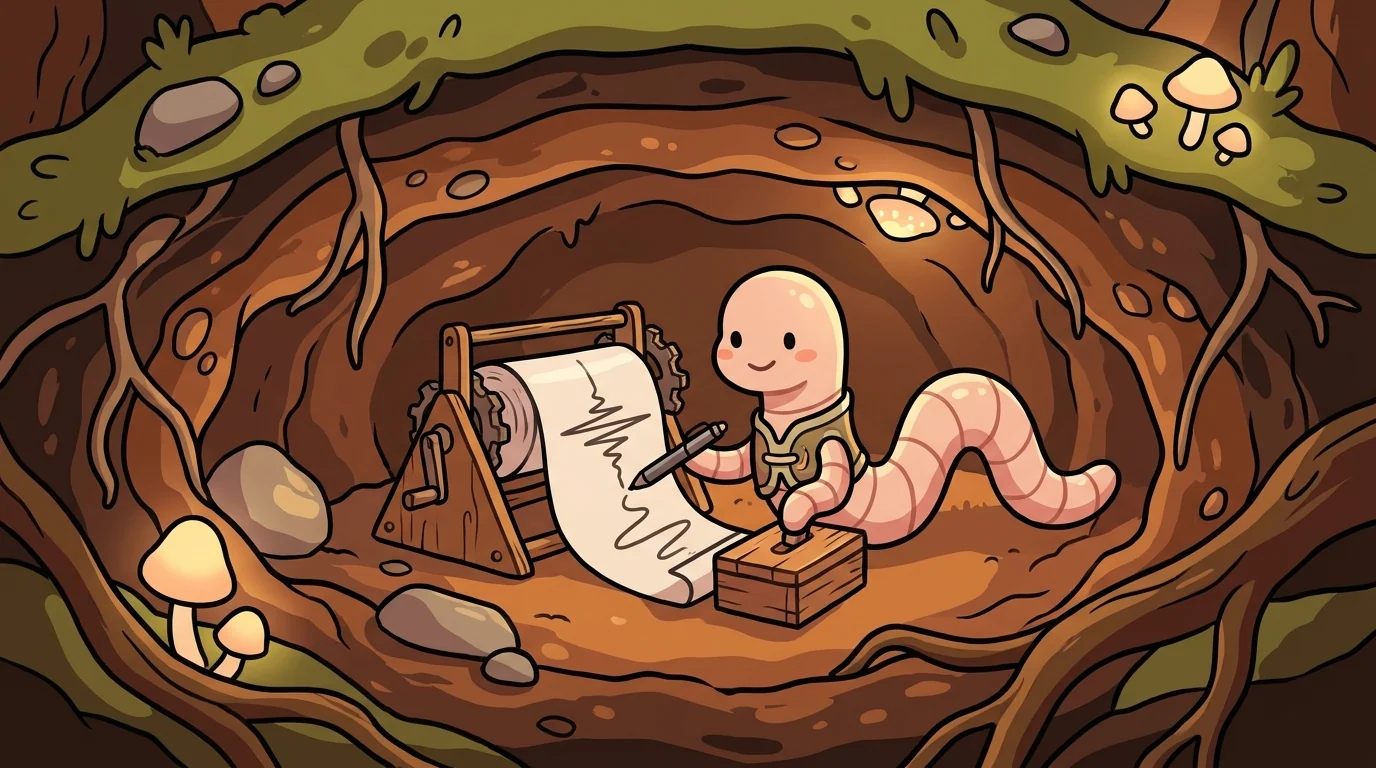
In the dim quiet of her burrow, a small earthworm-tween lay perfectly still against the soil, her soft pink-cream segments barely moving. A roll of paper crept slowly through the little box beside her, and a fine pen tip rested on it, waiting. Tremor was listening to the ground with her whole body, the way earthworms do.
Far off, something shifted. The pen twitched — a quick, sharp jiggle — then, a breath later, wobbled into a wider, rolling wave, and Tremor watched the pen draw both onto the paper. "There's the story," she said softly, tapping the box with one segment. "That fast little jiggle came first — that's the push-wave. The slow wobble arrived after — that's the shake-wave. And the gap between them tells me how far away it started." She counted under her breath, unhurried and calm. "A good way off. Gentle here. Nothing to fear." She smiled at the wavy lines. "Earthquakes are the Earth telling its story. I just read the lines — and reading them means I can be ready."
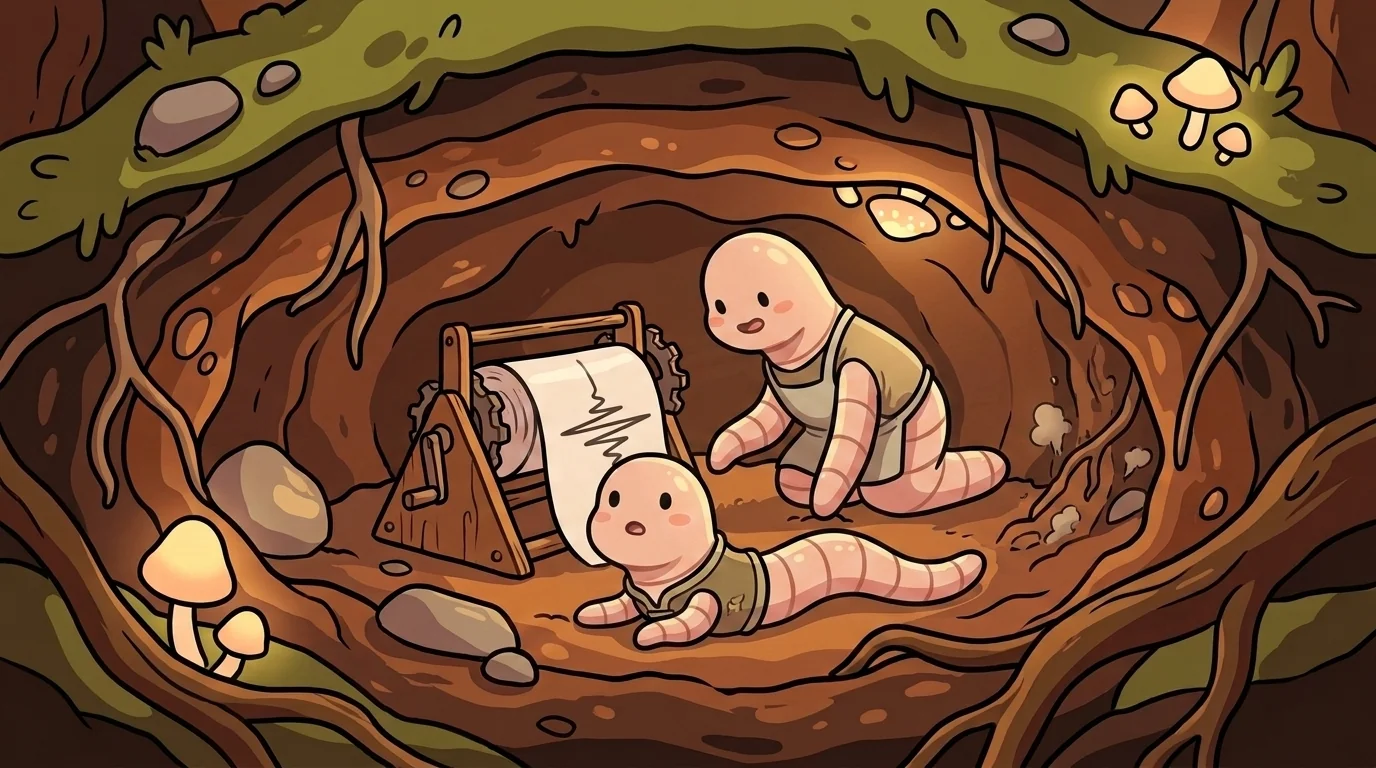
Tremor grew up underground at the edge of the village, in a family of vibration-readers. Earthworms all, they pressed their sensitive segments to the soil and felt the tiniest movements travel through it.
When Tremor was small, her father taught her to tell one wave from another by feel. "Lie flat," he told her one night. "Now — feel that first little shove? Quick, sharp, straight through?" Tremor had felt it: a fast nudge, there and gone. "That one's always first, and always harmless — it's just the messenger. But it means the bigger, slower shake is coming behind it." A moment later she'd felt the second wave, a broad rolling wobble. "So when your body catches that first quick shove," her father said, "you've got a heartbeat or two to get low and safe before the roll arrives. The ground warns us, little one, if we learn to listen. A family that reads the warning is a calm family." Tremor pressed herself flatter into the soil and felt, not fear, but a kind of quiet wonder — the ground was talking, and she was learning its language.
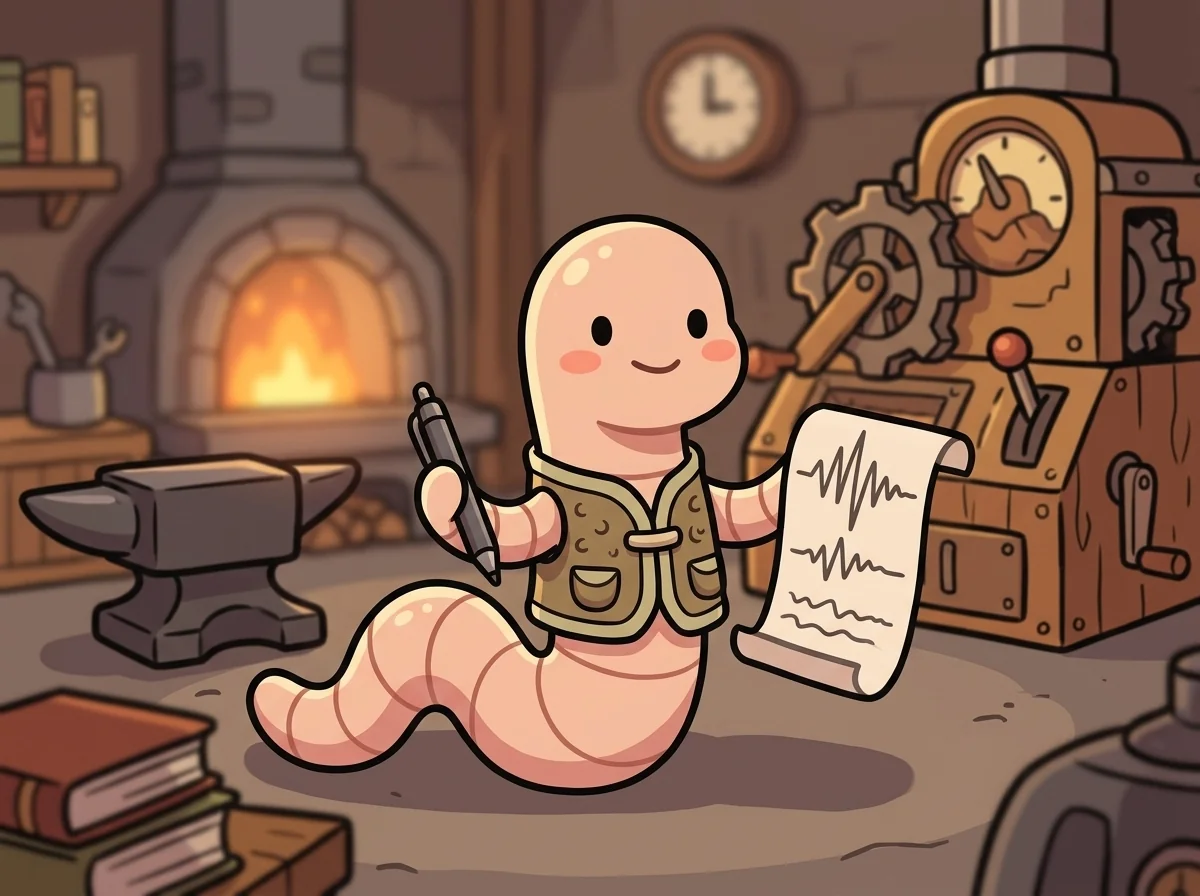
When Tremor was twelve, she wriggled up to the workshop at TectonicForge, her seismologist-vest full of tiny pockets. Geo, who taught the young ones, was waiting.
"Tell me about reading earthquakes," Geo said.
Tremor rose up on her segments. "Earthquakes are the Earth telling its story, and we can read the lines," she said. "My little box catches the ground's motion and draws it as waves. The fast push-wave, then the slower shake-wave — and from the gap between them, I can tell how far off the quake began. Line up three boxes in different places and I can find the exact spot it started." She settled. "But the best part isn't just the reading. It's that reading the lines is what lets us get ready — practice the drills, make the plans. Knowing beats being scared." Geo nodded slowly. "The reading of earthquakes is yours to teach," she said.
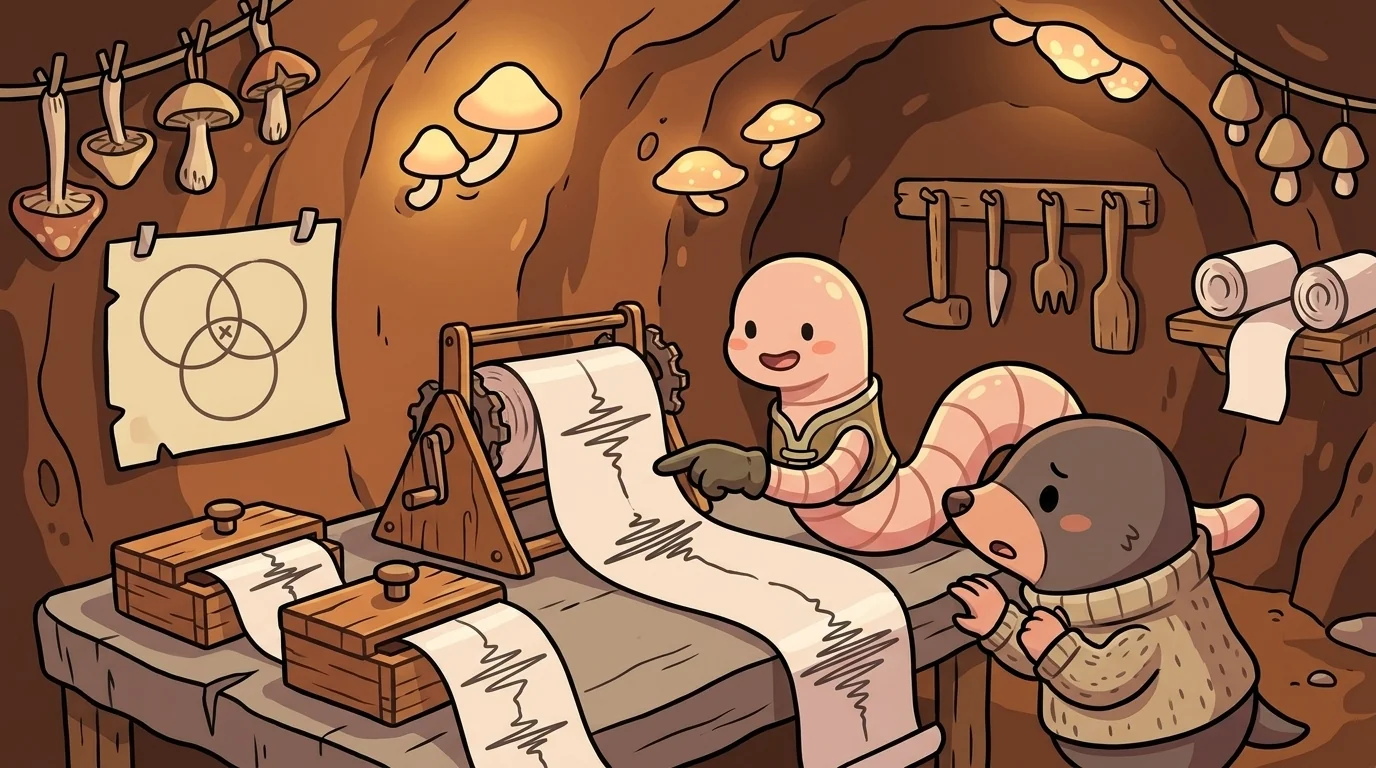
In her workshop, Tremor showed her little recording box to a worried student named Fen, who'd been having bad dreams about the ground since a quake rattled his town.
"Watch," Tremor said, and tapped the table gently. The pen made a tiny bump on the paper. She tapped harder; the pen swung a bigger wave. "The ground moves, the pen draws it. That's all a quake is on paper — a story the Earth wrote down." She pointed to two shapes on an older strip. "See this sharp little spike? Push-wave — first to arrive, quick and harmless. This wide wobble after it? Shake-wave — slower, stronger. Count the gap between them and you know how far the quake started from here." She traced three circles overlapping on a map. "Three boxes in three towns, three gaps, three circles — where they cross is exactly where it began. No mystery. Just reading."
Fen leaned in despite himself. "But what if a big one comes?"
"Then here's what your body already knows how to do," Tremor said, and dropped fast beneath the sturdy table. "Drop." She curled her segments over her head. "Cover." She gripped the table leg. "Hold On — until the shaking stops." She wriggled back out. "Practice it till it's just what you do. Pick a spot where your family meets afterward. Ask a grown-up to bolt the tall shelf to the wall so it can't tip." She looked at him kindly. "The mystery is the scary part. So we take the mystery away — line by line, plan by plan. And if any of this ever feels like too much, you can PAUSE, skip it, and come back when you're ready. The knowledge will wait for you."
Fen tried the drop, the cover, the hold. His hands were steadier than he expected.
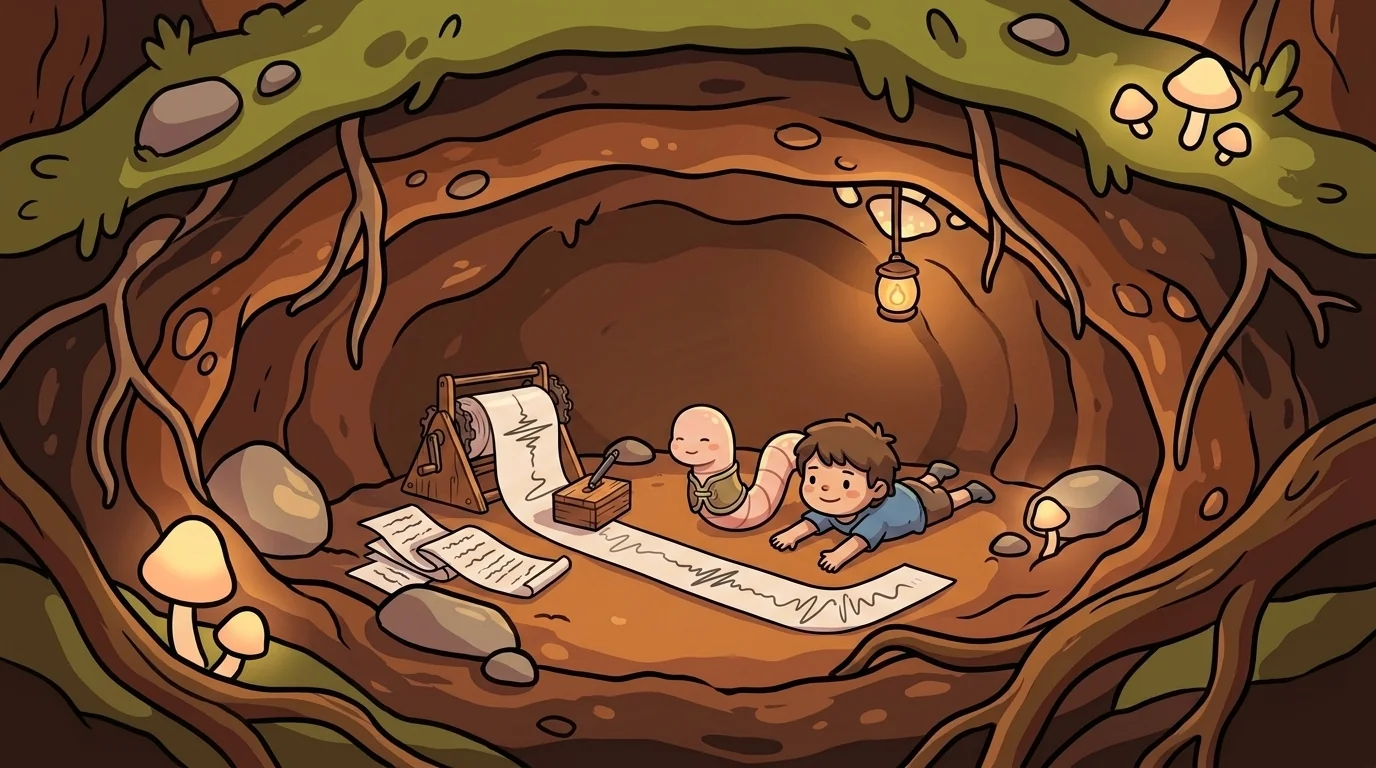
Afterward, Tremor and Fen rested side by side on the cool soil of the workshop floor. She named a couple of real quakes softly — a great one long ago near a coast far across the sea, another more recently in lands to the east — spoken with care, honoring the people who'd lived through them and rebuilt, never as a game.
Fen lay quiet, pressing one hand flat to the cool ground the way Tremor pressed her segments. The soil was doing its slow, ordinary work far below — pushing, catching, someday writing another wavy line for someone to read. And for the first time since his dreams began, that thought didn't tighten his chest. He knew the push-wave came first. He knew to drop, cover, hold. He knew where his family would meet. The ground wasn't a monster in the dark anymore; it was something with a pattern he could read.
He noticed his breathing had gone slow and easy, matching Tremor's. The knot behind his ribs had come loose. "It feels different now," he said quietly. "Lighter."
Tremor smiled, her segments soft against the earth. "That's what knowing does," she said. "The Earth tells its story. We read the lines. And we get ready — steady, and unafraid."
The TectonicForge ensemble
Tremor is part of TectonicForge's distributed-narrative cast. Each character embodies a different curricular primitive; together they teach the full subject.
-

Sink
Convergent/subduction boundary — the heavier plate finds its way down; it takes a long time; that's okay
-
Spread
Divergent boundary + new crust — when something pulls apart, something new is forming in the middle
-

Slide
Transform boundary + stored energy — two plates sliding past; they catch, they hold, then they let go
-

Vent
Volcanism + magma chemistry — eruptions tell us what was happening below