Slide
SLIDE — *two plates sliding past; they catch, they hold, then they let go.*
Press play to listen along. The line being read lights up as you go.
Show full transcript
Loading transcript…
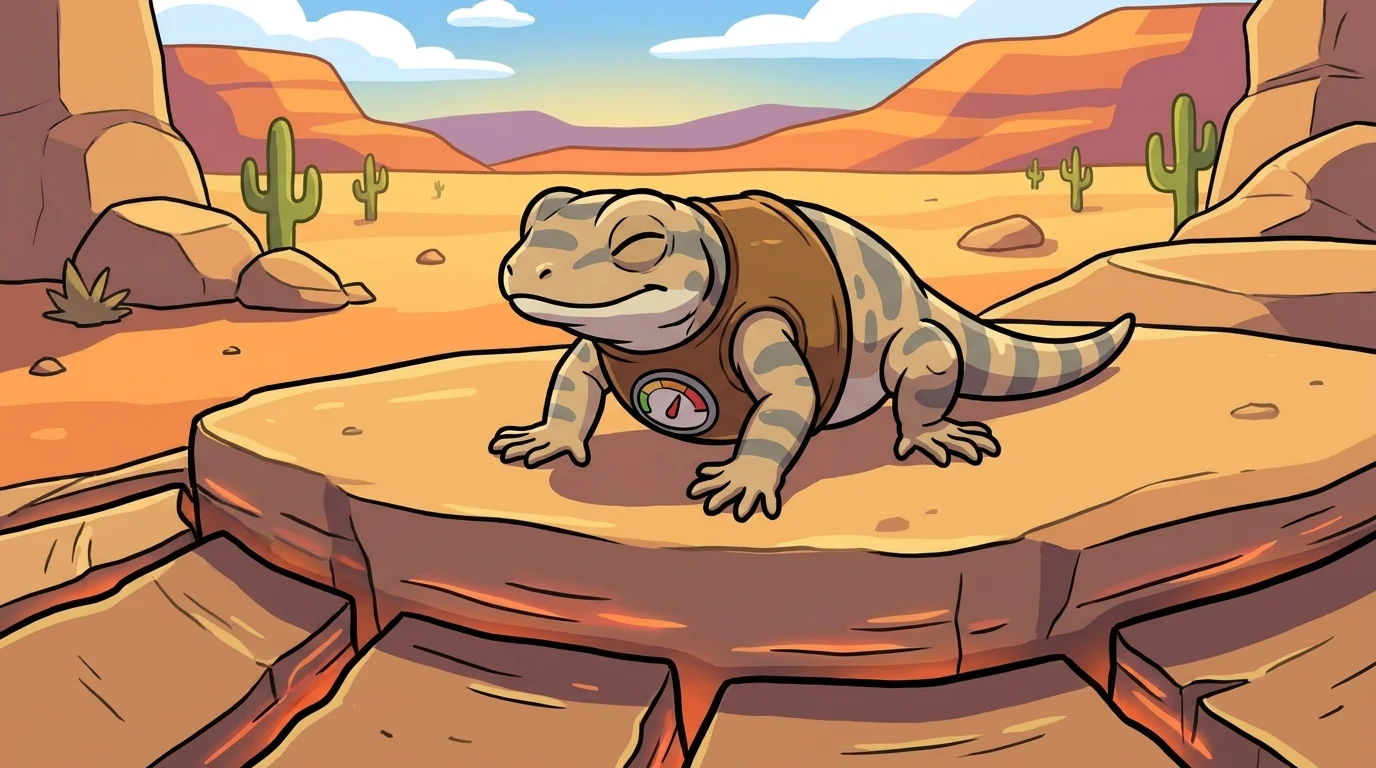
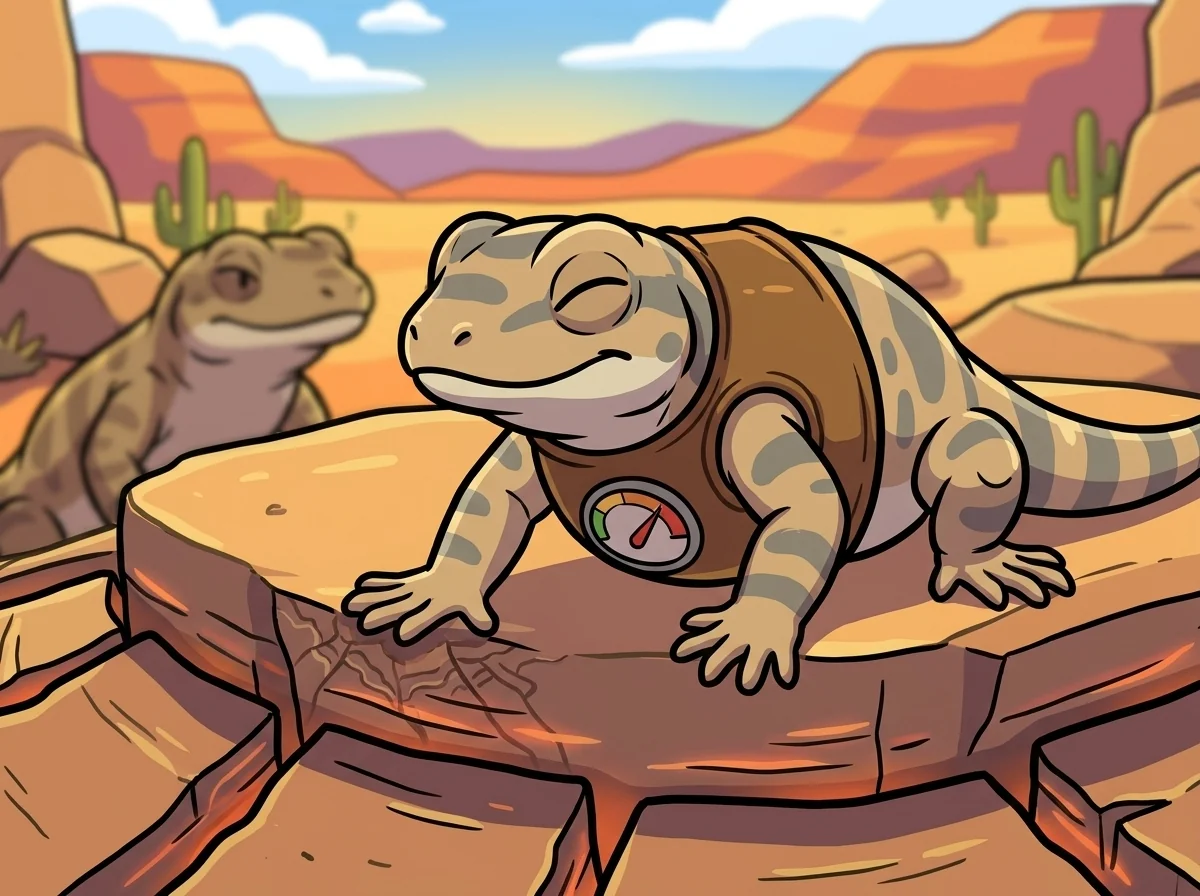
On a warm flat rock in the sun, a small round chuckwalla lizard pressed both front feet to the stone and went very still. Slide's soft tan-and-grey bands rose and fell with her slow breathing. She was listening with her whole body, the way her family always had.
Under her feet, two great slabs of ground were pushing sideways against each other — not crashing, not pulling apart, just grinding slowly, past and past. She could feel where they'd snagged, gripped tight by friction, and where the strain was quietly building. On her chunky little vest, a tiny needle crept upward, marking the stress as it climbed. "There you are," Slide murmured to the rock. "Two plates sliding past. Right now you're doing the middle part — you've caught, and you're holding." The needle rose another notch. "You'll let go when you're ready. And when you do, that'll be a quake." She stayed calm, one paw flat on the warm stone, unhurried and unafraid.
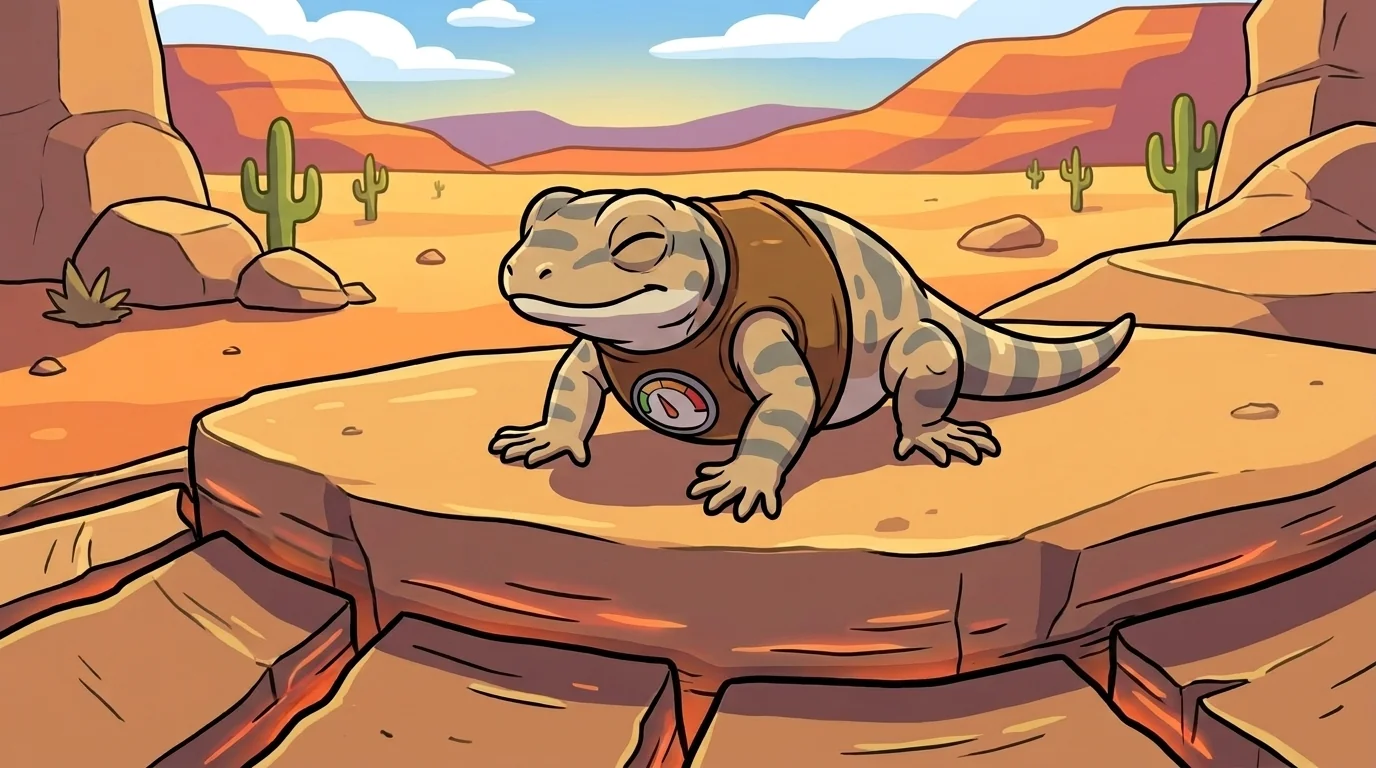
Slide grew up in a village pressed right against a long crack in the ground, where the earth sometimes shivered. Her family were ground-listeners, chuckwallas who spread themselves flat against the rock and read what it was doing far below.
When Slide was small, her grandmother taught her the pattern by feel. "Press down," her grandmother said one evening, both of them belly-flat on the cooling stone. "Feel how it's stuck? That's the catch. Feel that slow tightening, like a held breath? That's the hold." Slide had felt it — a deep, patient strain gathering in the ground. "And one day it slips, all at once, and lets the strain go. That's the let-go. That's a quake." Her grandmother had not sounded frightened at all. "The ground isn't angry, little one. It isn't punishing anyone. It's just doing a thing it always does, in the same order, every time. And because we know the order, we know how to get our families ready." Slide had pressed her cheek to the warm rock and felt, for the first time, more curious than scared.
When Slide was thirteen, she walked to the workshop at TectonicForge, her fault-map vest snug around her round little body. Geo, who taught the young ones, was waiting.
"Tell me about a sliding boundary," Geo said.
Slide didn't hesitate. She pressed one paw flat on the floor, as if reading it. "Two plates sliding past each other, sideways," she said. "They catch — friction grabs them tight. They hold — the strain builds up while they're stuck. Then they let go, all at once, and the strain releases in a slip. That slip is an earthquake." She looked up. "And then it starts over. It's a cycle, the same every time. So the right answer isn't to be scared of it. The right answer is to get ready for it." Geo studied the small calm lizard for a long moment, then nodded. "The sliding boundaries are yours to teach," she said.
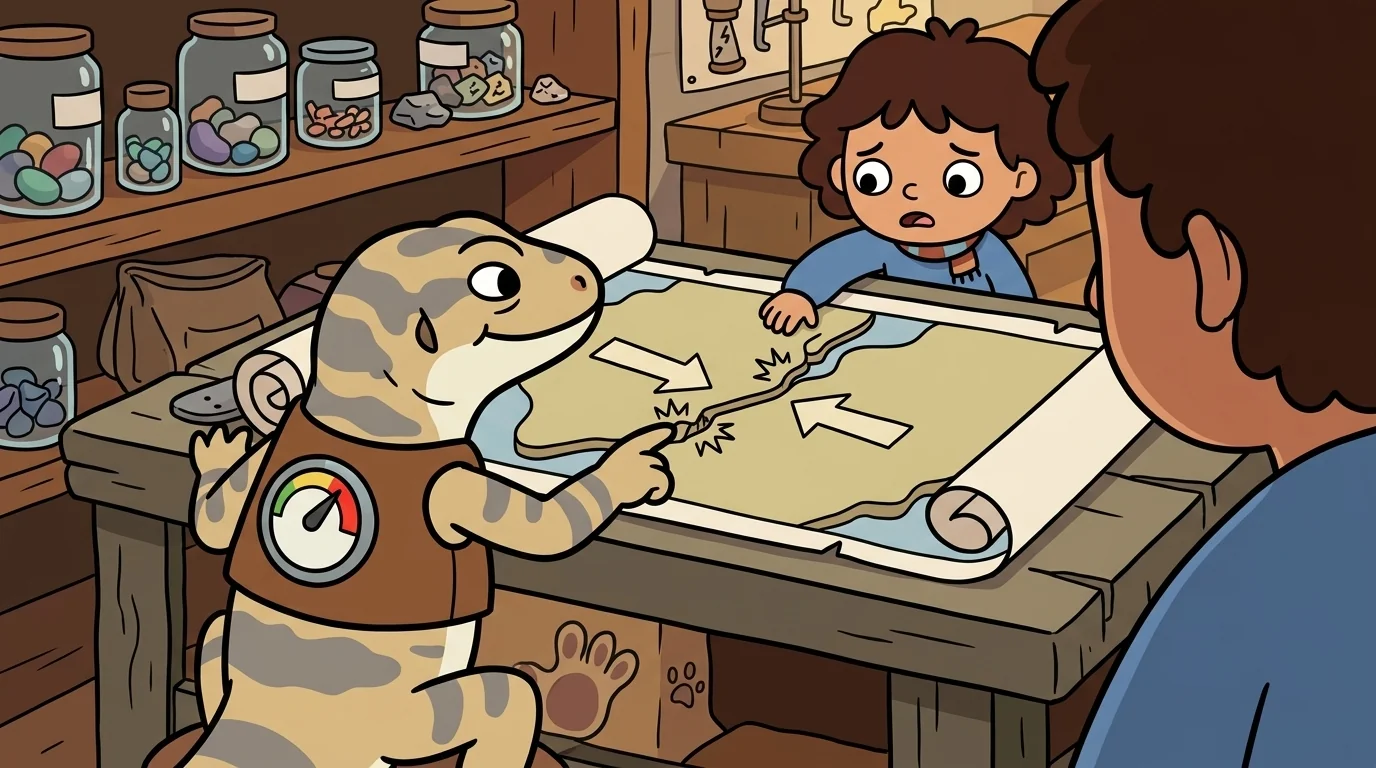
In her workshop, Slide unrolled her big fault-line map for a nervous young student named Wren, who'd felt the ground shake once and hadn't liked it.
"Watch my paw," Slide said gently. She traced a long line down the map, where two enormous plates ran alongside each other. "This whole boundary, the plates are creeping past — this side drifting one way, that side the other, just a few finger-widths every year. Slow as a growing fingernail." She pressed her paw flat on the line and held it. "But right here, they've snagged. Caught. So the ground on both sides keeps drifting, and the strain builds and builds at the snag." Her stress-meter needle climbed as she spoke. "Until — " she let her paw jump forward a notch — "it slips. All at once. And that release is the shaking you felt."
Wren's eyes were wide. "So it'll happen again?"
"It will. And here's the part that helps," Slide said, and rose up on her hind feet. "If the ground ever starts shaking, you Drop—" she dropped to her hands and knees "—Cover—" she tucked her head under her paws "—and Hold On—" she scooted under the sturdy workbench and gripped its leg "—until it stops." She peeked out. "You practice it till your body just does it. You help your family pick a place to meet. You get a grown-up to bolt the heavy shelves to the wall." She climbed back out. "That's what turns the scared feeling into a ready feeling. Knowing the cycle, and having a plan."
Wren tried the drop, the cover, the hold. It felt less like hiding and more like doing something.
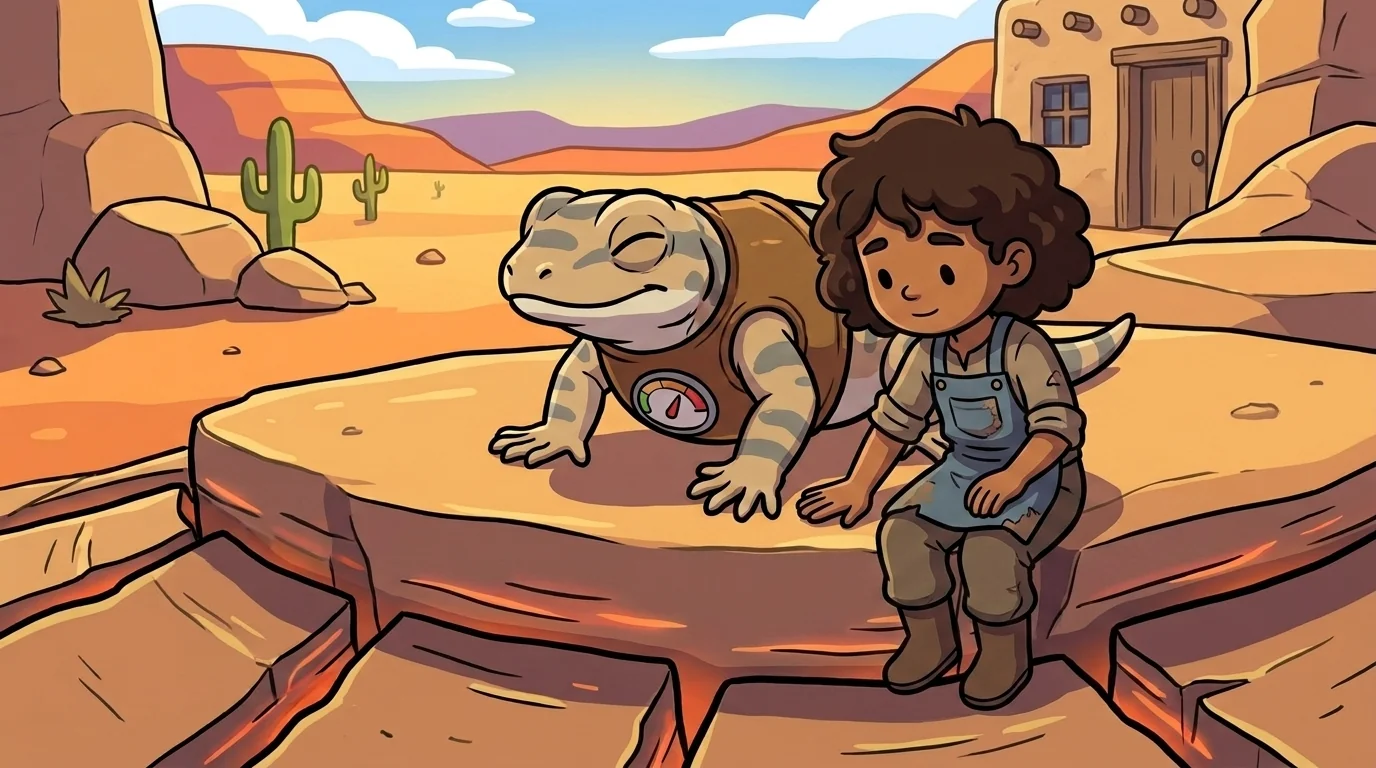
Later, Slide and Wren sat together on the warm workshop step, and Slide named a few real quakes softly — a town near Northridge that shook long ago, a city near Christchurch far across the sea — not as scary stories, but as places where people had felt the ground let go, grieved, and rebuilt, and learned to be ready.
"If you've ever felt a real quake yourself," Slide said, quiet and kind, "and this ever feels like too much, you can stop and come back another time. There's no rush."
Wren was quiet a moment, one hand resting on the sun-warmed stone step. Then she noticed her shoulders had come down from around her ears. Her breathing had slowed to match Slide's. The ground under the step was doing exactly what Slide had said it did — catching, holding, someday letting go — and somehow, now that she understood the pattern and knew the drop-cover-hold, it didn't sit in her chest like a cold stone anymore. It felt like something she could meet, steady on her feet.
"Better?" Slide asked.
Wren pressed her palm flat to the warm rock, the way Slide did, and felt her whole body go calm and sure. "Better," she said.
The TectonicForge ensemble
Slide is part of TectonicForge's distributed-narrative cast. Each character embodies a different curricular primitive; together they teach the full subject.
-

Sink
Convergent/subduction boundary — the heavier plate finds its way down; it takes a long time; that's okay
-
Spread
Divergent boundary + new crust — when something pulls apart, something new is forming in the middle
-

Vent
Volcanism + magma chemistry — eruptions tell us what was happening below
-

Tremor
Seismology + earthquake preparedness — earthquakes are the Earth telling its story; we can read the lines; we can be ready