
Sink
SINK — *the heavier plate finds its way down. it takes a long time; that's okay.*
Press play to listen along. The line being read lights up as you go.
Show full transcript
Loading transcript…
Sink was small, even for a tween. Her shell, a warm tan-cream, had soft bands that looked more like cozy pillows than hard armor. She wore a vest covered in embroidered maps and diagrams, a true Earth-watcher's uniform. In her hands, she carried a stack of cards and a model of the planet's layers. Her workshop smelled of damp earth and old paper.
She carefully set down her tools on a smooth, worn wooden table. "Today," she began, her voice soft but clear, "we'll watch how the Earth truly moves." Her dark, patient eyes seemed to hold millions of years of time. She wasn't talking about quick shifts. She meant the deep, slow stories of the planet.
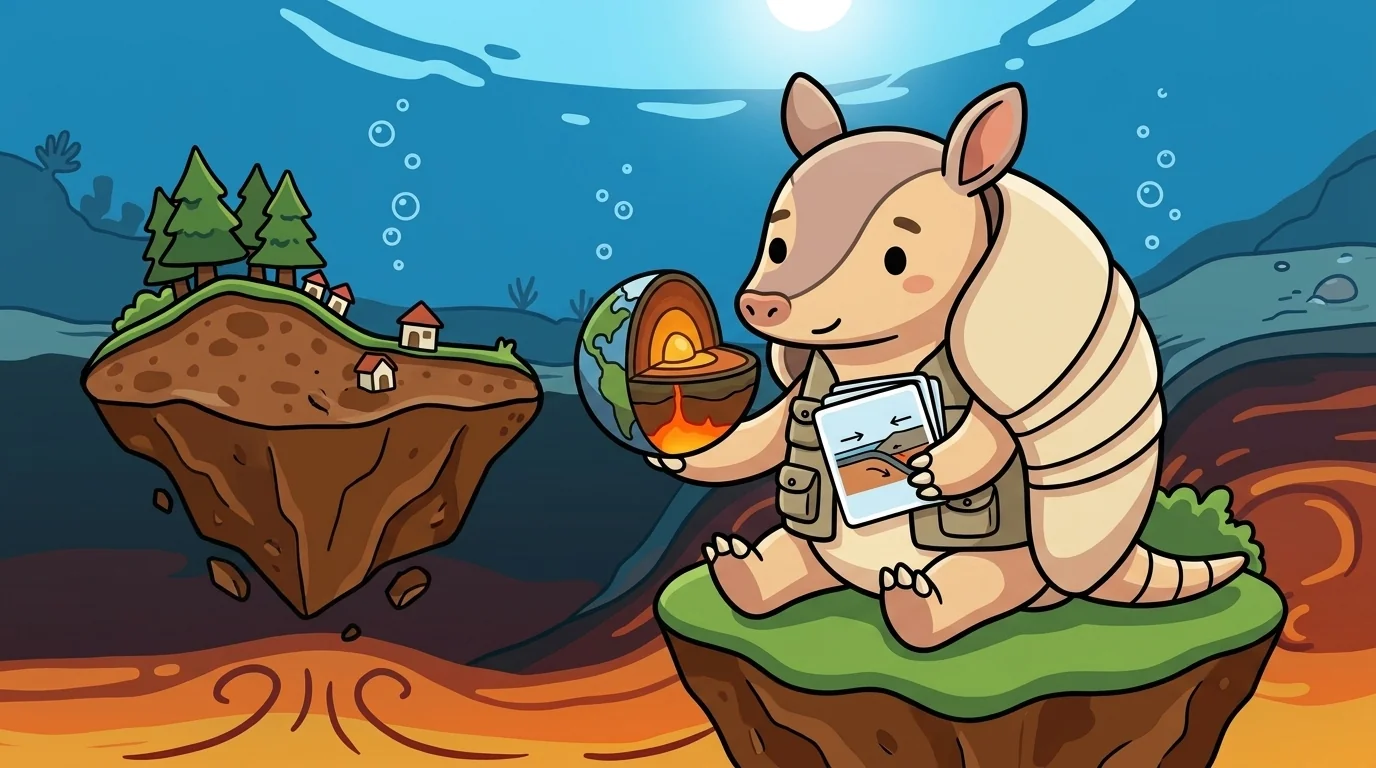
Sink picked up a layered Earth cross-section. It showed the thin crust and the thick, flowing mantle beneath. "See how the layers fit?" she asked, tracing a finger along the model. "The crust is thin as an eggshell. The mantle is like super-slow honey, always moving." Then she fanned out her plate-motion cards. Each card illustrated a different way Earth's giant plates interacted.
"Imagine two plates," Sink said, holding up two cards. "They don't just bump and stop. They collide." She brought the cards together slowly, a gentle nudge. "This is a *convergent* boundary." She paused, letting the simple movement sink in.
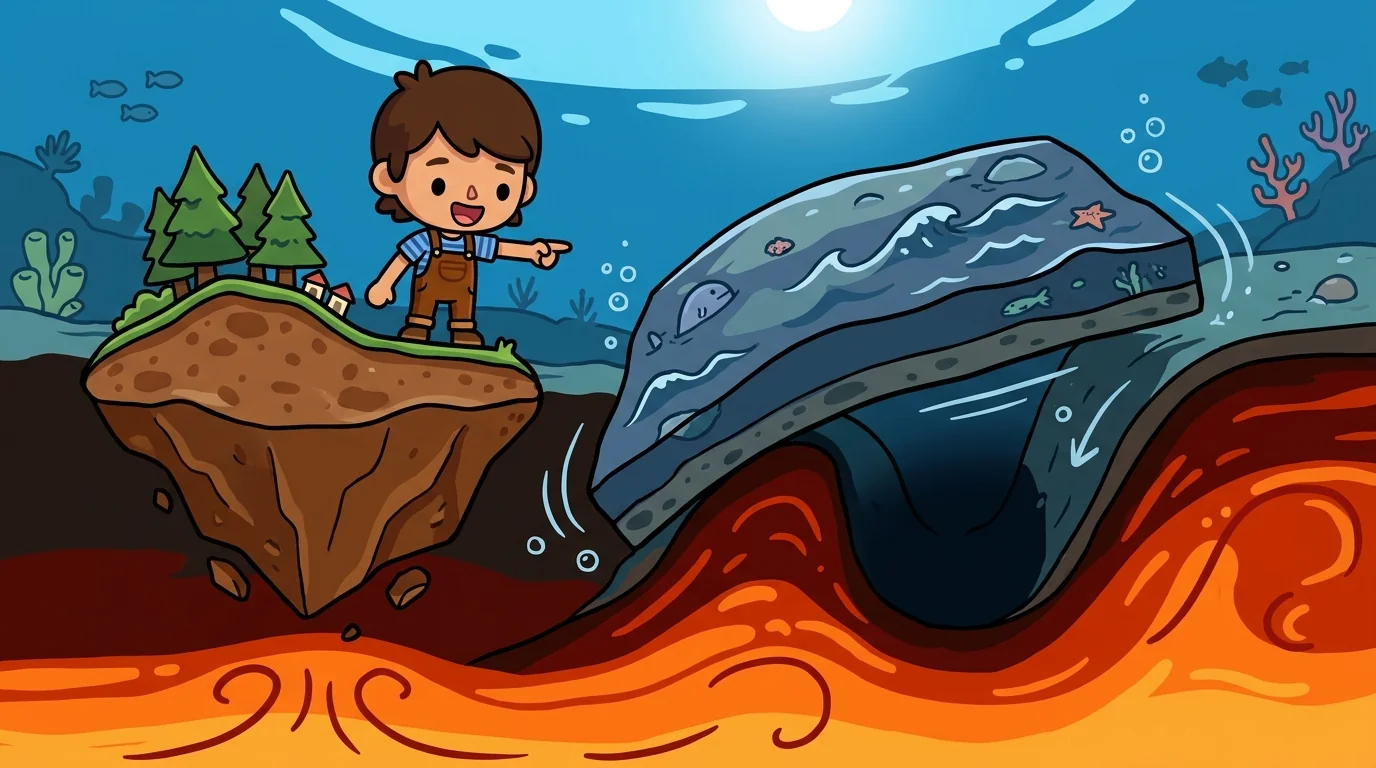
"Sometimes," she continued, "one plate is heavier. It finds its way down." She slid one card under the other. The top card lifted slightly as the bottom one disappeared. "This is *subduction*." She held the model steady. "The oceanic plate, often denser, slides beneath the lighter continental plate."
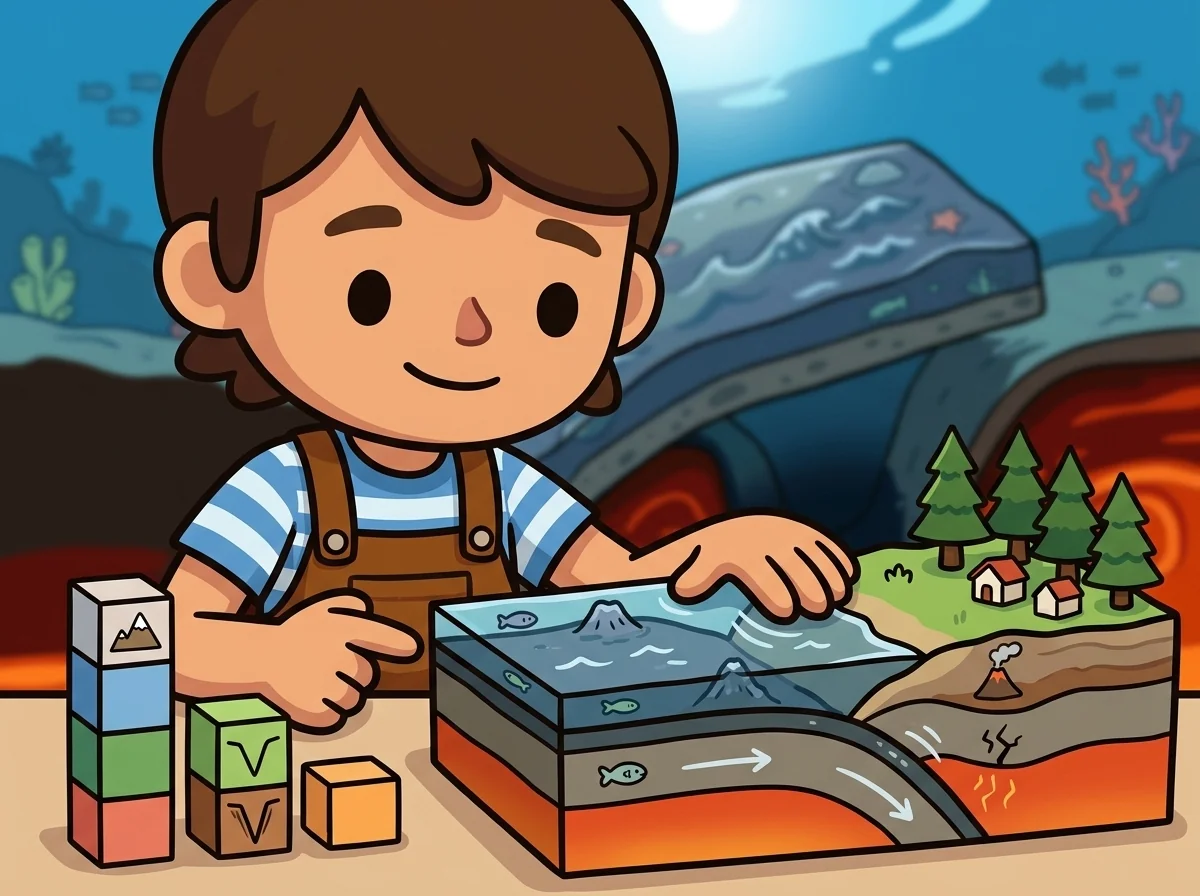
A young student, a squirrel with bright, curious eyes, leaned forward. "Does it happen fast?" he asked.
Sink smiled gently. "It's not a fast crash," she explained. "Think centimeters per year. To move just one meter? That takes about fifty years. To shift a hundred kilometers? That's five million years." She looked at her small audience. "Patient work. That's what Earth does."
She pointed to a region on a map embroidered on her vest, near the Pacific Ring of Fire. "Oceanic plate sinks under continental plate here. It has been doing so for millions of years." She moved her finger to another spot. "The Andes Mountains? Built by this slow subduction. The Mariana Trench, the deepest part of our oceans? Same process. That's the 'going-down' side."
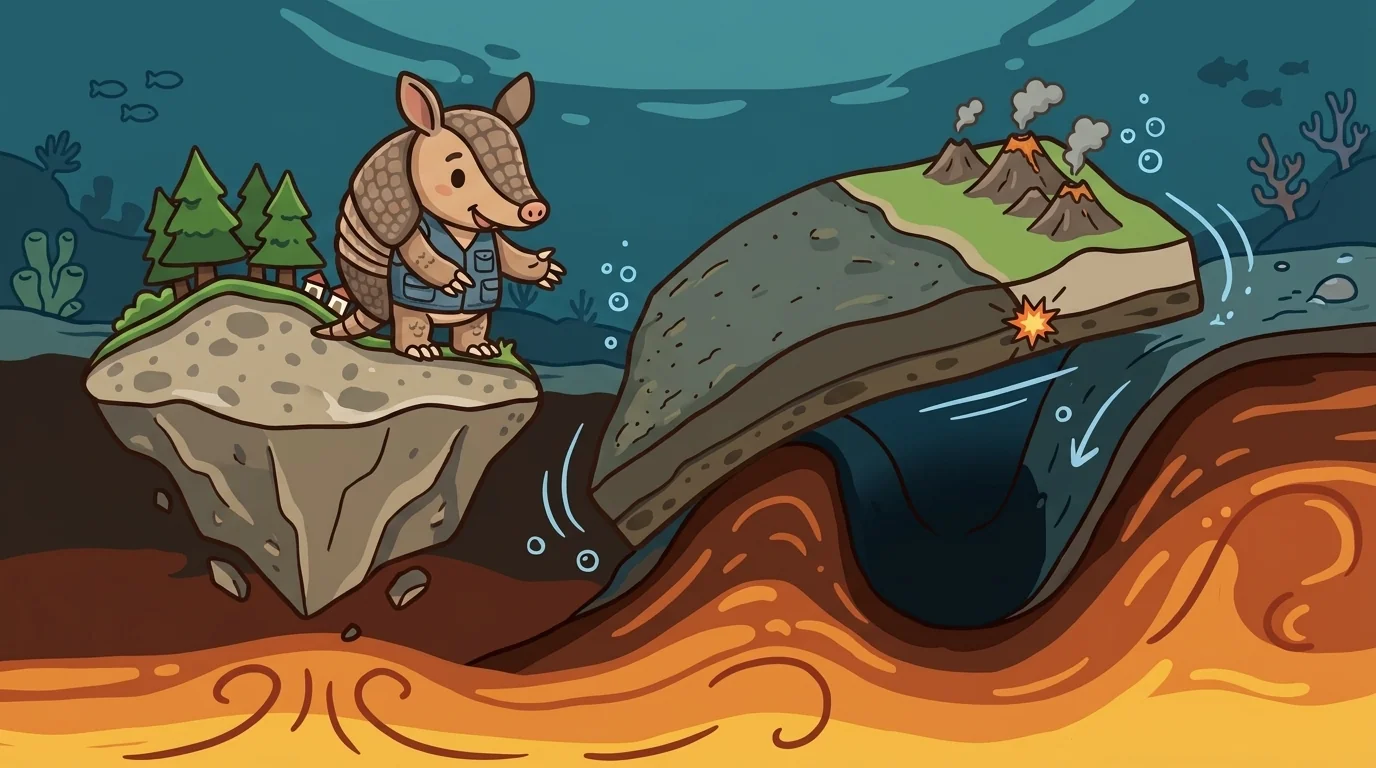
"Many people think of earthquakes when they hear 'plate collision'," Sink said, her voice thoughtful. "They imagine violence. But earthquakes are simply evidence." She tapped her model gently. "They happen when plates stick for a long time. Then they suddenly slip. It's the Earth doing its slow work. The story finally surfaces."
She continued, her voice quiet. "The 2011 Tōhoku earthquake and tsunami in Japan. That was the Pacific Plate sliding under Japan. It was devastating for the people there. A terrible, tragic event. But the geological process itself? That was the slow story finally surfacing. Both truths matter. The impact on people. And the patient work of the Earth."
Sink had learned this patience from her own family. They lived near the ancient mountains, a place called TectonicForge. For generations, her armadillo ancestors had watched the mountains slowly weather. They learned that "the mountains are doing patient work. The visible event we see today is the slow story finally surfacing." Sink carried that lesson deep inside her.
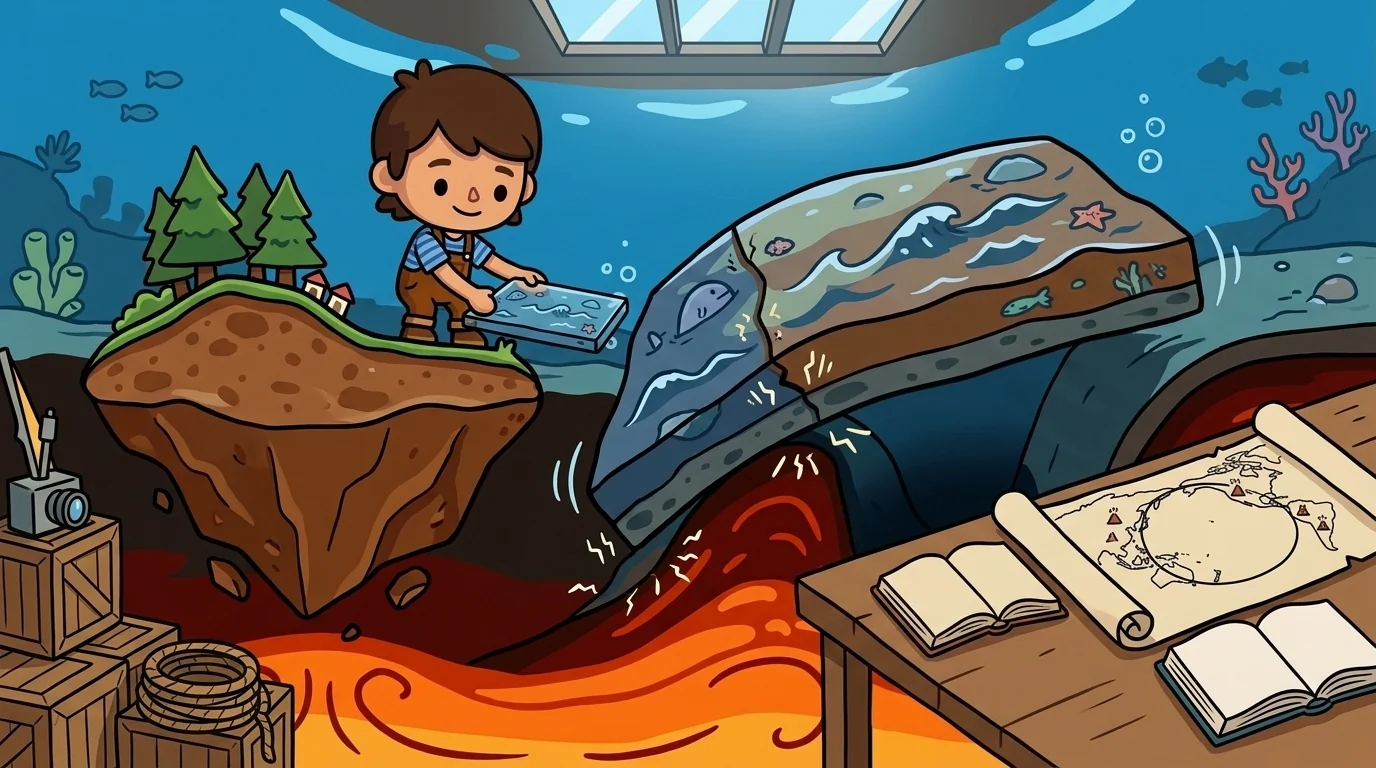
When she turned twelve, she walked to TectonicForge for her appointment. Geo, the village mentor, had asked her, "What is subduction?" Sink had answered, "The heavier plate finds its way down. It takes a long time; that's okay. Patient Earth process. Earthquakes are evidence." Geo had simply nodded. "You are appointed."
Now, in her own workshop, Sink looked at her students. "Don't think of Earth as 'destroying' places," she stated gently but firmly. "Earth is doing its patient work. Sometimes, people are simply in the path. We must respect the impact on people. And we must respect the slow work of Earth. They are not enemies."
"I am Sink," she finished, holding up her cross-section model. "The primitive I teach is *convergent/subduction*. The move is patient process. Visible evidence. And respect for the people affected when events surface." She smiled, a soft, encouraging look. "The heavier plate finds its way down. Slow and steady."
The TectonicForge ensemble
Sink is part of TectonicForge's distributed-narrative cast. Each character embodies a different curricular primitive; together they teach the full subject.
-
Spread
Divergent boundary + new crust — when something pulls apart, something new is forming in the middle
-

Slide
Transform boundary + stored energy — two plates sliding past; they catch, they hold, then they let go
-

Vent
Volcanism + magma chemistry — eruptions tell us what was happening below
-

Tremor
Seismology + earthquake preparedness — earthquakes are the Earth telling its story; we can read the lines; we can be ready