Yearn, Undertow and Face
WHAT THE CHARACTER WANTS — a living stage character is built from three layers: Yearn is the objective, what the character wants badly enough to drive the scene; Undertow is the subtext, the real meaning running under the spoken line; and Face is the acting that brings both alive through voice, body, and emotion
A story read by Yearn, Undertow and Face
Loading audio…
Press play to listen along. The line being read lights up as you go.
Show full transcript
Loading transcript…
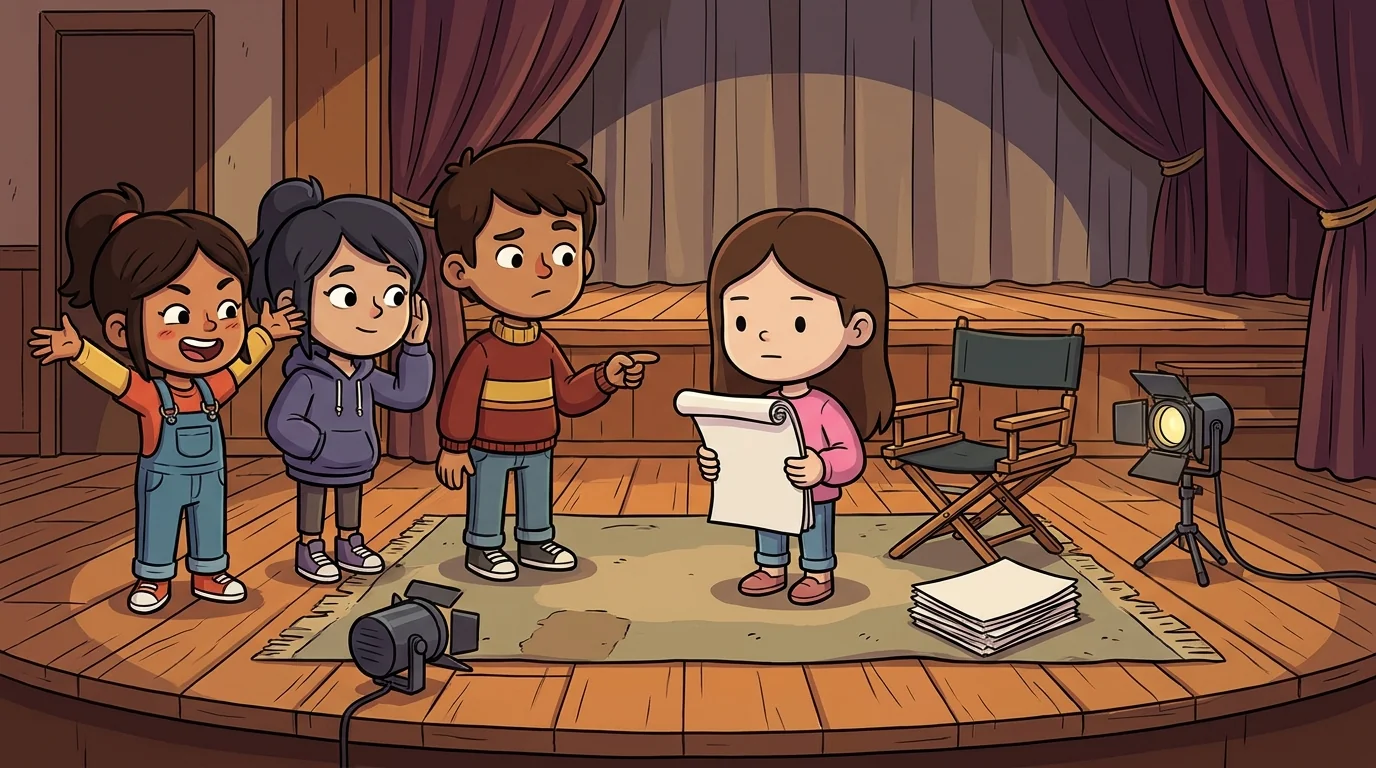
A young actor stood on the empty stage, script in hand, saying her line — "No, I'm fine, really" — and it came out flat as cardboard. True words, dead delivery. Three friends came to help, because they knew that a living character is built in layers, underneath the words, and they were about to add them one at a time.
Yearn asked the first and most important question: what does she want?
Undertow listened for what the line really meant, underneath.
And Face stood ready to bring it all alive in a body and a voice.
"You're saying the words," said Yearn, "but you don't know what she wants yet. That's why it's flat. A character with no want is a puppet. Let's find her want first."
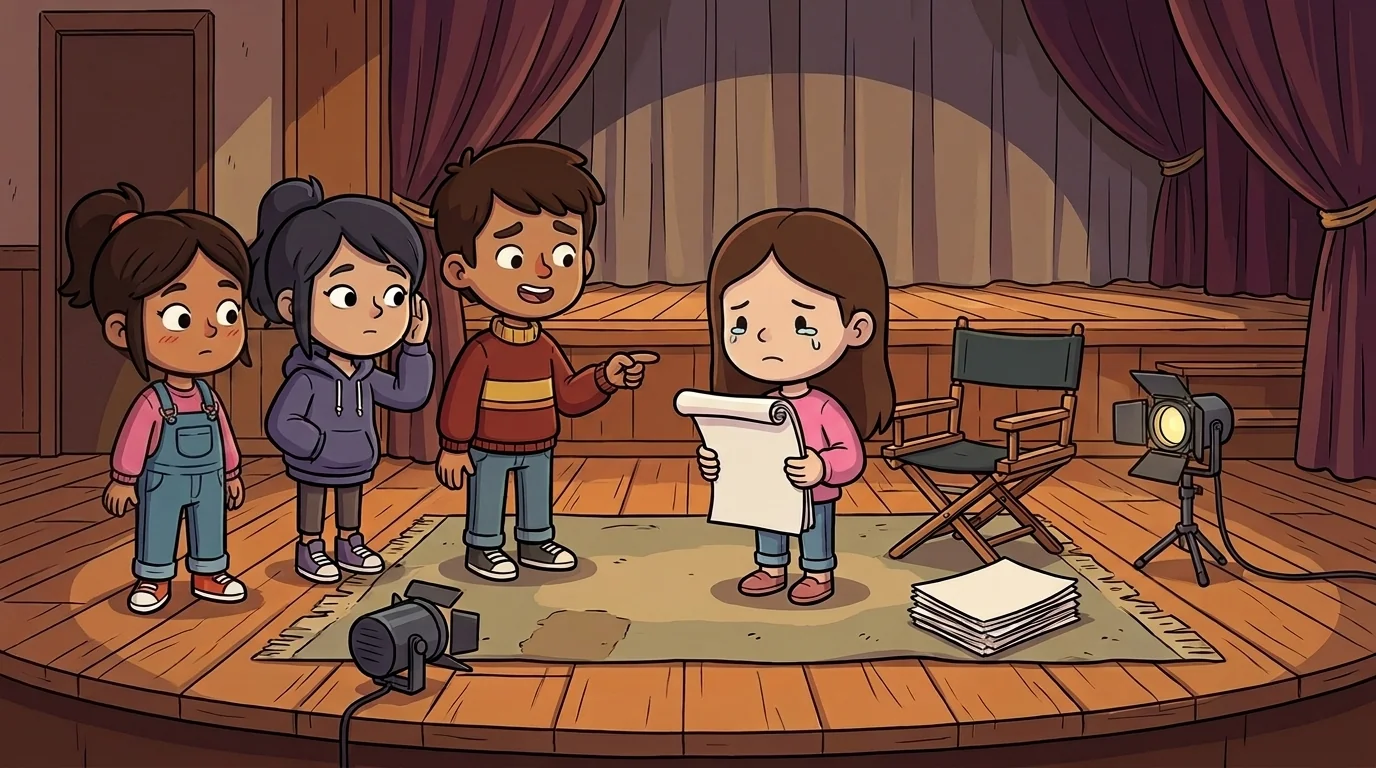
Yearn went first, because a character only comes alive once you know what they want — badly enough to drive them.
"'No, I'm fine, really,'" said Yearn. "Okay — but why does she say it? What does she want in this moment?" The young actor thought. "She... wants them to stop worrying about her?" "Warmer," said Yearn. "Why does she want that?" "Because... she doesn't want them to see she's about to cry. She wants to get out of the room before she breaks." "There." Yearn's eyes lit. "That's her objective. She wants to escape before she cries. Badly. That want is the engine of the whole line now." Yearn leaned in. "A character is never just saying words — they're always after something, trying to get something, wanting something badly enough to act. Find that want, that yearning, and suddenly the character has a reason to be alive. The line isn't 'I'm fine' anymore. It's 'let me out of here before you see me fall apart.' Same words. Completely different when you know the want underneath."

Then Undertow surfaced the thing the young actor was just beginning to feel — that the line's real meaning runs underneath the words, not in them.
"Notice what just happened," said Undertow. "She says 'I'm fine' — but she means the exact opposite. The real meaning is running under the line, like a current under calm water. That's subtext." Undertow traced the gap between the said and the meant. "The words on top: I'm fine, really. The truth underneath: I am not fine at all, and I'm barely holding on, and please don't push me or I'll crack." Undertow held up both. "That gap — between what's said and what's meant — is where all the good acting lives. People almost never say exactly what they feel; they say the polite thing, the brave thing, the covering thing, while the real feeling runs underneath. So an actor plays two things at once: the words on the surface, and the true current below. 'I'm fine' spoken by someone who is fine is nothing. 'I'm fine' spoken by someone breaking underneath — that's a moment that stops a room. The audience hears the words and feels the undertow, and knowing both is what makes a character real."
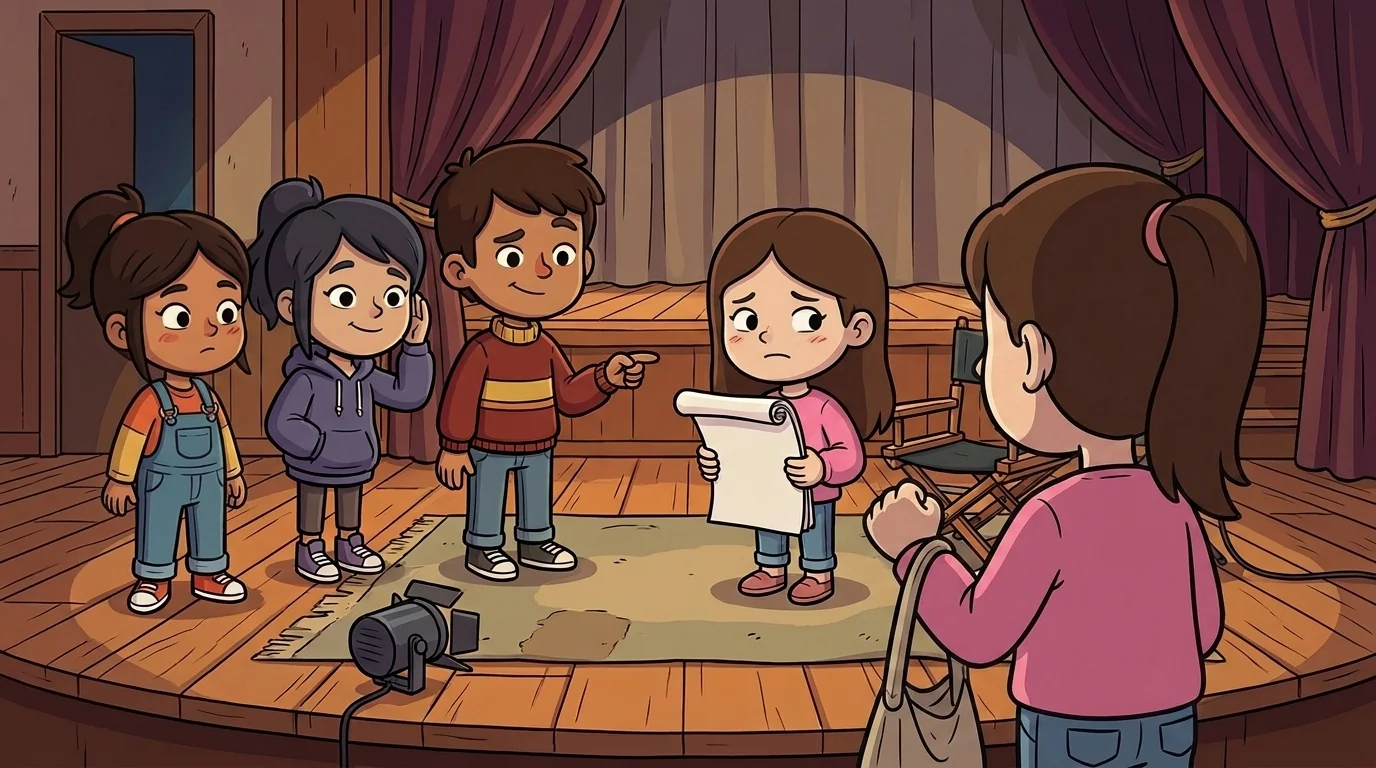
And then Face put it all into a body and a voice — because a want and a subtext are invisible until an actor makes them live.
"Now I make it real," said Face. "The want — escape before crying. The subtext — 'I'm not fine.' But the audience can't read her mind, so I put it in the body." And Face showed how: the too-quick answer, the eyes that dart to the door, the voice that goes a little too bright and tight, the hand that grips the strap of the bag, the tiny breath held to keep the tears down. "Now watch her say it." And the young actor said the line again — 'No, I'm fine, really' — but this time with the want and the subtext living in her body and voice, and it wasn't cardboard anymore. It was a girl about to cry, pretending not to be, trying to escape. The empty stage suddenly held a whole real person. "That's Face," said Face, gently. "Voice, body, the held breath, the darting eyes — the outside that lets the audience see the inside. The want and the subtext are the soul; I'm how they become visible. Together we make a living person out of five flat words."

And there she was — no longer a puppet reciting cardboard, but a whole living character, wanting something badly, meaning the opposite of what she said, and showing it all in a body the audience couldn't look away from.
"Good want," said Undertow.
"Good subtext," said Face.
"Good life," said Yearn.
There is a genuine wonder in watching a character come alive — in seeing five flat words on a page become a whole breathing person with wants and secrets and a held-back tear. And the actor's craft that does it is a kind of deep empathy: to find what someone wants badly, to hear the true feeling running under their brave words, and to let it live in a real body. It teaches you to look at people that way too — to wonder what they're really after, what they mean beneath what they say. And that feeling, when an actor makes you utterly believe in someone who doesn't exist, is one of theater's oldest gifts: the warm, astonished sense of a living soul, conjured out of nothing but want, subtext, and a truthful face.
The StageForge ensemble
Yearn, Undertow and Face is part of StageForge's distributed-narrative cast. Each character embodies a different curricular primitive; together they teach the full subject.
-

Face
Acting — character work through voice, body, and emotional life
-

Pen
Playwriting — turning ideas into scripts with character, conflict, structure
-

Block
Blocking — directing actors through stage geography
-

Rig
Stagecraft — the technical-theater craft that makes the visible-stage possible
-

Riff
Improvisation — the live-performance craft of Yes, and...
-

Rafter
Projection — making your voice reach the back row without shouting, by supporting it with breath so even a quiet line lands in the last seat
-

Yearn
The objective — what a character wants in a scene, badly enough to drive every line and move; the engine under a performance
-

Undertow
Subtext — the real meaning running under the spoken line; what a character truly means beneath the words they actually say
-

Freeze
Tableau — a frozen stage picture the whole cast holds so the audience can read the moment like a painting
-

Hitch
Pacing and timing — the rhythm of a scene and the deliberate pause that makes a line land, the held beat before the joke or the truth
-

Opening Night
The whole company on stage together — how acting, objective, subtext, tableau, and timing combine so one live scene truly comes alive