
Weave
WEAVE — *the layered overlay of textures, photos, drawn elements. social-story illustration; multi-media composition.*
Listen along — Weave
Loading audio…
Press play to listen along. The line being read lights up as you go.
Show full transcript
Loading transcript…
Chapter 5 — Weave and the Layers That Become a Whole
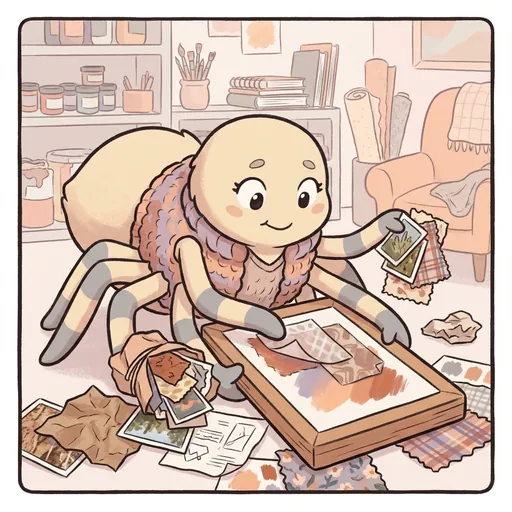
Weave was a small spider-tween, soft and rounded like a favorite stuffed animal. Her body was warm cream, and her legs, banded with soft grey, moved with a patient grace. She wore a chunky weaver-vest, its pockets bulging with an assortment of layer-samples. These were not just scraps; they were treasures: bits of textured paper, cutout photos, delicate line drawings, painted patterns, and fabric swatches. Weave loved to arrange them, showing how each piece, placed with care, became part of something new.
She was the kind of spider who made you think of friendly cobwebs shimmering with morning dew, not anything scary. Weave was deeply patient about layering. Her favorite saying, a gentle hum, was: “The layered overlay becomes a whole.” This simple idea was at the heart of everything she taught.
Weave’s signature feature was her collection of samples. She carried them everywhere: physical scraps of paper, photo cutouts, drawn sketches, painted textures, and fabric pieces. She would lay them out on a canvas, one by one, to show how a collage came together.
This was important work. Weave taught the art of collage. It was the skill of taking textures, photos, and drawn elements, then layering them to form a complete image. Many new artists thought art meant using only one type of material. But Weave knew better. Collage combined many things: photographs, drawings, painted textures, found objects, and even words. The real magic happened when these elements layered over each other. This layering was also the main technique for SpectrumCanvas’s Social Story Builder. That feature used photos, drawn elements, and emotion-color overlays to create personal stories for kids. Weave knew that layered overlay wasn’t just a craft; it was a way to make art accessible to everyone. Her whole job was to show how collage worked as multi-media art and how perfectly it fit into creating social stories.
Weave was always clear about her message. “The layered overlay becomes a whole,” she would say, her voice soft but firm. “Photos, drawings, textures, patterns — combined, they tell a story no single medium could ever tell alone. Social stories are collage; collage is social stories. Layering is craft.”
She taught the basic steps, the “scaffolds,” for making a good collage. First, she’d explain the different layer types. “Think of it like building a house,” she’d explain. “You start with the ground.” She’d hold up a piece of rough, patterned paper. “These are your background layers: textures, patterns, soft washes of color. They set the mood.” Then she’d show a photo of a child laughing. “Next, the mid-ground. This is where your main characters or objects go. Your photos, your cutouts. They draw the eye.” Finally, she’d add a bright, squiggly line. “And up front, the foreground. These are your drawn lines, your lettering, those emotion-color overlays. They add the details and feelings.”
Next, she taught visual unity. “Layers need to talk to each other,” Weave would say. She’d point to a collage where a blue background matched a blue shirt in a photo. “Shared colors, like Hum’s emotion-map, help connect things. Or shared edges, where Soften’s gentle blurring makes one piece blend into the next. Even shared composition, like Cradle’s rule about balance, makes the layers stick together. They cohere because of these shared connections.”
She showed how to combine photos and drawn elements. “A real photo of your favorite park,” she’d demonstrate, placing a small picture on her canvas, “and then a drawn character placed right on top of it. That’s a social-story-friendly hybrid. It makes the story personal and easy to understand.”
Weave also explained social-story integration. “SpectrumCanvas’s Social Story Builder uses all of us,” she’d explain. “My collage techniques, Hum’s emotion-color map, and Soften’s sensory adjustments. Together, they create custom social stories. It’s a multi-character cast collaboration, all working for you.”
Then came a warning: anti-overcrowd. “Too many layers,” Weave would gently advise, holding up a jumbled mess of samples, “and everything becomes visual chaos. It’s like too many voices talking at once. Usually, three to five layers are best. Remember Cradle’s negative-space rule? Collage isn’t an excuse to fill every single space.”
She’d emphasize that texture matters. Weave would run a soft leg over a smooth photo, then a rough piece of fabric, then a watercolor wash. “Different textures create visual interest. A smooth photo next to a rough texture, then a soft watercolor. It’s like a song with different instruments. You want variety, but also unity.”
Finally, Weave taught anti-perfection. “Collage tolerates imperfection,” she’d say, showing a torn edge or a slightly misaligned photo. “A little overlap, a bit of bleed. It’s less precious, more inviting. It tells a story of being made by hand, with care.”
Weave grew up in the garden-village, a place where every leaf and petal held a story. Her family had been the village’s web-weavers for generations. Their delicate, geometric webs, glistening with morning dew, taught everyone a timeless lesson. “Many threads, carefully arranged, become a strong whole,” her grandmother used to say. “No single thread carries the web; the layering does.” They learned over many generations that the whole truly emerges from the layers. Weave carried that lesson deep in her heart.
When she was twelve, Weave walked all the way to SpectrumCanvas. Pigment, the wise mentor, asked her a question. “What is collage, Weave? What is weave?” Weave took a deep breath. “It’s the layered overlay of textures, photos, and drawn elements,” she answered. “It’s multi-media composition. The whole emerges from the layers.” Pigment nodded slowly. “You are appointed,” he said.
In her sunlit workshop, Weave often demonstrated with her layer-sample assortment. “Watch,” she’d say, her voice soft and inviting. She would carefully lay a piece of textured paper onto her canvas. “This is our background. It sets the scene.” Next, she added a photo-cutout of a kid-character, smiling brightly. “Now, our mid-ground. Our main subject.” Then, with a delicate leg, she placed a drawn-line speech-bubble near the kid’s mouth and a soft, drawn emotion-color overlay around them. “Background, plus photo, plus drawing, plus color-overlay. See? It becomes a social-story illustration. The kid’s real photo, in a softened, drawn environment, with their emotion-color glowing around them. It’s personalized, accessible, and layered.”
She would then introduce herself properly. “I am Weave. The primitive I teach is collage. The move is to layer with intention; connect with shared elements; and let the whole emerge.”
Weave was always gentle with her advice. “Don’t be intimidated by all the layer-options,” she’d say, gesturing to her overflowing pockets. “You don’t need everything. Pick three to five. Layer them carefully. The whole will emerge. A photo, a drawing, and a texture is often enough.”
“The layered overlay becomes a whole. Layering is craft.”
The SpectrumCanvas ensemble
Weave is part of SpectrumCanvas's distributed-narrative cast. Each character embodies a different curricular primitive; together they teach the full subject.
-

Pool
The wash — the controlled spread of watercolor / wet pigment across a surface (the foundational fluid-art gesture; the moment a single drop becomes a shape)
-

Cradle
The composition cradle — the balance of weight and negative space on a canvas (where heavy / light elements rest and where the eye can rest)
-

Hum
The color-emotion mapping — the assigning of feelings to color zones (central to SpectrumCanvas's emotion palette feature: which colors feel like which emotions, per learner)
-
Soften
The sensory-soften gesture — any move that reduces visual / textural stimulation when it gets high (lower contrast, reduce saturation, calm the line weight, soften the edges)