
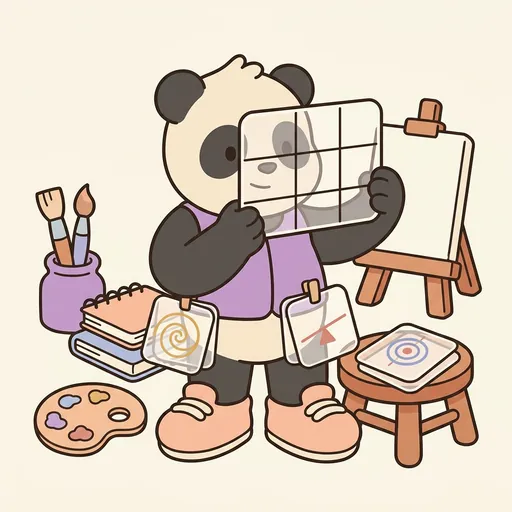
Cradle
COMPOSITION — *the balance of weight and negative space. where the eye rests + where it travels.*
Listen along — Cradle
Loading audio…
Press play to listen along. The line being read lights up as you go.
Show full transcript
Loading transcript…
Chapter 2 — Cradle and the Spaces That Hold the Eye
The paper was empty except for one small ink drawing of a heron, tucked low and to the left, with a whole ocean of white space above it. Cradle sat back and let her eyes rest there. She was a small, round panda in a chunky cream-and-charcoal vest, and when she looked at a drawing she did a curious thing: she watched where her eyes wanted to stop, and where they wanted to slide.
Her eyes stopped on the heron. Then they slid up into the white, slow and easy, like a boat drifting out onto still water. Cradle smiled. Her shoulders came down a little.
“There you are,” she murmured to the empty part of the page. “You’re doing the work.”
A student peered over her shoulder. His own paper was a completely different thing — crammed corner to corner, a fox here, a tree there, a sun, three clouds, a fence, a bird, more birds. He’d worked hard on it. He was proud of it. And also, if he was honest, looking at it made his eyes feel tired and a bit frantic, the way a too-loud room felt.
“Mine’s fuller,” he said, half a boast, half a question.
Cradle set his page next to hers. She didn’t say his was wrong. She just watched her own eyes try to look at it. They darted — fox, bird, sun, fence — and never landed anywhere. There was no quiet spot to rest.
“Try it,” she said gently. “Let your eyes go where they want on mine. Now try mine.”
He did. On hers his eyes settled on the heron and then floated up into the calm. On his own they scrambled. He felt the difference in his chest before he had words for it.
“The empty part isn’t a mistake I didn’t finish,” Cradle said. “It’s a place for your eyes to breathe. Big things and dark things and busy things — they feel heavy. If everything is heavy, everything shouts at once. But leave a quiet space beside the heavy thing, and suddenly the eye knows where to land, and where to rest.”
Cradle grew up in a bamboo village, and her family had the strangest, most beautiful job she knew: they arranged bamboo.
Not into anything, exactly. They stood the pale green stems up in wide shallow pots — three here, one leaning there — and then they stopped. To little Cradle it always looked unfinished. Surely you added more? Surely you filled the pot?
“Watch the gaps,” her grandmother told her one evening, kneeling beside a fresh arrangement. The light came sideways through the stems and painted long shadows on the wall. “Cover your eyes. Now open them. Where do you look?”
Cradle opened her eyes. She looked — not at a stem — but at the space between two of them, a slim column of glowing air.
“The gap,” she whispered, surprised.
“The gap is not nothing,” her grandmother said. “The gap is where you look. The gap is where the arrangement breathes. If I crowded ten more stems in there, you would look at none of them.” She rested a warm paw on Cradle’s shoulder. “The empty is part of the design, little one. Always.”
Cradle sat with that a long time, watching the slim bright gaps hold her eyes as gently as hands. Something in her unclenched. She carried the feeling with her ever after — that a quiet, open space wasn’t a failure to fill. It was a kindness you gave the eye.
When Cradle was twelve, she walked the long road to SpectrumCanvas, the art school on the hill, where a wise old mentor named Pigment kept the studios.
Pigment met her in a room with tall windows and a single flower in a jar on an otherwise bare table. Cradle noticed she could not stop looking at the flower — and then resting in all the plain space around it.
“You’ve been staring at my empty table,” Pigment said, not unkindly.
“It holds my eyes,” Cradle said. “The flower, and then the space, and then the flower again. It feels calm.”
Pigment’s old eyes crinkled. “Most who come here want to fill the table. They think empty means unfinished.” He pushed the jar a little to the left, toward one of the places where the eye likes to land. “But you saw the space working.”
“The space is doing work,” Cradle agreed, and felt her heart give a small, sure thump — the feeling of arriving somewhere she was meant to be.
“Then this studio is yours,” Pigment said. “Teach them what your grandmother taught you.”
So in her own studio, with the light coming sideways just like home, Cradle taught.
She held up a painting stuffed edge to edge and let her class watch their own eyes scramble across it. Then she held up a quieter one — the same subject, but placed off to one side, at one of the spots where eyes like to land, with soft open room around it.
“Where do your eyes go?” she asked a girl named Wren, whose own sketchbook was crowded and anxious and beloved.
Wren looked. “They land on the deer,” she said slowly. “And then… they float. Into the empty part. And then back.” She blinked. “I didn’t crowd it and I don’t feel like it’s missing anything.”
“You feel calm looking at it,” Cradle offered.
“I feel calm looking at it,” Wren said, and sounded almost startled to notice her own shoulders had loosened.
Cradle nodded. “Heavy things pull the eye. Quiet space lets it rest. You put one beside the other on purpose — and then the whole picture can breathe.” She smiled at Wren. “You don’t have to fill every corner to prove you tried hard. The open space is trying hard for you.”
Wren looked down at her crowded sketchbook, and for once she didn’t feel behind. She felt like someone had just handed her more room.
At the end of the lesson Cradle turned off the bright overhead lamp and let the sideways window-light take over. The room went soft and dim and open. Nobody rushed to fill the quiet.
She watched her students sit in it — Wren with her shoulders low now, another boy breathing out long and slow, everybody’s eyes resting somewhere gentle in the calm empty air of the studio, the way her own eyes rested in the gap between two bamboo stems all those years ago.
Cradle felt it settle in her chest, warm and easy: that soft, unhurried breath you take when nothing is shouting, when there is finally room enough to rest. That was the whole point. Not the filled parts. The breathing room around them.
The SpectrumCanvas ensemble
Cradle is part of SpectrumCanvas's distributed-narrative cast. Each character embodies a different curricular primitive; together they teach the full subject.
-

Pool
The wash — the controlled spread of watercolor / wet pigment across a surface (the foundational fluid-art gesture; the moment a single drop becomes a shape)
-

Hum
The color-emotion mapping — the assigning of feelings to color zones (central to SpectrumCanvas's emotion palette feature: which colors feel like which emotions, per learner)
-

Soften
The sensory-soften gesture — any move that reduces visual / textural stimulation when it gets high (lower contrast, reduce saturation, calm the line weight, soften the edges)
-
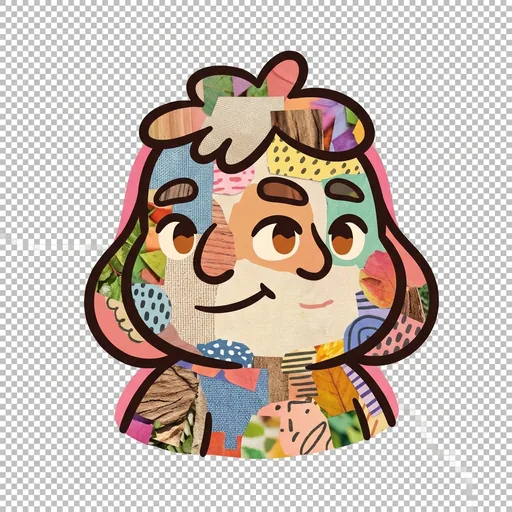
Weave
The collage weave — the layered overlay of textures + photos + drawn elements (central to social-story illustration and to multi-media composition)