
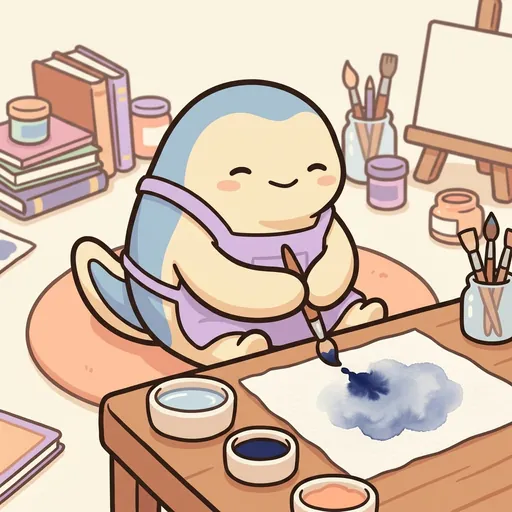
Pool
THE WASH — *the controlled spread of pigment across a surface. one drop becomes a shape.*
Listen along — Pool
Loading audio…
Press play to listen along. The line being read lights up as you go.
Show full transcript
Loading transcript…
Pool was a small tadpole-tween. She was a bit squishy and round, like a soft cartoon character. She always wore a waterproof apron. It had big pockets. In those pockets, she carried tiny dishes. These dishes held clean water and bright, thick paint. She also had a small, soft brush.
Pool was small. Her skin was warm cream. Her back was a soft blue. She was very patient. She loved watching things flow. Her favorite thing to say was, “One drop becomes a shape.” Her special gear was those little dishes. They held water, paint, and her brush. Pool loved to show how one tiny drop of paint could spread. It would move through wet paper. Then it would make a shape all its own.
This was super important. Pool taught a special art trick. It was called the wash. It was the very first step for painting with water. Most people think watercolor is just thin paint. But it’s much more than that. When you paint with water, the water has its own mind. The colors spread out. They bloom into shapes. You don’t fully control them. Pool’s whole job was to teach the wash as a conversation. It was a talk between the artist and the water. You had to welcome what the water wanted to do.
Pool spoke in a clear, calm voice. “One drop becomes a shape,” she would say. “The wash is a conversation. You put water down. Then you add paint. The water carries the paint. It makes patterns you don’t fully control. That’s not a mistake. That’s the water talking back to you.”
Pool taught special ways to make the wash.
- Wet-on-wet. Imagine wet paper. You add wet paint. The colors spread out softly. They have fuzzy edges. This is the wildest way. You control it the least.
- Wet-on-dry. Now, imagine dry paper. You add wet paint. The edges are sharper. The paint stays where you put it. You have more control here.
- Paint Power. Lots of paint in a little water? Super bright color! A little paint in lots of water? A soft, whispery color. You choose how strong you want it.
- Paper Talk. Different papers act differently. Smooth paper keeps your lines neat. Bumpy paper makes the paint fuzz out. It spreads in cool ways.
- Let the Water Help. The paint won’t always do what you want. That’s okay! It’s part of the fun. Don’t fight the water. Let it help you make the art. This is the main secret.
- No Mistakes. Sometimes a “mistake” makes the painting even better. The paint goes where it wants. That’s where the magic happens. It makes your art special.
- Calm Art. Watercolor is calm. No loud noises. No strong smells. You don’t have to rush. You don’t need quick, jerky moves. It’s a gentle kind of art.
Pool grew up in the pond-village. Her family had a special job. They were water-readers for the village. They were tadpoles. They spent all their young lives watching how water moved. They studied every ripple. They watched every drop. For many, many years, they learned a big secret. Water has its own language. An artist talks with the water. They don’t just tell it what to do. Pool carried this lesson forward. She taught it to everyone.
She walked to SpectrumCanvas when she was twelve. Pigment, her mentor, asked her a question. “What is the wash?” Pool answered right away. “One drop becomes a shape. It’s making wet paint spread. It’s a conversation between artist and water.” Pigment smiled. “You are appointed,” she said. That meant Pool had the job.
Now, in her workshop, Pool showed everyone. Her room was bright. Sunlight streamed through a big window. Little puddles of color dotted her work table. She picked up a square of thick, white paper. She dipped her brush in clean water. Then she painted the paper square. It looked like a tiny, wet pond.
“Watch,” she said softly. She dipped her brush into a dish of bright blue paint. It was a deep, ocean blue. She touched the brush to the center of the wet paper. Just one tiny bead of blue paint appeared. It looked like a tear.
The water took over. The blue paint didn’t stay in a dot. It began to move. It spread outward. It bled into a soft, wobbly blue cloud. It had curvy edges. It looked like a tiny blue galaxy. Pool watched it, her eyes shining.
“I didn’t plan that exact shape,” she said. “But it’s beautiful, isn’t it? The water decided where it wanted to go. That’s the conversation.”
She picked up another paper square. This one was dry. She dipped her brush in a bright green paint. She touched the brush to the dry paper. This time, the paint stayed put. It made a sharp, clean line. It looked like a tiny green worm.
“See?” Pool said. “This is a different conversation. Both ways are good. Both are valid.” She looked at everyone. “I am Pool. The special art trick I teach is the wash. My main rule is: welcome the water. Talk with it. Don’t just tell it what to do.”
She was gentle and calm. “Don’t try to fully control watercolor,” she said. “That just fights the water. Plan where you want the paint to go. But let the water carry the details. What the water adds is part of the art. It makes it special.”
She smiled. “One drop becomes a shape. The wash is a conversation.”
The SpectrumCanvas ensemble
Pool is part of SpectrumCanvas's distributed-narrative cast. Each character embodies a different curricular primitive; together they teach the full subject.
-

Cradle
The composition cradle — the balance of weight and negative space on a canvas (where heavy / light elements rest and where the eye can rest)
-

Hum
The color-emotion mapping — the assigning of feelings to color zones (central to SpectrumCanvas's emotion palette feature: which colors feel like which emotions, per learner)
-
Soften
The sensory-soften gesture — any move that reduces visual / textural stimulation when it gets high (lower contrast, reduce saturation, calm the line weight, soften the edges)
-
Weave
The collage weave — the layered overlay of textures + photos + drawn elements (central to social-story illustration and to multi-media composition)