
Mirror and Tug
REFLECTION-AND-INVERSE — negative numbers are positive numbers reflected across zero; inverse operations are pulls in the opposite direction along the number line. Subtraction is the same as adding the reflection; division is the same as multiplying the reciprocal. Two ways to talk about one symmetry.
Press play to listen along. The line being read lights up as you go.
Show full transcript
Loading transcript…
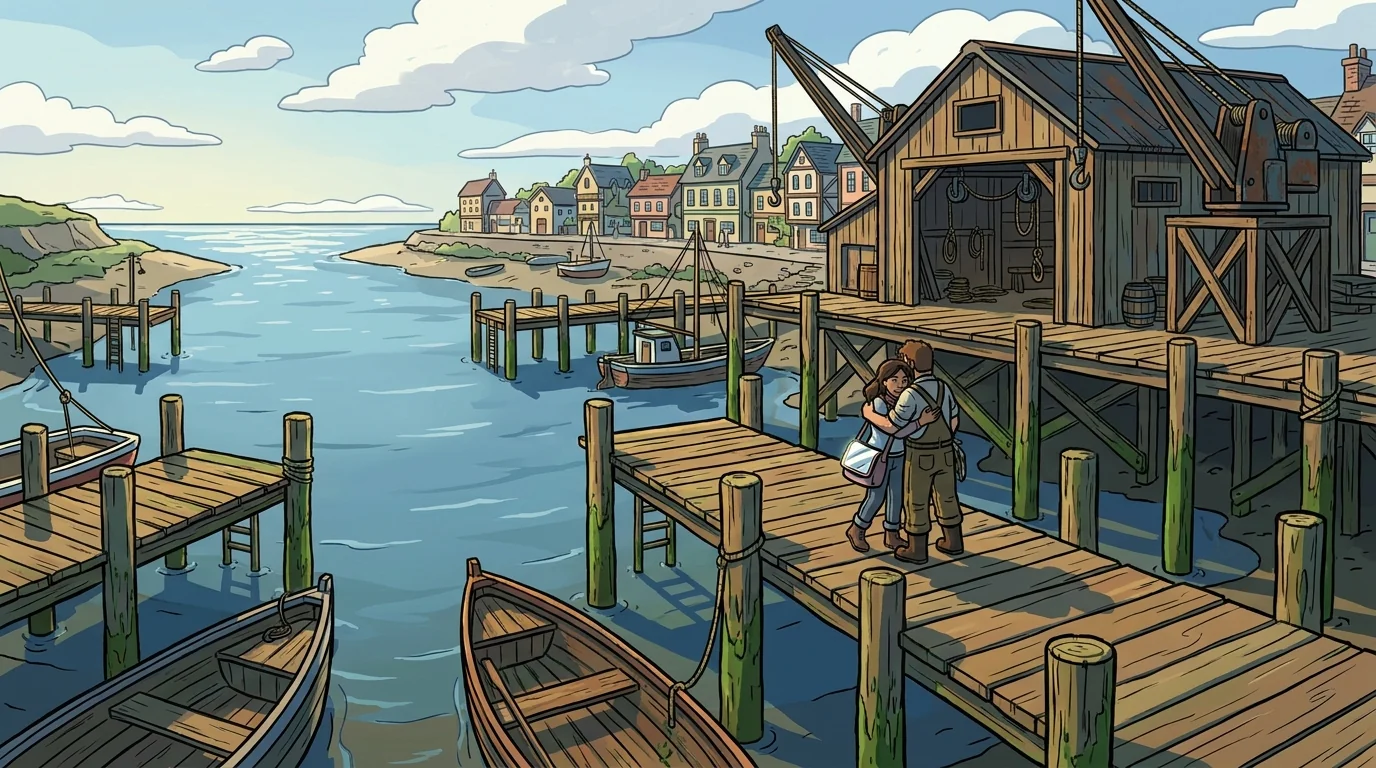
The ancient harbour-town of Bollard nestled precisely where the wide river emptied its freshwater into the vast, salty expanse of the sea. Twice each day, the ocean’s slow, deliberate swell pushed inland, lifting the entire harbour. Then, just as predictably, the water receded, draining back out to the open sea. The townspeople called this rhythmic exchange the breath of the harbour. With each inhale and exhale, the fishing vessels and cargo ships in the harbour rose and fell, their painted hulls shimmering in the shifting light. The sturdy wooden pilings of the docks bore thick green lines, a century’s worth of tide-stains that marked the water’s daily journey. Everyone in Bollard, even the youngest children, could read these intricate lines, instantly knowing whether the tide was coming in or going out.
Mirror had traveled to Bollard to visit her father's old friend, the harbour-master. She hadn't seen the coast since her early childhood, and a specific memory had drawn her back. She longed to find glass polished smooth by saltwater. Her father, a master glassblower, had promised her when she was a child that glass tumbled in the ocean for a decade became finer than anything he could ever create in his workshop. She needed to see if his claim held true.
Tug, on the other hand, had known the harbour his entire life. His parents’ rope-and-pulley workshop stood right on the dock, its heavy timbers groaning with the weight of generations of craft. He still returned once a season, his strong hands essential for operating the heavy cranes that lifted cargo from the ships.
They met on the long, weathered dock, directly in front of Tug’s family workshop. The afternoon sun cast long shadows, and the tide had just begun its slow, outward journey.
Tug spotted her first. A wide grin spread across his face as he lifted a hand in greeting. He hadn't known Mirror would be in town, but her presence felt entirely natural.
She walked towards him, her steps light. They exchanged a quick, familiar embrace. Both had spent years at the academy, their paths crossing often, forging a bond that felt more like family than mere professional acquaintance.
"What brings you all the way out here?" Tug asked, his voice warm with genuine curiosity.
"Sea glass," Mirror replied, her eyes already scanning the water.
"There's a perfect beach about a quarter mile north," Tug said, already planning. "I'll walk you there in an hour or so. The tide will be good and low by then."
"Perfect," she confirmed, a quiet satisfaction in her tone.
They settled onto the edge of the dock, their legs dangling above the water. Mirror let her bare feet skim the surface, enjoying the cool touch. Tug pointed to a particularly prominent green line on one of the pilings.
"Watch that one," he instructed. "The water’s at the plus-three line right now. By the time we head to the beach, it’ll be at plus-one. In another two hours, it’ll hit zero. If today's tide is especially strong, it might even drop to negative-one or negative-two. These pilings have marks all the way down to negative four, for the really extreme low tides."
"That's a number line," Mirror observed, a faint smile playing on her lips.
"That's a number line that drains and refills," Tug clarified, his gaze fixed on the receding water. "Twice a day. Every single day. Forever."
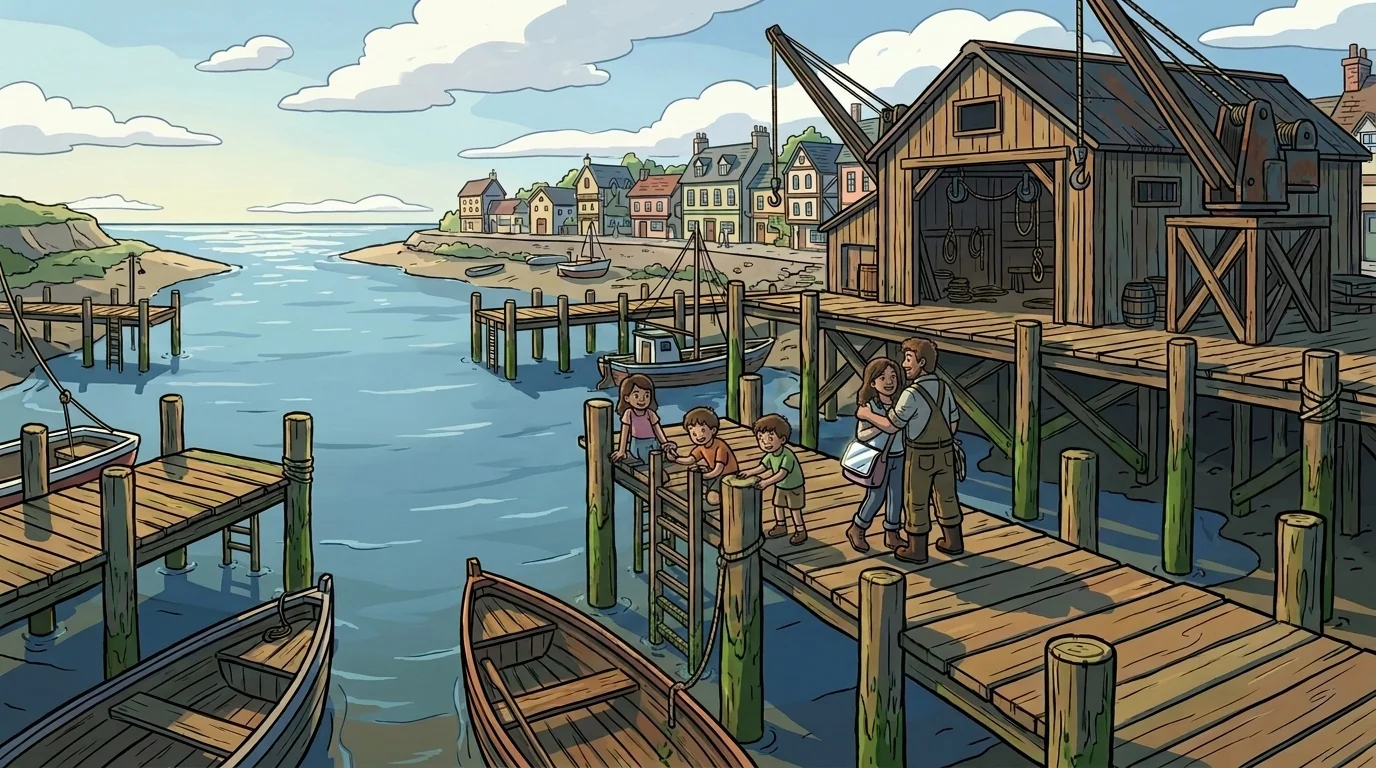
A small group of children played on the dock behind them, their voices carrying on the breeze. They were engaged in a spirited game of dares, challenging each other to descend the wooden ladder that led from the dock down into the water. The ladder was marked with rungs at precise one-foot intervals. The very top rung sat at plus-five relative to the standard low-water mark, while the bottom rung was at minus-three — three feet below even the lowest standard tide line, meaning it was perpetually submerged. Even at the deepest tide, those bottom three rungs remained underwater.
One of the children, a girl of about ten with bright, determined eyes, was halfway down the ladder. The water currently lapped at the plus-three line. She was perched on the plus-four rung, her sneakers just above the wetness. Two of the lower rungs — plus-one and plus-two — were dry, clearly visible above the water. The plus-three rung was just at water level, while plus-zero and everything below it disappeared into the murky depths.
"How many dry rungs are there below me?" she called up to her older brother, who stood on the dock.
He squinted, counting carefully. "Two dry," he reported. "And three under water. Then it goes negative."
"How many total rungs to the bottom?" she persisted, her voice echoing slightly over the water.
"Top of the ladder is plus-five," he recited, thinking aloud. "Bottom of the ladder is negative-three. So... that makes eight rungs total. Five above zero, three below zero."
"Eight!" she shouted back, a triumphant note in her voice. "Including the wet ones!"
Mirror leaned closer to Tug, a quiet appreciation in her eyes. "Pretty good," she murmured.
"Wait for the next part," Tug advised, a knowing look on his face.
Her brother on the dock yelled down again: "But if the tide drops to negative-two, how many dry rungs will there be then?"
The girl on the ladder paused, her brow furrowed in concentration. She visualized the water dropping, then her face cleared. Very confidently, she announced: "Five plus two is seven. Seven dry rungs. The water will drop two more feet."

"That's right!" her brother cheered, clearly impressed.
Mirror grinned at Tug. "She used negative numbers without even flinching."
"She used negative numbers because the harbour uses negative numbers," Tug explained, his voice gentle. "Every kid in this town learns to read the tide-stains by age six. They know the water can be at plus-three, or zero, or negative-two. They understand what those numbers mean physically. The formal math comes later. The physical picture, the concrete reality, always comes first."
"My father used to say that, too," Mirror recalled, a wistful note in her voice. "He'd hold up a clear glass sheet and then a finished, silvered mirror. He'd say: 'This is plus-one. That is negative-one. Same distance from zero. Opposite sides. One you look through. One you look at.'"
Tug nodded slowly, absorbing her words.
"That's the cleanest definition I've ever heard," he said, a genuine admiration in his tone.
A new, minor crisis erupted behind them.
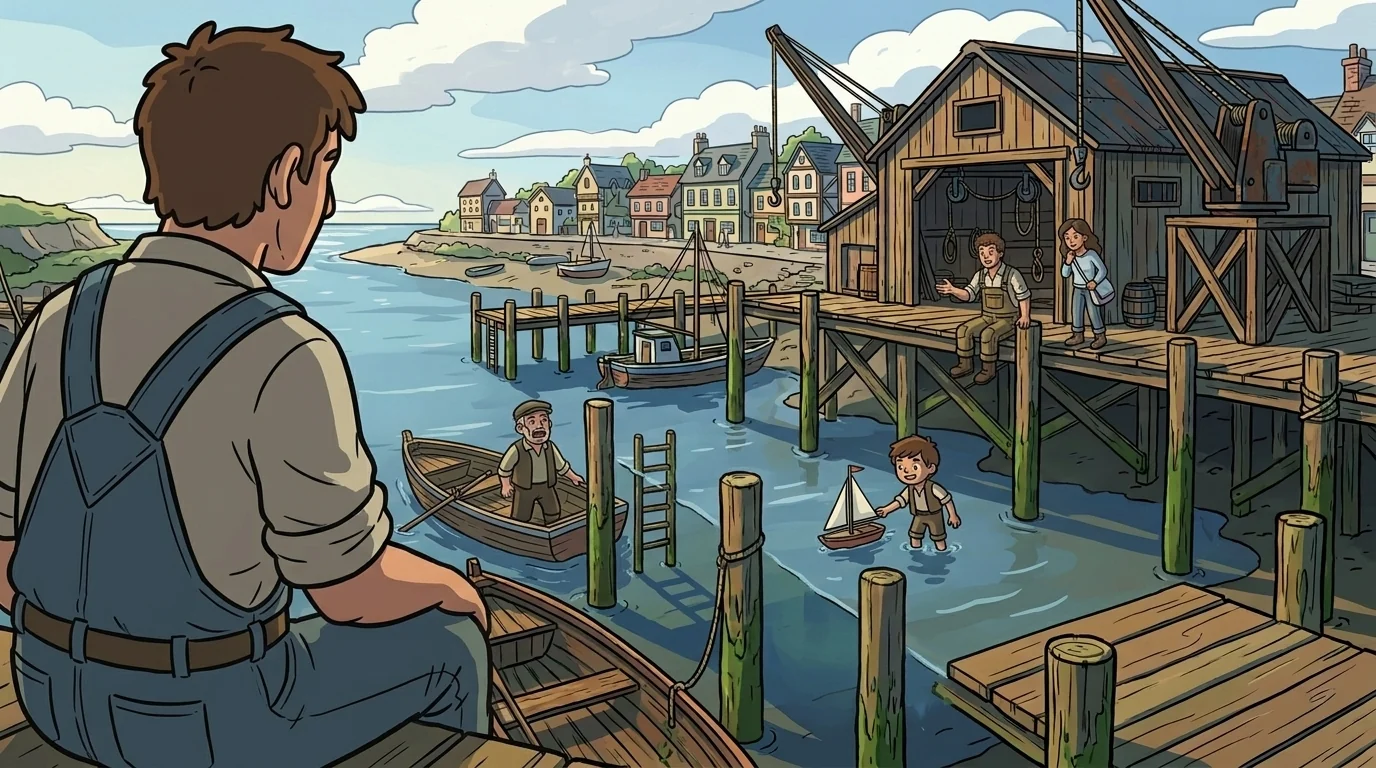
A different child — a small boy of about eight, with a mop of unruly brown hair — was standing on the plus-two rung. He clutched a small, brightly painted wooden boat. His mission was to gently lower it into the water without dropping it, a task that seemed to confound him. The water was still at plus-three. He needed to lower the boat down to the water, which, from his perspective, was one foot below his rung.
He shouted up, his voice tinged with frustration: "Dad! How far down do I lower it?"
His father, who was standing on the dock, called down with a helpful, if slightly confusing, explanation: "The water is at plus-three, son. You are at plus-two. The water is above your feet."
The boy looked utterly bewildered. He stared at his feet, then at the water, then back at his feet.
"Hold on," Mirror said, standing up with a decisive movement. "Let me try this one."
She walked over to the edge of the dock and leaned down, positioning herself so the boy could see her clearly without straining. "Hello," she said, her voice calm and friendly.
"Hello," the boy replied, still looking confused.
"You're standing on the plus-two rung," Mirror explained, pointing. "The water is at plus-three. So, where is the water compared to your rung?"
The boy thought hard, his brow furrowed. "Above me?" he ventured, his voice a question.
"Above you, exactly," Mirror confirmed. "And by how much?"
"One foot," he said, the answer clicking into place.
"Right," Mirror affirmed. "So, to put your boat into the water, you actually have to lift the boat up by one foot. Not down. The water's above you."
The boy’s eyes widened as he looked at the water, which was indeed sloshing just one foot above his rung. A sudden, delighted laugh escaped him. He carefully climbed up one rung, now at plus-three, and gently set his boat onto the water. The small vessel bobbed cheerfully, then floated away.
The father, relieved, shouted his thanks from the dock.
Tug, who had watched the entire exchange, spoke quietly beside Mirror. "That was the inverse move," he observed. "He thought he needed to lower. You showed him he needed to lift. Same distance, opposite direction. That's all an inverse operation really is."
Mirror sat back down beside him, a thoughtful expression on her face. "It's the same as the mirror thing," she agreed. "The reflection. Lower-by-one is the opposite-direction-by-one of lift-by-one. The boy needed to do the reflection. He was about to do the wrong half of the pair."
"That's the whole *inverse-operation principle in one little boat," Tug mused. "If you go the wrong direction by one foot, you correct it by going the opposite direction by one foot. Minus and plus are mirrors of each other. They have the same magnitude, but opposite signs. They undo each other. Tug and counter-tug.*"
He paused, a new idea sparking in his mind.
"You know," he said, his voice tinged with surprise, "I've been teaching inverse operations for fifteen years, and I have never thought about them as mirror images before. I always thought of them as pulls in opposite directions. But they're the same fundamental idea. The mirror image of plus-five across zero is negative-five. The inverse of adding five is subtracting five. It's the same symmetry. Just different vocabulary."
"My father would have liked that," Mirror said softly. "He always said the mirror taught the deepest lessons. He didn't know about algebra. But he knew about reflections."
"It's the same thing," Tug insisted, a sense of quiet revelation in his voice. "It's all the same thing."
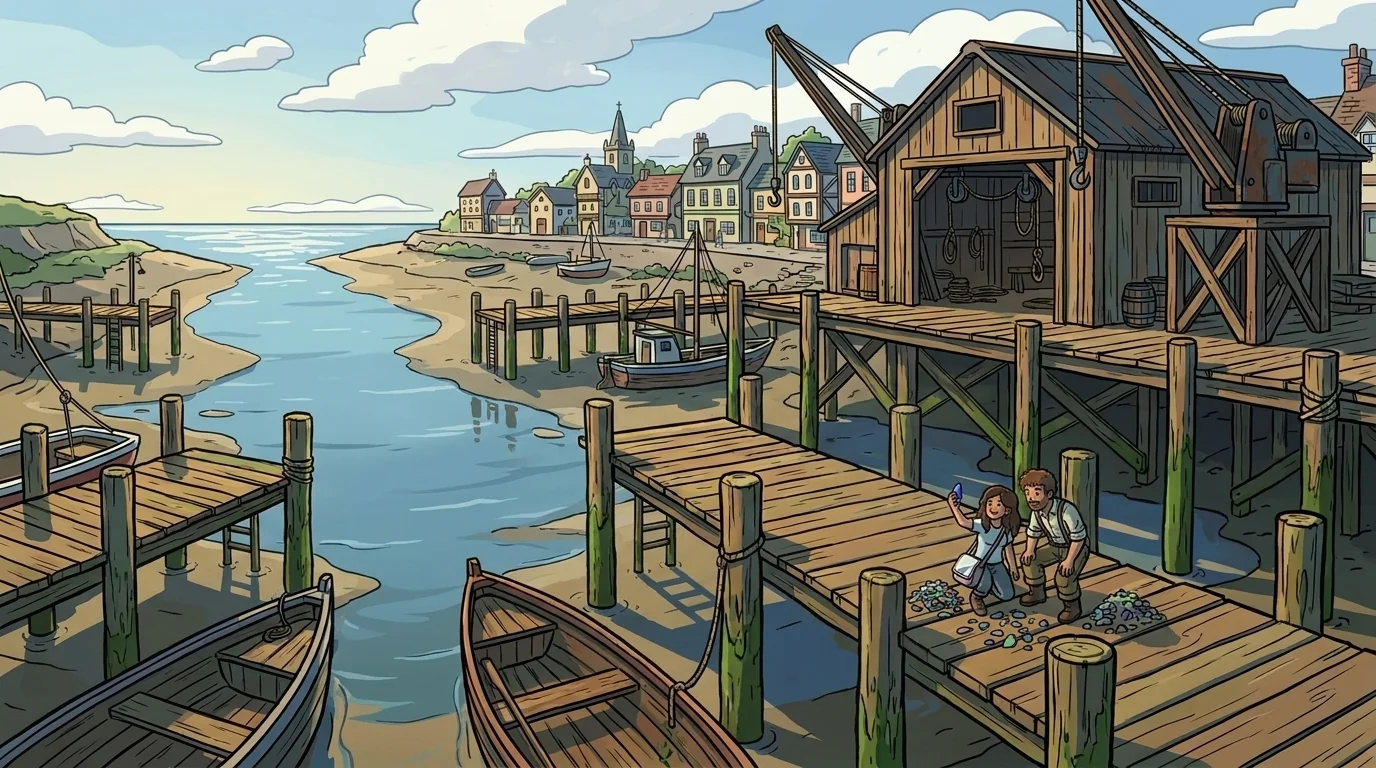
The tide continued its steady retreat. The plus-three line dropped to plus-two, then to plus-one. Mirror and Tug walked north along the dock, heading towards the promised beach. By the time they reached their destination, the water had settled at zero. As they finally sat down on the cool sand, it had dropped further, now resting at minus-one. The wet sand stretched out for thirty yards beyond the standard low-water line, revealing treasures previously hidden.
The sea glass was, exactly as Mirror's father had promised, breathtakingly beautiful. She carefully selected a small, smooth piece of cobalt-blue glass, clearly tumbled by the ocean for countless years. She held it up to the late-afternoon light, watching as the sun's rays passed through, softened and diffused by the saltwater-polish.
"Tug," she said, her voice barely a whisper.
"Mm," he responded, his eyes also on the horizon.
"There is no positive without negative. There is no addition without subtraction. There is no high tide without low tide."
"That's three ways of saying the same thing," Tug observed, a quiet understanding in his voice.
"Yes," Mirror confirmed.
"That's the chapter," Tug concluded. "Three ways. One symmetry."
"Yes," she agreed, a sense of completeness settling over them.
They stayed on the beach until the tide began its slow, inevitable return. Then, they walked home along the high-water line, observing the subtle changes. The water, they noticed, was now adding a foot of itself back onto the sand for every fifteen minutes that passed. It was reflecting the morning's pull, tugging against the morning's slack.
They both noticed it at precisely the same moment. Neither of them spoke. They both already knew.
The Numberverse ensemble
Mirror and Tug is part of Numberverse's distributed-narrative cast. Each character embodies a different curricular primitive; together they teach the full subject.
-

Tenfold
Place value — powers of 10, positional notation
-

Zeph
The zero placeholder — its load-bearing role in positional notation
-

Mirror
Negative numbers — reflection across zero on the number line
-

Skip
Skip-counting and multiples — repeated addition as forward stepping
-

Tug
Inverse operations — addition ↔ subtraction (and the same idea for × ↔ ÷) as opposite pulls on the same line