Tenfold
PLACE VALUE — each position in a written number is worth ten times the position to its right. The number 347 is 3 hundreds + 4 tens + 7 ones; this is positional notation.
Press play to listen along. The line being read lights up as you go.
Show full transcript
Loading transcript…
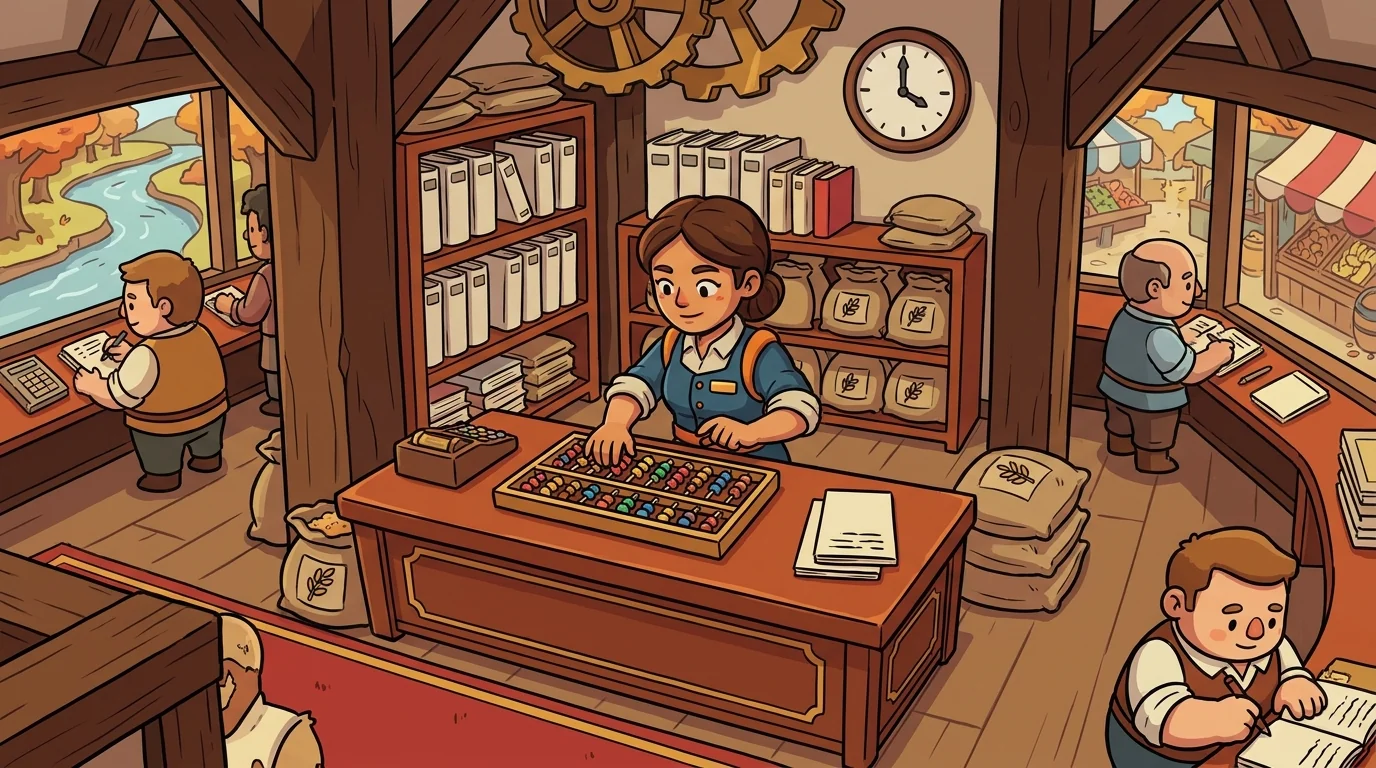
Tenfold was, for nineteen years, a counting-house clerk.
The counting-house was in the town of Decimal, which was a market town in a river valley and had — even in the kingdom's standards, where market towns were common — an unusually large counting-house. The counting-house tallied grain shipments, wool bales, salt barrels, and copper ingots for every merchant in three provinces. The volume of counting was, by Decimal's standards, enormous. On a busy autumn day, the counting-house clerks would tally tens of thousands of individual items.
Tenfold — whose given name was Dec, though everyone called her Tenfold after her tenth year as a clerk because she was uncannily good at the central tool of the trade — was the senior clerk in her counting-house's third room. The third room handled grain. Grain was, of all the things the counting-house tallied, the most numerous. A single grain shipment could be ten thousand bushels.

The central tool of the counting-house was the bead-frame.
A bead-frame, in Decimal's tradition, was a wooden rectangle the size of a tea-tray. It had ten horizontal wires stretched across it. Each wire held ten wooden beads. The bottom wire was the ones. The wire above it was the tens. The wire above that was the hundreds. And so on, up to ten million on the top wire.
To count items, you slid beads from left to right along the appropriate wire. When the ones wire had ten beads on the right, you slid them all back to the left and slid one bead on the tens wire to the right. Ten ones became one ten. The principle continued upward. Ten tens became one hundred. Ten hundreds became one thousand. Each position was worth ten times the position below it.
This is place value. It is the foundation of how numbers are written.
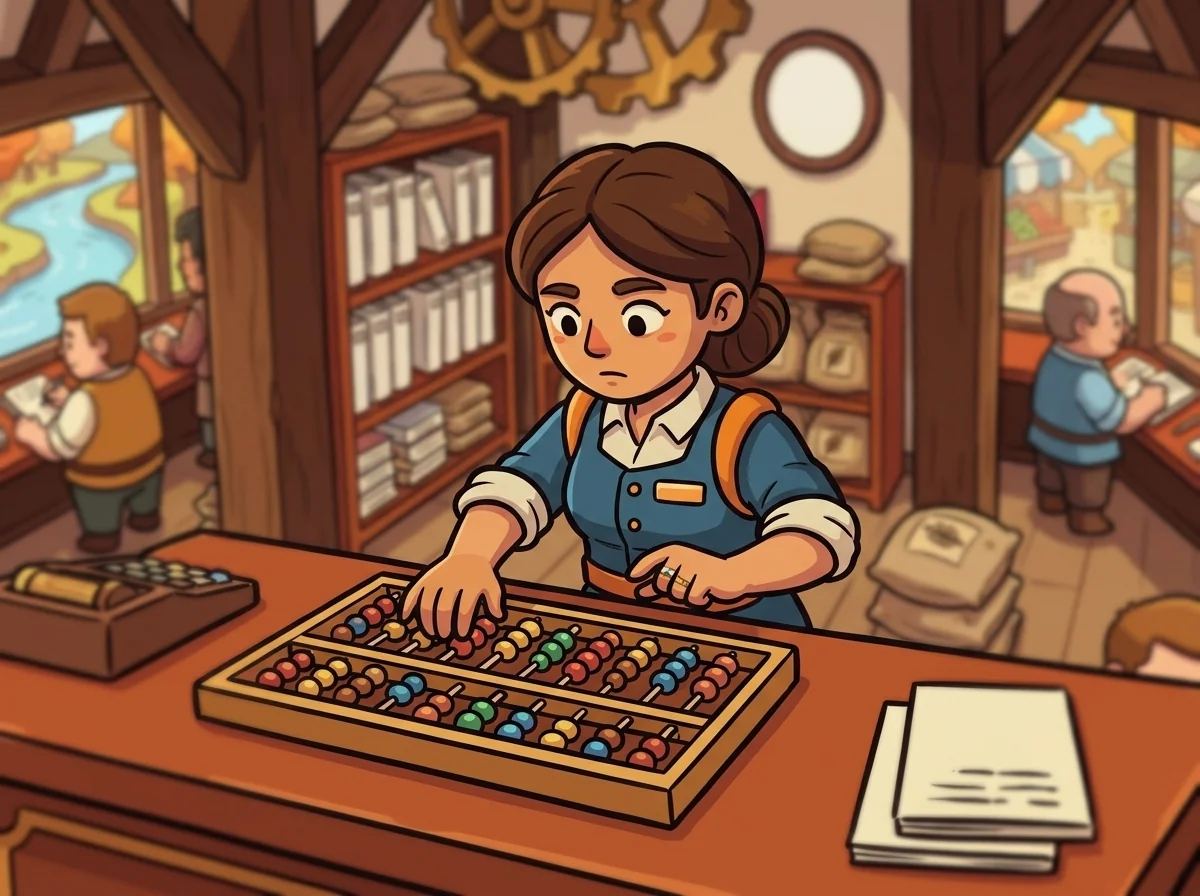
Tenfold did not, in her first year as a clerk, know that this was a foundational principle. She knew only that the bead-frame worked. It worked very well. It let you tally enormous quantities with very few beads. (A hundred beads on a ten-wire bead-frame could represent a number as large as ten million.)
What Tenfold gradually understood — over years of tallying grain shipments, wool bales, copper ingots — was that the bead-frame's logic was the logic of written numbers. When you wrote the number 347 on a slate, you were writing a tiny bead-frame: the 3 was three beads on the hundreds wire, the 4 was four beads on the tens wire, the 7 was seven beads on the ones wire. The position of the digit was its wire. The digit was the count of beads on that wire.
This was, to Tenfold, the deepest fact about numbers. It was the reason ten different symbols (0 through 9) could express any number whatsoever, no matter how large. It was the reason you could add two enormous numbers by adding column-by-column. It was the reason you could multiply by ten by shifting all the digits one position to the left.
She thought about this for years. Every time she tallied. Every time she added a column. Every time she slid a bead.
When the NumberVerse academy — which was attached to the larger GeometryForge / EquationQuest / ProofQuest academy network — was looking for someone to teach place value to children, the counting-house master sent Tenfold's name. The academy master came to Decimal. He watched Tenfold tally a wool-shipment for half an hour. He invited her to teach. Tenfold, who was thirty-one and beginning to think her wrists needed a break from bead-sliding, accepted.
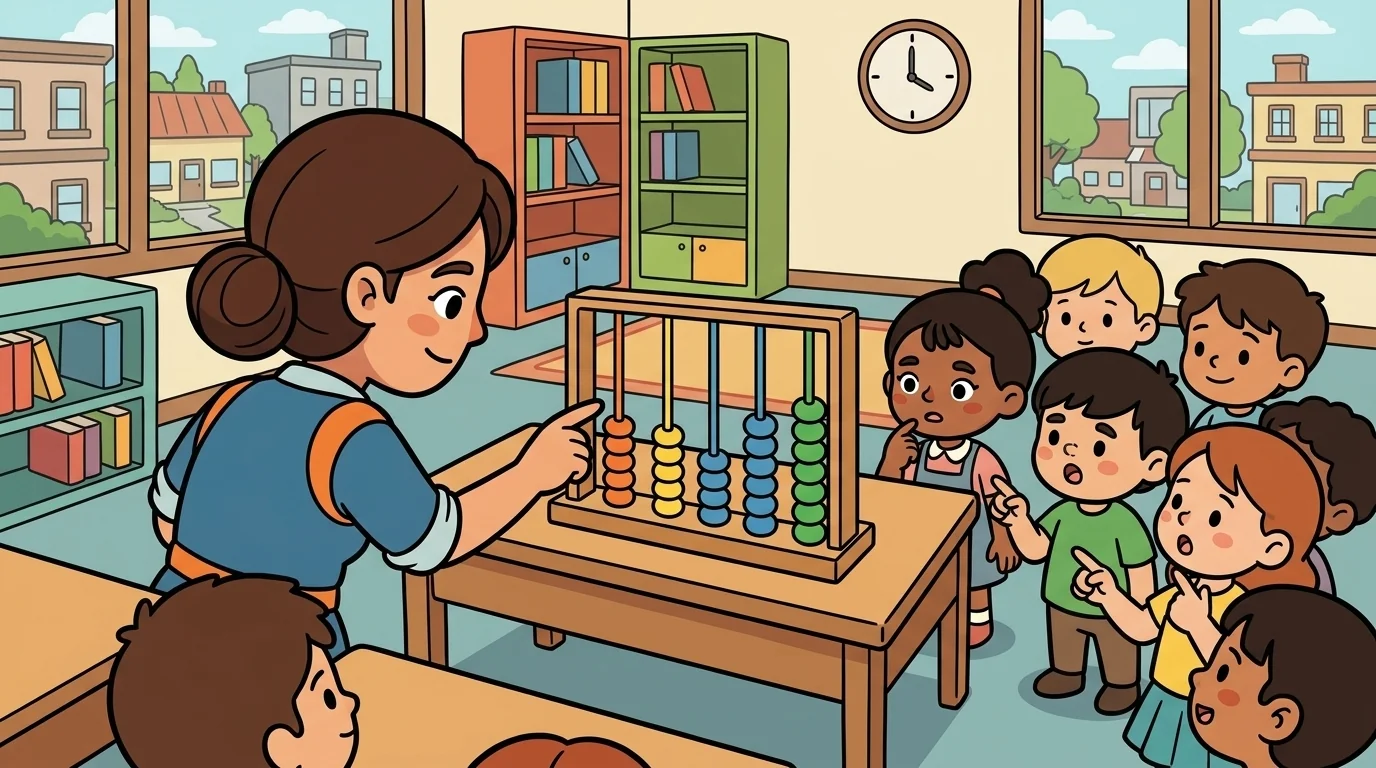
She arrived at the academy carrying her bead-frame. The bead-frame had been hers for nineteen years. The wires were polished smooth where she had slid the beads. The beads were worn into a slight oval shape. She still uses it. It is the first thing she shows children in their first lesson on place value.
She sets the bead-frame on her desk. She slides three beads on the hundreds wire. She slides four beads on the tens wire. She slides seven beads on the ones wire. She turns to the class. She says: "What number does this show?"
The children — always — count it. Some count the beads one at a time and get 347. Some recognize the columns and read it immediately as three-hundred-forty-seven.
Tenfold smiles. She says: "You read the columns. The columns are the value. Each column is worth ten times the column to its right. That is everything about how numbers are written."
Then she shows them what happens when you slide ten beads onto the ones wire. The ones wire overflows. She slides all ten back to the left and slides one bead on the tens wire to the right. Seven ones became seventeen. Seventeen has a seven in the ones column and a one in the tens column. The bead-frame agrees with the written number.
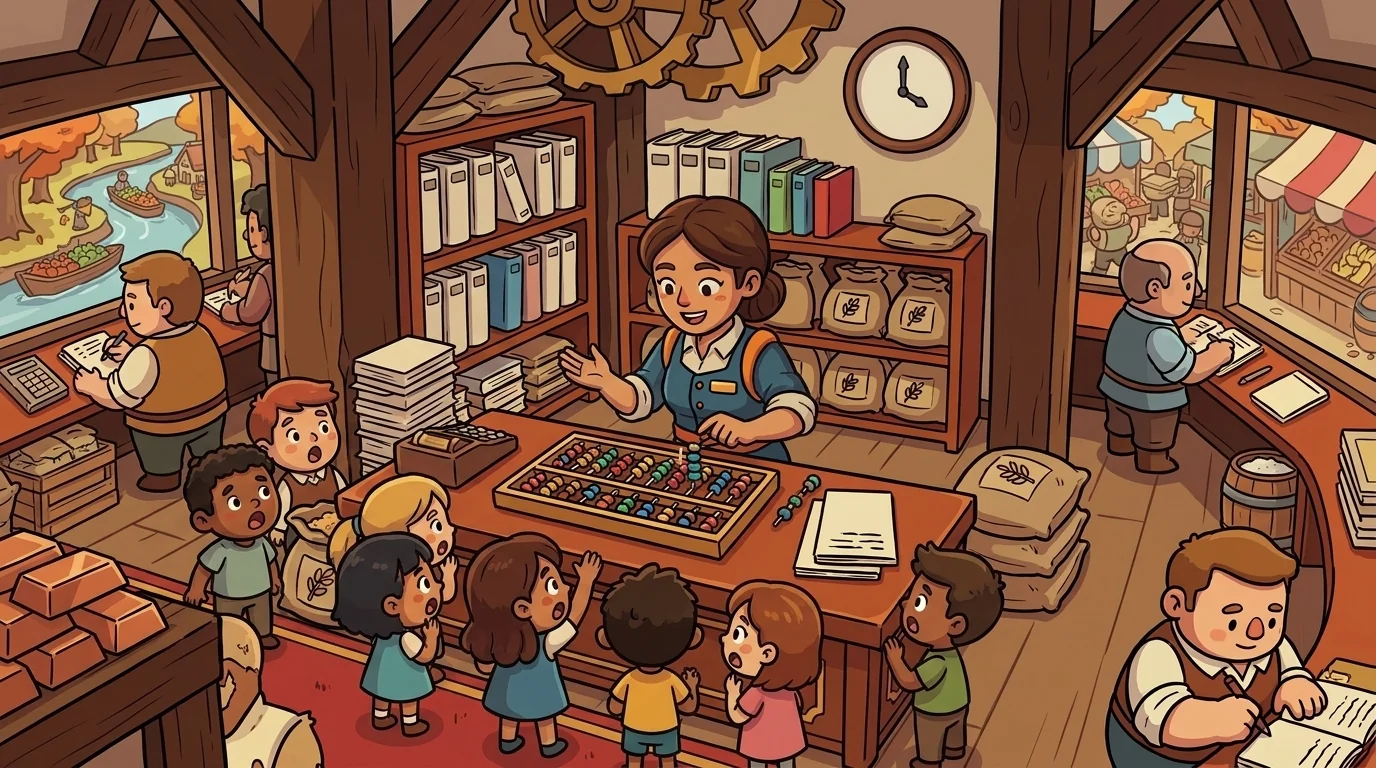
The children always gasp.
Tenfold says, in her even voice: "Ten of any column becomes one of the next column to the left. That is the secret of place value. The number ten is built into the system."
When children ask whether place value is hard, Tenfold always says the same thing:
"It is not hard. It is positional. Each digit means something different depending on where it sits. The 3 in 347 is three hundreds. The 3 in 3,400,000 is three millions. Same digit. Different position. Different value. Ten times bigger for every position to the left."
She slides a bead. The bead clicks. She has been sliding beads for twenty-six years.
The Numberverse ensemble
Tenfold is part of Numberverse's distributed-narrative cast. Each character embodies a different curricular primitive; together they teach the full subject.
-

Zeph
The zero placeholder — its load-bearing role in positional notation
-

Mirror
Negative numbers — reflection across zero on the number line
-

Skip
Skip-counting and multiples — repeated addition as forward stepping
-

Tug
Inverse operations — addition ↔ subtraction (and the same idea for × ↔ ÷) as opposite pulls on the same line