
Mirror and Tug
REFLECTION-AND-INVERSE — negative numbers are positive numbers reflected across zero; inverse operations are pulls in the opposite direction along the number line. Subtraction is the same as adding the reflection; division is the same as multiplying the reciprocal. Two ways to talk about one symmetry.
Press play to listen along. The line being read lights up as you go.
Show full transcript
Loading transcript…
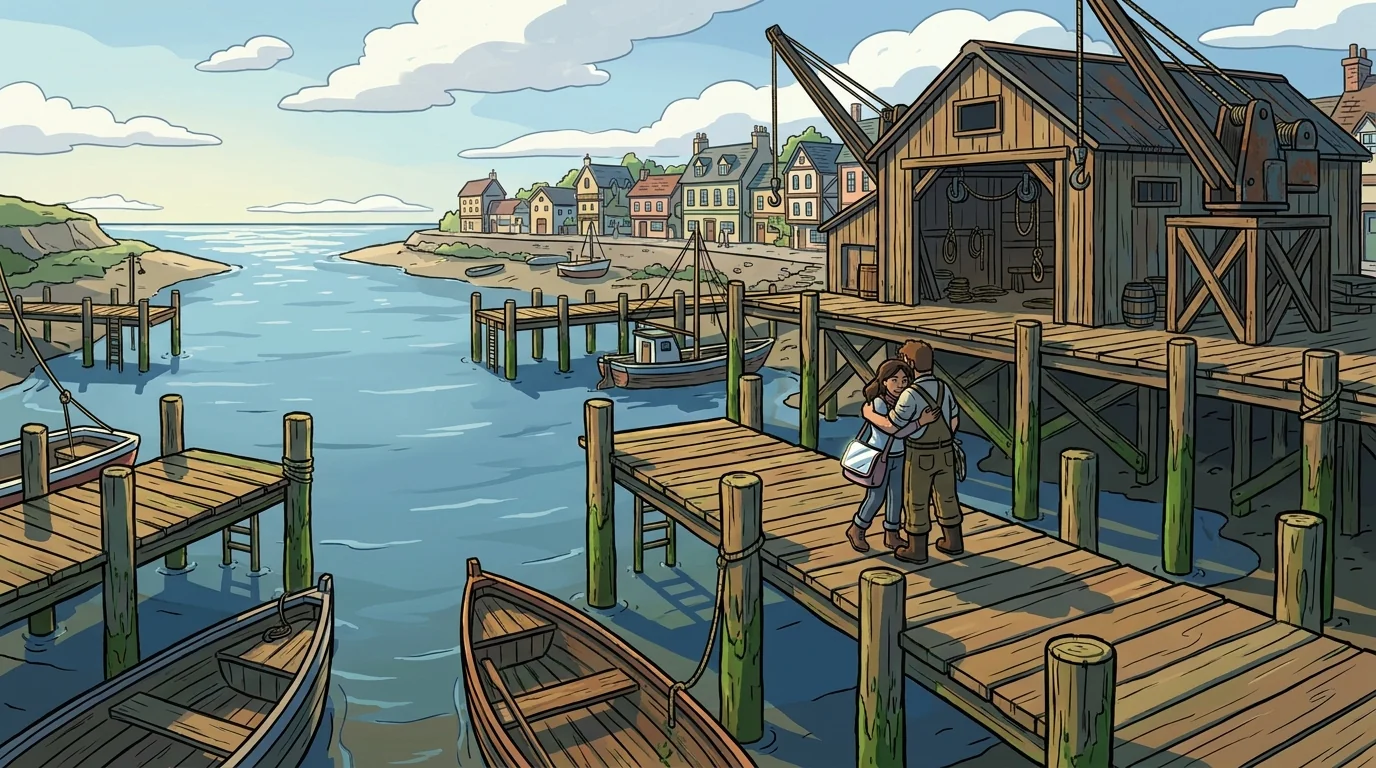
The harbour-town of Bollard sat at the mouth of a wide river. The river met the sea twice a day in a slow swell that lifted the harbour, and twice a day it drained out again. The townspeople called it the breath of the harbour. Boats rose. Boats fell. The wooden pilings of the docks were marked with thick green lines from a hundred years of tide-stains. Everyone in Bollard, even small children, could read the tide-stains and tell you whether the tide was coming in or going out.
Mirror came to Bollard to visit her father's old friend, the harbour-master. She had not been to the coast since her childhood. She wanted to look at glass that had been polished by saltwater — her father had told her, when she was small, that glass tumbled in seawater for ten years became finer than anything he could blow in the workshop. She wanted to see if it was true.
Tug came to the harbour because his parents' rope-and-pulley workshop was on the dock. He had grown up there. He still went home once a season to help with the heavy cranes.
They met on the long dock, in front of the workshop, on an afternoon when the tide was just beginning to go out.
Tug saw her first. He waved. He had not known Mirror would be in town.
She walked over. They embraced quickly. They had both been at the academy for years; they were old colleagues.
"What are you doing here?" Tug asked.
"Sea glass," Mirror said.
"There's a beach a quarter mile north. I'll walk you there in an hour. The tide will be low by then."
"Perfect."
They sat down on the edge of the dock to wait. Mirror dangled her feet over the water. Tug pointed to the green lines on the pilings.
"Watch that one," he said. "The water's at the plus-three line right now. By the time we go to the beach, it'll be at plus-one. Two hours from now, it'll be at zero. If it's a strong tide today, it'll go to negative-one or negative-two. The pilings have marks all the way down to negative four."
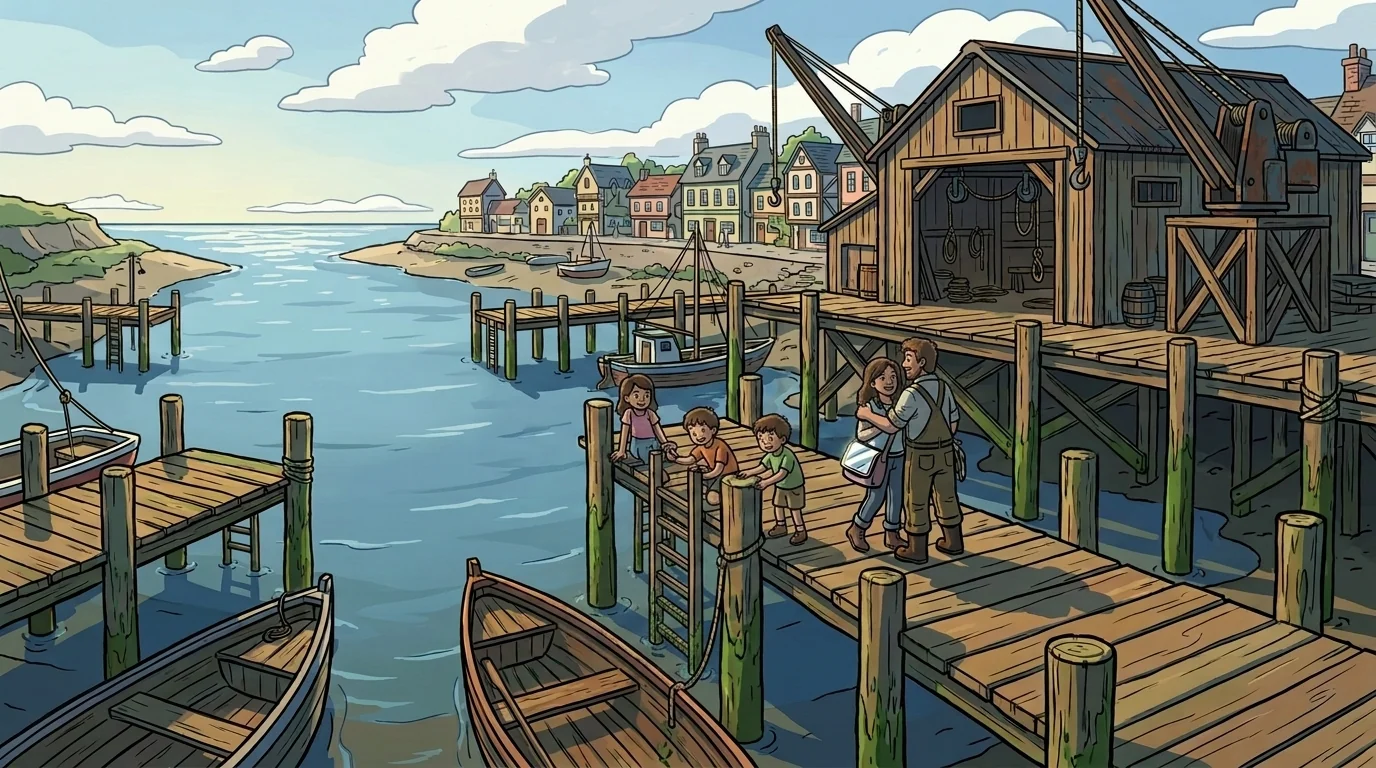
"That's a number line," Mirror said, smiling.
"That's a number line that drains and refills," Tug said. "Twice a day. Forever."
A small group of children were playing on the dock behind them. They were daring each other to walk down the wooden ladder that ran from the dock to the water. The ladder had rungs at one-foot intervals. The top rung was plus-five relative to the standard low-water mark. The bottom rung was minus-three — three feet below the lowest standard tide line, which meant it was always underwater. Even at the deepest tide, the bottom three rungs were submerged.
One of the children, a girl of about ten, was halfway down the ladder. The water was at plus-three. She was perched on the plus-four rung. Two of the lower rungs — plus-one and plus-two — were dry. Plus-three was just at water level. Plus-zero and below were underwater.
"How many dry rungs are there below me?" she called up.
Her brother counted. "Two dry," he said. "Three under water. Then it goes negative."
"How many total rungs to the bottom?"
"Top of ladder is plus-five. Bottom of ladder is negative-three. So... eight rungs total. Five above zero, three below zero."
"Eight!" she shouted up. "Including the wet ones."
Mirror leaned over to Tug. "Pretty good," she said.
"Wait for the next part," Tug said.
The brother on the dock yelled down: "But if the tide goes to negative-two, how many dry rungs will there be?"
The girl on the ladder thought. Then she said, very confidently: "Five plus two is seven. Seven dry rungs. The water will drop two more feet."

"That's right!" her brother shouted.
Mirror grinned at Tug. "She used negative numbers without flinching."
"She used negative numbers because the harbour uses negative numbers," Tug said. "Every kid in this town learns to read the tide-stains by age six. They know the water can be at plus-three, or zero, or negative-two. They know what those mean physically. The math comes later. The physical picture comes first."
"My father used to say that, too," Mirror said. "He'd hold up a glass sheet and a finished silvered mirror. He'd say: 'This is plus-one. That is negative-one. Same distance from zero. Opposite sides. One you look through. One you look at.'"
Tug nodded.
"That's the cleanest definition I've ever heard," he said.
A new problem broke out behind them.
A different child — a small boy of about eight — was standing on the plus-two rung. He was holding a small wooden boat. He wanted to lower it into the water without dropping it. The water was at plus-three. He needed to lower the boat down to the water, which was one foot below his rung.
He shouted up: "Dad! How far down do I lower it?"
The father, who was on the dock, called down: "The water is at plus-three. You are at plus-two. The water is above your feet."
The boy looked confused.
"Hold on," Mirror said, standing up. "Let me try this one."
She walked over to the edge of the dock and leaned down so the boy could see her. "Hello," she said.
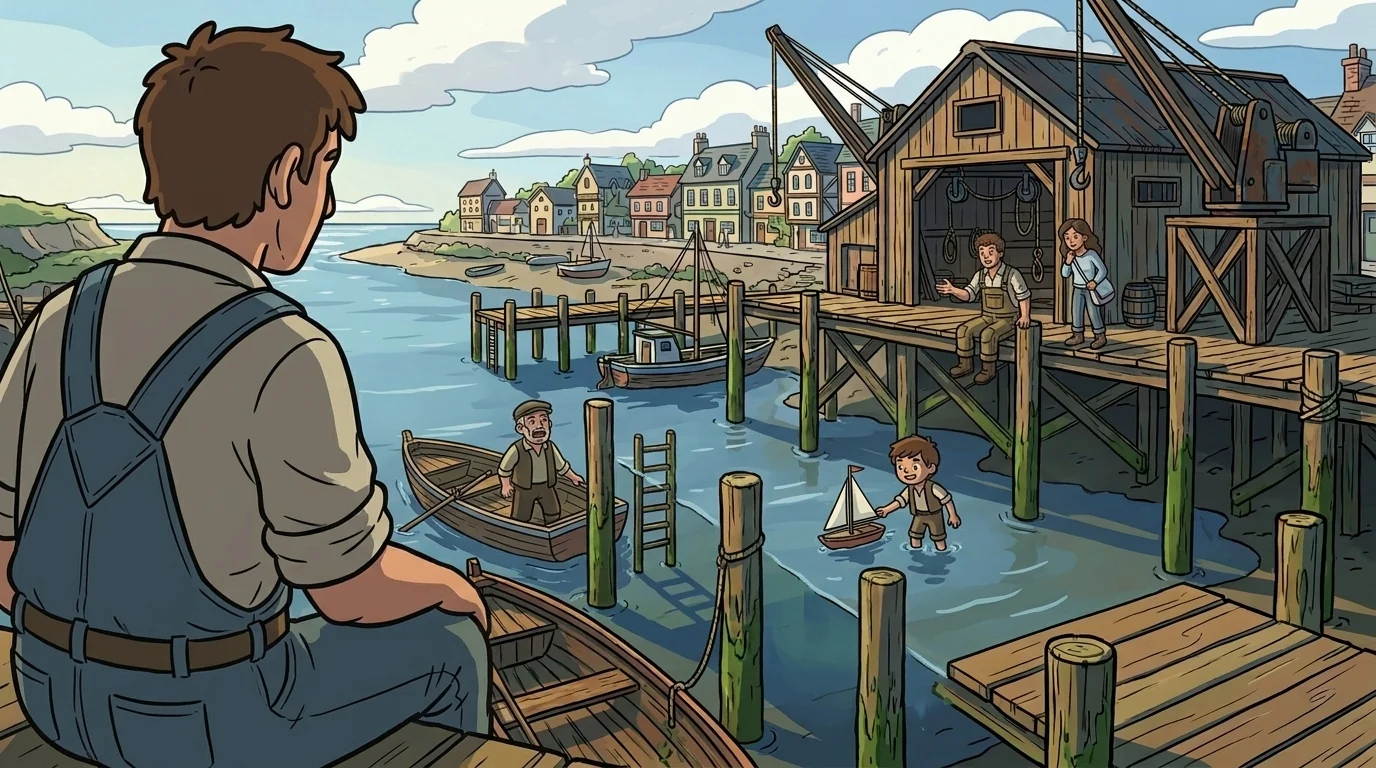
"Hello," the boy said.
"You're at the plus-two rung. The water is at plus-three. Where is the water compared to your rung?"
The boy thought. "Above me?"
"Above you, by how much?"
"One foot."
"Right. So to put the boat into the water, you have to lift the boat up by one foot. Not down. The water's above you."
The boy looked at the water, which was indeed sloshing just one foot above his rung. He laughed. He climbed up one rung. He set the boat gently onto the water. The boat floated away.
The father shouted thanks.
Tug, watching, said quietly: "That was the inverse move. He thought he needed to lower. You showed him he needed to lift. Same distance, opposite direction. That's all an inverse operation is."
Mirror sat back down beside him. "It's the same as the mirror thing," she said. "The reflection. Lower-by-one is the opposite-direction-by-one of lift-by-one. The boy needed to do the reflection. He was about to do the wrong half of the pair."
"That's the whole inverse-operation principle in one boat," Tug said. "If you go the wrong direction by one foot, you correct it by going the opposite direction by one foot. Minus and plus are mirrors of each other. They are the same magnitude, opposite sign. They undo each other. Tug and counter-tug."
He paused.
"You know," he said, "I've been teaching inverse operations for fifteen years and I have never thought about them as mirror images before. I always thought of them as pulls in opposite directions. But they're the same idea. The mirror image of plus-five across zero is negative-five. The inverse of adding five is subtracting five. Same symmetry. Different vocabulary."
"My father would have liked that," Mirror said. "He always said the mirror taught the deepest lessons. He didn't know about algebra. But he knew about reflections."
"It's the same thing," Tug said. "It's all the same thing."
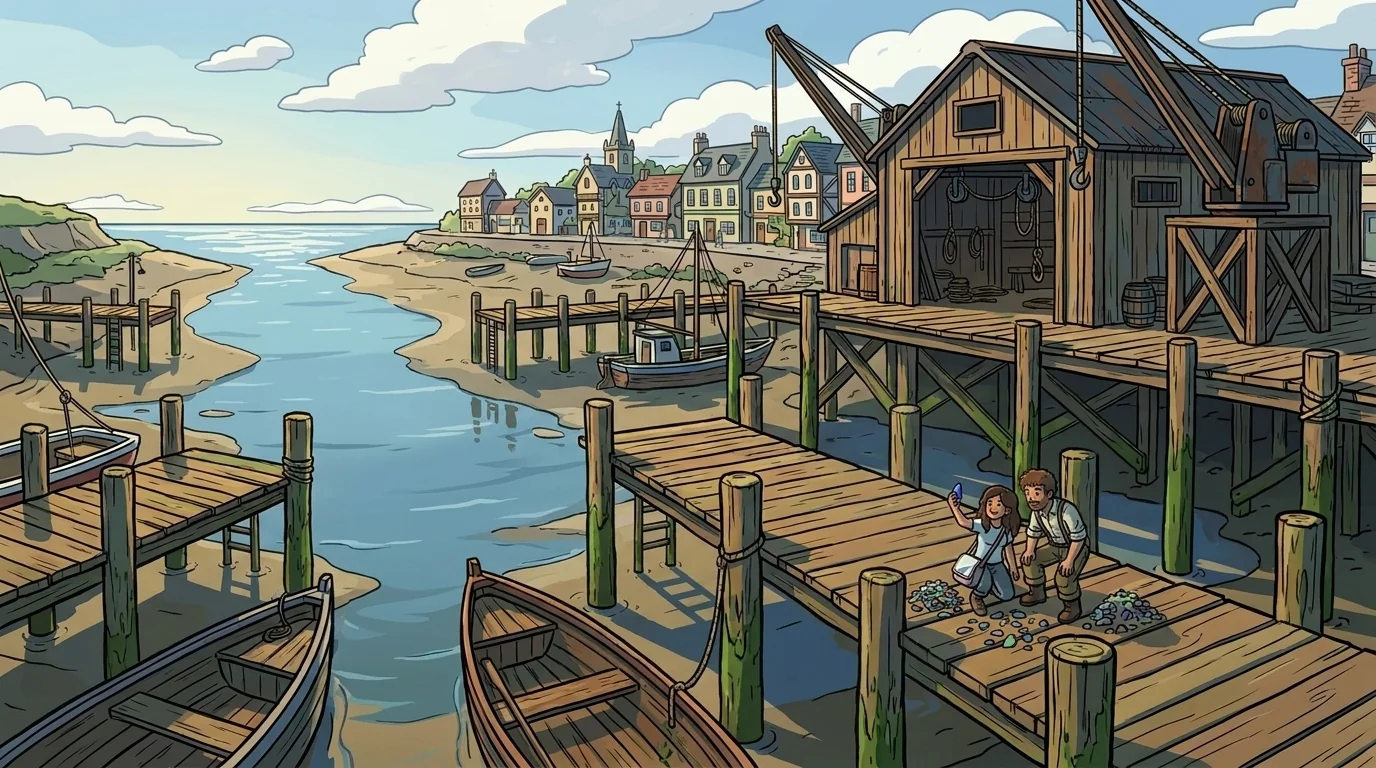
The tide went out further. The plus-three line dropped to plus-two, then to plus-one. Mirror and Tug walked north along the dock toward the beach. By the time they got there, the water was at zero. By the time they sat down on the sand, it was at minus-one. The wet sand extended out for thirty yards beyond the standard low-water line.
The sea glass was, exactly as Mirror's father had promised, beautiful. She picked up a small piece of cobalt-blue glass that had been tumbled for years. She held it up to the late-afternoon light. The light came through, softened by the saltwater-polish.
"Tug," she said.
"Mm."
"There is no positive without negative. There is no addition without subtraction. There is no high tide without low tide."
"That's three ways of saying the same thing."
"Yes."
"That's the chapter," Tug said. "Three ways. One symmetry."
"Yes."
They stayed at the beach until the tide started coming back in. Then they walked home along the high-water line. The water, they noticed, was now adding a foot of itself back onto the sand for every fifteen minutes that passed. Reflecting the morning's pull. Tugging against the morning's slack.
They both noticed it at the same time. Neither of them said anything. They both already knew.
The Numberverse ensemble
Mirror and Tug is part of Numberverse's distributed-narrative cast. Each character embodies a different curricular primitive; together they teach the full subject.
-

Tenfold
Place value — powers of 10, positional notation
-

Zeph
The zero placeholder — its load-bearing role in positional notation
-

Mirror
Negative numbers — reflection across zero on the number line
-

Skip
Skip-counting and multiples — repeated addition as forward stepping
-

Tug
Inverse operations — addition ↔ subtraction (and the same idea for × ↔ ÷) as opposite pulls on the same line