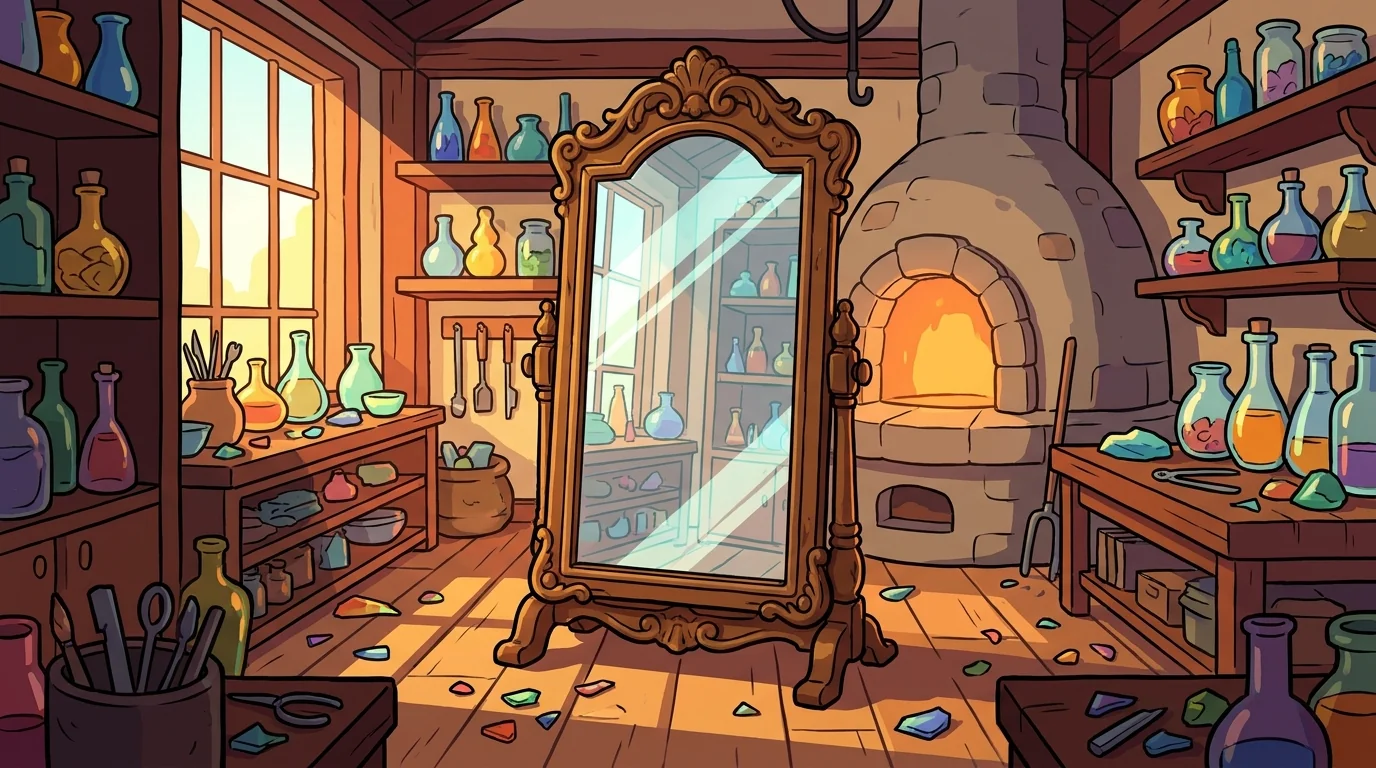
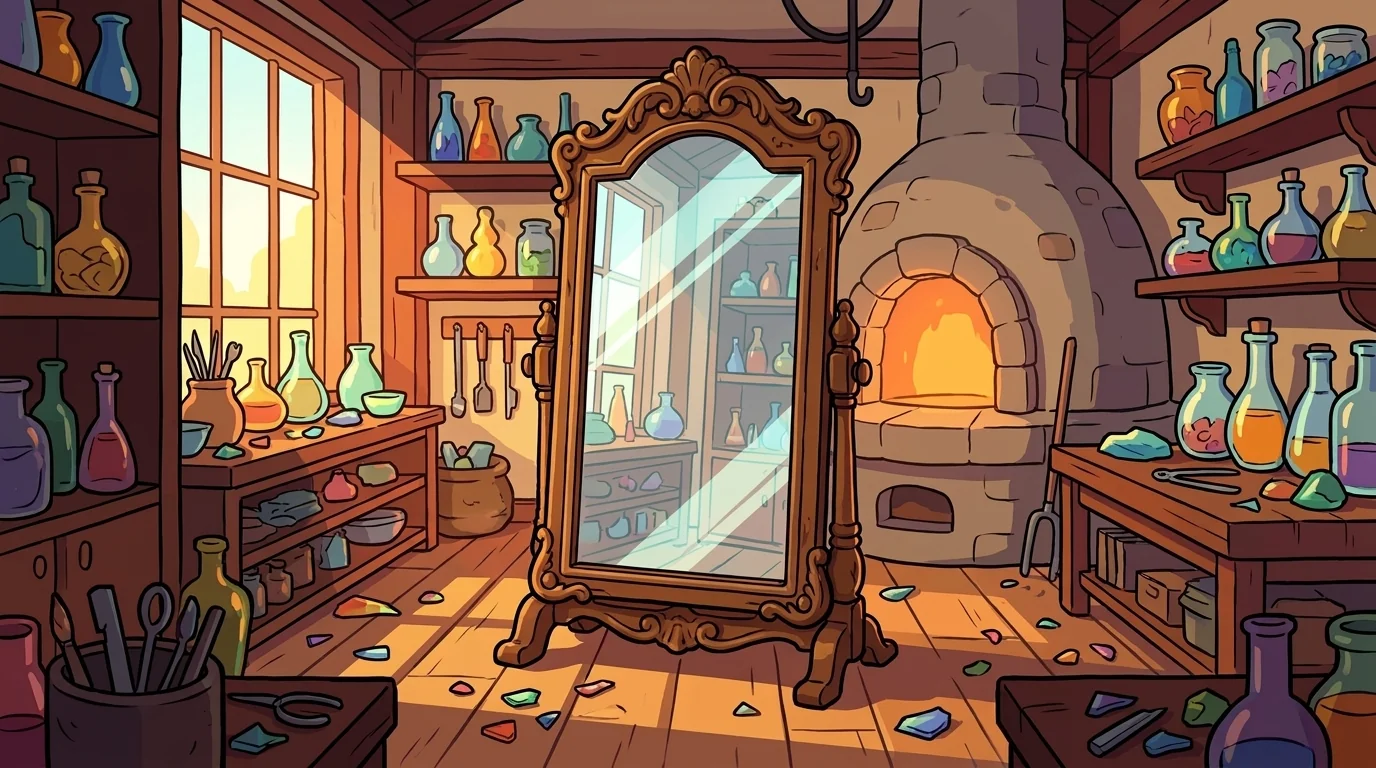
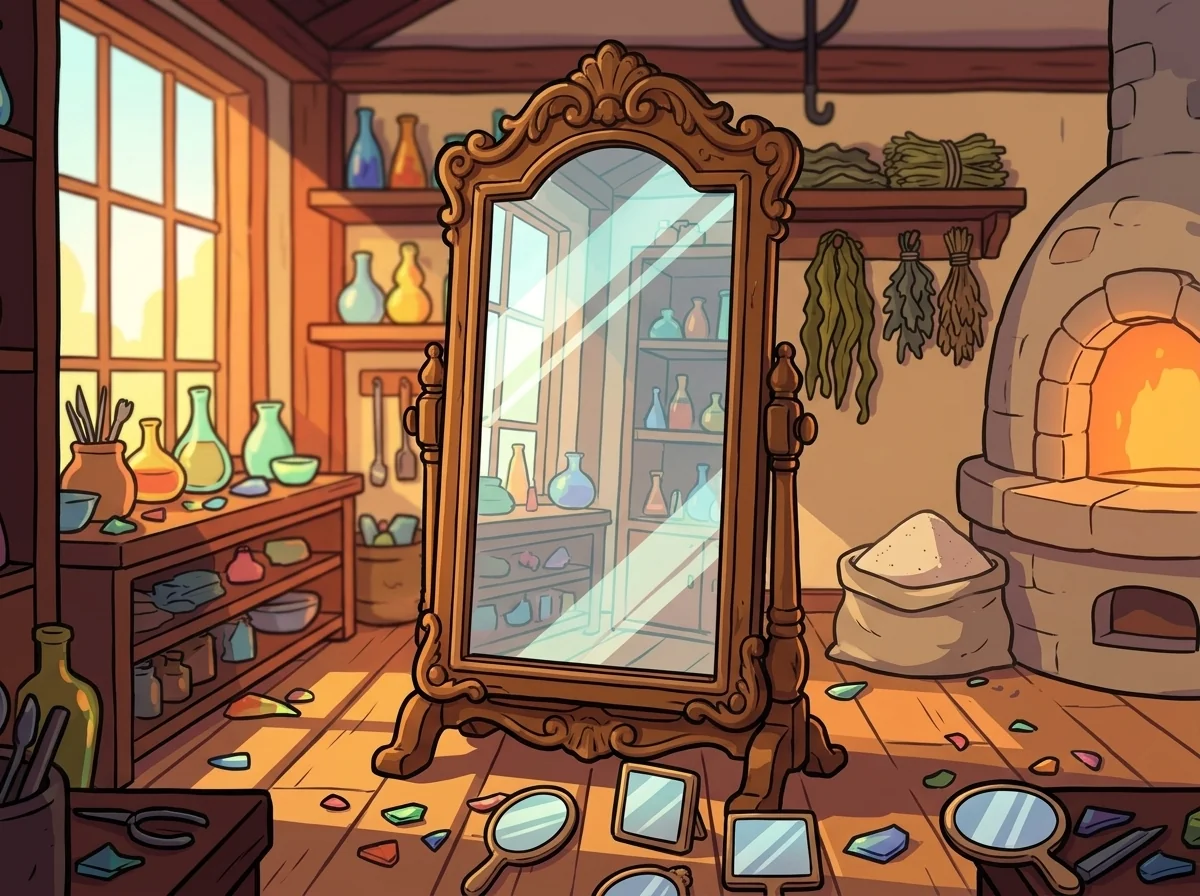
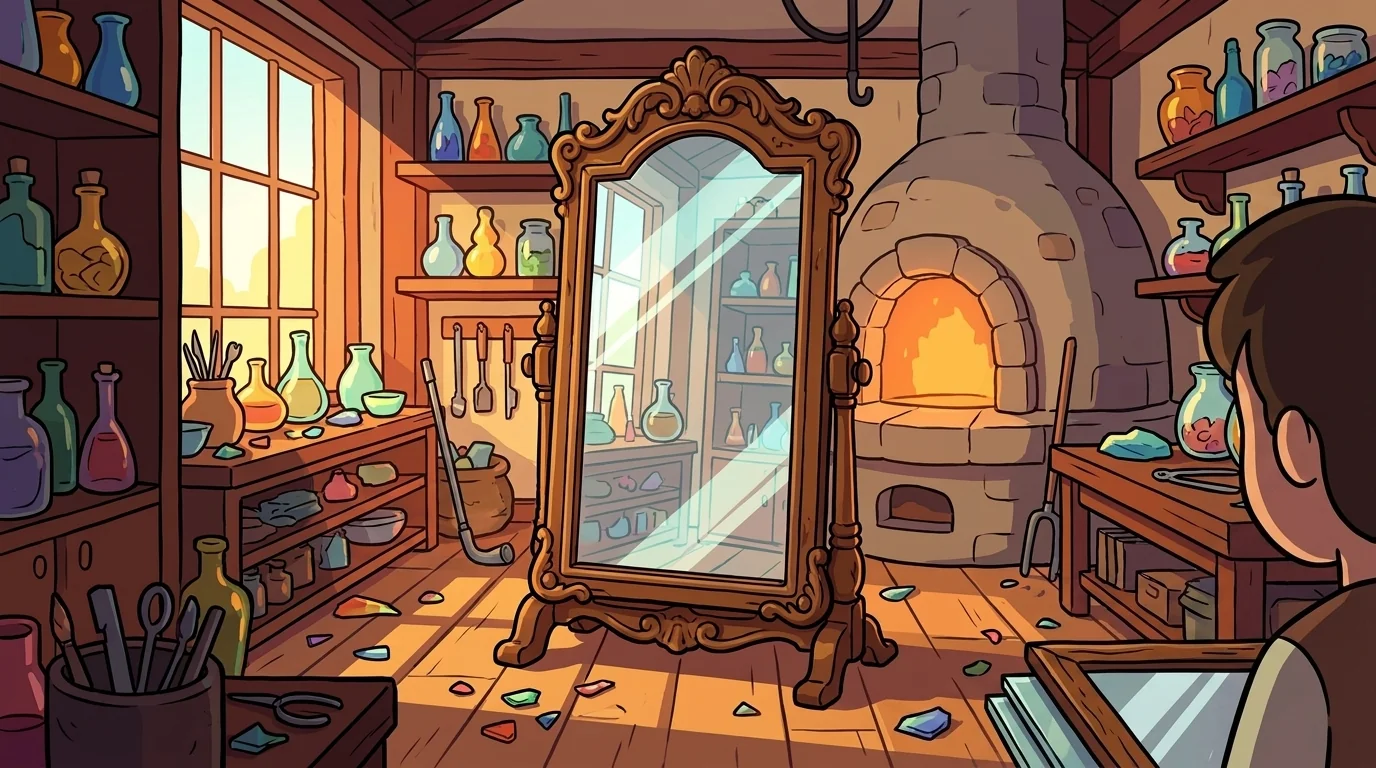
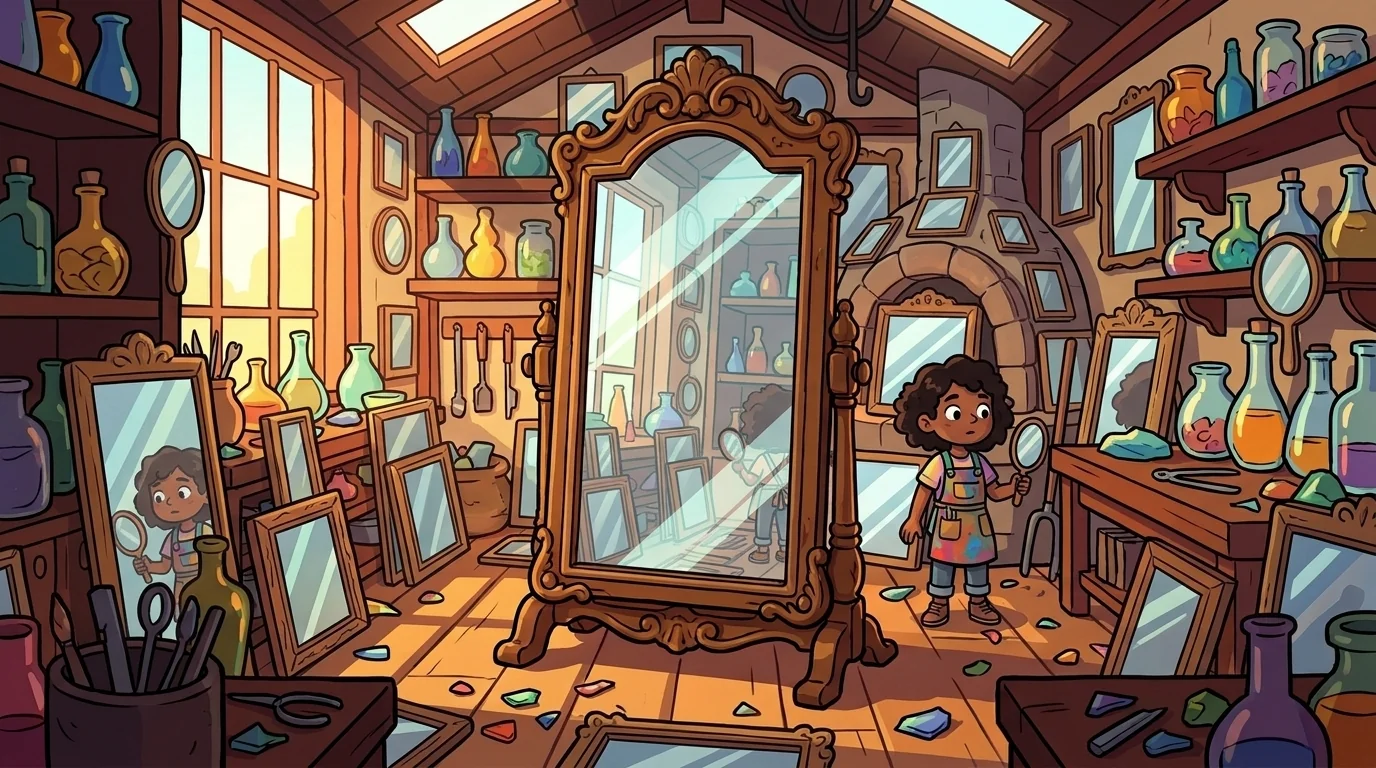
Mirror chapter opener illustration

Mirror

NEGATIVE NUMBERS — reflection across zero on the number line. Negative 3 is the mirror image of positive 3: same distance from zero, opposite direction.

Chapter 3 — Mirror and the Glass-Maker’s Daughter

Mirror grew up in a glass-making town.

The town — Reflection, on the kingdom’s western coast — had been famous for its glass for three centuries. The local sand was unusually fine. The local potash, from coastal seaweed, was unusually pure. The glass blown in Reflection’s workshops was the clearest in three kingdoms. The town’s main export was mirrors: hand-mirrors, parlour-mirrors, vanity-mirrors, the occasional very-large mirror commissioned by a noble’s house.

Mirror’s father — whose name was Verre, which is an old word for glass in the family’s language — ran one of the larger mirror workshops on the harbour side of Reflection. He silvered the back of each glass sheet himself. He framed the mirrors in turned walnut. He shipped them out by wagon and by boat.

Mirror — whose given name was Lia, though everyone called her Mirror by the time she was eight — was the second of three children. She grew up in and around the workshop. The workshop had, at any given moment, between twenty and forty finished mirrors leaning against the walls awaiting frames. The workshop was, in the right light, visually overwhelming. Reflections of reflections of reflections.

Lia was fascinated.

What fascinated her, specifically, was the symmetry of mirror images.

A chair in front of a mirror produced an image of a chair in the mirror. The image-chair was the same distance behind the mirror as the real chair was in front. The image-chair was the same size as the real chair. The image-chair had the same shape, same colour, same proportions. Only one thing was different: the image was flipped. Left and right were reversed. A chair’s armrest on its left side appeared in the image on the right side. The image was the chair reflected across the plane of the mirror.

Lia would sit on the workshop floor with a small stool in front of a parlour-mirror and stare at the reflection. She would walk back from the mirror by exactly five paces and see the image of herself five paces behind. She would walk back ten paces and see the image ten paces behind. Distance from the mirror was preserved. Direction was flipped.

She made it a game. At seven, she could predict where the reflection of any object in the workshop would appear, given the location of the object and the angle of the mirror. At nine, she could calculate the number of reflections in a corridor of two opposite mirrors (the answer, as some children have discovered, is infinite; this delighted her). At eleven, she had decided that mirrors were the most interesting object her father made.

When she was twelve, a wandering teacher came through Reflection. (The kingdom had a small but devoted tradition of wandering teachers; they walked from town to town, taught for a season, and moved on.) The teacher came to the workshop to look at the mirrors. The teacher’s name was Axis — who, decades later, would become the AI mentor at the NumberVerse academy (NumberVerse’s mentor “Axis” in the published kit is named after this same wandering teacher, in honour of his having found Mirror).

Axis spent an afternoon with Lia. He noticed that she could predict reflection-positions by eye. He sat down with her on the workshop floor. He pulled out a slate. He drew a horizontal line. He marked the middle: 0. He marked to the right: 1, 2, 3. Then he marked to the left of the zero: −1, −2, −3.

He said: “Look at this. The zero is the mirror. Positive 3 and negative 3 are reflections. Distance from zero is preserved. Direction is flipped.”

Lia stared.

She said, slowly: “The number line works the same way as a mirror.”

Axis nodded.

Lia said: “Negative numbers are reflections.”

Axis smiled. He said: “That is the deepest thing about them. People are sometimes confused by negative numbers. They think ‘less than nothing’ is impossible. It is not impossible. Negative numbers are not ‘less than nothing.’ They are reflections of positive numbers across zero. They are exactly as real as positive numbers. They are just on the other side of the mirror.”

Lia kept the slate. She still has it. It is framed and hangs on the wall of her academy classroom.

She decided, that afternoon, to study numbers. She studied with her father until she was fifteen (her father was good at counting glass-orders but did not know much about formal mathematics). She studied with the wandering teachers when they came through Reflection. She studied with the academy when she was nineteen. She has been teaching ever since.

When children arrive at the NumberVerse academy for their first lesson on negative numbers, Mirror always begins the same way. She brings a small hand-mirror from her father’s workshop. (She brings a new one every year. The workshop is still in business; her brother runs it now.) She places the hand-mirror on the desk, propped up so it stands vertical. She places a small wooden block in front of it. She turns to the class. She says: “Where is the image of the block?”

The children — always — point behind the mirror.

Mirror nods. She says: “How far behind?”

The children — always — say the same distance the block is in front.

Mirror smiles. She says: “Exactly. The mirror preserves distance. The mirror flips direction. Now look at this.”

She picks up her slate (the one Axis gave her thirty years ago) and shows the number line. She points to the zero. She says: “This is the mirror. Positive 3 and negative 3 are reflections. Same distance from the mirror. Opposite directions.”

The children understand it immediately.

When children ask her whether negative numbers are hard, Mirror always says the same thing:

“They are not hard. They are reflections. Every positive number has a negative reflection across zero. Adding a number moves you to the right. Adding a negative moves you to the left. It is the same motion in the mirror.”

She moves her hand. Her hand-mirror catches the movement. The reflection moves the opposite way.

She says, simply: “That is the whole idea.”


Voice register

Guidance: Serene, slightly hushed. Mirror-image gestures (often mirrors her own hand-movements). Carries the hand-mirror everywhere. Friends with Tug (both work with opposites).

Sample lines:

  • “Zero is the mirror. Positive 3 and negative 3 are reflections. Same distance from the mirror. Opposite directions.”
  • “Adding a positive moves you to the right. Adding a negative moves you to the left. It is the same motion in the mirror.”
  • “Negative numbers are not ‘less than nothing.’ They are reflections of positive numbers across zero. They are exactly as real.”
  • “Subtracting a negative is adding a positive. The double-flip puts you back on the original side.”

Arc across kits

  • Kit 1-5 — Not yet present.
  • Kit 6Anchor character. Full introduction. Children meet her with the hand-mirror.
  • Kit 7-9 — Recurring (negative-number arithmetic; coordinates with negative values).
  • Kit 10-12 — Featured: negative numbers in algebra (with Tug; opposite operations).
  • Kit 13-16 — Recurring ensemble member.

Relationships

  • Alliance: Tug (both work with opposites; the mirror-flip principle and the opposite-pull principle are sister ideas; they often co-teach).
  • Tension: None.

Cultural-context note

The glass-making-town framing is a deliberate generic European-coastal-craft tradition (Murano-style glass tradition, Bohemian glass tradition) without specific cultural attribution. Reflection is invented. The father’s name (Verre) is French-derived (glass) but the character is not coded as ethnically French; the language is treated as a generic family-tradition. The wandering-teacher Axis is the character whose name the published NumberVerse mentor inherits — a deliberate continuity move connecting the cast to the AI mentor.

The Numberverse ensemble

Mirror is part of Numberverse's distributed-narrative cast. Each character embodies a different curricular primitive; together they teach the full subject.