Zeph
ZERO PLACEHOLDER — zero's load-bearing role in positional notation. The difference between 7, 70, 700, 7000 is the zero holding the lower positions empty.
Press play to listen along. The line being read lights up as you go.
Show full transcript
Loading transcript…

Zeph grew up next door to Tenfold.
This is, in retrospect, consequential. The two girls — Tenfold (whose given name was Dec) and Zeph (whose given name was, simply, Zeph; her parents had liked the sound) — lived in adjoining houses on the western edge of Decimal. They were the same age. They went to school together. They walked home together. They each watched the other's family at suppers and on holidays.
The two families could not have been more different.
Tenfold's family was loud. Her parents talked over each other at supper. Her three older brothers wrestled in the parlor. Her two younger sisters ran in the garden at all hours. The house was always full of motion and sound.
Zeph's family was quiet. There were six of them — Zeph, her two older brothers, her two older sisters, and her mother (her father had been a sailor who had died in a storm when Zeph was three; the family did not, in Zeph's lifetime, talk about him much). The older brothers were busy. The older sisters were busier. Zeph's mother managed everything from a small chair by the kitchen window. Zeph was the youngest, the smallest, and the quietest.
She was, even by her family's standards, exceptionally quiet.

She rarely spoke at supper. She rarely interrupted. She rarely asked for things. When her older siblings were arguing about who had to clear the table, Zeph cleared the table. When her older siblings were debating who had said what to whom on which day, Zeph went outside to the garden and pulled weeds.
She was, the family eventually realized, the placeholder. She was the quiet space between the louder children. She held the family together by being where the noise was not.
When she was eight, she asked the family scholar — a friendly old man who came to the house once a week to tutor the older children, and who always brought Zeph a small slate so she could practice writing while her siblings worked on harder things — a question that had been bothering her.
She said: "How do you know 7 is different from 70?"
The scholar paused. He set down his book.
He said: "What makes you ask?"
Zeph said: "My brother said today that he bought 7 apples at the market. My sister said yesterday she bought 70 apples for the family. They are both numbers with a seven in them. They look almost the same. But one of them is ten times the other. How does the 7 know to be different?"
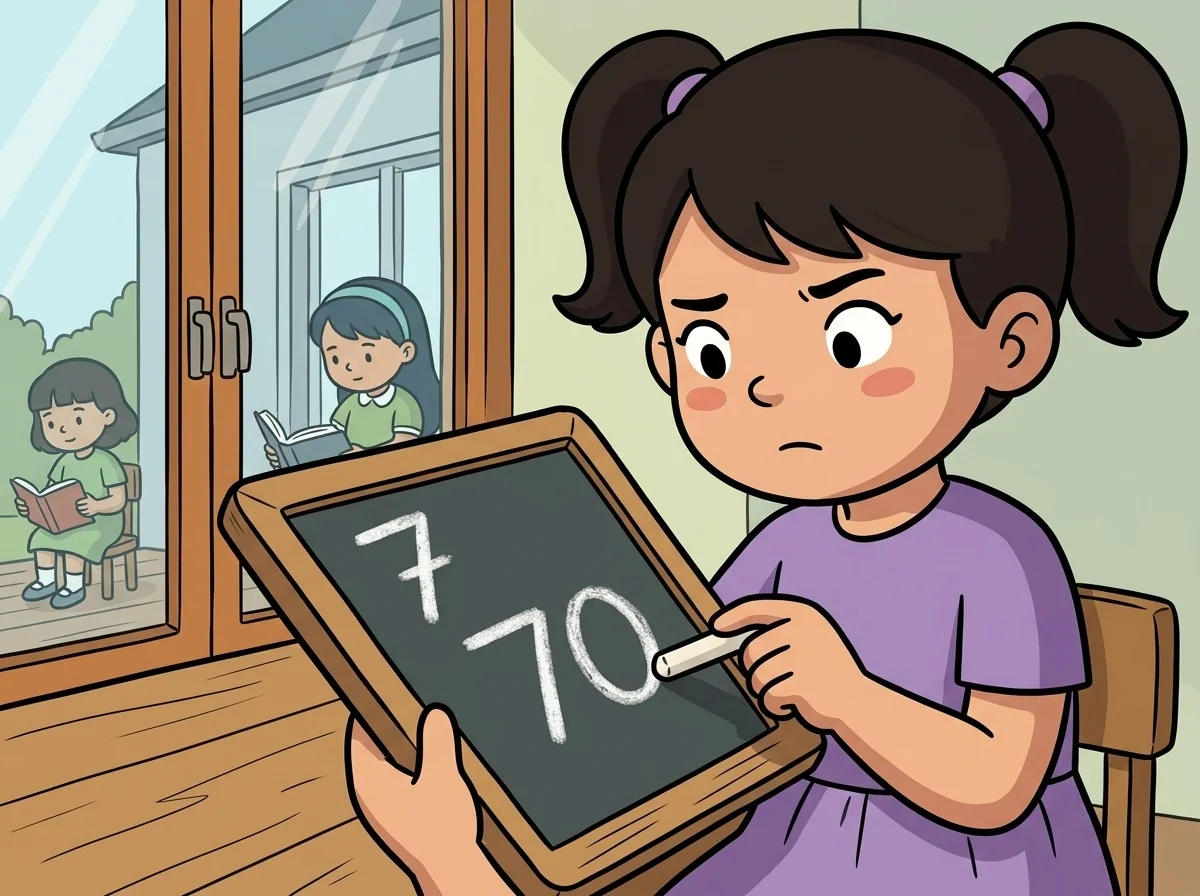
The scholar smiled. He had been a scholar for forty years and he knew, when an eight-year-old asked a question like this, that the eight-year-old was thinking. He took out a slate. He wrote on it:
7
He said: "This is seven. Read it."
Then he wrote:
70
He said: "This is seventy. Read it. What is the difference?"
Zeph looked. She said: "There is a 7 and a 0."

The scholar said: "And what does the 0 do?"
Zeph thought for a long moment.
She said: "It makes the 7 move."
The scholar's eyes widened. He said: "Move where?"
Zeph said, slowly, working it out: "To the left. The 7 used to be in the ones place. The 0 made it move to the tens place. The 0 is holding the ones place empty. The 7 went up. The 70 is ten times bigger because the 7 is one position to the left."
The scholar set down his slate. He looked at Zeph for a long time. Then he said: "Yes. That is exactly right. You have just understood one of the most important inventions in the history of writing numbers. The zero is not nothing. The zero is somewhere being empty. It holds the lower positions open so the higher digits keep their meaning. Without the zero, you would have no way to tell 7 from 70 from 700. The zero is what makes positional notation work."
Zeph nodded. She did not say anything for a while. She thought about it. The next morning, when she walked to school with Tenfold (then still called Dec), she explained to Tenfold what the scholar had said. Tenfold listened. Tenfold said: "That makes sense. The bead-frame works the same way. An empty wire is still a wire. It still counts as a position." They walked the rest of the way to school in quiet agreement.
That conversation, Zeph eventually said as an adult, was the moment she became who she was. She was not the quiet child who was overlooked. She was the placeholder. The quiet held things together. Being empty in a position was not nothing. It was exactly the right thing to be.
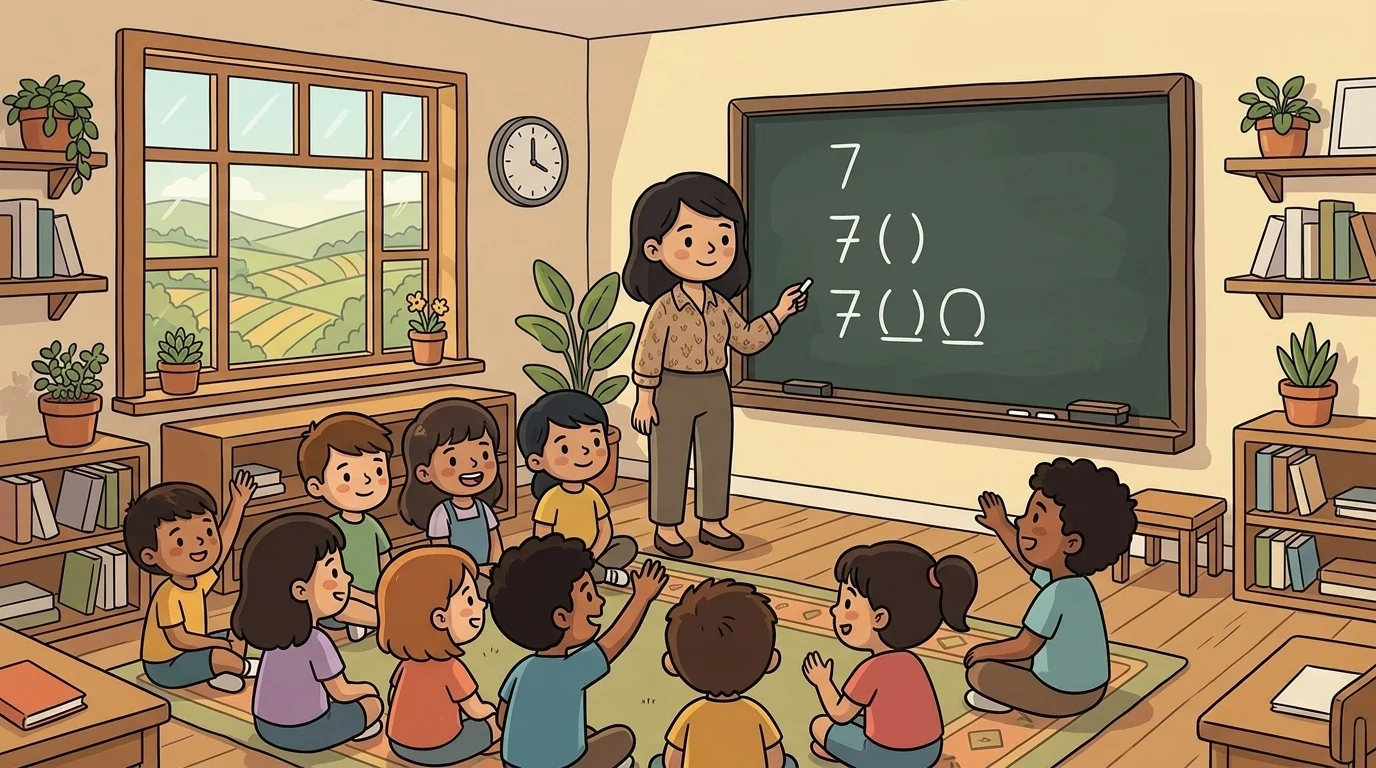
She studied numbers for the next twenty years. She joined the academy when she was twenty-eight. She has been teaching the zero ever since.
In her classroom, she begins every first-day lesson the same way. She writes on the board: 7. She writes below it: 70. She writes below that: 700. She turns to the class. She says: "What is the same? What is different?"
The children — always — say the 7 is the same. The position is different. The zeros at the end are different.
Zeph smiles. (Her smiles are small but warm.) She says: "Yes. The 7 is the same. The 0 is doing the work of holding the lower position empty so the 7 can be in a higher position. Without the 0, you would have no way to tell these three numbers apart. The 0 is doing more work than the 7."
When children ask her whether the zero is hard to understand, Zeph always says the same thing:
"It is not hard. The zero is somewhere being empty. Once you see that, the rest of arithmetic makes sense."
She still goes home to Decimal twice a year. She still walks the road between her old house and Tenfold's old house. She still does not say much at supper.
She does, however, hold the family together.
The Numberverse ensemble
Zeph is part of Numberverse's distributed-narrative cast. Each character embodies a different curricular primitive; together they teach the full subject.
-

Tenfold
Place value — powers of 10, positional notation
-

Mirror
Negative numbers — reflection across zero on the number line
-

Skip
Skip-counting and multiples — repeated addition as forward stepping
-

Tug
Inverse operations — addition ↔ subtraction (and the same idea for × ↔ ÷) as opposite pulls on the same line