
Heap and Spire
COUNT-AND-NOTICE — every culture in human history figured out two things: how to count, and how to notice the pattern in what they counted. The pair is the deep structure of math-as-recurring-human-work.
Press play to listen along. The line being read lights up as you go.
Show full transcript
Loading transcript…
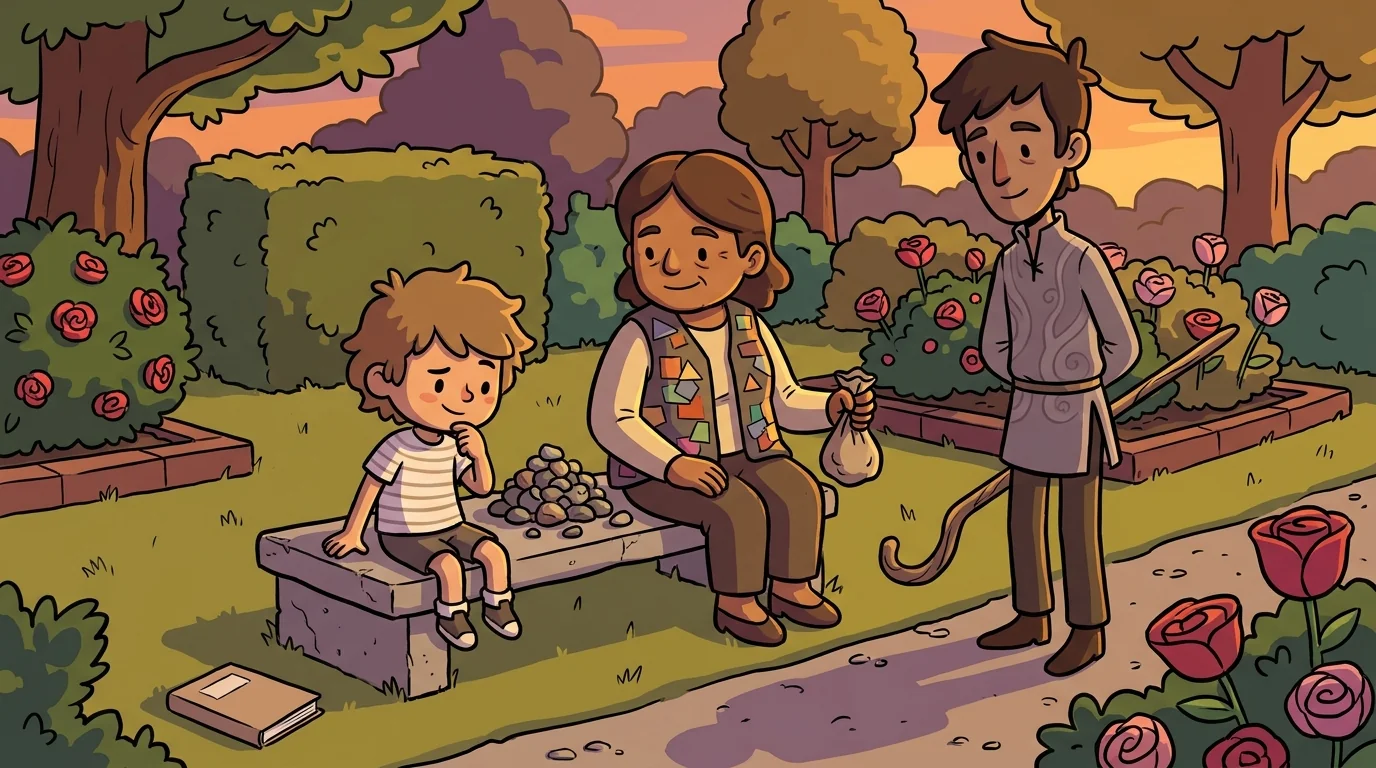
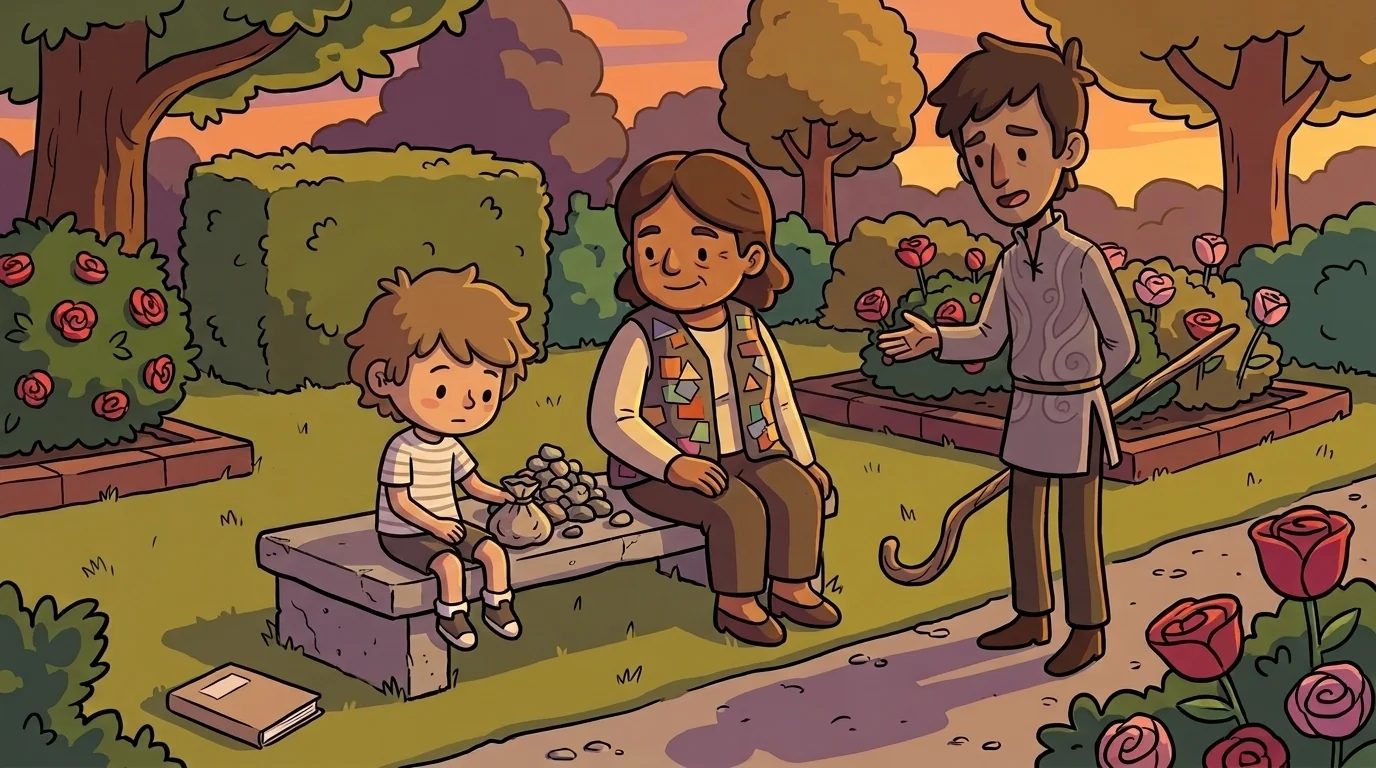
The MathLore gardens were quiet in the late afternoon. Pip the new student was sitting on a low stone bench. He had been studying for a while. He had pushed his book aside. He had wandered to the gravel path that ran around the rose-bed. He had been picking up pebbles for the last twenty minutes.
He now had a small pile of them on the bench beside him. He was looking at them.
Heap saw him from across the garden. She came over slowly, the way she always did. Her vest's many small abstract patches caught the late-afternoon light. She carried a small cloth bag in one paw.
"Pip," she said. "What are you doing?"
"Counting pebbles," Pip said. "I have a pile."
"How many?"
"Forty-one."
"And what will you do with forty-one pebbles?"
Pip shrugged. "Nothing. I just like the pile. I like that I know how many."
Heap nodded. She sat down on the bench beside the pile. She looked at it for a long, patient moment.
"That's a good thing to like," she said. "That is the first thing math ever was. A person, somewhere, looking at a pile of stones, and wanting to know how many."
Pip considered that.
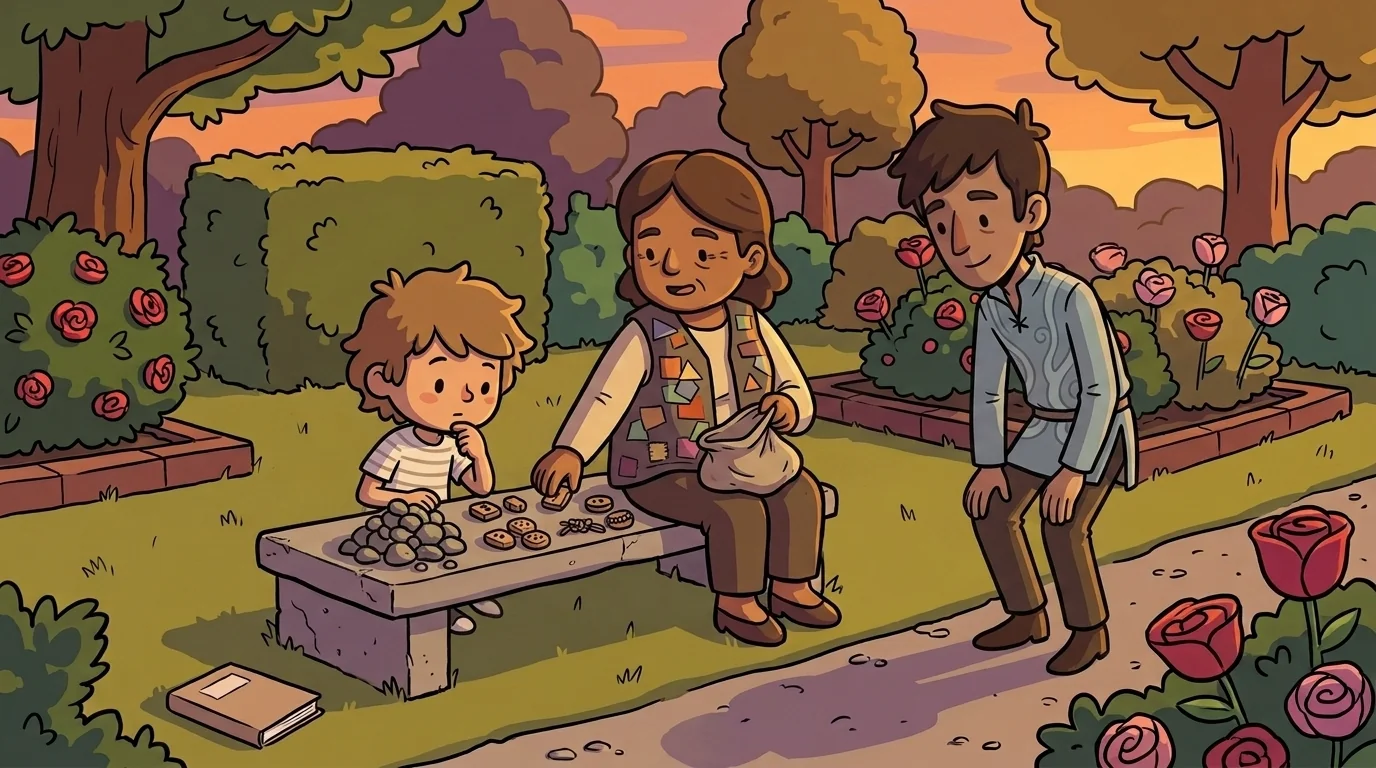
A small humming sound came from the rose-bed. Spire zipped over and hovered above the pile of pebbles. She glanced from Pip to Heap to the pile and back again.
"Oh," she said. "Forty-one pebbles. May I?"
She landed lightly on the bench.
Heap opened her cloth bag. Inside were small wooden tokens, each carved differently. She set out twenty-six of them.
"Watch," she said. "These tokens are tools I sometimes use to teach. Each carving is a way someone has counted — not in any particular place or time, just a way — across the long story of humans counting things. Some tokens have little notches. Some have groups of dots. Some have knot-patterns. Some have bead-patterns. They are all valid ways of recording how many."
Pip leaned in.
"Are any of them better than the others?" he asked.
"No," Heap said. "Each one works for the people who used it, in the conditions they faced. Some counted up to ten and then began a new ten. Some counted up to twenty. Some counted up to sixty (which is why an hour has sixty minutes — that bookkeeping has lasted a very long time). Some had a zero and some did not. Every way works. People around the world figured out their own ways. The story is the plural of all of those."
"So my forty-one pebbles," Pip said, "could be counted in any of these ways?"
"Of course."
"Show me one."
Heap nodded. She picked up Pip's pebbles. She set them out in four groups of ten and one extra pebble. She labeled the extra one with her paw. "Four tens, plus one. This is one common way. If your people count up to ten and then begin a new ten, you would write this as forty-one. That is what we usually call it."
"Yes."
"Now watch this." She rearranged the pebbles. Two groups of twenty, plus one extra. "Two twenties, plus one. If your people count up to twenty and then begin a new twenty, you would say the same pile is two-twenties-one."
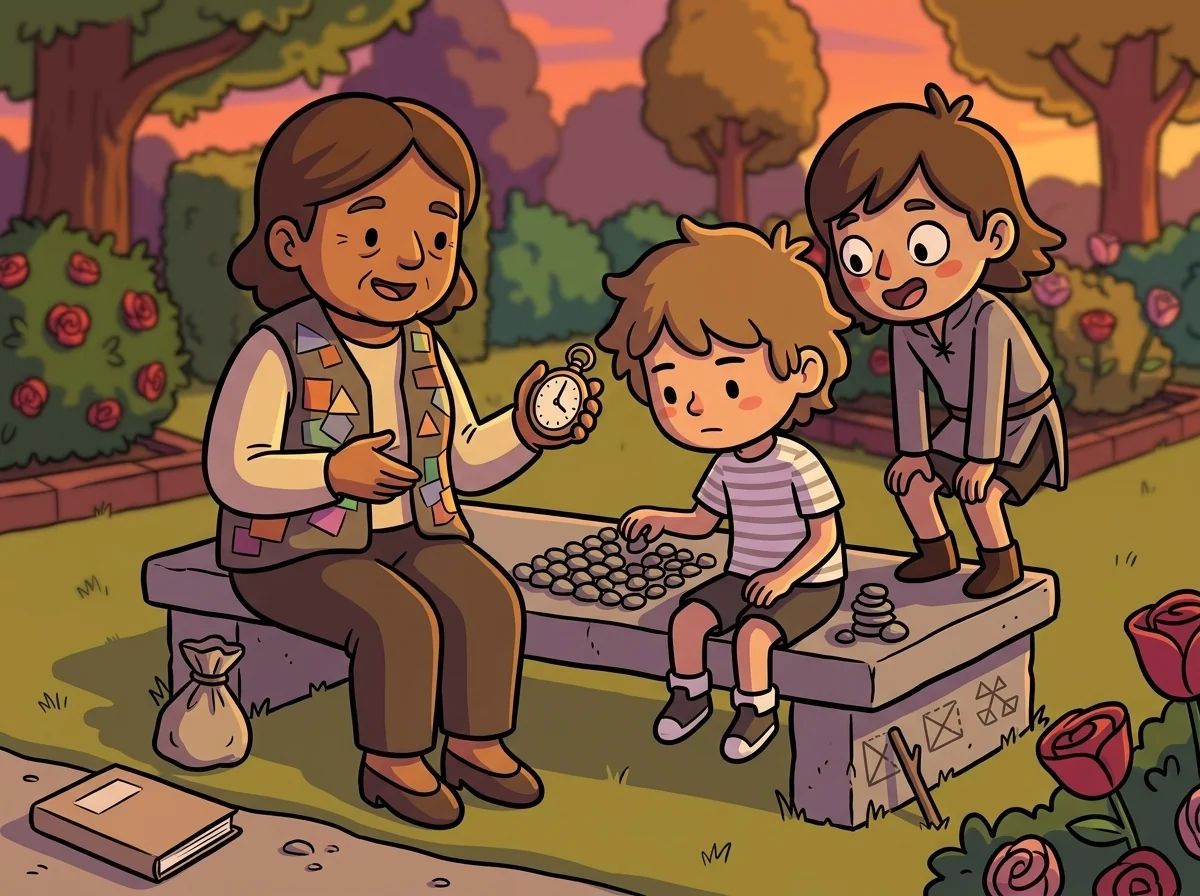
She rearranged them again. Two groups of sixteen, plus nine. "Sixteen-and-sixteen-and-nine. If your people grouped by sixteens — which has happened — you would call the same pile that."
Pip stared at the rearrangements.
"The pile is the same," he said. "But the name of the pile is different."
"That's exactly it," Heap said. "Counting is universal. The grouping you use to count is a choice. Every culture made the choice differently. The pile of forty-one pebbles did not change. Only the story we tell about the pile changed."
Spire had been watching very quietly. Now she hopped along the bench until she was perched right above the pile.
"Pip," she said. "May I show you the next thing?"
"Yes."
Spire tilted her head. She looked at the pile, which Heap had rearranged into four-tens-plus-one. She blinked.
"There is something interesting about your pile," she said. "Not just the count. Look at it again."
Pip looked.
He saw forty-one pebbles. He did not, at first, see anything else.
Spire said: "Spread them out. One at a time. Make a square. As big a square as you can. See what fits."
Pip moved the pebbles around. Six by six is thirty-six. Seven by seven would be forty-nine. Forty-one was between two square numbers. It did not make a perfect square. He could fit a six-by-six square, with five extra pebbles left over.
"It's between two squares," he said. "Six-squared is thirty-six. Seven-squared is forty-nine. Mine is closer to thirty-six."
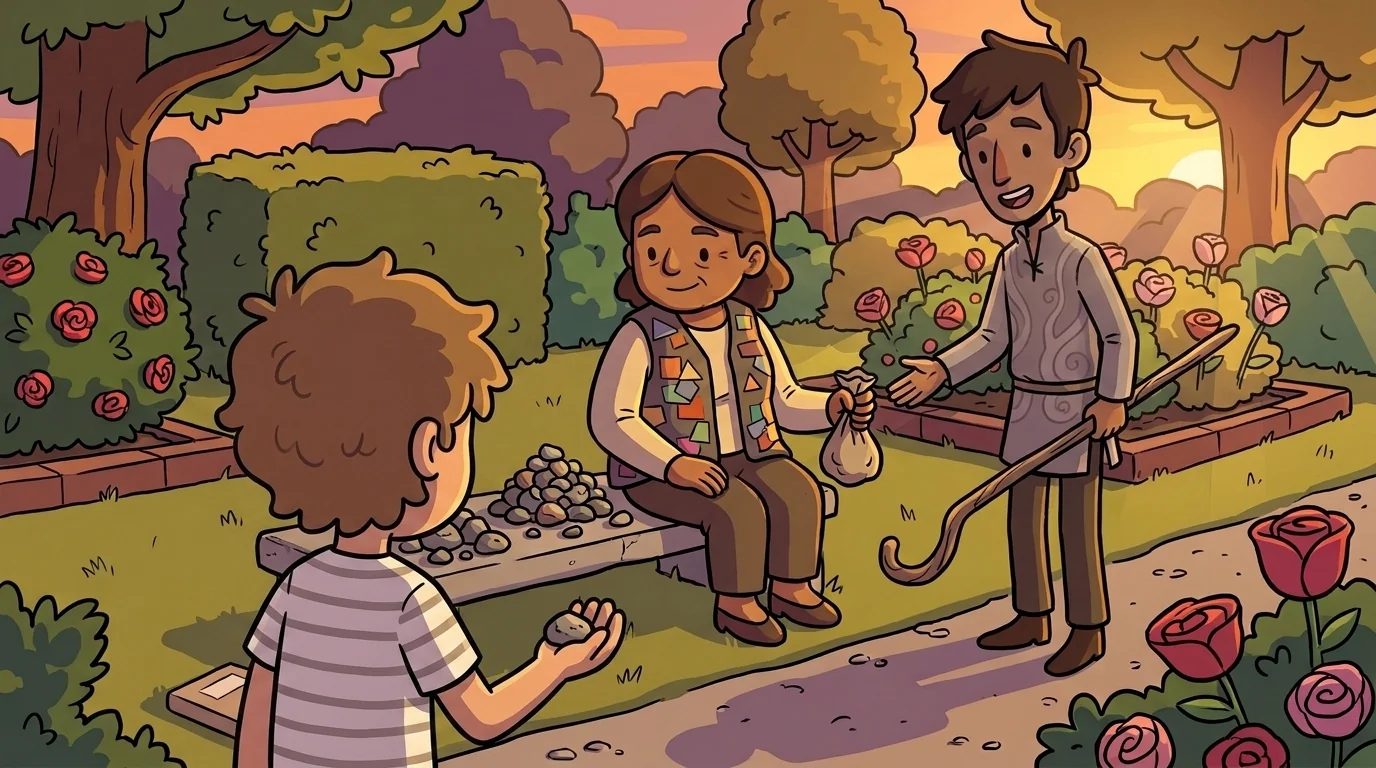
"That's a pattern," Spire said. "Every number lives between two squares. Some numbers are squares themselves. Most are not. The distance from a square is itself a property of the number. Forty-one is five away from thirty-six — the square below it."
"That's nice," Pip said.
"Try another pattern," Spire said. "Pull out the prime pebbles from your pile."
Pip thought. "Prime numbers are the ones with no factors other than one and themselves."
"Yes."
Pip set aside pebbles for two, three, five, seven, eleven, thirteen, seventeen, nineteen, twenty-three, twenty-nine, thirty-one, thirty-seven, forty-one. He counted them.
"Thirteen pebbles. The first thirteen primes."
Spire's eyes lit up. "Now what's special about thirteen?"
"It's prime," Pip said slowly.
"Yes. And forty-one is also prime. So the number of primes up to and including forty-one is itself prime. That's not always true. But it's true here. That's a small pattern hiding in your pile."
"How did you see that?"
"By looking," Spire said. "By slowing down. There are many patterns hiding in any pile of forty-one pebbles. Some you can see in a minute. Some you might not see for years."
Pip looked at his pile with new attention.
"There are more patterns?"
"There are always more patterns," Spire said. "Counting is the first story. Noticing is the second. Together they are the whole long story of math across every people who have ever lived."
Heap nodded slowly. She had not interrupted. She was simply present.
"That is the deep structure," she said. "Counting and noticing. Both are universal. Both have many forms. Every culture, in every era, did both. Some counted with knots. Some counted with beads. Some noticed the spiral in a sunflower. Some noticed the rectangle in a brick. Some noticed the prime-among-primes in a pile of forty-one pebbles. Different surfaces. Same two moves."
"Count and notice," Pip whispered.
"Count and notice," Heap said.
"That is the math," Spire said.
Pip looked down at his pebbles. He counted them again, very slowly. Forty-one. He noticed that thirteen of them were primes. He noticed that the pile was five short of a perfect square. He thought about the people, long ago, who had first noticed the same things in their own piles of stones and shells and beads.
He felt, very faintly, that he was part of a very long story.
He gathered up his forty-one pebbles. He put them carefully back into a small pouch.
He walked back to the bench, picked up his book, and sat down. He started reading again. The book was not about pebbles. It was about triangles. But triangles, he was starting to understand, were also things you count and notice patterns in.
The whole subject, suddenly, was a little less strange.
Heap and Spire watched him for a while. Then Heap said quietly: "He's got it."
"He's got it," Spire said.
They walked off across the gardens, and the late-afternoon light moved softly across the rose-bed.
The MathLore ensemble
Heap and Spire is part of MathLore's distributed-narrative cast. Each character embodies a different curricular primitive; together they teach the full subject.
-

Heap
Counting-as-first-story — every people figured out their own way to count
-

Spire
Pattern-as-discovery — patterns are everywhere when you slow down enough to see them
-

Vouch
Proof-as-shared-knowledge — show me why; if your why holds up, I'll build on it
-

Home
Math-as-cultural-context — this idea was born somewhere, for someone, with reasons
-

Carry
Cultural-transmission — the idea traveled; every place it visited, it grew