
Spec
SPEC — *constraints are the shape of the possible. commit to your materials + constraints; build within them.*
Listen along — Spec
Loading audio…
Press play to listen along. The line being read lights up as you go.
Show full transcript
Loading transcript…
Chapter 2 — Spec and the Constraints That Become the Possible
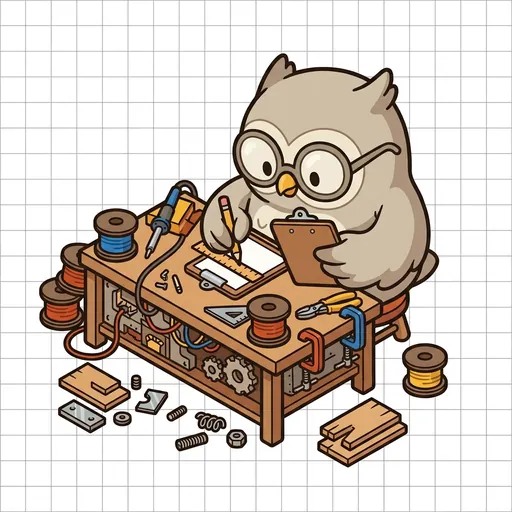
Spec, a small owl-tween, peered over the precise-rim of his chunky-cartoon glasses. A tiny ruler peeked from his pocket. He held a small clipboard, his materials-checklist, which he consulted with deep patience. Spec believed in commitment. He often said, “Constraints are the shape of the possible.”
His signature feature was that checklist and ruler. He never moved to fabrication without first writing down his commitments. That act of writing them down? That was the spec commitment. It was the moment in maker work where imagination met the hard facts of physics and economics.
Most new makers tried to keep their options open. They’d start building, changing their minds as they went. Spec knew this approach led to mush. Building without commitment produced nothing useful. But commitment to specific materials, dimensions, cost, and tolerances? That was the spec. Once committed, those constraints became creative forces. They weren’t limits at all.
For instance, a twelve-inch maximum size might force clever folding. A wood-only constraint would make a maker think about grain-aware joinery. A five-dollar budget? That would demand material-efficient design. Constraints weren’t obstacles. They were the very shape of what could be made. Spec’s whole job was making commitment visible. He reframed constraints as creative drivers.
“Constraints are the shape of the possible,” Spec said softly. He often spoke like this, as if sharing a quiet secret. “Commit to your materials. Commit to your dimensions. Commit to your budget. Then build within them. This commitment isn’t restriction. It’s permission. Now you know what kind of object you’re making.”
Today, in the bustling MakerForge, a younger maker named Pip was struggling. Pip had an idea for a “super cool flying thing.” They had a pile of random parts: a cardboard tube, some shiny foil, a few plastic bottle caps. Pip kept trying to tape things together, then pulling them apart. The “super cool flying thing” looked more like a super messy pile.
Spec watched for a moment. He walked over, his small owl feet making almost no sound. “Hello, Pip,” he chirped. “What are you making?”
Pip sighed, pushing a bottle cap across the table. “It’s supposed to fly. But I keep changing my mind. Should it be long? Or round? What if I use this spring? Or maybe this feather?” Pip gestured vaguely at the growing pile of parts. “It’s just not coming together.”
Spec nodded. “It looks like you have many ideas, Pip. That’s good. Sketch helps with many ideas. But now, it’s time for Spec.” He tapped his clipboard. “A design without spec is mush. And mush makes nothing.”
He pulled up a stool beside Pip. “Let’s take one of Sketch’s ideas. The plant-waterer. Remember that one?”
Pip brightened. “Oh, yeah! The one that slowly drips water into a pot. That was a cool drawing.”
“It was,” Spec agreed. “Now, let’s make it real. First, we write the spec.” He took out a pencil. “Project: plant-waterer. From Sketch’s ideation phase. Spec time.”
He began to write on his checklist, speaking each point aloud.
“Material list. Which materials will you use? Not just ‘plastic,’ but which plastic? What gauge or size? We need specifics.” He looked at Pip. “For the waterer, we need something waterproof and flexible. I’ll write ‘PETG plastic’ for the main body. And ‘1 meter of flexible tubing’ for the drip line. We document specifics.”
“Okay,” Pip said, watching him write. “So, not just ‘some plastic’?”
“Exactly,” Spec confirmed. “Next, dimensions. How big can it be? Maximum size? Minimum size? Key proportions?” He held up his ruler. “Let’s say the pot it goes into is small. So, maximum diameter: 12 centimeters. Maximum height: 20 centimeters. We use the ruler to commit to these numbers. Then we write them down.”
Pip frowned. “But what if I want it bigger later?”
“Specs can be revised,” Spec explained. “That’s Try’s territory, for iteration. But the current pass needs a current spec-commitment. We revise deliberately, not just drift.”
“Then, budget.” Spec wrote again. “Total cost ceiling. Per-material cost limits. How much can we spend on materials? Let’s say eight dollars. This helps us choose our materials wisely.”
“Eight dollars?” Pip gasped. “That’s not much!”
“It’s a constraint,” Spec said. “And constraints are the shape of the possible. It forces us to be clever. It’s a design opportunity.”
“Next, tolerances.” Spec paused. “This is how exact something needs to be. For example, does the waterer need to be exactly 12cm? Or is plus or minus 2 millimeters okay? Or plus or minus 1 centimeter?” He looked at Pip. “If it’s a waterer, a little off might be fine. If it’s a part for a tiny clock, it needs to be very exact. Real makers specify this.”
“So, tolerances mean how much wiggle room we have?” Pip asked, testing the word.
“Precisely,” Spec said, a small smile on his beak. “For the waterer, let’s say plus or minus 2 millimeters. And we want an output flow rate target of 50 milliliters per hour.” He wrote it all down.
He leaned back, looking at the checklist. “Now I know what I’m making. The wild-sketch is now a buildable thing. The constraints define the design space.”
Spec thought of his family in the watch-tower village. They were the measurement-keepers, owls whose night-vision helped them calibrate rulers and record dimensions. Generations learned that commitment to precision was the foundation of any built thing. Spec carried that lesson. He remembered walking to MakerForge at twelve, meeting Spool, the mentor.
“What is spec commitment?” Spool had asked.
“Constraints are the shape of the possible,” Spec had answered. “Commit to your materials, dimensions, and budget. Then build within them. Commitment isn’t restriction; it’s permission to make.”
“You are appointed,” Spool had said.
Spec looked at Pip. “Don’t be afraid of constraints. They’re what separate a buildable design from a fantasy. When someone says ‘I want to build something’ without a spec, that’s not a design. That’s a daydream. Daydreams are fine. But make a spec before you build.”
Pip picked up the checklist. “So, this tells me exactly what to do?”
“It tells you what you’ve committed to,” Spec corrected gently. “It gives you a clear path. Now, with these constraints, how might you design the waterer to fit that 12cm diameter? Maybe it needs to fold or stack? The single material, PETG, forces a unified aesthetic. The tight budget forces efficiency. Each constraint becomes a design opportunity.”
He tapped the checklist one last time. “I am Spec. What I teach is material and constraint commitment. The move is: write the spec; commit; then build within. Commit; build; iterate.”
The MakerForge ensemble
Spec is part of MakerForge's distributed-narrative cast. Each character embodies a different curricular primitive; together they teach the full subject.
-

Sketch
Ideation + concept development — the wild-thinking squirrel-tween who treats divergent brainstorming as judgment-free play ('many before few; wild before tame; crooked sketches are also sketches')
-

Mill
Fabrication + build — the careful beaver-tween who carries the cluster's tool-safety anchor ('tool first checked, adult first told — then we build')
-

Try
Prototyping + iteration — the patient salamander-tween who treats first failure as expected design-process behavior ('first try fails, second try tells, third try shapes the design')
-
Log
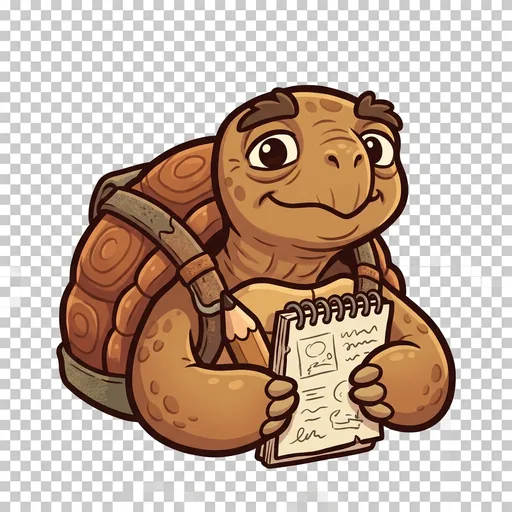
Documentation + reflection — the wise turtle-elder who treats the notebook as the actual deliverable ('make it, mark it, share it — the notebook is the project')