
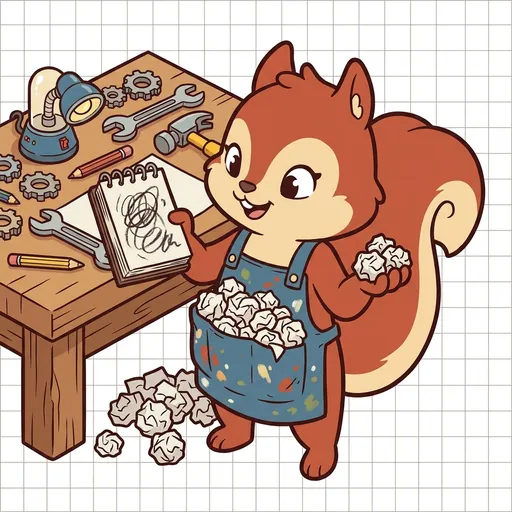
Sketch
IDEATION — *many before few; wild before tame; crooked sketches are also sketches.*
Listen along — Sketch
Loading audio…
Press play to listen along. The line being read lights up as you go.
Show full transcript
Loading transcript…
Chapter 1 — Sketch and the Crooked Lines That Count
The pencil never stopped moving. Sketch hunched over her workbench, a young squirrel in a paint-splattered apron, and her hand flew across the page — scratch, scratch, scribble. A lopsided cup. A cup with legs. A cup that was somehow also a hat. She tore the sheet off, crumpled it into a ball, and tossed it onto the growing pile beside her without slowing down.
“Six,” she muttered. “Come on. More.”
Her reddish-brown tail flicked. Around her, the crumpled paper balls sat in a happy little mountain, each one a drawing that hadn’t worked. She never threw them out. She patted the pile like it was a sleeping cat and kept going — a seventh cup, an eighth, this one dribbling water out of tiny holes.
“There you are,” she whispered to the eighth one, and grinned.
She had learned to draw this way in the village granary, where her family stored the winter food.
Every autumn, the squirrels buried nuts — not in one careful spot, but everywhere. Under the roots. Behind the shed. In holes they knew they’d forget. Little Sketch had followed her grandmother across the frosted hillside one morning, watching her poke acorn after acorn into the dirt.
“But you’ll lose most of these,” Sketch had said, worried. “You won’t remember where they all are.”
Her grandmother had smiled, breath fogging in the cold. “That’s the plan, dear one. The ones we forget grow into trees. We don’t need every nut to sprout.” She pressed another into the soil. “We just need to plant enough of them that some do.”
Sketch had turned that over in her small head for a long time. Plant many. Only some grow. But you need many to start. It felt, somehow, like the truest thing anyone had ever told her.
When she was twelve, she walked the long road to MakerForge with her sketchpad under her arm.
Spool, the mentor, was waiting at the gate. She didn’t ask Sketch to introduce herself. Instead she set a blank sheet of paper on a stone between them and said, “Draw me a bridge.”
Sketch didn’t draw one bridge. Her pencil was already going — a rope bridge, a stone arch, a bridge made of stacked turtles, a folding bridge, a bridge that was really just a very long dog. Eleven bridges in under a minute, most of them ridiculous, the turtles especially.
Spool watched the pencil, not the pictures. When it finally stopped, she picked up the sheet and studied the folding bridge tucked in the corner — the one Sketch had almost scribbled over.
“You went wide before you went deep,” Spool said quietly. “You made a crowd before you picked a favorite.” She set the paper down. “Most people draw one bridge and fall in love with it too soon. Stay.”
Sketch’s workshop smelled of graphite and cedar shavings. A kit of young makers crowded around her bench one afternoon, and a rabbit named Fen slumped in the back, arms crossed.
“I can’t think of anything good,” Fen said. “Everything I draw is dumb.”
Sketch clapped her paws once. “Perfect. Draw me a dumb plant-waterer, then. Right now. Ten seconds.” She flipped to a clean page and demonstrated, pencil scratching — a dripping bottle, a long drip-line, a plant-shaped sponge, a tiny robot lugging a watering can. Scribble, tap. A kid holding a hose. A spinning ring. A little umbrella that popped open when it rained.
“Eight,” she said, holding up the page. “Three minutes. Most of them silly.” Fen almost smiled.
Then Sketch went still, staring at the spinning ring. “Wait.” She circled it. “What if that ring didn’t spin — what if it just sat around the plant’s base and dripped, slow, all day?” She tapped it, eyes bright. “That one came out of the pile of silly ones. It wasn’t the plan. It just showed up.”
Fen uncrossed his arms and grabbed a pencil. “Can mine have turtles?”
“Yours better have turtles,” Sketch said.
That evening, after the kit had gone, Sketch sat alone with her mountain of crumpled paper.
She picked up a few of the balls and smoothed them open — the cup that was a hat, the bridge made of dogs, a dozen ideas that had gone nowhere. She wasn’t embarrassed by them. She felt something warmer than that, looking at the whole wild pile: the quiet, easy gladness of a mind that had never once been afraid to try something silly.
“You’re all steps,” she told the paper softly. “Every crooked one of you got me somewhere.”
She set them back on the pile, patted it like a sleeping cat, and let the calm settle all the way through her chest before she went to bed.
The MakerForge ensemble
Sketch is part of MakerForge's distributed-narrative cast. Each character embodies a different curricular primitive; together they teach the full subject.
-
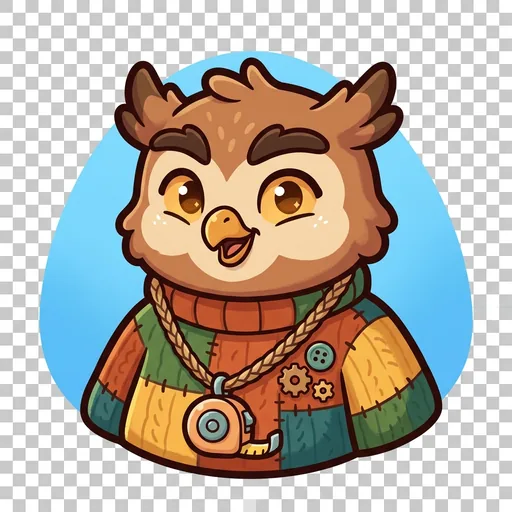
Spec
Material + constraint commitment — the measured owl-tween who treats spec-commitment as the moment imagination meets physics ('constraints are the shape of the possible')
-

Mill
Fabrication + build — the careful beaver-tween who carries the cluster's tool-safety anchor ('tool first checked, adult first told — then we build')
-
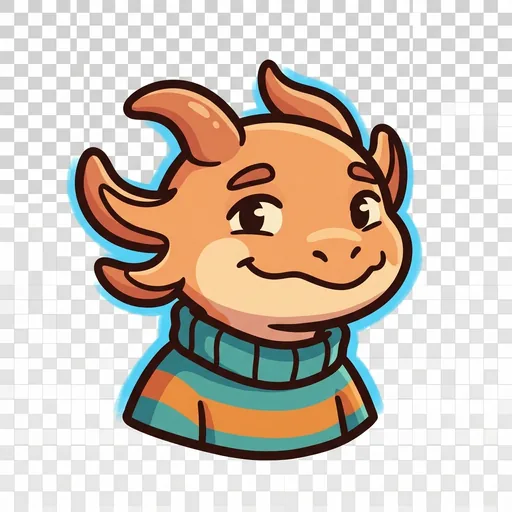
Try
Prototyping + iteration — the patient salamander-tween who treats first failure as expected design-process behavior ('first try fails, second try tells, third try shapes the design')
-
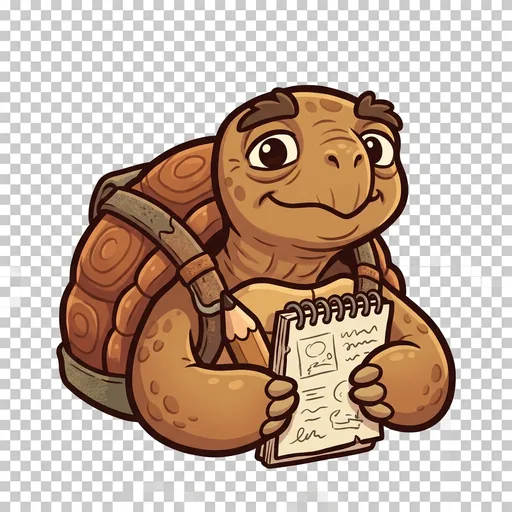
Log
Documentation + reflection — the wise turtle-elder who treats the notebook as the actual deliverable ('make it, mark it, share it — the notebook is the project')