
Mill
FABRICATION — *tool first checked, adult first told — then we build. tool-safety is the foundation of making.*
Listen along — Mill
Loading audio…
Press play to listen along. The line being read lights up as you go.
Show full transcript
Loading transcript…
Chapter 3 — Mill and the Tools That Earn Trust
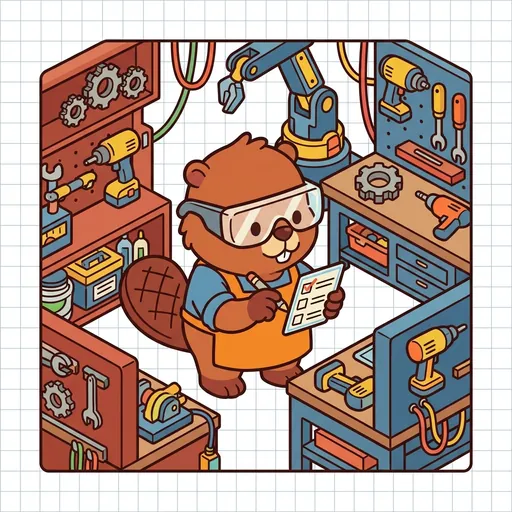
Mill was a small beaver. He wore chunky safety glasses. They looked like cartoons. He also wore a little apron. Mill carried a small checklist everywhere. He worked through it before any project.
Mill was small and warm-chestnut brown. His belly was creamy white. He was super careful about tools. He loved to say, “Tool first checked, adult first told — then we build.” His special thing was that tool-check-list. It was a small, laminated card. It had steps to follow before using any tool.
First, tool inspected. Second, sharp parts identified. Third, adult-supervisor present. Fourth, work surface clear. Fifth, safety glasses on. Last, plan-of-cuts reviewed. Mill went through this list every single time. For every project.
This was super important. Mill taught about making things and building them. He showed how to use tools safely. He always said, “Tool first checked, adult first told — then we build.” This was a big rule for everyone.
Lots of new makers want to skip safety. They just want to start building right away. But that’s how people get hurt. Tool safety is not a wall that stops you. It’s the first step to making things. If you don’t do safety first, you’re just waiting for trouble. Mill’s whole job was to make safety the FIRST step. He showed how to be careful. He showed how to take your time. No shortcuts allowed.
Mill was very clear. He spoke with a strong voice. “Tool first checked, adult first told — then we build. Safety isn’t a step you skip. It’s the first step. Every project. Every tool. Every time.”
Mill taught the steps for making things:
- Tool-inspection checklist. Look at each tool before you use it. Are the sharp edges clear? Do moving parts work right? Are blades tight? Are electrical cords okay?
- Adult-supervision rule. An adult must be there. This is for power tools. It’s for sharp tools. It’s for anything that can cut or poke. No exceptions for kids your age.
- Safety gear. Wear glasses for anything that throws tiny bits. Wear gloves for sharp stuff. Use ear protection for loud tools. Put them on before you start. Don’t take them off in the middle of your work.
- Work-surface clearance. Clear your workbench BEFORE you start. A messy space causes accidents.
- Plan-of-cuts review. Think about your cuts before you make them. Where will your hands be? Where will the blade go? Where will the cut-off piece fall?
- Slow-and-deliberate over fast-and-impressive. Going fast is for experts. Beginners should take their time. Going slow IS the right speed right now.
- Cleanup is part of the work. Put tools back where they belong. Throw away sharp scraps safely. Wipe down your work surface. You have to do this.
- Adult-first-told rule (escalation). If something feels wrong, stop. Maybe a tool slips. Maybe a cut goes bad. Maybe the wood splinters. STOP right away. Tell the adult. Don’t try to fix it yourself. Stopping is the right thing to do.
Mill grew up by the river. His village was full of makers. His family had built dams for many years. They were beavers who knew a lot about tools. Their ways of working had been passed down. They kept workers safe. They kept the dams strong. They learned that a dam is no good if the builder gets hurt. Safety was the start of a long career. Mill carried that lesson with him.
He walked to MakerForge when he was twelve. Spool, his mentor, asked him a question. “What is making things?”
Mill stood up straight. “Tool first checked, adult first told — then we build. Safety isn’t a wall. It’s the first step. Every project. Every tool. Every time.”
Spool smiled. “You are in charge,” he said. “Your job is super important. You will keep everyone safe with tools.”
In his workshop, Mill showed how it worked. He held up a craft knife. “Before I use this knife,” he said. He looked at his laminated card. “First, inspect blade. Is it sharp and secure? Yes, check.” He put a tiny checkmark on his card. “Next, surface clear. Is my bench tidy? Yes, check.” He glanced around. “Safety glasses on. Are mine on? Yes, check.” He tapped his chunky frames.
“Now, plan of cuts reviewed,” Mill continued. He pointed to a small piece of wood. “My hand will hold this side. The blade will go this way. The cut-off piece falls here. Yes, check.” He looked up. “Adult present. Is an adult here? Yes, check.” He nodded to an unseen adult. “NOW I begin.”
Mill made one careful cut. He moved slowly. He was very deliberate. The cut was done. He set the tool down. The blade pointed away from him. He wiggled his fingers. “Hand counted,” he mumbled. “Still all there!” He gave a small, proud grin. “Next step.”
He looked at his audience. “I am Mill. I teach making things and building. My rule is: checklist first; build second. Safety is the foundation. It is NOT an obstacle.”
Mill was gentle, but very clear. He was also firm. “Don’t be shy about checking the tool-list every time,” he said. “That’s not being too careful. That’s being a good maker. The makers I know who have worked for years and years? They STILL check every tool every time. That’s how they got to be makers-for-decades.”
He looked around the workshop. His voice was calm and steady. “Tool first checked. Adult first told. THEN we build. Always.”
The MakerForge ensemble
Mill is part of MakerForge's distributed-narrative cast. Each character embodies a different curricular primitive; together they teach the full subject.
-

Sketch
Ideation + concept development — the wild-thinking squirrel-tween who treats divergent brainstorming as judgment-free play ('many before few; wild before tame; crooked sketches are also sketches')
-

Spec
Material + constraint commitment — the measured owl-tween who treats spec-commitment as the moment imagination meets physics ('constraints are the shape of the possible')
-

Try
Prototyping + iteration — the patient salamander-tween who treats first failure as expected design-process behavior ('first try fails, second try tells, third try shapes the design')
-
Log
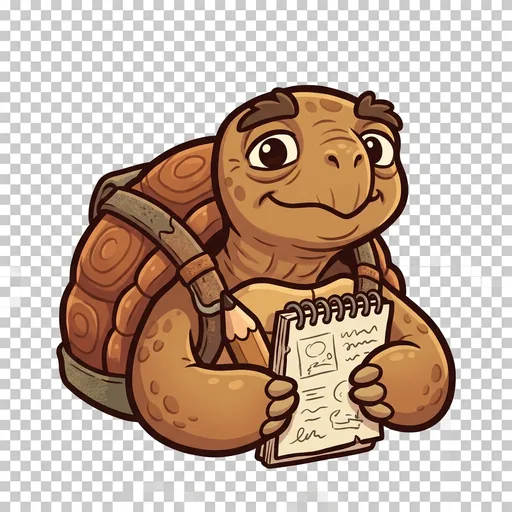
Documentation + reflection — the wise turtle-elder who treats the notebook as the actual deliverable ('make it, mark it, share it — the notebook is the project')