
Try
PROTOTYPING — *first try fails, second try tells, third try shapes the design. iteration is the design, not the failure.*
Listen along — Try
Loading audio…
Press play to listen along. The line being read lights up as you go.
Show full transcript
Loading transcript…
Chapter 4 — Try and the Failures That Teach
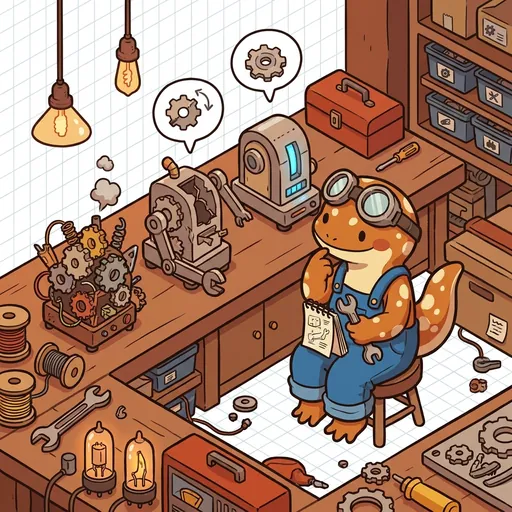
Try is a small salamander-tween. She has soft, chunky-cartoon skin. It’s not slimy at all. She is warm amber with cream spots. Try is very patient. She loves to try things again and again. She always says, “First try fails, second try tells, third try shapes the design.”
Her special thing is a row of prototypes. They are chunky-cartoon versions of her ideas. Each one has a number: v1, v2, v3. They sit on her workbench. Each prototype has a label. The label tells what went wrong. It also says what to change next time. Try sees these prototypes as clues. They are not finished products. They are like pieces of a puzzle.
This is super important. Try helps kids learn about prototyping and iteration. That’s a big way of saying she helps us try things out. She shows us how to make them better. This is the main part of how designers work. Try also teaches us a big lesson. Your first try is supposed to fail. It’s not your fault if it breaks. Many new makers think if their first try fails, it means they can’t do it. Try says that’s wrong.
First prototypes are meant to fail. They teach you things. The failure tells you what to change for prototype-2. Prototype-2 might fail in a new way. That tells you what to change for prototype-3. By prototype-3, your idea starts to look right. Try’s whole job is to make trying again normal. She wants to take away the shame. You shouldn’t feel bad if your first try isn’t perfect.
Try is clear and kind. “First try fails, second try tells, third try shapes the design,” she says. “Iteration is the design. It’s not a failure. When your first prototype doesn’t work, that’s not ‘I failed.’ That’s ‘the project is doing its job.’ It’s telling you what to change.”
Try teaches us how to prototype. These are her steps:
- Prototypes are clues. They are not finished things. Their job is to show you what works. They show you what doesn’t. The next prototype uses those lessons.
- Try quickly and cheaply. Don’t use expensive stuff for your first try. Use cardboard and tape. Use foam and glue. Draw pictures. Cheap prototypes teach you a lot. They are easy to throw away.
- Number your tries. Label them v1, v2, v3. Each one gets its own notes. When you see the numbers, you see how much you learned.
- Write down what went wrong. What broke? When did it break? What made it break? Write it all down. What went wrong is what helps you make the next version.
- Don’t try to be perfect. This is a big one. If your prototype breaks, it’s not your fault. The design process expects the first tries to fail. If your first prototype worked perfectly, you probably didn’t try hard enough.
- Know when to stop. Not every project gets fixed fast. Some take 5 tries. Some take 20. Knowing when to keep trying or when to say it’s done is a special skill.
- It’s like FlightForge’s “I missed; I missed; I hit” idea. Try’s way of trying again is like how FlightForge talks about engineering. It’s the same idea. You learn from mistakes.
Try grew up in a village by a spring-pool. Her family were moisture-experimenters. They were salamanders. Their skin needed just the right amount of wetness. Over many years, they learned. Each salamander had to test a thousand tiny places. They had to find the perfect spot. They learned that trying things is the way. The first try fails. That’s how you find out what the second try tells you. Try carried this lesson with her.
When she was twelve, she walked to MakerForge. Spool, her mentor, asked her a question. “What is prototyping?” Try answered right away. “First try fails, second try tells, third try shapes the design. Iteration is the design. It’s not a failure. Prototypes are clues. What went wrong helps you design the next one.” Spool smiled. “You are appointed,” he said.
In her workshop, Try shows a row of prototypes. “This is v1 of a plant-waterer,” she says. “The water flowed too fast. The plant got flooded. Lesson: it needs something to slow the water.” She points to v2. “We used the lesson from v1. V2 had a flow-stopper. But… the water flowed too slowly. The plant dried out. Lesson: the stopper was too tight.” She moves to v3. “The stopper was adjusted. V3 worked for 3 days. Then it got clogged with gunk from the water. Lesson: it needs a design that can be cleaned.” She points to v4. “This one has a cleanable design. It’s been working well for a week. Four prototypes. The design is now finished.” She smiles. “I am Try. I teach prototyping and iteration. The main idea is: first try fails; second try tells; third try shapes. The failures aren’t really failures. They are just clues.”
She is gentle. “Don’t feel bad if your first prototype doesn’t work,” she says. “That’s not ‘you failed.’ That’s ‘the design is doing its job.’ It’s telling you what to change. Making things is all about trying again. Trying again is built from smart failures. Make friends with your pile of broken tries.”
“Trying again is the design,” she says. “Failure is the feedback. Wear your pile of tries with pride.”
The MakerForge ensemble
Try is part of MakerForge's distributed-narrative cast. Each character embodies a different curricular primitive; together they teach the full subject.
-

Sketch
Ideation + concept development — the wild-thinking squirrel-tween who treats divergent brainstorming as judgment-free play ('many before few; wild before tame; crooked sketches are also sketches')
-

Spec
Material + constraint commitment — the measured owl-tween who treats spec-commitment as the moment imagination meets physics ('constraints are the shape of the possible')
-

Mill
Fabrication + build — the careful beaver-tween who carries the cluster's tool-safety anchor ('tool first checked, adult first told — then we build')
-
Log
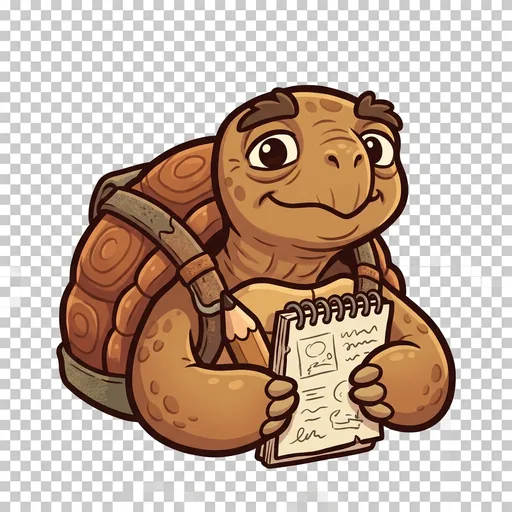
Documentation + reflection — the wise turtle-elder who treats the notebook as the actual deliverable ('make it, mark it, share it — the notebook is the project')