
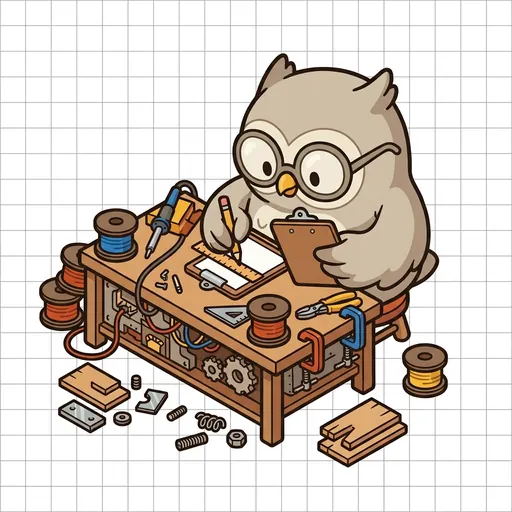
Spec
SPEC — *constraints are the shape of the possible. commit to your materials + constraints; build within them.*
Listen along — Spec
Loading audio…
Press play to listen along. The line being read lights up as you go.
Show full transcript
Loading transcript…
Chapter 2 — Spec and the Rules That Become the Possible
Spec pushed his chunky glasses up his beak and held the little ruler against the edge of the tabletop. “Twelve centimeters,” he murmured, and wrote it down on his clipboard. Then he measured again, just to be sure. “Twelve. Good.”
He was a small grey owl, patient as a stone, and he never began a build without first filling a page. Around him other makers were already stacking, cutting, gluing in a happy blur — but Spec sat with his checklist and his pen, and he wrote. Material. Size. Cost. One line at a time, until the page held the whole shape of what he was about to make.
Only then did he pick up a single piece of wood.
He had learned to slow down in Watch-Tower Village, where his family were the measurement-keepers.
When Spec was small, a neighbor had come racing up the tower steps, arms full of planks. “I’m building a shelf!” the neighbor announced. “Right now! I couldn’t wait!” And he’d started nailing, no plan, just excitement — wide here, narrow there, one shelf tilting, the next too heavy. By nightfall the whole thing had folded sideways into a pile of splinters.
Spec’s father had watched from the tower window, then rested a wing on young Spec’s shoulder. “That,” he said gently, “is what happens when you keep every choice open. It looks free. But it builds nothing.” He handed Spec a ruler. “Choosing isn’t losing. Choosing is how a thing gets to be real.”
Spec had held that ruler like a treasure ever since.
At twelve, he walked to MakerForge and found Spool waiting.
She didn’t ask him for a speech. She pointed at a jumble of parts on the bench — string, tubes, three kinds of plastic, a heap of wire — and said, “Build me a whistle. You may use anything here.”
Most young makers would have grabbed at everything. Spec picked up his pen instead. He wrote: One tube. Wood mouthpiece. Ten centimeters long. Nothing else. Then he set the pen down and, working only inside those four lines, folded the tube and shaped the wood and — in about a minute — blew a clean, bright note.
Spool tilted her head. “You could have used all of it,” she said.
“If I use all of it, I never finish,” Spec answered. “The rules told me what I could make. So I made it.”
She almost smiled. “Stay.”
One afternoon a kit of young makers gathered at Spec’s bench, and a fidgety fox named Rill was bouncing on her heels.
“Sketch gave us a wild idea for a plant-waterer,” Rill said. “Can we just start?”
“We can start,” Spec said, “the moment we choose.” He pulled his checklist close and picked up his pen. “Watch. What’s it made of?” He wrote as he spoke. Bendy tube, one meter. “How big can it be?” No wider than twelve centimeters. No taller than twenty. “What can we spend?” Eight dollars, no more. “How much water?” Fifty milliliters an hour.
He stopped and let the fox read the page. “Now — try building it any bigger than twenty centimeters.”
“I can’t,” Rill said slowly. “There’s no room.”
“Right. And because there’s no room, you’ll have to fold the tube clever.” Spec tapped the page. “The rule didn’t stop you. It just showed you the smart way in.” He slid the clipboard toward her. “A build with no plan is mush. This isn’t mush anymore. It’s a thing we can actually make.”
Rill stared at the six little lines, and her bouncing stopped.
That evening Spec tucked his clipboard under his wing and stepped out onto the tower balcony to watch the last light go.
Down in the workshop, the plant-waterer sat finished — small, folded neat, dripping its slow steady fifty milliliters just like the page had promised. It had started as one of Sketch’s crazy scribbles. Now it was real, because somewhere in between, someone had been brave enough to choose.
Spec breathed out, long and easy. There was a particular calm he loved, and it wasn’t the calm of having many choices — it was the quiet, unhurried steadiness of knowing exactly what he was going to make. His shoulders dropped. His chest went loose and warm.
“Choose,” he said softly to the dark. “Build. Then try again.” And he stood there a while longer, glad, before he went inside.
The MakerForge ensemble
Spec is part of MakerForge's distributed-narrative cast. Each character embodies a different curricular primitive; together they teach the full subject.
-

Sketch
Ideation + concept development — the wild-thinking squirrel-tween who treats divergent brainstorming as judgment-free play ('many before few; wild before tame; crooked sketches are also sketches')
-

Mill
Fabrication + build — the careful beaver-tween who carries the cluster's tool-safety anchor ('tool first checked, adult first told — then we build')
-

Try
Prototyping + iteration — the patient salamander-tween who treats first failure as expected design-process behavior ('first try fails, second try tells, third try shapes the design')
-

Log
Documentation + reflection — the wise turtle-elder who treats the notebook as the actual deliverable ('make it, mark it, share it — the notebook is the project')