
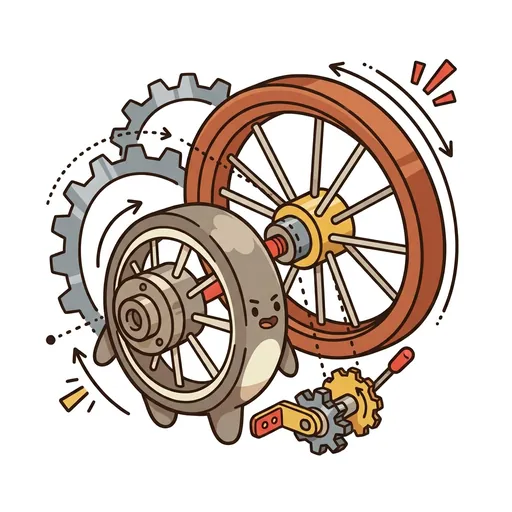
Spoke
WHEEL-AND-AXLE — *one turn of the hub, many turns of the rim. radial mechanical advantage.*
Listen along — Spoke
Loading audio…
Press play to listen along. The line being read lights up as you go.
Show full transcript
Loading transcript…
Chapter 4 — Spoke and the Hub-and-Rim Trade
Spoke was a small, living wheel-and-axle. Its form was like a chunky cartoon, all warm grey and cream, with a clearly visible hub, a wide rim, and sturdy spokes connecting them. Spoke wasn’t a person, and it wasn’t gendered. It simply was a wheel-and-axle, a mechanism brought to life.
Spoke hummed with a deep, constant curiosity about radial geometry. Its favorite phrase, a gentle whirring sound, was “one turn of the hub, many turns of the rim.” This wasn’t just a saying; it was Spoke’s core truth. The geometric relationship between its small hub and its wide rim was the mechanism. This was the wheel-and-axle primitive, one of the most important inventions in human history. It wasn’t just a wheel. It was a wheel attached to an axle, a smaller shaft running through its center.
Force applied at the rim, with its large radius, could produce high torque at the axle, which had a small radius. Or, force applied at the axle could generate speed at the rim. It was the same kind of force-distance trade as Pry’s lever, but in a circular motion. This simple idea allowed for incredible things: rolling, which almost eliminated friction loss; gears, which combined multiple wheel-and-axles; and wheels on vehicles of every kind. Spoke’s whole purpose was to make this radial mechanical advantage visible. It celebrated the wheel-and-axle’s transformative role in human technology.
Spoke was clear, its voice a steady, rhythmic whir. “One turn of the hub, many turns of the rim. Radial mechanical advantage.” It would pause, letting the words sink in. “The hub is small; the rim is large. Push the hub, and the rim spins faster. Push the rim, and the hub turns with much more force. It’s the same force-distance trade as a lever, but it works in a circle.”
Spoke taught the fundamental ideas of the wheel-and-axle. It started with the definition: a wheel attached to an axle. Force on one part became a magnified force or speed on the other, depending on the radius ratio. Spoke understood that this ratio, the wheel-radius divided by the axle-radius, was the key to mechanical advantage. A larger ratio meant more force multiplication.
It loved to point out doorknobs. “See?” Spoke would whir, nudging a doorknob with its rim. “You push the knob, which is the large wheel. That rotates the tiny latch-rod inside, the small axle, with incredible force. That’s how it opens the door.”
Spoke always reminded everyone that wheels weren’t just for transportation. “Think of steering wheels,” it would whir, perhaps observing a miniature car model in the corner of the workshop. “The driver turns the large wheel, and the smaller shaft, the axle, steers the car with powerful precision.” Or screwdrivers. “The handle is the wheel, the shank is the axle. A small twist of your hand becomes a strong turn for the screw.” Faucet handles, too. “Even the windlasses on old wells, pulling up heavy buckets of water from deep underground, use this same principle.” The mechanism was everywhere, Spoke understood, often hidden in plain sight, making daily tasks easier, stronger, faster.
There was an important difference, Spoke knew, between wheels and simple rollers. Rollers just tumbled along, grinding against the ground. Wheels, however, rotated on axles, a point of minimal contact. This axle-bearing design drastically reduced friction, making wheels on axles far more efficient. Spoke would often demonstrate this by rolling a smooth log next to a small cart wheel across the workshop floor, showing how much easier the wheel spun, how little effort it took to keep it moving. The log would slow, but the wheel seemed to glide.
And then there were gears. Spoke saw gears as paired wheel-and-axles, their precisely cut teeth meshing together. A large gear turning a small gear meant a change in speed and torque, a delicate dance of ratios. It was all about those circular trades of force and distance, a symphony of rotation. Spoke found beauty in their intricate movements.
Spoke often reflected on its own history, a deep hum of ancient knowledge within its core. The wheel-and-axle had appeared in vehicles around 5500 BCE, changing how people moved goods and themselves. Pottery wheels, even earlier, had revolutionized crafting. It was one of the most transformative human inventions, a silent, constant force shaping civilization.
In the MachineForge workshop, a place of whirring motors and the scent of oiled metal, Spoke had been made on a sturdy wheelwright’s bench. Cog, the wise mentor, a being of interlocking gears and quiet wisdom, had once asked, “What is a wheel-and-axle, Spoke?”
Spoke had spun gently, a confident whir rising from its core. “One turn of the hub, many turns of the rim. Radial mechanical advantage.”
Cog had simply nodded, its own gears clicking softly. “You are appointed.”
Now, Spoke often demonstrated its principles right there amidst the tools and half-finished projects. It would position itself, its warm grey form perfectly balanced. Then, it would begin to turn its hub, slowly, steadily. The larger rim, connected by the spokes, moved a surprising distance, a blur of cream against the workshop’s busy backdrop. “See?” Spoke would whir, its spokes a visible, graceful blur. “Small input at the hub; large output at the rim. That’s force-to-speed.” It was like a whisper becoming a shout, a slow push transforming into swift motion.
Then it would reverse the demonstration. Someone might be invited to push Spoke’s rim slowly, a deliberate, gentle pressure. The hub, much smaller, would rotate with immense, silent power, a feeling of concentrated strength. “Push the rim slowly,” Spoke would explain, its voice a steady, rhythmic pulse. “The hub spins with high torque. That’s force-to-torque. It works both directions. Same physics, same conservation of work. The energy never disappears, it just changes form.”
Spoke would then declare its purpose, a final, clear statement. “I am Spoke. The primitive I teach is the wheel-and-axle. The move is radial force-distance trade. One turn of the hub equals many turns of the rim.”
Spoke was gentle in its teaching, but firm in its message. “Don’t think of wheels as just transportation,” it would often say, its voice a soft, insistent whir, like a distant bicycle chain. “Doorknobs. Faucets. Screwdrivers. Steering wheels. They are all wheel-and-axles. This mechanism is one of the most common things you use every single day, even if you don’t realize it.”
“Hub and rim,” Spoke would conclude, a final, satisfying turn, a silent nod to its own design. “Radial mechanical advantage.”
The MachineForge ensemble
Spoke is part of MachineForge's distributed-narrative cast. Each character embodies a different curricular primitive; together they teach the full subject.
-

Pry
Lever — push longer to lift heavier; the trade between force and distance
-

Hoist
Pulley — pull down here and watch it go up there; redirecting force
-

Ramp
Inclined plane — climb the long slow way; less force, same work
-

Auger
Screw — round and round becomes step and step; spiral inclined plane
-

Cleave
Wedge — push forward and split it apart; force concentrated to a sharp edge
-

Pinion
A gear train: meshing teeth trade turning-speed for turning-force and pass the motion along, faster or stronger as you choose.
-
Flex
A spring: bend it to store your push, let go and it gives every bit back — energy held, then returned.
-

Lobe
A cam: a spinning shape with a bump that turns steady spinning into a repeating push, like a music box keeping a beat.
-
Ratchet
A ratchet: lets motion go forward freely but locks when it tries to slip back, holding every bit of progress, click by click.