
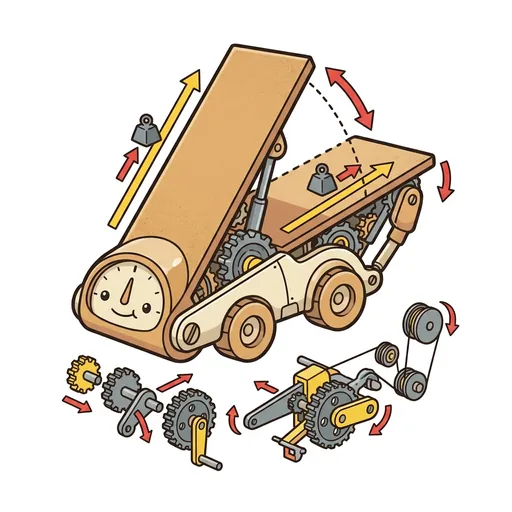
Ramp
INCLINED PLANE — *climb the long slow way; less force, same work. the slope spreads the work over distance.*
Listen along — Ramp
Loading audio…
Press play to listen along. The line being read lights up as you go.
Show full transcript
Loading transcript…
Chapter 3 — Ramp and the Long Slow Way Up
The grain sack weighed as much as two apprentices, and the loft door was a full story overhead.
Ramp lay across the granary floor, a long flat plank the color of warm tan and cream, one end resting on the ground and the other tilted up toward the loft. When an apprentice tried to hoist the sack straight up the ladder, they made it two rungs and sagged.
“This way,” Ramp said gently, and shrugged its long surface into a smoother, gentler slope. “Don’t lift me straight up. Walk me up the slope.”
The apprentice dragged the sack onto Ramp’s low end and pushed. The sack slid up the long incline, slow, but easy — a soft steady push instead of a straining heave — and reached the loft at last. It had climbed exactly as high as the ladder would have taken it. It had simply taken the long, patient road to get there.
“Climb the long slow way,” Ramp murmured, well satisfied. “Less force, same work.”
Ramp had not always trusted the long way. When it was new it felt small next to the loud machines — the pulleys that flew, the levers that heaved. Nobody, it thought glumly, even called a ramp a machine.
An old mountain switchback set it straight one evening. The switchback zigzagged up a cliff, patient and endless. “Watch a cart come up me,” it said.
Ramp watched. A cart that could never have gone straight up the cliff instead wound up the gentle zigzag, a little at a time, and reached the top without ever straining. And Ramp understood, with a slow warm certainty: the height had not been cheated. The work had not vanished. It had been spread out — smeared thin over a long distance, so that no single moment of it was too hard.
Ramp stopped feeling small after that. The long slow way, it decided, wasn’t the humble way. It was the clever way, so clever most people used it every day and never noticed they were leaning on a machine at all.
Ramp came to the MachineForge quietly, half-expecting to be waved off as too simple to bother with. Cog, the old grey gear who ran the workshop, did not wave it off. He rolled a stone barrel to its foot.
“Show me,” Cog said.
Ramp made itself steep first. The barrel needed a hard shove to climb even a little. Then Ramp softened its angle, long and gentle — and the same barrel rolled up with a light, easy push, all the way to the same height, just over a far longer path.
“Same barrel, same height,” Ramp said. “Steep costs more push over less distance. Gentle costs less push over more. The work never changes — only how you spend it.”
Cog set a hand on Ramp’s low end, the way you’d rest a hand on a good horse. “People forget you’re a machine,” he said. “That’s their mistake, not yours. There’s a bench here for the machine that built the pyramids.”
On lesson day Ramp brought out its favorite little red ball for the apprentices.
It steepened itself and rolled the ball up the sharp slope. Whizz — the ball shot up fast, but the push it took was enormous. Then Ramp flattened to a gentle grade and rolled the same ball up again. Slowly, slowly it climbed, but the push was feather-light.
“Same ball,” Ramp said. “Same spot at the top. Different push, different path.” A quiet apprentice named Del had been hanging at the back, and Ramp turned to them. “Watch for me out there. Wheelchair ramps at every door. The spiral in a parking garage. A mountain road’s switchbacks. A water-slide. All of them, me — spreading a hard climb out into a gentle one.” Del’s eyes lifted, noticing suddenly, and Ramp felt seen in a way it rarely was.
When the workshop emptied, Ramp lay long and low across the floor in the last of the light.
It thought about the grain sack and the switchback and the red ball, and about all the doorways in the world with a gentle slope cut into the curb that nobody ever thanked. It did not mind so much anymore.
A soft, steady contentment settled along Ramp’s whole flat back — the calm of the quiet worker who knows the truth even when no one says it aloud. The long slow way was the kind way, and the clever way, and most days the easier way too. And every so often, like tonight, someone finally looked up and noticed. That noticing, Ramp thought, was worth every unhurried climb.
The MachineForge ensemble
Ramp is part of MachineForge's distributed-narrative cast. Each character embodies a different curricular primitive; together they teach the full subject.
-
Pry
Lever — push longer to lift heavier; the trade between force and distance
-

Hoist
Pulley — pull down here and watch it go up there; redirecting force
-

Spoke
Wheel-and-axle — one turn of the hub, many turns of the rim
-
Auger
Screw — round and round becomes step and step; spiral inclined plane
-

Cleave
Wedge — push forward and split it apart; force concentrated to a sharp edge
-
Pinion
A gear train: meshing teeth trade turning-speed for turning-force and pass the motion along, faster or stronger as you choose.
-
Flex
A spring: bend it to store your push, let go and it gives every bit back — energy held, then returned.
-
Lobe
A cam: a spinning shape with a bump that turns steady spinning into a repeating push, like a music box keeping a beat.
-
Ratchet
A ratchet: lets motion go forward freely but locks when it tries to slip back, holding every bit of progress, click by click.